
Confirm Form C‑S (Lite) Eligibility in myTax: Practitioner Steps
Singapore-incorporated companies with annual revenue of S$200,000 or below may file Form C-S (Lite)-form-c-filing/overview-of-form-c-s-form-c-s-(lite)-form-c), while those with revenue up to S$5 million may use Form C-S. Both forms sit within myTax Portal, where IRAS surfaces the simplified option once revenue is entered. Form C-S (Lite) only suits companies with straightforward taxable income and no disallowed claims.
Overview:
Companies with revenue of S$200,000 or less can file Form C-S (Lite), but must meet all qualifying conditions, including Singapore incorporation, no disallowed claims, and 17% tax rate.
Revenue must be carefully calculated as the main income from principal activities before expenses, annualized if the financial period exceeds 12 months, and compared against thresholds for eligibility.
Income types taxed below 17% or claims for reliefs such as group relief, foreign tax credits, or investment allowances exclude a company from using the Lite form.
Proper CorpPass authorisation and accurate completion of the six essential fields in myTax Portal are crucial to avoid filing errors and delays.
Sufficient preliminary checks on revenue figures, income types, and claims reduce risk of rejection and ensure the correct form is filed accordingly.
1. Checklist: qualifying conditions explained one by one
Before you open myTax Portal, it helps to confirm each condition on its own. IRAS sets four main requirements for Form C-S (Lite), and missing any one of them means a different form applies.
- Incorporation: the company must be incorporated in Singapore, not a branch of a foreign entity.
- Revenue ceiling: annual revenue must sit at S$200,000 or below for C-S (Lite), compared with S$5 million for standard Form C-S.
- Tax rate on income: all income must be taxed at the prevailing 17% corporate rate, with no income taxed at a reduced or exempt rate.
- No disallowed claims: the company must not claim carry-back relief, group relief, investment allowance or foreign tax credit.
Each of these conditions works independently. A company could sit comfortably under the revenue threshold yet still fail the test because it claims group relief for a loss transferred from a related entity. In that case, Form C becomes the only option, regardless of how small the business is.
Some income types, such as certain foreign-sourced dividends or income under a tax incentive scheme, may be taxed differently or exempted. When that happens, the return no longer qualifies for the Lite form, because IRAS designed Form C-S (Lite) around companies with the simplest possible tax position.
Revenue itself needs a clear definition before you tick that box, which the next section covers using the figures IRAS publishes for YA 2026.
2. How to check your company’s revenue and basis period
Revenue, for eligibility purposes, means the company’s main income from its principal activity, generally before deducting expenses. It excludes separate-source income such as interest, gains from asset disposals or dividend income, which are reported elsewhere on the form. Getting this figure right is the single most important step before choosing a form type.
- Pull your revenue line from your financial statements, using the figure recognised under financial reporting standards for the period.
- Check whether your first financial period exceeds 12 months, since newly incorporated companies often close their first accounts after 13 to 18 months.
- Annualise where needed, following the method set out in the YA 2026 explanatory notes, which calculate revenue for the 12 months ending on the financial year end.
- Compare the annualised figure against S$200,000 and S$5 million, not the raw figure from a longer accounting period.
Say a company incorporated in August 2024 closes its first accounts in December 2025, covering 17 months. IRAS explanatory notes direct the company to compute revenue for the 12 months ending on that December year end, rather than using the full 17-month total, when testing the thresholds.
Pro Tip: Keep a simple spreadsheet tracking monthly revenue from day one, so annualising for a long first period takes minutes rather than hours.
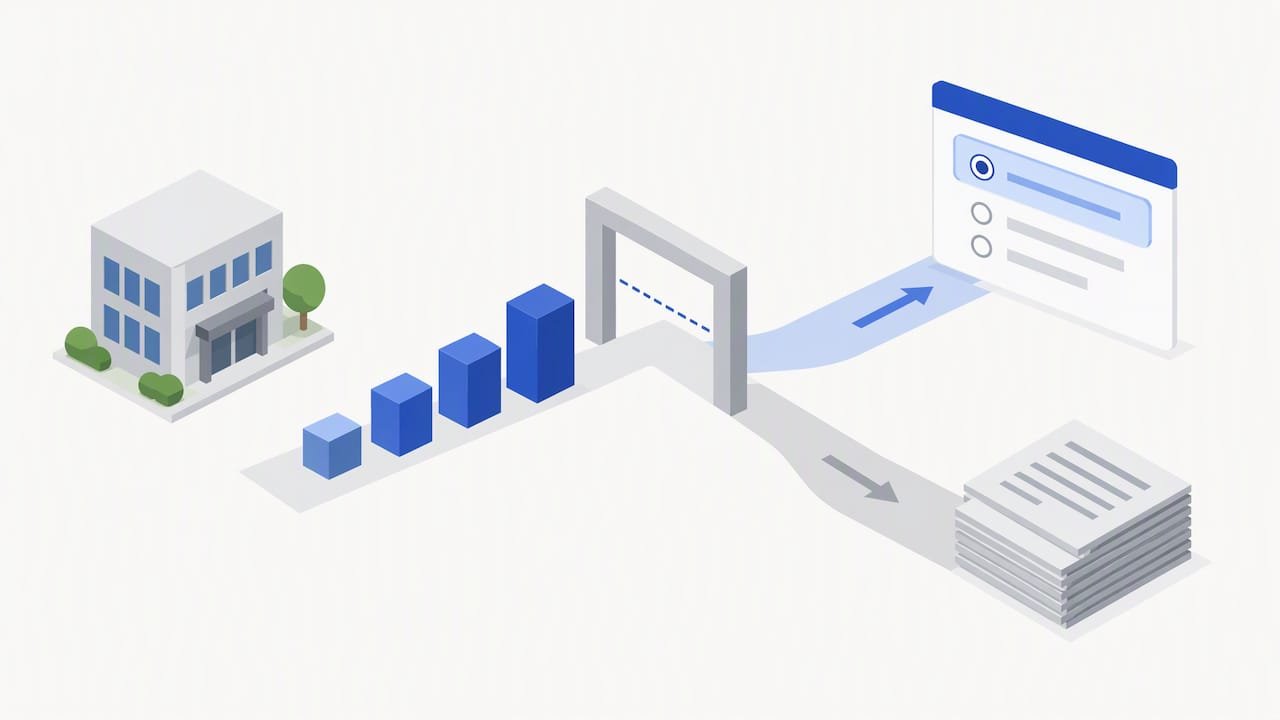
If revenue temporarily exceeds S$5 million due to a one-off contract or exchange rate movement, an administrative concession allows continued use of Form C-S, provided every other qualifying condition still holds. This concession does not apply indefinitely, and sustained breaches push the company back to Form C. Once you enter your revenue figure in myTax Portal’s Form Type Selection screen, the system automatically offers the C-S (Lite) option when the figure sits at or below S$200,000.
3. Which income types and claims rule you out of C-S (Lite)
Some companies meet the revenue test easily but fall outside Form C-S (Lite) because of how their income is taxed or because of specific claims they make. Recognising these early avoids wasted time filling in the wrong form.
- Tax-exempt or concessionary-rate income: any income taxed below 17%, including income under pioneer incentive schemes, disqualifies the company from the Lite form.
- Group relief claims: transferring losses to or from a related Singapore company requires Form C.
- Foreign tax credit claims: companies claiming relief for tax paid overseas on foreign income must use Form C.
- Investment allowance claims: capital allowance incentives tied to qualifying projects fall outside the Lite form’s scope.
- Carry-back relief: applying current year losses against a prior year’s taxable income requires the full form.
A company in a tax-loss position can still file Form C-S (Lite) if it meets the other conditions and does not seek carry-back relief. The loss is simply reported and carried forward under standard rules.
Investment holding companies often trip this test, since dividend and interest income may need separate treatment despite sitting below the revenue threshold. Companies earning shipping income under specific tax treatments, or those benefiting from pioneer status, almost always require Form C because their income is not taxed uniformly at 17%.
4. Step by step: filing Form C-S (Lite) in myTax and CorpPass requirements
Filing itself is a short process once eligibility is confirmed, but the sequence matters, particularly around CorpPass authorisation.
- Confirm CorpPass access first. The person filing needs the ‘Preparer’ or ‘Approver’ role for Corporate Tax (Filing and Applications), assigned through CorpPass by the company’s administrator.
- Log in to myTax Portal using Singpass linked to the authorised CorpPass role.
- Select the Form Type Selection screen and enter your annual revenue figure. IRAS automatically presents Form C-S (Lite) when revenue sits at S$200,000 or below.
- Complete Part A, covering basic company information such as UEN, revenue and the tax computation summary.
- Complete Part B, which captures the six essential fields for C-S (Lite): revenue, net profit or loss before tax, qualifying conditions confirmation, and the remaining declarations IRAS requires on the simplified form.
- Complete Part C if the company has specific declarations, such as related party transactions or realised gains from foreign assets, as updated in the YA 2026 explanatory notes.
- Declare reviewer details where applicable. If an SCTP Accredited Tax Advisor or Accredited Tax Practitioner reviewed the return, the form asks for their name and membership number.
- Save as draft if needed, since myTax Portal retains incomplete submissions for later completion.
- Review the confirmation page carefully before final submission, as amendments after filing require a separate request to IRAS.
- Submit ahead of the deadline, allowing time for CorpPass access issues or last-minute document checks.
The overview of Form C-S, Form C-S (Lite) and Form C confirms that only six essential fields appear on the Lite form, which is what makes it considerably quicker to complete than the standard C-S or full Form C.
5. Common pitfalls, red flags and how to avoid them
Most rejected or amended filings trace back to a handful of recurring mistakes, nearly all of which are preventable with a short review before submission.
- Misclassifying income: treating exempt or concessionary income as standard taxable income, then realising later that a disallowed claim applies.
- Incorrect revenue calculation: using the raw figure from a first financial period longer than 12 months, instead of annualising it correctly.
- Overlooking the 12 month rule: forgetting that eligibility is tested against the annualised figure, not the total for an extended period.
- Missing CorpPass authorisation: attempting to file without the correct Preparer or Approver role assigned in advance.
- Incomplete reviewer details: leaving reviewer fields blank when a tax professional actually reviewed the return, which can raise questions later.
- Late submission pressure: leaving the filing until close to the deadline, with no buffer for CorpPass troubleshooting.
Pro Tip: Run a short internal checklist against the four qualifying conditions a week before your filing deadline, not on the day itself.
A company that files Form C-S (Lite) while actually claiming group relief risks an amended assessment once IRAS reviews the submission. Correcting this after the fact takes considerably longer than checking the conditions upfront.
6. Practical checklist and how Bizsquare can help
Before preparing a Form C-S (Lite) filing, we typically request the company’s financial statements, UEN, prior year tax computations and details of any related party transactions. This lets us confirm revenue sits within the threshold and that no disallowed claims apply.
Our review process checks each qualifying condition individually: incorporation status, the revenue figure annualised correctly where needed, the 17% tax rate condition, and the absence of group relief, foreign tax credit, investment allowance or carry-back claims. Once confirmed, we prepare the six essential fields required on the Lite form and flag anything that would push the filing towards full Form C.
A second set of eyes on a tax return catches errors that are easy to miss on a short form, since the simplicity of C-S (Lite) does not remove the need for accurate figures behind it. For companies wanting this review alongside preparation, our corporate tax filing and advisory service covers both.
7. Short perspective: when to use C-S (Lite) versus filing Form C
Form C-S (Lite) suits small, stable companies with one straightforward income stream and nothing unusual to declare. If your company claims reliefs, holds investment income taxed differently, or has cross-border tax positions, Form C is the more honest route, even though it takes longer to complete.
We would caution against treating the Lite form as a reason to relax record-keeping. IRAS still expects full supporting documentation behind every figure, and a simplified form is a presentation choice, not a reduction in underlying compliance obligations. Keeping complete records all year makes either form straightforward to complete when the deadline arrives.
Bizsquare call to action: help confirming eligibility and filing
Confirming eligibility for Form C-S (Lite) takes more than checking revenue against a single number, and getting it wrong carries real consequences once IRAS reviews a submission. Our team works through each qualifying condition with you, prepares the filing, and flags anything that points towards full Form C instead.

Before reaching out, it helps to have a few things ready:
- Your latest financial statements and revenue figures for the relevant year.
- Your company’s UEN and basic incorporation details.
- Singpass and CorpPass access details for whoever manages filings.
- Notes on any related party transactions, foreign income or prior year claims.
Our corporate tax filing and advisory service covers eligibility checks, preparation and review, and pairs naturally with our accounting and bookkeeping support if your revenue records need tidying up first. Contact a professional service to confirm which form fits your company this year.
FAQ
1.) What is the revenue limit for Form C-S Lite eligibility?
Companies with annual revenue of S$200,000 or below may use Form C-S (Lite). Companies above that figure, up to S$5 million, use standard Form C-S instead.
2.) What is the difference between Form C-S and Form C-S Lite?
Form C-S (Lite) applies to companies with revenue of S$200,000 or below and only six essential fields to complete. Standard Form C-S covers companies with revenue up to S$5 million and requires more detailed fields.
3.) What is Form C in Singapore?
Form C is the standard corporate income tax return required for companies that do not meet the qualifying conditions for Form C-S or Form C-S (Lite). It applies to companies with more complex income, higher revenue, or claims such as group relief or foreign tax credit.
4.) What is the due date for a company tax return in Singapore?
Corporate income tax returns, including Form C-S (Lite), are generally due by 30 November of the relevant year of assessment. Extensions or waivers may apply in specific circumstances.
5.) What claims disqualify a company from Form C-S Lite?
A company claiming group relief, foreign tax credit, investment allowance or carry-back relief must file Form C instead. Any income taxed at a rate other than the standard 17% also disqualifies a company from the Lite form.
6.) Can a newly incorporated company with a long first year use Form C-S Lite?
Yes, provided its revenue for the 12 months ending on its financial year end sits at S$200,000 or below. The explanatory notes for YA 2026 set out how to annualise revenue for periods longer than 12 months.
7.) What CorpPass role is needed to file Form C-S Lite?
The person filing needs either the ‘Preparer’ or ‘Approver’ role for Corporate Tax (Filing and Applications) in CorpPass. This role must be assigned by the company’s CorpPass administrator before accessing myTax Portal.
8.) Does a company in a tax loss position still qualify for Form C-S Lite?
Yes, a company in a loss position can file Form C-S (Lite) if it meets the other qualifying conditions and does not claim carry-back relief. The loss is reported and carried forward under standard rules.
9.) What happens if revenue temporarily exceeds the Form C-S threshold?
IRAS allows an administrative concession permitting continued use of Form C-S if the breach is temporary and all other conditions still hold. Sustained breaches require switching to Form C.
10.) How much income tax will I pay in Singapore if I earn $100,000?
Corporate income tax rates and reliefs depend on the company’s chargeable income and any exemptions that apply, and this varies by circumstance. We recommend checking your specific position with a tax adviser rather than relying on a single generic figure.
11.) What is the minimum requirement for a company to have to file taxes?
Every Singapore-incorporated company must file an annual corporate income tax return with IRAS, regardless of whether it made a profit. The applicable form, Form C-S (Lite), Form C-S or Form C, depends on revenue and the complexity of its income.