
S$100,000 Cap Coming: Singapore SMEs and the EDG Grant
The EDG grant in Singapore funds custom business transformation projects for local companies, covering consultancy, software and manpower costs. If your firm is registered here with at least 30% local equity, apply through the Business Grants Portal. Never start project work before your Letter of Offer arrives.
Overview:
SMEs can receive up to 50% support and large companies up to 30%, with green projects eligible for support up to 70 percent.
Applicants must not start project activities, sign contracts, or make payments before receiving formal approval from Enterprise Singapore.
Support is assessed individually for each project based on scope, costs, and outcomes, with no overall funding cap published.
Eligibility requires a physical Singapore operation, at least 30% local ownership, and demonstrated financial capacity to fund the project upfront.
The application process via the Business Grants Portal typically takes 8 to 12 weeks for a complete submission.
What Does the EDG Grant Singapore Programme Actually Fund?
The Enterprise Development Grant exists to help Singapore companies upgrade, innovate and expand into new markets, rather than cover routine running costs. Enterprise Singapore structures every project under one of three pillars, and your application must fit clearly into at least one, supported by specialised offerings like a Business Japanese Course to enhance market readiness for projects in Japan.
Core Capabilities covers projects that strengthen the fundamentals, think business strategy development, financial management, or human capital systems. Innovation and Productivity funds process redesign, automation and product development. Market Access supports overseas expansion activities, including market studies, standards adoption and setting up overseas marketing presence.
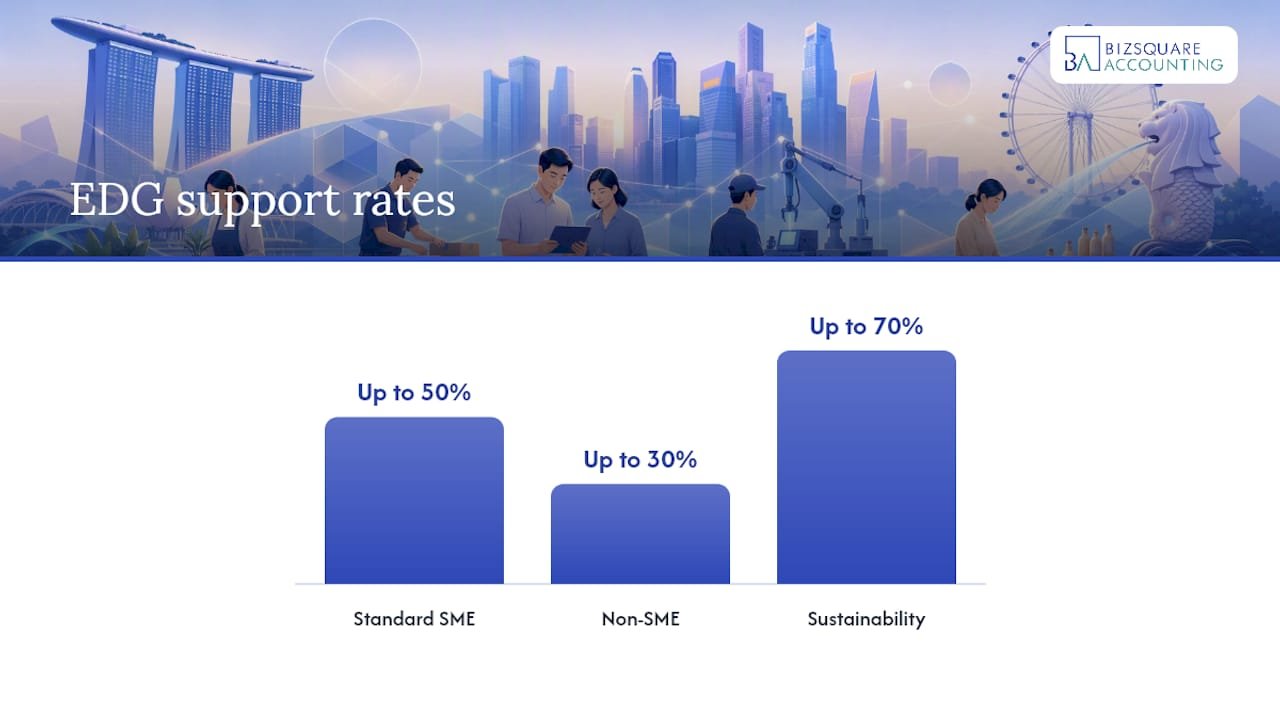
Qualifying costs fall into three buckets: third-party consultancy fees, software and equipment purchases, and internal manpower costs directly tied to the project. Enterprise Singapore confirms that SMEs can receive up to 50% support, while non-SMEs typically receive up to 30%. Sustainability-linked projects can qualify for support of up to 70%, reflecting the government’s push under the Enterprise Sustainability Programme.
| Support level | Applies to | Typical rate |
|---|---|---|
| Standard SME support | Local SMEs meeting eligibility | Up to 50% |
| Non-SME support | Larger qualifying companies | Up to 30% |
| Sustainability projects | Green transformation initiatives | Up to 70% |
There’s no published overall funding cap under EDG itself. Instead, support is assessed project by project, based on scope, cost reasonableness and expected outcomes.
Who Is Eligible for the EDG Grant in Singapore?
Eligibility hinges on three checks Enterprise Singapore applies consistently, and screening yourself against them first saves weeks of back and forth.
- Your business must be registered and operating in Singapore, with a genuine physical presence, not just a mailing address.
- At least 30% of your company’s shares must be held by Singaporeans or Singapore permanent residents, traced through to the ultimate individual owners, not intermediate holding entities.
- Your company must show financial readiness to carry out the project, meaning stable cash flow and the capacity to fund costs upfront before reimbursement.
- You must not have commenced any project activity, signed contracts, or made payments before receiving formal approval.
That last point trips up more applicants than any other requirement. Enterprise Singapore treats early commencement as a breach of terms, and it can void your entire application regardless of how strong the proposal is otherwise. If you’re unsure whether your shareholding structure qualifies, our guide to SME grant options in Singapore breaks down eligibility across several schemes side by side.
How Do You Apply for an EDG Grant on the Business Grants Portal?
Every EDG application runs through the Business Grants Portal, the single government channel for EDG, PSG and MRA submissions. There are no pre-approved vendors here, and third parties cannot submit on your behalf; the company itself must log in and apply.
- Log in using CorpPass, verifying your company’s UEN and authorised representative status.
- Select “Enterprise Development Grant” and choose the relevant project pillar, Core Capabilities, Innovation and Productivity, or Market Access.
- Enter accurate contact details, since the Letter of Offer gets addressed to whoever is named here, and errors delay signing.
- Upload your project proposal, describing objectives, activities, timeline and expected outcomes with measurable KPIs.
- Attach supporting documents, quotations, and consultant certifications where applicable.
- Review everything carefully, then submit and note your application reference number for tracking.
Once submitted, you can check status directly on the portal rather than emailing for updates. According to the BGP user guide on EDG submissions, a complete application generally takes several weeks to process, though incomplete submissions can take considerably longer.
Pro Tip: Draft your project proposal before you even open the portal. Rushing this section under a login timer is the fastest way to submit a vague, poorly justified application.
What Documents and Certifications Does EDG Require?
The EDG application checklist sets out exactly what Enterprise Singapore expects, and missing even one item stalls your review.
- Audited or management financial statements for the most recent financial year.
- A registrar search or ultimate beneficial owner declaration confirming your local shareholding.
- A detailed project proposal with clear objectives, timelines and measurable outcomes.
- Quotations from vendors or consultants, showing itemised costs matching your proposal.
- For management consultancy costs, consultant certification under TR 43 or SS 680, the technical reference and standard governing consultancy competency in Singapore.
Consultants delivering strategy, finance or productivity advisory typically need this certification, though internal staff and certain specialist engagements are exempt. Before engaging anyone, our guide to working with a business consultant explains what credentials to verify. The most common pitfalls remain incomplete paperwork, starting work early, and proposals that describe activities without tying them to measurable results.
How Does the EDG Claims and Reimbursement Process Work?
EDG operates on a reimbursement basis, meaning you pay first and claim afterwards, once deliverables are met and invoices settled.
- Submit your claim with audited proof of payment, deliverable evidence and a completion report.
- Claims must reach Enterprise Singapore no later than six months from the end of your qualifying period, or they may be forfeited entirely.
- Interim claims are possible for longer projects, though most SMEs submit a single final claim.
- Disbursement usually arrives via PayNow Corporate once your claim is approved.
- Any change to project scope, timeline or cost requires a formal change request before proceeding, not after.
Missing the claim deadline is one of the most avoidable ways businesses lose funding they’ve already earned.
EDG, PSG, MRA and the Coming EDGE Consolidation
Singapore currently runs three main grant schemes, and choosing the right one matters more than most applicants realise.
- EDG suits customised, larger scale transformation projects with tailored consultancy and manpower components.
- Productivity Solutions Grant (PSG) covers pre-approved, off-the-shelf software and equipment, faster to apply for but far less flexible. Our PSG accounting software guide explains when this route beats a custom EDG project.
- Market Readiness Assistance (MRA) targets smaller overseas expansion costs like market entry and business matching.
Government announcements in 2026 confirm that EDG, PSG and MRA will eventually merge into a single scheme called EDGE, with a standard track offering up to S$100,000 support per business per year, expected to launch in the second half of 2026. EDG remains fully open until that transition happens. If your project is large and well scoped now, applying under EDG before EDGE launches may still be the smarter move, since consolidated caps could affect how bigger transformation projects get funded later.
Practical Checklist for a Stronger EDG Application
A well-prepared application rarely fails on eligibility alone, it fails on how the proposal is written and documented.
- Map every required BGP field to a document before you start typing, financial statements, quotations, proposal narrative, and consultant certification.
- Write outcomes as measurable KPIs, revenue targets, headcount changes, or productivity gains, not vague aspirations.
- Verify your consultant’s TR 43 or SS 680 certification directly, don’t rely on their word alone.
- Budget internal manpower costs honestly, including staff hours often overlooked until the claim stage.
Pro Tip: Assessors respond to specificity. A proposal linking each activity to a measurable outcome consistently performs better than one describing broad ambitions.
Enterprise Singapore’s own guidance and independent commentary both stress that detailed, evidence backed proposals materially improve approval odds, a pattern worth taking seriously before you submit.
Author perspective: strategic choices for Singapore SMEs considering EDG
Businesses that scope one project tightly, rather than bundling three ambitions into one proposal, tend to get approved faster and disbursed cleaner. If you’re planning a large transformation purchase, weigh timing carefully against the EDGE launch later in 2026, since caps and processes may shift. Whatever you decide, verify current requirements directly with Enterprise Singapore before submitting anything.
How Bizsquare Can Support Your EDG Application
A done-for-you alternative is available to help draft proposals, financial schedules and claim documentation in one coordinated engagement rather than interpreting BGP fields solo.

Proposal drafting aligned to project pillars, preparation of financial schedules, liaison with certified consultants, and claims process support are offered once the project delivers. This typically sits alongside our broader corporate advisory and outsourced CFO services, so your grant application connects to sound financial planning rather than standing alone. If you’re also weighing consultancy support for the proposal itself, our business consultant services page outlines exactly what that engagement includes. Consider reaching out for an eligibility check before committing time to drafting applications.
Sources
FAQ
1.) Who Is Eligible for the EDG Grant in Singapore?
Companies registered and operating in Singapore, with at least 30% local shareholding traced to individual owners, and demonstrated financial readiness to fund the project upfront.
2.) How Much Is an EDG Grant?
SMEs can receive up to 50% support, non-SMEs up to 30%, and sustainability linked projects up to 70%, with no fixed overall funding cap under the scheme itself.
3.) What Is an EEG Grant?
There’s no scheme officially called an “EEG grant” in Singapore, this typically refers to a misspelling of EDG, the Enterprise Development Grant.
4.) How Long Does an EDG Application Take to Process?
Complete applications typically take 8 to 12 weeks, though incomplete submissions or missing documents often extend this considerably.
5.) Can I Start My Project Before EDG Approval?
No, starting work, signing contracts, or making payments before receiving your Letter of Offer can void your entire application.
6.) What Costs Does EDG Cover?
Third-party consultancy fees, software and equipment purchases, and internal manpower costs directly tied to the approved project scope.
7.) Do I Need a Certified Consultant for EDG?
For management consultancy costs, yes, your consultant typically needs TR 43 or SS 680 certification, though internal staff and some specialists are exempt.
8.) What Happens to EDG When EDGE Launches?
EDG remains open until EDGE launches, expected in the second half of 2026, after which EDG, PSG and MRA consolidate into one scheme.
9.) How Do I Submit an EDG Claim?
Submit audited proof of payment and deliverable evidence via the Business Grants Portal within six months of your project’s qualifying period ending.
10.) What Is the Difference Between EDG and PSG?
EDG funds customised, larger transformation projects with consultancy and manpower components, while PSG covers pre-approved, off-the-shelf software and equipment.
11.) Why Do EDG Applications Get Rejected?
Common reasons include incomplete documentation, starting the project before approval, and proposals lacking measurable, well-justified outcomes.
12.) Can Bizsquare Help With My EDG Proposal?
Yes, Bizsquare assists with proposal drafting, financial schedules, consultant liaison and claims support throughout the EDG application process.