
Bookkeeping Checklist: Customer Accounting Singapore for GST Firms
Customer accounting applies when you sell prescribed goods worth more than S$10,000 to a GST registered business customer. If this applies to you, stop charging GST on that invoice. Instead, issue a customer accounting tax invoice and let your customer account for the output tax themselves.
Overview:
Customer accounting applies to sales of prescribed goods exceeding S$10,000 to GST-registered business buyers, shifting the output tax reporting responsibility to the customer.
Only prescribed goods such as mobile phones, memory cards, and off-the-shelf software count, with mixed invoices requiring separate line item calculations to determine the threshold.
Suppliers must issue a customer accounting tax invoice showing the buyer’s GST number and clearly state the sale is subject to customer accounting, with no GST charged.
Customers need to record and claim input tax in their GST return, provided the invoice has complete and correct supplier details and the goods are for business use.
Record keeping of invoices and supporting documentation must be maintained for at least five years to ensure compliance and support input tax claims during audits.
Table of Contents
- What customer accounting is and when it applies in Singapore
- Which goods are prescribed and how to count them
- Supplier obligations: invoicing, reporting and the customer accounting tax invoice
- Customer obligations: reporting and claiming input tax
- Exceptions, options and special arrangements
- Record keeping, invoices and penalties: retention rules you cannot skip
- Practical compliance checklist and bookkeeping steps
- What advisers get wrong about customer accounting
- How Bizsquare Accounting supports your GST compliance
- Sources
- FAQ
What customer accounting is and when it applies in Singapore
The Inland Revenue Authority of Singapore introduced customer accounting for prescribed goods from 2019. The scheme shifts the responsibility for reporting output tax from the seller to the buyer for certain high-value, high-risk goods. This change was designed to close a gap where some sellers collected GST from customers but never remitted it to the government.
A supply becomes a “relevant supply” under IRAS guidance/charging-gst-(output-tax)/when-to-charge-goods-and-services-tax-(gst)/customer-accounting-for-prescribed-goods) when three conditions are met together. These conditions decide whether you need to apply the rules at all.
- The goods sold are on the prescribed list.
- The buyer is GST registered and acquires the goods for business purposes.
- The GST exclusive value of the sale exceeds the prescribed threshold.
Consider an invoice containing S$7,000 of mobile phones and S$5,000 of office furniture. Only the mobile phone portion counts toward the S$10,000 threshold, so customer accounting would not apply here because the prescribed goods alone fall under the limit.
Which goods are prescribed and how to count them
The prescribed goods list is narrow and specific. According to the e-Tax Guide on customer accounting, three categories are covered.
- Mobile phones, including smartphones and feature phones.
- Memory cards and similar portable storage devices.
- Off-the-shelf software, meaning standard packaged software not customised for a specific buyer.
Certain items fall outside the scheme even though they seem related. Software pre-loaded onto hardware at the point of sale is excluded, as are bundled mobile subscription plans sold together with a handset. These exclusions trip up many sellers who assume every electronics sale qualifies.
When an invoice mixes prescribed and non-prescribed goods, only the value of the prescribed items counts toward the S$10,000 threshold. Keep separate line items on your invoice so you can calculate this split accurately and defend your position if IRAS asks questions later.
Supplier obligations: invoicing, reporting and the customer accounting tax invoice
Once a sale meets the threshold, you carry specific duties as the supplier. IRAS guidance on invoicing customers sets out exactly what your invoice must contain and how you report the sale.
- Issue a customer accounting tax invoice that shows your customer’s GST registration number and a clear statement that the sale is subject to customer accounting.
- Do not charge or collect any GST on this relevant supply, even though you would normally apply GST to a sale of this kind.
- Report the GST exclusive value of the sale in Box 1 of your GST return, but do not include any output tax for this supply in Box 6.
Getting this invoice wrong is one of the most common compliance slips among sellers of electronics and software. Our invoice checklist for Singapore businesses walks through every mandatory field so you can build a template once and reuse it correctly.
Customer obligations: reporting and claiming input tax
As the buyer, you take on the GST reporting that your supplier would normally handle. This means extra entries in your GST return, but it also means you can usually recover the tax.
- Record the output tax due on the purchase and include the GST exclusive value in Box 1 of your return.
- Record the same purchase as a taxable purchase in Box 5, then claim the corresponding input tax in Box 7 if you hold a valid customer accounting tax invoice and meet the normal input tax conditions.
- Missing or incomplete supplier details on the invoice are a frequent reason input tax claims get disallowed later.
Pro Tip: Check that your supplier’s GST registration number and the customer accounting statement appear clearly on every invoice before you file, not after.
Exceptions, options and special arrangements
Not every prescribed goods sale falls under customer accounting, and a few special arrangements give businesses flexibility.
- Certain supplies are excepted from the scheme entirely, including exports and supplies that already qualify for zero rating.
- A supplier may choose to apply customer accounting to a sale below S$10,000 if the customer agrees and conditions are met, though this is optional rather than required.
- Self-billing arrangements let the customer issue the tax invoice instead of the supplier, provided a documented self-billing agreement exists between both parties.
- A customer making an occasional purchase above the threshold may seek prior written approval from the Comptroller of GST to apply customer accounting on that specific transaction.
Record keeping, invoices and penalties: retention rules you cannot skip
Good record keeping is what protects your input tax claims during a GST audit. The rules here are strict and apply to every GST registered business, not just those dealing in prescribed goods.
- Retain tax invoices and all supporting documents for at least five years from the end of the relevant accounting period, according to IRAS record keeping guidance.
- Maintain a sales listing that separates prescribed goods transactions from regular GST supplies, since this makes your GST return easier to verify.
- Keep your GST accounts reconciled monthly so any customer accounting entries are easy to trace back to the original invoice.
Record retention under Singapore GST law runs for at least five years from the end of the accounting period, and falling short can mean a disallowed input tax claim during an audit.
Singapore’s InvoiceNow network and broader e-invoicing push are becoming increasingly relevant here too, since digital invoices create a cleaner audit trail that supports your records automatically.
Practical compliance checklist and bookkeeping steps
Turning these rules into daily practice takes a bit of planning, but the workflow is manageable once set up correctly.
Before issuing or accepting a customer accounting invoice, run through these checks.
- Verify your customer’s GST registration status through the IRAS GST registered business search before the sale.
- Obtain written confirmation that the goods are for business use, not personal use, and file this with the invoice.
- Confirm the GST exclusive value of prescribed goods on the invoice separately from any non-prescribed items.
On the bookkeeping side, suppliers should post the sale at the GST exclusive value without any output tax entry, since no GST was charged. Customers should post two entries in the same period, an output tax liability and a corresponding input tax claim, provided the invoice and supporting documents are complete.
Most cloud accounting platforms, including Xero and QuickBooks, allow you to tag transactions with a specific GST treatment code for customer accounting; if you are selling prescribed goods online, this complete guide to setting up Shopify in Singapore can help ensure your ecommerce invoicing is configured correctly. Setting this up correctly from the start avoids manual adjustments at filing time. Our guide on bookkeeping accuracy for Singapore SMEs covers how to structure these controls properly.
Pro Tip: Run a reconciliation report before every GST filing deadline to catch any customer accounting entries that landed in the wrong box.
What advisers get wrong about customer accounting
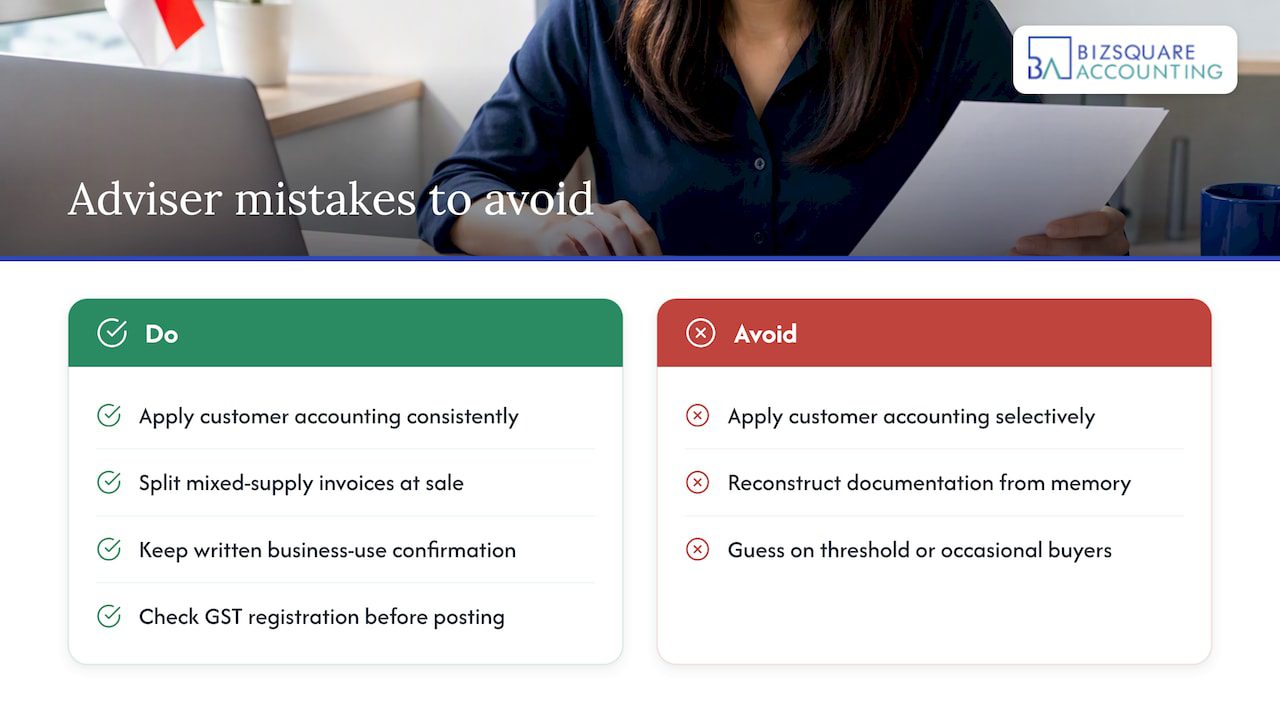
The biggest pitfall is not malice, it is inconsistency. Businesses often apply customer accounting to some invoices and forget it on others within the same month, usually because mixed supply invoices were not split correctly at the point of sale.
A second common error is weak documentation. Written confirmation of business use, GST registration checks and the invoice statement itself need to exist together, not be reconstructed later from memory. When a transaction sits close to the S$10,000 threshold or involves an occasional buyer, advisers should recommend seeking a written ruling from IRAS rather than guessing. That single step avoids most disputes before they start.
How Bizsquare Accounting supports your GST compliance
Customer accounting adds a layer of complexity that most in-house finance teams only encounter once or twice a year, which makes mistakes easy and costly. Specialized accounting firms work alongside Singapore businesses to keep this process accurate from the first invoice to the final filing.

Our team supports clients through several connected services.
- GST filing and advisory to confirm whether customer accounting applies to your specific sales.
- Bookkeeping setup and cloud accounting configuration so your software tags transactions correctly from day one.
- IRAS audit support if a past filing needs review or correction.
A compliance review with Bizsquare typically covers your recent invoices, your GST return entries and your record keeping practices, then flags any gaps before IRAS does. Get in touch through our GST filing and advisory services page to arrange a review for your business.
FAQ
1.) Is it mandatory to keep records for five years in Singapore?
Yes, GST registered businesses must retain tax invoices and supporting records for at least five years from the end of the accounting period. Falling short of this can lead to disallowed input tax claims during a GST audit.
2.) Do we charge GST to overseas customers?
Sales exported outside Singapore are generally zero rated rather than subject to customer accounting, since the goods leave the country. Customer accounting applies specifically to local sales of prescribed goods to GST registered business customers, so cross border exports follow separate export rules instead.
3.) Do I need to charge GST if I earn under S$75,000?
Customer accounting only applies to GST registered businesses, so a business below the compulsory GST registration threshold would not charge GST at all on standard sales. Once voluntarily or compulsorily registered, the usual customer accounting rules for prescribed goods above S$10,000 would then apply.
4.) What accounting services are available for small businesses in Singapore?
Small businesses can access bookkeeping, GST filing, payroll processing and cloud accounting setup through professional service providers. These services help confirm whether customer accounting applies and keep GST returns accurate from the start.
5.) What counts as prescribed goods under Singapore’s customer accounting rules?
Prescribed goods cover mobile phones, memory cards and off-the-shelf software, as listed in the IRAS e-Tax Guide. Software preloaded on hardware and bundled mobile subscriptions are excluded from this list.
6.) What happens if a supplier wrongly charges GST on a relevant supply?
The supplier should correct the error and issue a proper customer accounting tax invoice without GST charged. The customer should then account for output tax themselves in their own GST return, following the normal customer accounting process.
7.) Can a supplier apply customer accounting below the S$10,000 threshold?
Yes, a supplier may choose to apply customer accounting to a sale below the threshold if the customer agrees and the usual conditions are otherwise met. This arrangement is optional rather than a default requirement.
8.) How does self-billing work under customer accounting?
Under self-billing, the customer issues the tax invoice instead of the supplier, provided a documented self-billing agreement exists between both parties. Copies of these invoices must still be retained to support input tax claims during an audit.