


TL;DR:
Singapore’s corporate tax rate is a flat 17% of chargeable income, but most companies pay a lower effective rate due to exemptions and rebates. For YA 2026, a 50% tax rebate capped at S$40,000, along with schemes like SUTE and PTE, significantly reduce actual tax payable. Proper planning, compliance, and expert support ensure companies optimize benefits while maintaining transparency and regulatory adherence.
Corporate Tax Rates in Singapore: Essential Guide for 2026
Singapore’s headline corporate tax rate is a flat 17% of chargeable income, applied equally to local and foreign companies. Many business owners treat this figure as the final word on what they owe, and that assumption can cost them significantly. In practice, Singapore’s corporate tax system is layered with exemption schemes, rebates, and targeted incentives that can reduce the effective tax rate well below 17%. For Year of Assessment (YA) 2026, those opportunities are particularly meaningful. This guide walks through how the tax structure works, which schemes apply, how to calculate actual tax payable, and how to stay fully compliant before the November deadline.
Table of Contents
- Understanding Singapore’s corporate tax structure
- Major tax rebates and exemptions for 2026
- Calculating effective corporate tax: Practical scenarios
- Practical tips and common compliance pitfalls
- Why the lowest rate isn’t always the best goal
- How expert support streamlines your Singapore taxes
- Frequently asked questions
Key Takeaways
| Point | Details |
|---|---|
| Headline rate is 17% | Singapore’s corporate tax rate is officially 17% but few companies pay this full rate. |
| Rebates and exemptions | Tax rebates and exemption schemes can substantially decrease your actual tax payable. |
| Effective rates are lower | The majority of businesses pay an effective tax rate well below 17% due to reliefs. |
| Compliance is crucial | File returns and claim benefits by the 30 Nov 2026 deadline to maximize savings and avoid penalties. |
Understanding Singapore’s corporate tax structure
Singapore’s corporate income tax framework is built on a single statutory rate applied to a carefully defined tax base. Understanding the mechanics of this framework is the first step toward calculating what your company will actually pay.
The statutory corporate income tax rate is 17%, and it applies to what the Inland Revenue Authority of Singapore (IRAS) defines as chargeable income. Chargeable income is not simply total revenue. It is the company’s taxable income after all allowable deductions have been subtracted. Allowable deductions typically include operating expenses, capital allowances, and approved donations. The resulting figure is the base on which the 17% rate is applied.
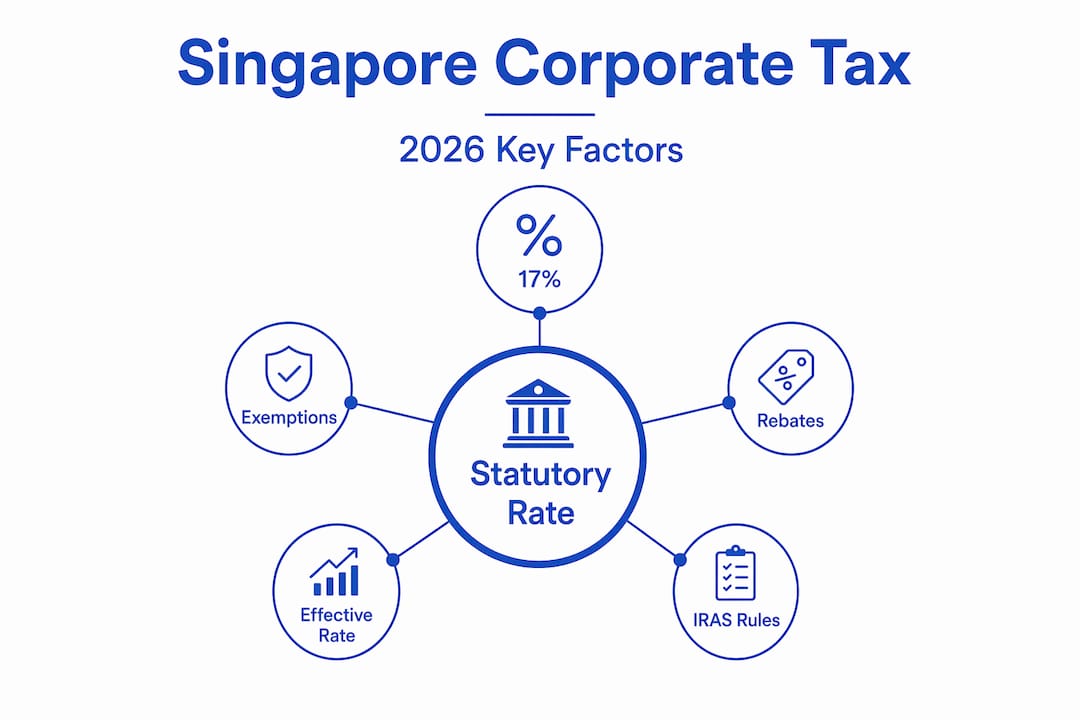
However, the statutory rate and the effective tax rate are two very different numbers. The effective tax rate is what a company actually pays as a percentage of its total income, once all exemptions, reliefs, and rebates are factored in. For most Singapore-incorporated companies, particularly smaller businesses and newer enterprises, the effective rate is substantially lower than 17%.
Here is why that matters in practice:
- Singapore’s corporate tax system operates on a one-tier tax system, meaning tax paid at the corporate level is the final tax on that income. Dividends distributed to shareholders are not taxed again at the individual level.
- Tax exemptions reduce the portion of chargeable income that is subject to the 17% rate. Depending on the scheme, large portions of income may be taxed at 0% or at a reduced effective rate.
- Tax rebates reduce the actual tax payable after the rate has been applied to chargeable income.
- Singapore does not impose capital gains tax, and dividends received from overseas are generally exempt under the foreign-sourced income exemption framework.
The result is that most companies, especially those in their early years or those with chargeable income below S$10 million, pay an effective corporate tax rate that is meaningfully below 17%. According to the Ministry of Finance, effective rates are frequently below 17% due to the combined effect of exemptions and rebates. For business owners focused on filing corporate tax in Singapore correctly and efficiently, knowing this distinction is fundamental.
Major tax rebates and exemptions for 2026

Once you understand how the Singapore tax structure is assembled, the next step is identifying which rebates and exemption schemes your company qualifies for in YA 2026. These mechanisms can dramatically reduce what your company owes.
The 2026 corporate income tax rebate
For YA 2026, IRAS has granted a CIT Rebate of 50% of corporate tax payable, capped at S$40,000 per company. This rebate applies automatically to all companies that have tax payable for YA 2026. No separate application is required.
In addition, qualifying active local employers receive a cash grant enhancement of up to S$2,000. This cash grant is available even to companies with zero tax payable, provided they meet the employment criteria. The combined benefit from the rebate and the cash grant is capped at S$40,000 per company.
“For Year of Assessment (YA) 2026, a Corporate Income Tax Rebate is granted as 50% of corporate tax payable, with a cash grant enhancement to specified active local employers; the combined maximum benefits are capped.” — IRAS Corporate Tax Rate, Rebates and Exemption Schemes
Start-Up Tax Exemption (SUTE)
The Start-Up Tax Exemption scheme, commonly referred to as SUTE, is designed to reduce the tax burden on newly incorporated Singapore companies during their early years of operation. To qualify, a company must:
- Be incorporated in Singapore.
- Be a tax resident of Singapore for that year of assessment.
- Have no more than 20 shareholders, all of whom are individuals, or at least one individual shareholder holding a minimum of 10% of the issued ordinary shares.
- Not be engaged primarily in investment holding or property development for sale.
Under SUTE, for the first three consecutive years of assessment, the following exemptions apply to chargeable income:
- 75% exemption on the first S$100,000 of chargeable income.
- 50% exemption on the next S$100,000 of chargeable income.
- The remaining chargeable income above S$200,000 is taxed at the full 17%.
This means that on the first S$200,000 of chargeable income, a qualifying start-up pays tax on only S$25,000 of the first S$100,000 and S$50,000 of the next S$100,000, resulting in a dramatically reduced effective rate on that income.
Partial Tax Exemption (PTE)
Once a company exits the SUTE period, or if it does not qualify for SUTE, it falls under the Partial Tax Exemption scheme. The PTE applies to all companies that are not eligible for SUTE and provides:
- 75% exemption on the first S$10,000 of chargeable income.
- 50% exemption on the next S$190,000 of chargeable income.
- The remaining chargeable income above S$200,000 is taxed at the full 17%.
The PTE provides a more modest benefit than SUTE but still meaningfully reduces the effective rate for companies with chargeable income up to S$200,000.
Comparison of exemption schemes and rebate for YA 2026
| Scheme | Who qualifies | Exemption on first S$100,000 | Exemption on next S$100,000 | YA 2026 rebate | Cap |
|---|---|---|---|---|---|
| Start-Up Tax Exemption (SUTE) | New companies (first 3 YAs), qualifying shareholders | 75% | 50% | 50% of tax payable | S$40,000 combined |
| Partial Tax Exemption (PTE) | All other companies | 75% on first S$10,000; 50% on next S$190,000 | Included in prior column | 50% of tax payable | S$40,000 combined |
| CIT Rebate only | All companies with tax payable | Not applicable | Not applicable | 50% of tax payable | S$40,000 combined |
How to claim the rebate and exemptions: step-by-step
- Determine your eligibility for SUTE or PTE based on your company’s incorporation date, shareholder structure, and business activity.
- Calculate your chargeable income by subtracting all allowable deductions from your taxable revenue.
- Apply the relevant exemption to reduce the portion of chargeable income subject to the 17% rate.
- Compute the gross tax payable by applying 17% to the remaining non-exempt chargeable income.
- Apply the 50% CIT Rebate to the gross tax payable, subject to the S$40,000 cap.
- Factor in the cash grant of up to S$2,000 if your company qualifies as an active local employer.
- Report the final tax payable in your corporate income tax return filed with IRAS.
For a detailed walkthrough of the corporate tax guide covering each of these steps, including documentation requirements, it is advisable to consult a structured resource before filing season begins.
Pro Tip: Model both SUTE and PTE scenarios for your company each year, particularly in the transitional year when SUTE eligibility ends. The difference in effective tax rate between the two schemes can be significant, and planning ahead allows you to structure income and deductions optimally.
Calculating effective corporate tax: Practical scenarios
Understanding what you qualify for is critical, but knowing how to calculate your tax payable brings it all together. The following worked examples illustrate how the exemptions and rebate interact in practice for YA 2026.
Scenario A: Start-up company using SUTE and the 2026 CIT rebate
Assume a qualifying start-up has chargeable income of S$300,000 for YA 2026.
Step 1: Apply SUTE exemptions
- First S$100,000: 75% exempt, so taxable amount = S$25,000
- Next S$100,000: 50% exempt, so taxable amount = S$50,000
- Remaining S$100,000: fully taxable at 17%
Step 2: Compute gross tax payable
- Tax on S$25,000 at 17% = S$4,250
- Tax on S$50,000 at 17% = S$8,500
- Tax on S$100,000 at 17% = S$17,000
- Gross tax payable = S$29,750
Step 3: Apply 50% CIT rebate
- 50% of S$29,750 = S$14,875 (well below the S$40,000 cap)
- Net tax payable = S$14,875
Effective tax rate = S$14,875 / S$300,000 = approximately 4.96%
This illustrates how a start-up with S$300,000 in chargeable income pays an effective rate of under 5%, compared to the 17% headline rate.
Scenario B: Established company using PTE and the 2026 CIT rebate
Assume an established company has chargeable income of S$500,000 for YA 2026.
Step 1: Apply PTE exemptions
- First S$10,000: 75% exempt, so taxable amount = S$2,500
- Next S$190,000: 50% exempt, so taxable amount = S$95,000
- Remaining S$300,000: fully taxable at 17%
Step 2: Compute gross tax payable
- Tax on S$2,500 at 17% = S$425
- Tax on S$95,000 at 17% = S$16,150
- Tax on S$300,000 at 17% = S$51,000
- Gross tax payable = S$67,575
Step 3: Apply 50% CIT rebate
- 50% of S$67,575 = S$33,787.50 (below the S$40,000 cap)
- Net tax payable = S$33,787.50
Effective tax rate = S$33,787.50 / S$500,000 = approximately 6.76%
Comparison of effective rates by company profile for YA 2026
| Company profile | Chargeable income | Gross tax (before rebate) | CIT rebate applied | Net tax payable | Effective rate |
|---|---|---|---|---|---|
| Start-up (SUTE) | S$300,000 | S$29,750 | S$14,875 | S$14,875 | ~4.96% |
| Established (PTE) | S$500,000 | S$67,575 | S$33,787.50 | S$33,787.50 | ~6.76% |
| Large company (PTE) | S$2,000,000 | S$298,575 | S$40,000 (capped) | S$258,575 | ~12.93% |
As the table shows, effective corporate tax rates in Singapore are consistently below the 17% statutory rate for most companies, particularly those with lower chargeable income. For companies with very high chargeable income, the rebate cap means the effective rate approaches but does not reach 17%. For assistance with precise calculations before submission, professional tax filing services can ensure accuracy and full utilization of available benefits.
Practical tips and common compliance pitfalls
Now that you know how to compute your effective tax, let us ensure you avoid costly compliance mistakes that can result in penalties, interest charges, or missed savings.
Key actions ahead of the 30 November 2026 deadline
The YA 2026 corporate tax filing deadline is 30 November 2026 for companies filing their income tax returns. Missing this deadline can result in late filing penalties and the loss of certain administrative concessions. Here is what companies should complete before that date:
- Submit the Estimated Chargeable Income (ECI) within three months from the company’s financial year end. Note that ECI filing is separate from and earlier than the annual income tax return.
- Prepare and finalize audited or unaudited financial statements depending on the company’s size and statutory requirements.
- Reconcile accounting profit to chargeable income by identifying all allowable deductions, capital allowances, and non-deductible expenses.
- Confirm SUTE or PTE eligibility for the current year, particularly if it is a transitional year for the company.
- Verify employment records if claiming the cash grant component of the CIT Rebate, as active local employer status must be substantiated.
- File Form C, Form C-S, or Form C-S (Lite) as appropriate based on the company’s revenue and complexity.
Common compliance mistakes to avoid
Several recurring errors affect Singapore companies during tax filing season. These are not merely administrative oversights. They can trigger IRAS audits, result in underreported income, or cause companies to forfeit valid exemptions.
Misinterpreting chargeable income is among the most frequent errors. Some companies include non-taxable income in their chargeable income computation, while others fail to include income that is taxable in Singapore even if earned overseas. Singapore taxes income on a territorial basis, but certain foreign-sourced income remitted to Singapore may be taxable unless it meets specific exemption conditions.
Failing to claim allowable deductions is another costly mistake. Expenses that are wholly and exclusively incurred in the production of income are deductible, but companies sometimes omit legitimate deductions due to poor record-keeping or misclassification.
Misunderstanding the rebate cap causes some companies to miscalculate their net tax payable. The S$40,000 cap applies to the combined total of the CIT Rebate and the cash grant, not to each separately.
Missing the ECI deadline is a separate and serious compliance failure. IRAS requires companies to file their ECI within three months of the financial year end. Companies that miss this window may lose the option to pay tax by installment.
Pro Tip: Set calendar reminders at least 60 days before each key compliance deadline, including the ECI due date and the 30 November return deadline. Assign a responsible person internally or engage a professional firm to manage these milestones. For structured IRAS tax compliance support, working with an experienced consultancy ensures that no deadline is overlooked.
Why the lowest rate isn’t always the best goal
Here is a perspective that many tax guides will not offer directly: the relentless pursuit of the lowest possible tax bill is not always the most intelligent business strategy, and in some cases, it actively works against a company’s long-term interests.
Consider what happens when a company structures its affairs purely to minimize tax in the current year. Management attention shifts toward aggressive deduction claims, creative income deferral, and complex arrangements that require ongoing maintenance. This consumes time, introduces audit risk, and can strain the company’s relationship with IRAS. A single IRAS inquiry into an aggressive tax position can cost more in professional fees, management hours, and reputational concern than the tax savings it was designed to achieve.
The more productive framing is this: effective tax management is more than minimizing this year’s number. Think about your company’s overall fiscal health. A company that pays a slightly higher effective rate but maintains clean, well-documented accounts, files on time, and builds a transparent record with IRAS is in a far stronger position when it seeks financing, attracts investors, or prepares for an acquisition.
There is also the matter of growth planning. Companies that obsessively minimize taxable income through deductions and deferrals sometimes suppress the financial metrics that lenders and investors use to assess creditworthiness. A company showing very low taxable income may struggle to demonstrate the profitability needed to secure a business loan or attract equity investment.
The practical wisdom here is to use every legitimate exemption and rebate that Singapore’s tax system provides, because those are intentional government incentives designed to support business growth. SUTE exists to help start-ups reinvest capital. The PTE exists to support smaller companies. The CIT Rebate for YA 2026 is a direct stimulus measure. Using these tools is not aggressive tax planning. It is exactly what the system is designed for.
What companies should avoid is the layer beyond legitimate incentives: arrangements with no commercial substance, related-party transactions priced to shift income artificially, or deduction claims without proper documentation. These create exposure that far outweighs any short-term savings.
For companies serious about corporate tax filing strategies that balance savings with compliance integrity, the goal should be a defensible, well-documented tax position that holds up to scrutiny and supports the company’s broader financial narrative.
How expert support streamlines your Singapore taxes
Navigating Singapore’s corporate tax system requires more than reading the rules once. The interaction between chargeable income calculations, exemption schemes, rebate caps, ECI filing, and annual return deadlines creates a compliance environment where small errors carry real financial consequences.
Bizsquare Accounting provides end-to-end support for Singapore companies managing their corporate tax obligations. From determining which exemption scheme applies to your company’s structure, to preparing accurate tax computations and filing returns with IRAS, our consultants handle every step with precision. Whether you are a start-up navigating SUTE for the first time or an established business optimizing under PTE and the 2026 rebate, our team ensures that your tax position is both compliant and fully optimized. Explore our resources on filing corporate tax in Singapore or speak directly with our advisors about tailored corporate tax advisory services designed for your company’s profile.
Frequently asked questions
What is the corporate tax rate for companies in Singapore for 2026?
The headline corporate tax rate in Singapore is 17% of chargeable income, applied equally to both local and foreign companies, though effective rates are typically lower once exemptions and rebates are applied.
How does the 2026 corporate income tax rebate work?
For YA 2026, IRAS grants a 50% rebate on corporate tax payable, with a cash grant of up to S$2,000 for qualifying active local employers, and the combined benefit is capped at S$40,000 per company.
Who qualifies for the Start-Up Tax Exemption scheme?
Newly incorporated Singapore tax-resident companies with 20 or fewer shareholders, where all shareholders are individuals or at least one individual holds 10% or more of ordinary shares, may qualify, provided the company is not primarily engaged in investment holding activities.
When is the tax filing deadline for Singapore companies in 2026?
The corporate income tax filing deadline for YA 2026 is 30 November 2026, unless IRAS grants a specific waiver, and companies must also file their Estimated Chargeable Income within three months of their financial year end.