

Company Secretary Requirements in Singapore: 2026 Guide
Overview
Every Singapore company must appoint a qualified, resident company secretary within six months of incorporation to ensure compliance and avoid penalties. The secretary’s statutory duties include maintaining registers, filing annual returns, and supporting governance, with outsourcing often being the most reliable solution. Singapore’s requirements are stricter than the UK’s but less licensing-intensive than Hong Kong’s, emphasizing the importance of continuous, professional compliance management.
Every Singapore company must appoint a company secretary within six months of incorporation under the Companies Act. This is not optional. The Accounting and Corporate Regulatory Authority (ACRA) enforces this rule strictly, and directors who allow a vacancy to exceed six months face fines of up to S$1,000. The company secretary role is a formal compliance position, distinct from the board of directors, and it carries specific eligibility criteria, ongoing statutory duties, and governance responsibilities. This guide covers the full scope of company secretary requirements in Singapore, including who qualifies, what the role involves, and how to avoid costly compliance gaps.
What are the company secretary requirements in Singapore?
The company secretary requirements in Singapore are defined under the Companies Act (Cap. 50) and administered by ACRA. Every locally incorporated company must have at least one company secretary who is a natural person, ordinarily resident in Singapore, and not the sole director of the company.
The eligibility rules are specific and non-negotiable:
- Natural person only. A corporate entity cannot serve as company secretary. The appointment must be an individual.
- Ordinarily resident in Singapore. The secretary must be a Singapore citizen, a Singapore permanent resident, or an Employment Pass or Dependant’s Pass holder who resides in Singapore.
- Not the sole director. In a single-director company, that director cannot also serve as company secretary. This rule exists to maintain a separation of governance oversight.
- Age and formal qualifications. Singapore law does not prescribe a specific professional qualification for private company secretaries. However, the person must be capable of performing the statutory duties required.
This separation between the director and secretary roles is an intentional internal control. ACRA designed it to prevent a single individual from overseeing their own compliance, which would undermine the purpose of the role entirely. For foreign entrepreneurs incorporating in Singapore, this means identifying a qualified resident individual or engaging a professional service provider before or shortly after incorporation.
Compared to jurisdictions like Hong Kong and the United Kingdom, Singapore’s rules are relatively accessible. Hong Kong requires residency and licensing for corporate secretaries under Anti-Money Laundering laws, making the bar higher. The UK, by contrast, does not require private limited companies to appoint a company secretary at all, though public limited companies must. Singapore sits in the middle: mandatory appointment, residency required, but no formal professional certification needed for private companies.

Pro Tip: If you are a sole director of a newly incorporated Singapore company, identify your company secretary candidate before you complete incorporation. Waiting until after incorporation reduces your window to meet the six-month deadline.
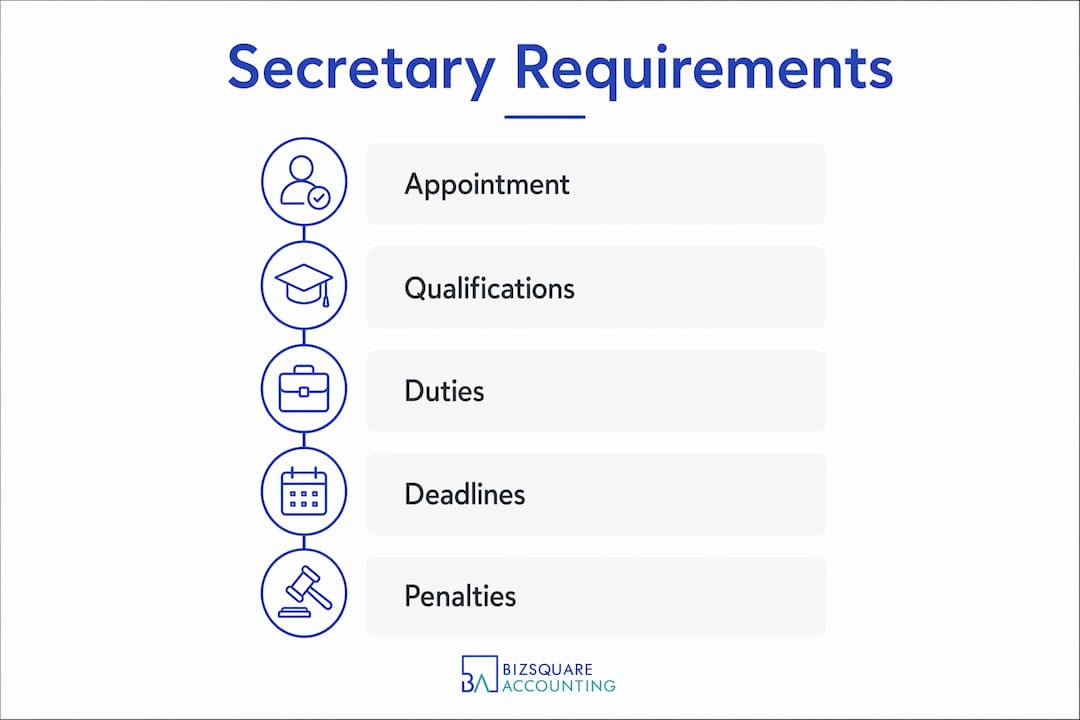
What are the key duties of a company secretary?
The company secretary job description in Singapore covers a broad range of statutory and administrative responsibilities. These duties are not ceremonial. They form the operational backbone of a company’s compliance with ACRA and other regulatory bodies.
The following are the core statutory duties every company secretary must fulfill:
- Maintain statutory registers. The secretary keeps the Register of Members, Register of Directors, Register of Charges, and other records required under the Companies Act. These must be accurate and available for inspection at all times.
- Organize board and shareholder meetings. The secretary prepares meeting notices, drafts agendas, records minutes, and distributes resolutions. Proper documentation of board decisions is a legal requirement, not just good practice.
- File annual returns and statutory documents. The secretary coordinates the timely submission of the Annual Return to ACRA, typically within five months of the financial year-end for companies with share capital. Late filings attract penalties.
- Notify ACRA of changes. Any change in directors, shareholders, registered address, or share capital must be reported to ACRA within the prescribed timeframe. The secretary manages these notifications to keep company records current.
- Remind directors of compliance deadlines. The secretary tracks filing calendars and alerts directors to upcoming obligations, including tax filing deadlines with the Inland Revenue Authority of Singapore (IRAS) and ACRA submission dates.
- Maintain the company’s registered address. The secretary confirms that the company’s official address on ACRA’s Bizfile+ registry is current and that all statutory correspondence reaches the right people.
- Support corporate governance. Beyond paperwork, the secretary advises directors on procedural matters, ensures resolutions are properly passed, and helps the board operate within the law.
Neglecting these statutory duties creates compounding risk. A missed annual return leads to a penalty. An unrecorded share transfer creates disputes. An outdated register can invalidate corporate decisions. The secretary is the compliance owner who keeps all of these moving parts in order.
Pro Tip: Ask your company secretary to maintain a compliance calendar with all ACRA and IRAS deadlines. A shared digital calendar with automated reminders reduces the risk of missed filings significantly.
How do you navigate appointment challenges for single-director startups?
Single-director companies face the most practical difficulty in meeting company secretary requirements. The sole director restriction is the most common compliance trap for early-stage startups in Singapore.
Here are the key challenges and how to address each one:
- The sole director restriction creates an immediate gap. A founder who incorporates as the only director cannot self-appoint as secretary. This means every single-director company needs a second person in a compliance role from day one.
- The six-month deadline is firm. Vacancies exceeding six months expose directors to fines of up to S$1,000. Many founders discover this rule only after the deadline has passed.
- Resignation timing must be managed carefully. When a company secretary resigns, the company must appoint a replacement before the vacancy reaches six months. Founders should plan secretarial transitions in advance, not reactively.
- Appointing a family member or employee carries risk. A trusted employee or family member can serve as company secretary if they meet the residency requirement. However, they must understand the statutory duties involved. Appointing someone who cannot perform the role creates a different compliance problem.
- Outsourcing is the most reliable solution. Professional corporate secretarial firms provide a qualified, resident individual to serve as company secretary. This eliminates the residency concern, the sole director restriction, and the risk of appointment gaps in a single arrangement.
The practical reality for most Singapore startups is that outsourcing the company secretary role costs far less than managing a compliance penalty or a governance dispute. The benefits of outsourcing extend beyond cost avoidance. A professional provider brings institutional knowledge of ACRA processes, filing timelines, and governance best practices that an internal appointee rarely has from day one.
Pro Tip: Plan the appointment of your company secretary before your previous secretary submits a resignation. This prevents any gap in the position and keeps your company fully compliant at all times.
How do Singapore’s rules compare to Hong Kong and the UK?
Understanding how Singapore’s company secretary requirements compare to other jurisdictions helps business owners appreciate what makes the local framework distinctive. The table below summarizes the key differences.
| Requirement | Singapore | Hong Kong | United Kingdom |
|---|---|---|---|
| Mandatory appointment | Yes, within 6 months of incorporation | Yes, at incorporation | Only for public limited companies (PLCs) |
| Residency requirement | Must be ordinarily resident in Singapore | Must be a Hong Kong resident or licensed corporate secretary | No residency requirement |
| Sole director restriction | Sole director cannot serve as secretary | Sole director cannot serve as secretary | No restriction for private companies |
| Professional qualification | Not required for private companies | Required for corporate secretaries under AML laws | Required for PLCs; not for private companies |
| Regulatory authority | ACRA | Companies Registry (Hong Kong) | Companies House (UK) |
| Penalty for non-compliance | Fines up to S$1,000 | Fines and potential prosecution | Fines for PLCs; no penalty for private companies |
Singapore’s framework is more demanding than the UK’s for private companies, but less prescriptive than Hong Kong’s licensing regime. The UK model allows private limited companies to operate without a company secretary entirely, though many still appoint one for governance purposes. Hong Kong’s residency and licensing rules make it harder to use a foreign professional for the role.
Singapore’s approach reflects a deliberate policy choice. ACRA wants every company to have a resident compliance officer who can be held accountable under local law. This makes the role more meaningful than a formality and gives regulators a clear point of contact for each registered company.
Why outsourcing your company secretary is a strategic decision
Outsourcing the company secretary role in Singapore is not just a workaround for the sole director restriction. It is a governance decision that affects the quality of a company’s compliance management over time.
The core advantages of engaging a professional corporate secretarial service include:
- Continuous compliance coverage. A professional provider tracks all ACRA and IRAS deadlines on behalf of the company. This removes the risk of missed filings caused by internal oversight or staff turnover.
- Expertise in statutory processes. Corporate secretarial firms handle ACRA filings, resolutions, and register updates daily. Their familiarity with Bizfile+ and ACRA procedures reduces errors and processing delays.
- No vacancy risk. When an internal secretary resigns, the company faces a compliance gap. A professional provider maintains continuity because the service agreement covers the role, not a single individual.
- Cost efficiency for SMEs. Hiring a full-time company secretary is expensive for most small and medium enterprises. Outsourcing provides the same statutory coverage at a fraction of the cost.
- Governance advisory support. Experienced corporate secretarial providers advise directors on procedural matters, help draft resolutions, and flag governance issues before they become problems.
Outsourcing company secretary roles to a licensed or professionally experienced entity mitigates the risk of vacancy and supports continuous compliance management. For SMEs and startups in Singapore, this is often the most practical path to meeting all company secretary requirements without building internal capacity prematurely.
SME compliance matters more than most founders initially realize. A single missed annual return or an undocumented board resolution can complicate future fundraising, audits, or corporate restructuring. The importance of SME compliance is often underestimated until a problem surfaces at the worst possible time.
Key takeaways
Every Singapore company must appoint a qualified, ordinarily resident company secretary within six months of incorporation, and the sole director cannot hold both roles simultaneously.
| Point | Details |
|---|---|
| Mandatory appointment deadline | Appoint a company secretary within six months of incorporation to avoid fines up to S$1,000. |
| Eligibility rules are strict | The secretary must be a natural person, ordinarily resident in Singapore, and not the sole director. |
| Duties are statutory, not optional | Maintaining registers, filing annual returns, and notifying ACRA of changes are legal obligations. |
| Single-director companies need external help | Sole directors must appoint a separate individual or outsource to a professional provider. |
| Outsourcing reduces risk and cost | Professional secretarial services prevent vacancy gaps and provide governance expertise for SMEs. |
The role most founders underestimate
The company secretary role is consistently treated as a box-ticking exercise by early-stage founders in Singapore. This is a mistake that becomes visible only when something goes wrong.
From a governance perspective, the company secretary is the person who keeps the company’s legal identity intact. Missed filings, unrecorded resolutions, and outdated registers do not just attract ACRA penalties. They create disputes with shareholders, complicate due diligence during fundraising, and can invalidate corporate decisions that the business has already acted on.
The qualifications for company secretary in Singapore are deliberately accessible. ACRA does not require a law degree or a professional certification for private companies. What the role demands is diligence, familiarity with statutory deadlines, and the discipline to maintain accurate records consistently. These are operational skills, not academic ones.
The most common mistake seen among Singapore SMEs is appointing a company secretary without briefing them on the actual duties involved. A name on the ACRA register is not the same as an active compliance officer. The appointment must be backed by a clear understanding of responsibilities on both sides.
For founders who are managing multiple priorities, outsourcing this role to a firm like Bizsquare is not a sign of weakness. It is a recognition that compliance management requires dedicated attention. The cost of a professional secretarial service is predictable. The cost of a compliance failure is not.
How Bizsquare helps you meet company secretary requirements
Bizsquare provides corporate secretary services designed specifically for Singapore companies that need reliable, compliant, and professionally managed secretarial support from day one.
Bizsquare assigns a qualified, ordinarily resident company secretary to your company, meeting all ACRA eligibility requirements and the six-month appointment deadline. For single-director companies, Bizsquare’s outsourced model resolves the sole director restriction immediately. The service covers statutory register maintenance, ACRA filings, annual return coordination, and governance documentation. Bizsquare also supports company incorporation in Singapore, so founders can address both incorporation and secretarial compliance in a single engagement. Explore the full scope of company secretary requirements and how Bizsquare manages them on your behalf.
FAQ
1.) What are the legal requirements for a company secretary in Singapore?
Every Singapore company must appoint a company secretary within six months of incorporation under the Companies Act. The secretary must be a natural person, ordinarily resident in Singapore, and cannot be the sole director of the company.
2.) Can the sole director also be the company secretary?
No. ACRA prohibits a sole director from serving as company secretary. Single-director companies must appoint a separate individual or engage a professional secretarial service.
3.) What qualifications does a company secretary need in Singapore?
Singapore does not require a specific professional qualification for company secretaries of private companies. The person must be a natural person who is ordinarily resident in Singapore and capable of performing the statutory duties.
4.) What happens if a company does not appoint a company secretary?
Directors face fines of up to S$1,000 if the company secretary post remains vacant for more than six months. Ongoing non-compliance can also affect the company’s standing with ACRA.
5.) What are the main duties of a company secretary in Singapore?
The company secretary maintains statutory registers, organizes board and shareholder meetings, files annual returns with ACRA, notifies ACRA of company changes, and reminds directors of compliance deadlines. These duties are statutory obligations under the Companies Act.
6.) How do I appoint a company secretary in Singapore?
The appointment is recorded through ACRA’s Bizfile+ portal. The company must file the secretary’s particulars, including their identification and residential address. Full guidance on how to appoint a company secretary is available through Bizsquare.
7.) Can a foreigner be a company secretary in Singapore?
A foreigner can serve as company secretary if they are ordinarily resident in Singapore, such as an Employment Pass or Dependant’s Pass holder. A non-resident foreigner does not qualify.
8.) How much does a company secretary cost in Singapore?
Professional corporate secretarial services in Singapore typically range from S$300 to S$800 per year for standard private company requirements. The cost varies based on the scope of services and the complexity of the company’s compliance needs.
9.) Is a company secretary the same as a corporate secretary?
Yes. The terms are used interchangeably in Singapore. Both refer to the individual appointed under the Companies Act to manage statutory compliance and governance administration for a company.
10.) What is the difference between a company secretary and a director?
A director manages the business and makes strategic decisions. A company secretary manages statutory compliance, maintains records, and supports governance administration. The two roles are legally distinct and cannot be combined in a single-director company.
11.) Can I change my company secretary after appointment?
Yes. A company can change its company secretary at any time by filing the change through ACRA’s Bizfile+ portal. The outgoing secretary’s resignation and the incoming secretary’s appointment must be filed promptly to avoid a compliance gap.
12.) Does a company secretary need to attend board meetings?
The company secretary is not legally required to attend every board meeting, but they are typically present to record minutes and ensure proper procedural compliance. Their role in meeting documentation is a core statutory duty.
13.) What records must a company secretary maintain?
The company secretary must maintain the Register of Members, Register of Directors and Chief Executive Officers, Register of Charges, and minutes of all board and shareholder meetings. These records must be kept at the company’s registered office and made available for inspection when required.