
TL;DR:
- Business tax accountancy involves preparing, managing, and filing a company’s tax obligations to ensure compliance and optimize financial results. It relies on accurate records, timely filings, and understanding exemptions and rebates, especially under Singapore’s tax schemes and the 2026 Budget incentives. Engaging professional tax advisors aids compliance, maximizes rebate benefits, and reduces the risk of costly errors.
Business tax accountancy is the systematic process of preparing, managing, and filing a company’s tax obligations to ensure compliance and optimize financial outcomes. For Singapore business owners and financial officers, this practice sits at the center of every major financial decision. The Inland Revenue Authority of Singapore (IRAS) governs corporate tax filings, and the rules change with each Budget cycle. Singapore’s flat 17% corporate tax rate provides a stable foundation, but the real opportunity lies in understanding exemptions, rebates, and grants that can significantly reduce a company’s tax burden. The 2026 Budget introduced a 40% corporate tax rebate for qualifying companies, making accurate tax accounting more valuable than ever.
What is business tax accountancy and why does it matter in Singapore?
Business tax accountancy covers the full cycle of recording financial transactions, preparing accounts, calculating taxable income, and filing returns with IRAS. It is not simply bookkeeping. The distinction matters because tax accounting applies specific rules about what income is taxable, which expenses are deductible, and when those figures must be reported.
Singapore operates a territorial tax system. Companies pay corporate income tax only on income sourced in Singapore or remitted to Singapore from abroad. The corporate tax rate stays at 17% for 2026, unchanged from prior years. That rate applies to chargeable income, which is net profit after allowable deductions and exemptions.
Two exemption schemes reduce the effective rate for most companies. The Startup Tax Exemption Scheme provides full exemption on the first SGD 100,000 of chargeable income and 50% exemption on the next SGD 100,000 for qualifying new companies. The Partial Tax Exemption applies to all other companies, offering 75% exemption on the first SGD 10,000 and 50% on the next SGD 190,000. These schemes make accurate income tax accounting critical because a miscalculation in chargeable income directly affects the exemption bands.
The table below summarizes the key tax parameters for 2026.
| Tax Parameter | Details |
|---|---|
| Corporate tax rate | 17% flat on chargeable income |
| Startup Tax Exemption | 100% on first SGD 100,000; 50% on next SGD 100,000 |
| Partial Tax Exemption | 75% on first SGD 10,000; 50% on next SGD 190,000 |
| 2026 Corporate Tax Rebate | 40% rebate capped at SGD 30,000 for companies with at least one local employee in 2025 |
| Cash Grant | SGD 1,500 automatic cash grant for qualifying companies in 2026 |
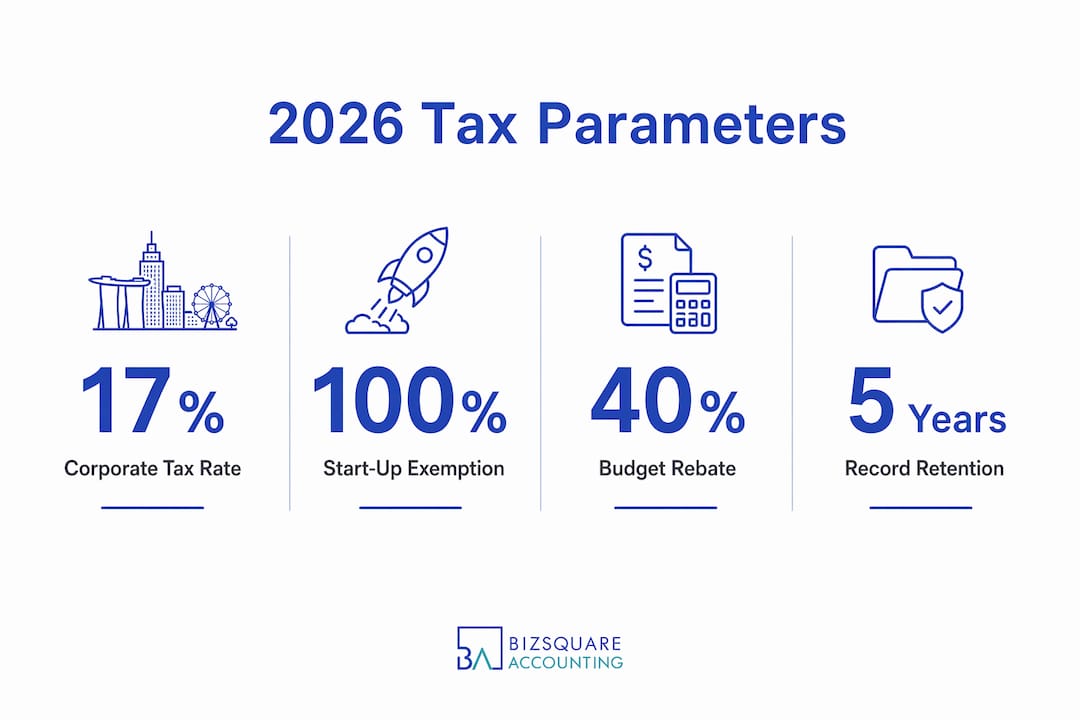
The 2026 Budget rebate applies automatically to companies that employed at least one local worker in 2025. That means no application is required, but the company must have filed its tax return accurately to receive the correct rebate amount. Poor tax accounting directly costs money here.
Essential record keeping for Singapore tax filings
Accurate records are the foundation of every successful tax filing. IRAS requires businesses to keep accounting records and source documents for a minimum of five years. This applies to invoices, receipts, bank statements, contracts, and any document supporting a financial claim.

The five-year rule is not just a formality. IRAS auditors can request records from any prior year within that window. A company that cannot produce supporting documents risks having deductions disallowed, which increases its chargeable income and tax liability.
Proper bookkeeping for tax purposes requires attention to the following areas:
- Bank reconciliations: Match every bank statement line to a corresponding entry in the accounts. Unreconciled items are a common audit trigger.
- Supplier and customer balances: Verify that outstanding payables and receivables are accurate at year end. Overstated expenses or understated income affect taxable profit.
- Accruals and prepayments: Record income and expenses in the correct accounting period. IRAS assesses tax on income earned, not just cash received.
- Credit notes: Ensure credit notes are properly recorded against the original invoice. Missing credit notes inflate revenue figures.
- GST tax invoices: A valid GST invoice must include the supplier’s GST registration number, the invoice date, a description of goods or services, and the GST amount charged. Inaccurate GST invoice details can result in disallowed input tax claims.
Accounting software plays a direct role in maintaining these standards. Zoho Books, for example, integrates invoicing, bookkeeping, and document management in one platform, which simplifies year-end preparation and reduces the risk of missing documents. For Singapore SMEs managing multiple transactions daily, a centralized system is not optional. It is the practical difference between a clean audit and a costly one.
Pro Tip: Set a monthly close schedule. Reconcile accounts, review outstanding invoices, and flag any missing documents at the end of each month. This turns a stressful year-end process into a straightforward one.
For a deeper look at maintaining accuracy in your accounts, Bizsquare’s guide on bookkeeping accuracy for SMEs covers common pitfalls and practical fixes.
How does professional tax advisory improve compliance and tax savings?
Tax advisory services go beyond filing returns. A qualified tax advisor or CPA reviews a company’s financial position, identifies eligible deductions, and structures transactions to minimize tax exposure within the law. For Singapore SMEs, this expertise becomes especially valuable when navigating grants and incentives that carry specific eligibility conditions.
The 2026 Budget enhanced the Market Readiness Assistance (MRA) scheme, which supports companies expanding overseas. Specialists assist in maximizing MRA benefits by verifying documentation, confirming eligible expenses, and managing cross-border cost allocation rules. A business that misclassifies an overseas expense can lose the grant claim entirely.
Professional tax advisors typically manage the following for their clients:
- Chargeable income calculation: Identify all allowable deductions, including capital allowances, R&D expenses, and approved donations.
- ECI filing: Prepare and submit the Estimated Chargeable Income within three months of the financial year end.
- Form C or Form C-S preparation: Compile the annual corporate tax return with supporting schedules.
- GST compliance review: Check that all GST-registered transactions meet IRAS formatting and reporting standards.
- Grant and rebate eligibility checks: Confirm the company qualifies for the 40% corporate tax rebate and any applicable enterprise development grants.
“The 2026 Budget’s enhanced MRA scheme signals a pragmatic shift for SMEs, making expert tax advisory essential to maximize internationalization grants.” — The Straits Times
The value of corporate tax consulting extends to risk management. An advisor who reviews filings before submission catches errors that could trigger an IRAS audit. That preventive role alone justifies the cost for most growing companies.
Pro Tip: Engage a tax advisor at the start of your financial year, not just at year end. Early planning allows you to structure expenses and investments in ways that reduce your chargeable income before the period closes.
What are the most common tax compliance challenges for Singapore businesses?
Tax compliance failures in Singapore follow predictable patterns. Understanding them helps business owners and financial officers build processes that prevent problems before they occur.
The most frequent challenges include:
Missing ECI deadlines: The ECI must be filed within three months after the financial year end. Companies with a december year end must file by march 31. Late filing attracts penalties and can affect the company’s compliance record with IRAS.
Late corporate tax returns: The annual corporate tax return is due by november 30 each year. Missing this deadline can result in composition fines and increased audit scrutiny in subsequent years.
Incomplete GST records: GST-registered businesses must maintain records that support every input and output tax claim. Missing invoices or invoices without the required GST details result in disallowed claims during an audit.
Incorrect expense classification: Expenses that are capital in nature cannot be deducted as revenue expenses. Misclassifying a renovation cost as a repair, for example, inflates deductions and creates a discrepancy that IRAS may flag.
Failure to claim available exemptions: Some companies file without applying the Startup Tax Exemption or Partial Tax Exemption correctly. This results in overpayment of tax, which is recoverable but time-consuming to correct.
Inadequate digital records: IRAS increasingly expects businesses to maintain organized digital records. Paper-only systems create retrieval problems during audits and slow down the filing process.
Overlooking the 2026 rebate eligibility: Companies that employed local workers in 2025 qualify for the 40% rebate automatically, but only if the tax return is filed accurately and on time. An error in the return can delay or reduce the rebate.
The practical solution to most of these challenges is a structured compliance calendar. Map every filing deadline at the start of the financial year. Assign responsibility for each task. Review records monthly rather than quarterly. For companies without an in-house finance team, outsourcing to a firm that specializes in business tax preparation removes the risk of missed deadlines entirely.
For companies considering the difference between managing accounts internally and using professional support, Bizsquare’s comparison of DIY vs. professional bookkeeping provides a clear framework for making that decision.
Key Takeaways
Effective business tax accountancy in Singapore requires accurate records, timely filings, and proactive use of available exemptions and rebates to minimize tax liability legally.
| Point | Details |
|---|---|
| Singapore’s tax rate | The flat 17% corporate tax rate applies to chargeable income after exemptions and deductions. |
| 2026 rebate opportunity | Companies with at least one local employee in 2025 receive a 40% rebate capped at SGD 30,000 automatically. |
| Five-year record rule | IRAS requires all accounting records and source documents to be kept for a minimum of five years. |
| Filing deadlines | ECI is due within three months of year end; the annual corporate tax return is due by november 30. |
| Advisory value | Professional tax advisors reduce audit risk, maximize grant eligibility, and catch errors before submission. |
Singapore’s tax system rewards preparation, not reaction
The businesses that benefit most from Singapore’s tax incentives are not the largest ones. They are the ones that prepare earliest. The 2026 Budget’s 40% corporate tax rebate and the enhanced MRA scheme are not complicated to access, but they require clean records, accurate filings, and a clear understanding of eligibility conditions. Most companies that miss out do so because they treat tax as a year-end task rather than a year-round discipline.
The complexity of tax compliance in Singapore has grown steadily over the past several years. IRAS has expanded its digital reporting expectations, tightened GST invoice requirements, and introduced new grant structures that carry their own documentation rules. A business owner managing operations, sales, and staff cannot realistically stay current on all of these changes without dedicated support.
The most underused resource for Singapore SMEs is early-stage tax planning. Most advisors are engaged in october or november, when the filing deadline is approaching. By that point, the financial year is closed and the options are limited. Engaging a tax professional in january or february, when the year is just beginning, opens up decisions about capital expenditure timing, salary structuring, and grant applications that are simply not available at year end.
Digital tools like Zoho Books reduce the administrative burden, but they do not replace judgment. Software records what happened. A qualified advisor interprets what it means for your tax position and recommends what to do next. The combination of good software and professional oversight is the most reliable path to clean compliance and optimized tax outcomes.
— Vandro
How Bizsquare supports Singapore businesses with tax accountancy
Bizsquare provides corporate tax filing, advisory, and bookkeeping services tailored for Singapore SMEs and growing companies. The team manages ECI preparation, annual corporate tax returns, GST compliance reviews, and grant eligibility checks, covering the full scope of tax accounting services that businesses need to stay compliant and financially sound.
For companies looking to maximize the 2026 Budget rebates and MRA scheme benefits, Bizsquare’s advisors verify eligibility, prepare supporting documentation, and submit filings accurately and on time. Business owners who want to reduce tax risk and capture available incentives can start with Bizsquare’s corporate tax filing and advisory services. For companies at the formation stage, Bizsquare also supports company incorporation in Singapore with full compliance setup from day one.
FAQ
What is business tax accountancy?
Business tax accountancy is the practice of recording financial transactions, calculating taxable income, and filing corporate tax returns in compliance with IRAS requirements. It covers income tax accounting, GST compliance, and tax planning to reduce a company’s overall tax liability.
What is Singapore’s corporate tax rate in 2026?
Singapore’s corporate tax rate remains at 17% for 2026, applied to chargeable income after allowable deductions and exemptions. Startups and qualifying companies benefit from additional exemption schemes that reduce the effective rate significantly.
Who qualifies for the 2026 corporate tax rebate?
All companies that employed at least one local worker in 2025 qualify for the 40% corporate tax rebate capped at SGD 30,000, plus an automatic SGD 1,500 cash grant. No separate application is required, but accurate and timely tax filing is necessary to receive the correct amount.
When are corporate tax filing deadlines in Singapore?
The ECI must be filed within three months after the company’s financial year end. The annual corporate tax return is due by november 30 each year. Late filings attract penalties and can increase audit risk.
How long must Singapore businesses keep accounting records?
IRAS requires businesses to retain accounting records and source documents for a minimum of five years. This includes invoices, receipts, bank statements, and any document that supports a tax claim or deduction.
What does a tax advisor do for a Singapore SME?
A tax advisor calculates chargeable income, prepares ECI and Form C or Form C-S filings, reviews GST compliance, and identifies eligible grants and rebates. For SMEs, advisors also verify eligibility for schemes like the enhanced MRA and ensure documentation meets IRAS standards.
What is the Startup Tax Exemption Scheme?
The Startup Tax Exemption Scheme provides 100% tax exemption on the first SGD 100,000 of chargeable income and 50% exemption on the next SGD 100,000 for qualifying new companies. It applies for the first three consecutive years of assessment from the year of incorporation.
What happens if a Singapore company files taxes late?
Late ECI or corporate tax return filings result in composition fines from IRAS. Repeated late filings increase audit risk and can affect the company’s compliance standing with both IRAS and ACRA.
What is chargeable income in Singapore?
Chargeable income is the net taxable profit of a company after deducting all allowable expenses, capital allowances, and applicable exemptions from gross income. The 17% corporate tax rate applies to this figure.
Can Singapore businesses file corporate taxes online?
Yes. IRAS provides the myTax Portal for companies to file ECI and corporate tax returns online. Most tax accounting services and advisors submit filings through this portal on behalf of their clients.
What is the difference between bookkeeping and tax accounting?
Bookkeeping records daily financial transactions, while tax accounting applies tax rules to those records to calculate taxable income and prepare filings. Both are necessary, but tax accounting requires knowledge of IRAS regulations, exemption schemes, and deductibility rules. Bizsquare’s guide on bookkeeping vs. accounting explains the distinction in practical terms.
What is the Market Readiness Assistance scheme?
The Market Readiness Assistance (MRA) scheme is a government grant that supports Singapore SMEs expanding into overseas markets. The 2026 Budget enhanced the scheme’s coverage and funding levels, making professional advisory support important for companies seeking to maximize their claims.