


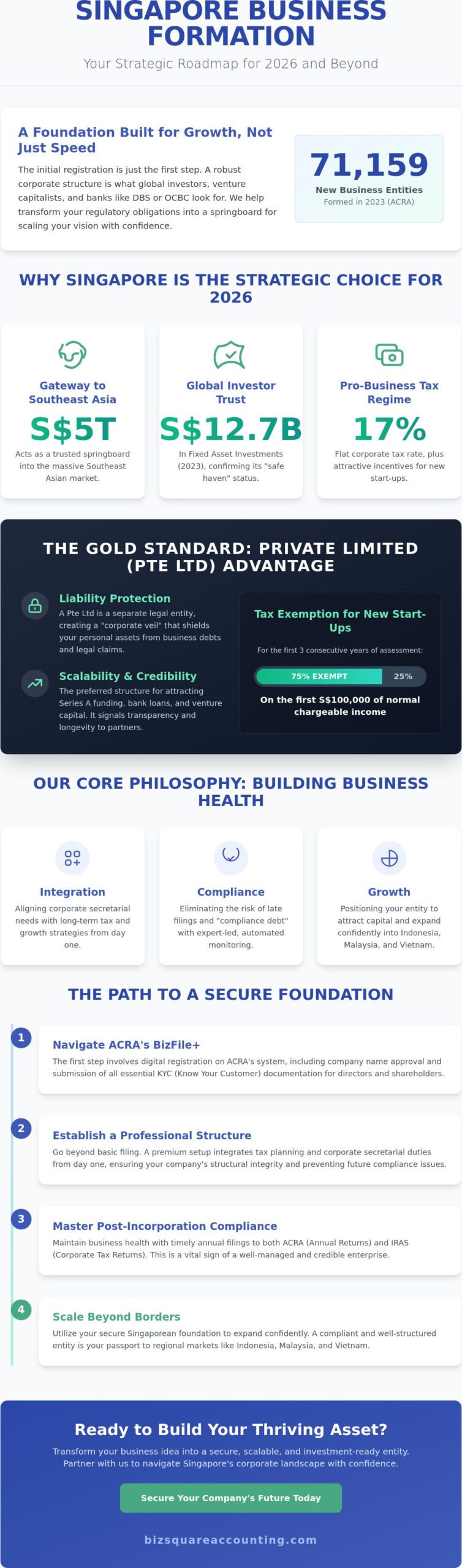
A business foundation built solely on speed is a liability waiting to surface. While ACRA reported that 71,159 new business entities were formed in 2023, many founders quickly discover that the initial business formation singapore process is only the first step in a much longer journey. You likely believe that entering this market should be a gateway to global opportunity, yet the confusion over ACRA and IRAS requirements often creates unnecessary anxiety about legal liability and hidden costs.
As a premium provider of corporate services, we don’t just crunch numbers; we act as a strategic partner to help you master the complexities of registration and build a secure, scalable foundation. We understand that your business is a living entity that requires structural integrity to thrive. By aligning your compliance with your growth goals, we help you transform regulatory obligations into a springboard for scaling your vision confidently.
Business Formation Singapore: The 2026 Strategic Guide for Growth
This guide provides a clear roadmap for your annual filings and a strategic framework for maintaining a legally compliant entity throughout 2026. You’ll learn how to simplify your regulatory obligations and strengthen your position in the regional ecosystem with a professional, expert approach.
Key Takeaways
- Understand why Singapore is the strategic choice for 2026, positioning your firm as a premium gateway to the Southeast Asian market and a magnet for global investors.
- Evaluate the Private Limited structure as the gold standard for scalability, ensuring your business has the structural integrity required for long-term growth.
- Navigate the step-by-step process of business formation singapore using ACRA’s BizFile+ system while meeting all essential KYC and documentation requirements.
- Transition from viewing compliance as a hurdle to seeing it as a vital sign of business health through professional secretarial and accounting synergy.
- Discover how to scale your operations beyond borders, utilizing a secure Singaporean foundation to expand confidently into Indonesia, Malaysia, and Vietnam.
Why Business Formation in Singapore is the Strategic Choice for 2026
Singapore remains the undisputed epicenter for regional expansion. As we look toward 2026, the city-state continues to leverage its highly developed market economy to act as a springboard into the S$5 trillion Southeast Asian market. Choosing business formation singapore isn’t just a legal requirement; it’s a calculated move to establish a presence in a jurisdiction that global investors trust implicitly. A robust corporate structure is the first thing a venture capitalist or a local bank like DBS or OCBC looks for when evaluating a loan application. Without a clean, professional setup, your company’s growth could stall before it even begins.
We view your company as a living entity that requires structural integrity. A strong foundation ensures that your “Business Health” remains optimal as you scale. This proactive approach transforms the registration process from a bureaucratic hurdle into a strategic advantage. It signals to partners and creditors that your enterprise is built for longevity and transparency, reducing the friction often found during due diligence processes.
The 2026 Economic Landscape for Singapore SMEs
The 2026 outlook emphasizes stability and digital integration. While global markets fluctuate, Singapore’s pro-business tax regime, including the 17% corporate tax rate and various incentives for new start-ups, provides a predictable environment for scaling. Localized expertise is no longer optional. With ACRA’s digital-first regulatory framework evolving, businesses need partners who understand real-time compliance. Singapore’s status as a “safe haven” attracted over S$12.7 billion in Fixed Asset Investments in 2023, a trend expected to persist through 2026. This influx of capital creates a fertile ecosystem for SMEs to find mentors and collaborators.
Moving Beyond “Crunching Numbers”
Successful entrepreneurs realize that business formation singapore requires more than just submitting digital forms. At Bizsquare, we don’t just crunch numbers. We focus on your total financial and structural integrity. A premium initial setup prevents the accumulation of “compliance debt,” which often leads to heavy penalties or audit failures three years down the line. We integrate tax planning, secretarial duties, and growth strategy from day one. Our philosophy centers on three core pillars:
- Integration: Aligning your corporate secretarial needs with your long-term tax strategy.
- Compliance: Eliminating the risk of late filings through automated, expert-led monitoring.
- Growth: Positioning your entity to attract Series A funding or expansion capital effortlessly.
Whether you’re a solo founder or a scaling SME, your foundation determines your ceiling. A strategic partnership ensures your entity remains a thriving asset rather than a stagnant file in a cabinet. Speak with us today to secure your company’s future.
Choosing Your Entity: Private Limited vs. Other Business Structures
Selecting the right vehicle is the first vital step in successful business formation singapore. The Accounting and Corporate Regulatory Authority (ACRA) offers several registration options, yet most entrepreneurs prioritize a structure that protects personal assets while fostering long-term health. Whether you’re a solo consultant or an ambitious tech founder, your choice determines your tax obligations, personal liability, and your ability to scale across Southeast Asia.
The Private Limited (Pte Ltd) Advantage
A Private Limited company is a separate legal entity, which means it can own property, enter contracts, and sue or be sued in its own name. This structure creates a protective “corporate veil” that shields your personal savings and assets from business debts or legal claims. For new startups, the Inland Revenue Authority of Singapore (IRAS) offers premium tax benefits to support early growth. Under current 2024 regulations, the Tax Exemption Scheme for New Start-Up Companies provides a 75% exemption on the first S$100,000 of normal chargeable income for the first three consecutive years of assessment.
The requirements for a Pte Ltd are designed to be accessible yet robust:
- Shareholders: Between 1 and 50 individuals or corporate entities.
- Directors: At least one director who is ordinarily resident in Singapore.
- Capital: A minimum initial paid-up capital of just S$1.
- Company Secretary: A qualified secretary must be appointed within six months of incorporation.
A Private Limited company is the most flexible vehicle for foreign and local entrepreneurs. At Bizsquare, we don’t just crunch numbers; we help you build these foundations so you can scale confidently and attract the right investors.
Alternative Structures: Sole Proprietorship and LLP
If you’re running a low-risk micro-business, a Sole Proprietorship offers the simplest setup with the least administrative burden. However, it’s important to recognize that this structure lacks legal distinction between the owner and the business. If the business faces financial distress, your personal assets are fully exposed to creditors. For professional service providers like architects or lawyers, a Limited Liability Partnership (LLP) is often a preferred middle ground. It combines the internal flexibility of a partnership with the benefits of limited liability for individual partners.
While these alternative options involve lower initial compliance costs, they often limit your future trajectory. It’s significantly harder to raise venture capital or secure corporate bank loans without the structure of a Pte Ltd. Choosing the right model for business formation singapore ensures your venture remains compliant while staying ready for regional expansion. You can consult with our expert team to determine which path aligns with your specific three-year growth plan.
The Step-by-Step Process of Singapore Company Registration
Establishing a solid foundation for business formation singapore requires a methodical approach to the digital landscape managed by the Accounting and Corporate Regulatory Authority (ACRA). The entire registration process occurs through the BizFile+ system, a streamlined portal that facilitates rapid incorporation. While the system is efficient, it demands rigorous KYC (Know Your Customer) compliance. You must prepare identification documents, proof of residential addresses, and signed consent forms for all proposed officers. Whether you’re a local founder or an international investor, these documents act as the structural integrity of your application. For a broader perspective on the regulatory environment, the official guide to setting up a business in Singapore provides essential context for global enterprises.
The timeline for incorporation is remarkably swift. Name approval typically takes less than 15 minutes, and official incorporation can be completed within the same day. However, if the application is referred to external government agencies for review, the process can extend from 14 days to two months. We don’t just crunch numbers; we proactively identify potential triggers for these referrals to keep your timeline on track. Common pitfalls that cause delays include outstanding Medisave contributions from local directors or choosing names that conflict with existing entities.
Step 1: Company Name and SSIC Codes
Your company name must be unique and free from sensitive keywords that suggest government affiliation. It’s vital to select the correct Singapore Standard Industrial Classification (SSIC) codes, which categorize your business activities for statistical and regulatory purposes. Most companies select two primary SSIC codes that best reflect their revenue streams. To avoid costly trademark disputes, always perform a search on the IPOS (Intellectual Property Office of Singapore) portal before finalizing your name choice. This extra layer of security ensures your brand identity is protected from the start.
Step 2: Appointing Key Personnel and Registered Address
Singapore law mandates that every company must have at least one director who is ordinarily resident in Singapore. This includes Singapore Citizens, Permanent Residents, or holders of an EntrePass or Employment Pass. Within six months of incorporation, you must also appoint a qualified Company Secretary to manage ongoing compliance. Your registered office address must be a physical location in Singapore where official communications can be delivered, as P.O. boxes are strictly prohibited. These requirements are not just bureaucratic hurdles; they are the essential pillars that strengthen your company’s legal standing in the region.
Navigating Post-Incorporation Compliance: More Than Just ACRA Filings
Success doesn’t end once you receive your Unique Entity Number (UEN). Many founders mistakenly treat business formation singapore as a one-time administrative hurdle. In reality, incorporation marks the birth of a living entity that requires consistent care to remain in good standing with both the Accounting and Corporate Regulatory Authority (ACRA) and the Inland Revenue Authority of Singapore (IRAS).
At Bizsquare, we don’t just crunch numbers; we act as the guardian of your company’s structural integrity. This role involves a seamless synergy between your corporate secretarial records and your financial health. All bookkeeping must adhere strictly to the Singapore Financial Reporting Standards (SFRS). These standards ensure your financial statements are transparent, professional, and ready for any potential audit or investment opportunity. Whether you are a solo entrepreneur or a scaling SME, maintaining these foundations is what allows you to scale confidently.
Staying compliant requires strict adherence to a specific annual calendar. Private companies must hold their Annual General Meeting (AGM) within 6 months of their financial year end. Following the AGM, the Annual Return must be lodged with ACRA within 7 months of the year end. On the tax front, IRAS requires the filing of Estimated Chargeable Income (ECI) within 3 months of the financial year end, followed by the final tax return (Form C-S or Form C) by 30 November. Missing these dates can lead to composite fines or even court summons, which can tarnish a company’s reputation.
The Role of the Corporate Secretary
A premium corporate secretary is your first line of defense against regulatory risk. They maintain your statutory registers, manage board resolutions, and track every ACRA deadline to prevent late filing penalties, which typically start at S$300 per breach. By acting as a meticulous record-keeper, a professional secretarial service ensures your corporate history is always “audit-ready,” providing the security you need to focus on your core business operations.
Tax and GST Compliance Strategy
Your tax strategy must evolve as your revenue grows. Singapore law mandates GST registration if your taxable turnover exceeds S$1 million at the end of any calendar year. Proactive monitoring of this threshold prevents backdated taxes and heavy penalties. For a deeper look at these requirements, see The Comprehensive Guide to Singapore Company Incorporation in 2026. Managing your ECI filings accurately ensures you utilize available tax exemptions for new companies, which can significantly strengthen your bottom line.
Scaling Beyond Borders: How Bizsquare Strengthens Your Business Foundation
Completing your business formation singapore is more than a regulatory milestone; it’s the strategic launchpad for capturing the broader Southeast Asian market. With ASEAN’s regional GDP projected to grow by 4.5% in 2024, Singapore serves as the vital nerve center for companies eyeing regional dominance. We view your initial setup as the structural foundation that must be robust enough to support rapid, multi-market scaling. Bizsquare doesn’t just manage your filings; we act as a guardian of your business health, ensuring your corporate structure is ready for the demands of international expansion.
Your Gateway to Indonesia and Malaysia
Expanding operations into Indonesia or Malaysia introduces layers of regulatory complexity that often stall growth. Bizsquare simplifies this transition by providing cross-border business registration and regional payroll services through a single, trusted partnership. This unified approach eliminates the friction of dealing with multiple agencies across different jurisdictions. Our strategic advisory helps you transition from the Singapore market to the Indonesian or Malaysian landscape while maintaining total compliance. We ensure your financial reporting remains consistent, whether you are managing operations of varying scales across these countries. Having one partner for regional compliance provides the clarity needed to move fast without risking legal setbacks.
Strategic Advisory and Premium Support
Many SMEs reach a stage where they require executive-level financial oversight but find the S$180,000 to S$250,000 annual salary of a full-time CFO out of reach. Bizsquare solves this by providing “Outsourced CFO” services that offer high-level financial analysis without the full-time cost. We don’t just crunch numbers; we provide the professional foresight required to strengthen your business for the long term. This includes preparing your accounts for potential audits, investment rounds, or regional acquisitions. Our premium support ensures that your financial “health” is always a priority, allowing you to focus on your core product while we handle the intricate details of fiscal management.
By integrating your accounting, tax, and secretarial functions, we create a seamless flow of information that supports better decision-making. This holistic view is essential for businesses that want to scale confidently and sustainably. Whether you’re a startup looking for your first big break or an established firm moving into Vietnam or Malaysia, our team provides the expert guidance to keep your foundation secure.
Secure Your Competitive Edge for 2026
Building a successful enterprise starts with a rock-solid foundation. As you navigate business formation singapore, remember that your choice of entity and commitment to compliance aren’t just administrative tasks. They’re strategic decisions that dictate your ability to scale across Southeast Asia. Since 2013, Bizsquare has helped entrepreneurs turn regulatory requirements into genuine growth opportunities. We provide a premium one-stop shop for compliance across Singapore, Indonesia, and Malaysia. We don’t just crunch numbers; we offer premium Outsourced CFO and Strategic Advisory solutions to ensure your business health remains optimal. Whether you’re a startup or an established SME, having a trusted partner allows you to focus on your vision while we handle the intricate details of ACRA filings and regional tax laws. Our decade of regional expertise ensures your expansion is seamless and secure. Your business deserves a partner that values its structural integrity as much as you do. Let’s build a legacy that thrives well beyond the coming year.
Speak with our expert consultants at Bizsquare Accounting today
Frequently Asked Questions
What are the minimum requirements for business formation in Singapore?
To initiate business formation in Singapore, you need at least one shareholder, one resident director, and one qualified company secretary. You must also provide a local registered office address and a minimum initial paid-up capital of S$1. Whether you’re a solo founder or a growing team, these baseline requirements ensure your entity sits on a firm legal foundation from day one.
Can a foreigner own 100% of a Singapore company?
Yes, foreign entrepreneurs can own 100% of a Singapore company’s equity without needing local partners or shareholders. This open-door policy makes business formation in Singapore highly attractive for international investors looking to scale across Southeast Asia. We help you navigate these ownership structures confidently, ensuring your corporate health remains a top priority as you expand.
How long does it take to register a company through ACRA BizFile?
Registration through the ACRA BizFile system typically takes about 15 minutes after the fee is paid, provided the company name is approved. If the application is referred to a government agency for review, the process can extend from 14 days to 60 days. We simplify this timeline by ensuring all your documentation is meticulous before submission to avoid unnecessary delays.
Do I need a local director if I am a foreign entrepreneur?
Every Singapore company must appoint at least one director who is “ordinarily resident” in Singapore. This means they must be a Singapore Citizen, a Permanent Resident, or an EntrePass holder. If you don’t have a local contact, we provide premium nominee director services to help you meet this legal mandate while you focus on your strategic growth.
What are the ongoing annual compliance costs for a Singapore company?
Annual compliance costs typically range from S$1,500 to S$5,000 for small businesses, depending on the volume of transactions and required services. These costs cover the annual return filing fee of S$60 paid to ACRA, alongside professional fees for secretarial, accounting, and tax filing. We don’t just crunch numbers; we help you manage these expenses to strengthen your company’s financial health.
What is the difference between a Company Secretary and a Bookkeeper?
A Company Secretary handles legal compliance and statutory filings, while a Bookkeeper manages your daily financial records and ledger entries. Every Singapore company must appoint a secretary within 180 days of incorporation to manage board resolutions and ACRA filings. Whether you need administrative governance or precise financial tracking, both roles are vital to maintaining a secure and professional business structure.
Is GST registration mandatory for all new Singapore businesses?
GST registration is only mandatory if your annual taxable turnover exceeds S$1 million at the end of a calendar year. Businesses with lower turnover can choose to register voluntarily, which might be beneficial if you’re reclaiming GST on business inputs. We analyze your specific revenue patterns to determine if voluntary registration will support your long-term scaling strategy or create unnecessary administrative weight.
Can I change my business structure after incorporation?
You can change your business structure, such as converting a sole proprietorship into a private limited company, as your operations grow. This transition involves registering a new entity and transferring assets, which often provides better tax benefits and limited liability protection. Our experts guide you through this evolution, ensuring your business foundations remain robust during periods of change.