


TL;DR:
- Most Singaporean business owners filing U.S. taxes in 2026 should use a hybrid approach of IRS e-file software and CPA advisory. This method balances costs, ensures compliance, and supports year-round tax planning, especially for complex situations like multi-state nexus and foreign ownership.
For most Singaporean business owners filing U.S. corporate taxes in 2026, a hybrid approach wins. Pair reliable, IRS e-file-capable software with periodic CPA advisory. This combination controls costs, keeps you compliant with U.S. rules, and supports year-round tax planning.
Three reasons this fits Singapore-based owners specifically:
- Cost control: Software handles routine data entry; a CPA handles judgment calls only.
- U.S. compliance: A credentialed CPA with a valid PTIN ensures filings meet IRS standards.
- Year-round planning: Quarterly estimated tax reviews prevent surprise liabilities at year-end.
The single best approach for 2026: Use IRS e-file-capable software for bookkeeping and form preparation, then engage a CPA with a valid PTIN for advisory review before submission. This hybrid model gives you the best tax filing solutions 2026 has to offer, at a fraction of full-service firm costs.
Table of Contents
- What are the main solution types for U.S. business tax filing?
- How do you choose the right tax filing solution?
- What does U.S. business tax filing typically cost in 2026?
- How does automation and AI change tax filing in 2026?
- What security standards should you require before sharing tax data?
- What documents do you need to prepare before filing?
- What does a practical hybrid filing workflow look like?
- Which solution fits your business profile?
- Does IRS Free File apply to your business?
- How do the top tax filing platforms compare in 2026?
- What mistakes do businesses commonly make when filing in 2026?
- What tax law changes affect U.S. business filing in 2026?
- How do state taxes and multi-state filing add complexity?
- How should you handle a tax audit, and what role does your filing solution play?
- Key Takeaways
- The hybrid model is the right call, and here is why
- Bizsquare helps Singapore businesses manage U.S. tax filing with confidence
- Useful sources
- FAQ
What are the main solution types for U.S. business tax filing?
Five distinct approaches exist, each suited to a different business profile.
| Solution Type | Best For | Main Tradeoff |
|---|---|---|
| DIY tax software | Simple returns, single-entity owners | No advisory; errors are your responsibility |
| Online platform with CPA support | Small businesses wanting guided help | Costs more than pure DIY; CPA depth varies |
| Local CPA / tax advisory firm | Complex situations, audit risk | Higher cost; scheduling constraints |
| Full-service accounting firm | Multi-entity, international structures | Premium pricing; often overkill for small firms |
| Hybrid software + advisor | Most Singapore-owned U.S. businesses | Requires coordination between two parties |
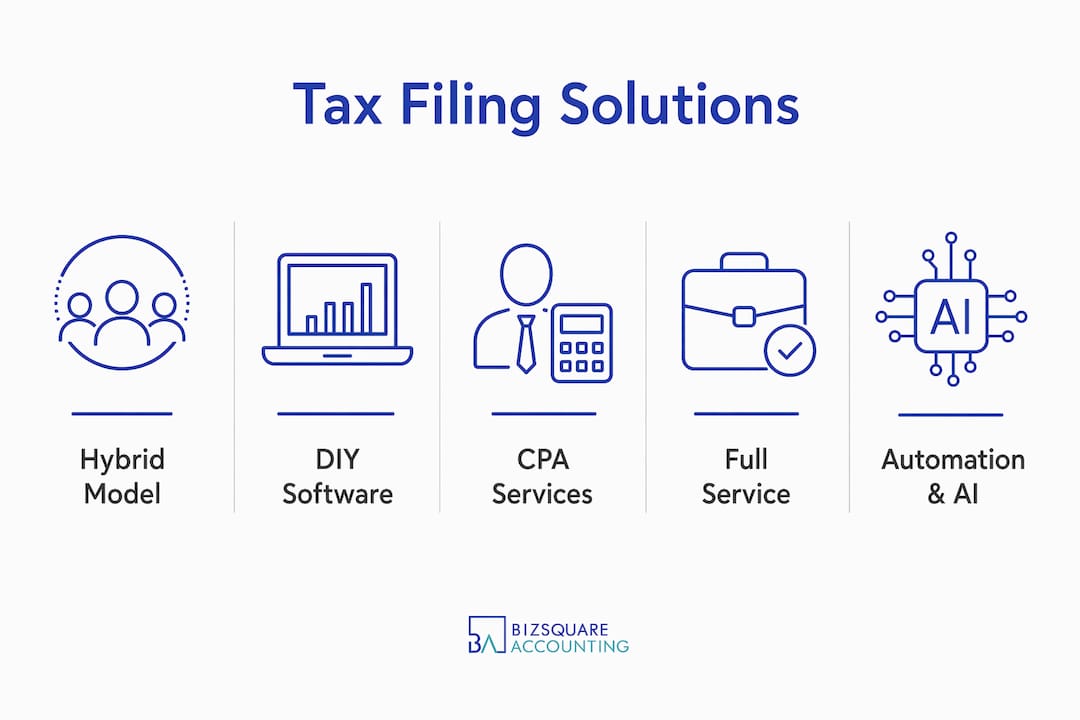
The hybrid model sits in the middle of this spectrum. It gives Singapore business owners the efficiency of software and the judgment of a licensed professional, without the full-service price tag.

How do you choose the right tax filing solution?
Start with four non-negotiable trust signals: IRS e-file partner status, a CPA credential, a valid PTIN (Preparer Tax Identification Number), and a published methodology or process explanation. Any provider missing these warrants caution.
Key evaluation criteria:
- Complexity of your tax situation (single entity vs. multi-state vs. foreign-owned subsidiary)
- Estimated tax planning needs, especially for owners with 1099 or pass-through income
- Multi-state nexus exposure
- Data security certifications (SOC 2, ISO 27001)
- Audit support availability
- Pricing model transparency (flat fee vs. per-form vs. hourly)
10 questions to ask a prospective provider:
- Are you an IRS e-file authorized provider?
- Do your preparers hold a valid PTIN and CPA credential?
- How do you handle multi-state nexus determinations?
- What security certifications does your platform carry?
- Do you offer audit representation, and at what cost?
- How is your fee structured, and what triggers additional charges?
- Do you support Schedule C, Schedule K-1, and Form 5472 for foreign-owned entities?
- How do you handle estimated quarterly tax payments?
- What is your data retention and deletion policy?
- Can you provide a written engagement letter before work begins?
Four red flags that should stop the conversation:
- No PTIN or CPA credential on file for the preparer
- Fees quoted only verbally, with no written breakdown
- No mention of data encryption or security certifications
- Guarantees of specific refund amounts before reviewing your documents
Pro Tip: Many DIY platforms add fees for self-employment forms late in the filing flow. Always confirm the total cost for your specific forms before you start, not after.
What does U.S. business tax filing typically cost in 2026?
Cost varies significantly by business complexity. Here are realistic ranges for common scenarios:
The cost of U.S. business tax filing in 2026 varies by business complexity and service provider. Simple software-only filings may be possible at no cost, while CPA-led advisory and foreign-owned entity filings typically require a much higher investment. Check with providers for updated ranges as pricing can differ based on scope, forms required, deadlines, and filing model.
Timeline and key U.S. deadlines for 2026:
- January–February: Gather W-2s, 1099s, K-1s, and payroll reports
- March 15: S-Corp and partnership returns due (Form 1120-S, Form 1065)
- April 15: Individual returns and C-Corp returns due (Form 1040, Form 1120)
- Quarterly estimated taxes: April 15, June 16, September 15, January 15
For Singapore businesses managing estimated tax deadlines for U.S. contractors or 1099 earners, quarterly planning is not optional. Professional advisers consistently recommend year-round estimated tax management rather than a single year-end review.
Pro Tip: Filing earlier costs less. Some vendors raise fees in April as the deadline approaches. Submitting in February or early March typically locks in lower software pricing.
How does automation and AI change tax filing in 2026?
Automation reduces routine work substantially. Industry guidance reports up to an 80% reduction in planning time for small firms using AI-enabled tools. However, human oversight remains essential for complex business tax decisions.
Common AI-enabled tasks in 2026:
- Automated data import from bank feeds and accounting software
- Receipt classification and expense categorization
- Estimated quarterly tax calculations
- Anomaly detection that flags unusual deductions before submission
Consider two practical examples. A small Singapore-based importer with U.S. inventory uses AI to classify thousands of purchase receipts automatically, then a CPA reviews the depreciation schedule. A professional services firm uses automated estimated tax tracking quarterly, with a CPA advisory session each quarter to adjust for revenue changes.
Where AI commonly fails: Multi-state nexus determinations, foreign-owned entity disclosures (Form 5472), treaty-based positions, and situations where the tax law changed mid-year. These require a licensed professional, not an algorithm.
Automation and AI now give small accounting firms access to planning features previously limited to large enterprises. For Singapore business owners, this means affordable advisory is more accessible than it was even two years ago.
What security standards should you require before sharing tax data?
Insist on SOC 2 or ISO 27001 certification, TLS encryption for data in transit and at rest, and a documented audit trail for all file access. These are baseline requirements, not premium features.
IRS e-file partner status and a valid PTIN for preparers serve as additional trust signals. The IRS vets e-file partners before granting authorization, so that status confirms a minimum compliance threshold.
Data residency matters for Singapore businesses. When your company data crosses borders, confirm where it is stored, which jurisdiction’s privacy law governs it, and whether the provider will sign a data processing agreement. Sharing sensitive financial records with a U.S. platform from Singapore creates cross-border data obligations under both PDPA (Singapore) and U.S. privacy frameworks. Request a written data handling policy before engagement.
Minimize exposure by sharing only the documents required for the specific filing. Avoid emailing raw financial files; use the provider’s encrypted portal instead.
What documents do you need to prepare before filing?
Prepare both entity-level and owner-level documents before engaging any provider. Missing records are the most common cause of filing delays and surprise charges.
Entity-level documents:
- Revenue exports from your accounting system
- Bank statements (all business accounts)
- Payroll reports and W-2s issued
- 1099s received and issued
- Depreciation schedules and fixed asset registers
- Prior-year tax returns
- Entity formation documents (articles of incorporation, EIN confirmation)
Owner-level documents:
- K-1s from partnerships or S-Corps
- Foreign income statements (if applicable)
- Schedule C supporting records for sole proprietors
Additional records to prepare:
- Crypto transaction logs (cost basis, sale dates, and proceeds for each transaction)
- Multi-state nexus documentation (sales by state, payroll by state, property locations)
- Form 5472 supporting records for foreign-owned U.S. entities
For a detailed breakdown of deductible expenses and what records support each claim, the types of tax deductions guide provides a useful reference for Singapore-based owners managing cross-border obligations.
What does a practical hybrid filing workflow look like?
The recommended workflow: annual CPA advisory engagement, combined with quarterly automated estimated tax tracking and year-end software-assisted form preparation.
Step-by-step workflow:
- January (Owner): Collect all entity and owner documents; reconcile bank accounts in accounting software.
- February (Software/Bookkeeping): Run automated data import; categorize expenses; generate draft P&L and balance sheet.
- February–March (CPA): Review draft financials; confirm depreciation, deductions, and any treaty positions; prepare or review tax forms.
- March 15 (Owner + CPA): Submit S-Corp or partnership returns; confirm estimated tax payment for Q1.
- April 15 (Owner + CPA): Submit individual or C-Corp returns; make Q1 estimated payment.
- Quarterly (Software + CPA): Track revenue, update estimated tax calculations, adjust Q2–Q4 payments.
- October (Owner): If on extension, finalize and submit extended returns.
| Role | Responsibility | Timing |
|---|---|---|
| Business owner | Document collection, bank reconciliation | January, ongoing |
| Bookkeeping / software | Data import, categorization, draft forms | February |
| CPA advisor | Review, deduction strategy, form sign-off | February–April, quarterly |
| Software (automated) | Estimated tax tracking, anomaly alerts | Quarterly |
For Singapore businesses managing U.S. bookkeeping alongside local compliance, integrating both into one workflow reduces duplication and keeps records audit-ready.
Which solution fits your business profile?
- Single-owner services firm: Hybrid model works well. Use software for Schedule C preparation, engage a CPA for annual review.
- Small product e-commerce (single state): DIY software with CPA consultation at year-end is sufficient for straightforward inventory situations.
- Multi-state seller: Full CPA advisory is strongly recommended. Nexus rules differ by state, and errors carry significant penalty risk.
- Foreign-owned U.S. subsidiary: Hire a full-service firm or specialist CPA early. Form 5472 filing requirements and transfer pricing considerations require expert handling from day one.
- High-growth startup: Hybrid model with quarterly CFO-level advisory. Tax planning should align with fundraising and equity events.
Red-flag profile: Any foreign-owned entity with intercompany transactions, foreign shareholders, or U.S. employees should engage full-service accounting before the first filing, not after the first IRS notice.
Does IRS Free File apply to your business?
IRS Free File remains the primary zero-cost federal filing option for eligible taxpayers. Eligibility depends on income thresholds and the specific partner offer. Most business entities (S-Corps, C-Corps, partnerships) do not qualify for Free File, as it targets individual filers.
For Singapore business owners with U.S. individual filing obligations (Form 1040 with foreign income), Free File may apply if income falls within the threshold. Check the IRS site directly to confirm eligibility for the current filing season, as partner offers and income limits change annually.
Direct File initiatives faced structural changes in 2025–2026, with some programs discontinued. Free File partners remain the main route for truly free federal filing.
How do the top tax filing platforms compare in 2026?
The major platforms each occupy a distinct position in the market.
TurboTax leads on guided experience. It offers DIY, Expert Assist, and Expert Full Service tiers. The platform guarantees 100% accuracy and maximum refund, and includes audit support. It suits filers who value hand-holding and are willing to pay a premium for it.
H&R Block combines an intuitive interface with live CPA access across paid tiers. Its free tier covers more situations than most competitors, including unemployment income. Thousands of in-person offices add a layer of accessibility that purely online platforms cannot match.
FreeTaxUSA is the strongest value option. Federal filing is free for most return types, and state filing starts at $15. Audit Defense adds $20. For cost-conscious filers with straightforward business returns, it delivers full form support at a fraction of competitor pricing.
TaxAct offers an accuracy guarantee that covers penalties and interest, plus legal or audit fees up to $100,000. Its Deduction Maximizer tool suggests deductions based on your situation. The Premier/Self-Employed tier supports Schedule C and small-business forms.
TaxSlayer prices by support level rather than complexity. Self-employed packages include quarterly payment reminders and access to a specialty tax professional. It suits confident filers who want to pay only for the help they actually need.
Jackson Hewitt charges a flat $25 for DIY federal and state returns, regardless of how many states you file. For multi-state filers on a budget, that flat fee is a meaningful advantage over platforms charging $40 per state.
The 2026 editorial reviews also highlight updated support for Schedule 1A across major platforms, so confirm your chosen software supports any new forms relevant to your situation before committing.
What mistakes do businesses commonly make when filing in 2026?
Missing the March 15 deadline for S-Corps and partnerships is the most frequent and costly error. Extensions must be filed proactively; the IRS does not grant them automatically.
Misclassifying workers as independent contractors when they meet the IRS employee test creates payroll tax liability retroactively. This is a common audit trigger for small businesses.
Failing to file Form 5472 for foreign-owned U.S. entities carries a $25,000 penalty per missed form. Singapore-owned U.S. subsidiaries must treat this as a hard deadline, not an afterthought.
Overlooking state-level estimated tax obligations is another frequent gap. Federal compliance does not satisfy state requirements, and each state has its own payment schedule and thresholds.
Finally, using AI-generated deduction suggestions without CPA review creates risk. Automated tools flag opportunities, but a licensed professional must confirm eligibility before claiming them.
What tax law changes affect U.S. business filing in 2026?
Several provisions from the Tax Cuts and Jobs Act (TCJA) are scheduled to sunset or change, making 2026 a pivotal filing year. The 20% qualified business income (QBI) deduction for pass-through entities is set to expire at the end of 2025 under current law, meaning 2025 returns (filed in 2026) may be among the last to claim it at full value. Confirm the current legislative status with your CPA, as Congress may extend or modify this provision.
Bonus depreciation continues its phase-down. The rate dropped to 40% for property placed in service in 2025, down from 60% in 2024. Businesses with significant capital expenditures should model the impact on their 2025 return.
The corporate alternative minimum tax (CAMT) at 15% applies to corporations with average annual adjusted financial statement income exceeding $1 billion. This affects large foreign-owned U.S. subsidiaries but not most small businesses.
The Schedule 1-A is a new addition that major editorial reviews tested across platforms in 2026. Confirm your software supports it if your return requires it.
How do state taxes and multi-state filing add complexity?
State tax obligations arise from nexus, which is the legal connection between a business and a state that triggers a filing requirement. Nexus can result from physical presence (an office, warehouse, or employee) or economic activity (sales exceeding a state’s threshold).
Most states now enforce economic nexus thresholds following the South Dakota v. Wayfair Supreme Court decision. A Singapore-owned business selling into multiple U.S. states may owe sales tax, income tax, or both in each state where it crosses those thresholds.
State income tax rates and filing deadlines vary significantly. California, for example, imposes an 8.84% corporate tax rate and has its own estimated payment schedule. Texas has no corporate income tax but levies a franchise tax. New York applies both a corporate income tax and a metropolitan commuter transportation mobility tax for businesses in certain counties.
Multi-state filers should maintain a nexus register, tracking sales, payroll, and property by state. A CPA with multi-state experience is strongly recommended for any business operating across three or more states.
How should you handle a tax audit, and what role does your filing solution play?
An IRS audit begins with a notice, typically a CP2000 (proposed changes) or a formal examination letter. The first step is to read the notice carefully and identify exactly what the IRS is questioning. Do not respond without professional guidance.
Most tax filing platforms offer some form of audit support. TaxAct partners with ProtectionPlus for audit assistance. FreeTaxUSA offers Audit Defense for $20 at filing. TurboTax includes audit support with paid tiers. The quality of that support varies, so confirm what “audit support” actually covers before relying on it.
For Singapore-owned U.S. entities, IRS audits often focus on transfer pricing, related-party transactions, and Form 5472 compliance. These are areas where platform-based audit support is insufficient. Full CPA or tax attorney representation is the appropriate response.
The best audit defense is a clean filing. Accurate records, consistent methodology, and a CPA-reviewed return significantly reduce audit risk. A hybrid approach that includes CPA sign-off before submission is the most practical form of audit prevention available to small and mid-size businesses.
Key Takeaways
The most effective approach to U.S. business tax filing in 2026 is a hybrid model that pairs IRS e-file-capable software with periodic CPA advisory, covering quarterly estimated taxes and year-end form review.
| Point | Details |
|---|---|
| Hybrid model is the default | Software handles data prep; a CPA with a valid PTIN handles review and advisory. |
| Trust signals are non-negotiable | Require IRS e-file partner status, CPA credential, PTIN, and SOC 2 or ISO 27001 before sharing data. |
| File early to save money | Some vendors raise fees in April; filing in February or March locks in lower pricing. |
| Foreign-owned entities need specialist help | Form 5472 carries a $25,000 penalty per missed filing; engage a CPA before the first return. |
| Bizsquare supports Singapore businesses | Bizsquare’s corporate tax filing and advisory service covers U.S. filing obligations for Singapore-based owners. |
The hybrid model is the right call, and here is why
The conventional wisdom says to pick either software or a CPA. That framing misses the point entirely. Software alone cannot handle the judgment calls that matter most for Singapore-owned U.S. businesses: treaty positions, Form 5472 obligations, multi-state nexus, and QBI deduction eligibility in a year when that deduction may be expiring. A CPA alone, without automated bookkeeping feeding clean data into the process, is expensive and slow.
The hybrid model works because it assigns each task to the right tool. Automation handles volume and routine classification. A credentialed CPA, with IRS e-file authorization and a valid PTIN, handles the decisions that carry real financial and legal consequence. Data security, specifically SOC 2 or ISO 27001 certification and encrypted file transfer, is the third anchor. Without it, the efficiency gains from automation create a different kind of risk.
Singapore business owners managing U.S. filing obligations face a specific challenge: the IRS does not adjust its requirements for cross-border complexity. The hybrid approach is the most practical way to meet those requirements without overpaying for full-service accounting on every return.
Bizsquare helps Singapore businesses manage U.S. tax filing with confidence
Singapore-based business owners with U.S. filing obligations face a genuinely complex situation. Bizsquare provides the advisory layer that makes the hybrid model work in practice.

Bizsquare’s corporate tax filing and advisory service covers the judgment-intensive work: reviewing your entity structure, confirming Form 5472 obligations, advising on estimated quarterly payments, and coordinating with your U.S. software or preparer. The accounting and bookkeeping service keeps your records clean and audit-ready throughout the year. For businesses that need strategic financial oversight, the outsourced CFO service adds a layer of planning that goes beyond annual filing.
The next step is straightforward. Schedule a consultation with Bizsquare to confirm your U.S. filing obligations, identify the right software and advisory combination for your business profile, and get a clear fee structure before the April 15 deadline approaches.
Useful sources
- IRS Free File partner offers: The official IRS page to check current eligibility thresholds and available partner offers for free federal filing.
- Best Tax Software for 2026 Filing Season (Taxo): Editorial comparison covering Schedule 1-A support, platform pricing, and fee timing across major software options.
- FreeTaxUSA review, PCMag: Detailed review of FreeTaxUSA’s pricing, form support, and audit defense options for cost-conscious filers.
- PCMag reporting on Direct File changes: Covers structural changes to Direct File initiatives and what they mean for free filing options in 2026.
- TurboTax official site: Details on tier options, expert access, accuracy guarantees, and e-file capabilities.
- TaxAct official site: Covers accuracy guarantee terms, Deduction Maximizer, and audit assistance partnership details.
- Affordable tax planning software for small firms (Uncle Kam): Explains how AI-enabled tools reduce planning time and what small firms can now access affordably.
- Business tax guide for small business owners (JurisLedger): Independent primer on tax filing automation and small business filing basics.
- Bizsquare corporate tax filing and advisory: Bizsquare’s service page for Singapore businesses needing U.S. corporate tax filing support and advisory.
For hands-on guidance tailored to your business structure, contact Bizsquare directly to schedule a consultation.
FAQ
What is the best tax filing approach for Singapore business owners in 2026?
The hybrid model, combining IRS e-file-capable software with periodic CPA advisory, delivers the best balance of cost, compliance, and tax efficiency for most Singapore-owned U.S. businesses.
Does IRS Free File apply to Singapore-owned U.S. businesses?
Free File targets individual filers and most business entities (S-Corps, C-Corps, partnerships) do not qualify. Check the IRS Free File page directly to confirm eligibility for your specific situation.
What is the penalty for missing Form 5472 as a foreign-owned entity?
The IRS imposes a $25,000 penalty per missed or incomplete Form 5472 filing. Singapore-owned U.S. subsidiaries must file this form and should engage a CPA before their first U.S. return.
There is no universal cost for U.S. business tax filing in 2026. Pricing depends on the complexity of your return, the forms required, level of CPA involvement, and your chosen service model. Consult providers directly for a tailored quote.
When is the S-Corp and partnership tax return deadline in 2026?
S-Corp and partnership returns (Form 1120-S and Form 1065) are due on March 15. C-Corp and individual returns are due on April 15. Extensions must be filed proactively before these dates.
What trust signals should you require from a tax preparer?
Require a valid PTIN, CPA credential, IRS e-file partner status, and SOC 2 or ISO 27001 data security certification before sharing any financial records with a provider.
Can AI handle all business tax filing tasks in 2026?
AI handles data import, expense classification, and estimated tax calculations well, but it cannot reliably manage multi-state nexus determinations, Form 5472 disclosures, or treaty-based positions. A licensed CPA must review these areas.
What is the QBI deduction and does it apply in 2026?
The 20% qualified business income deduction for pass-through entities is scheduled to expire after 2025 under current law. The 2025 returns filed in 2026 may be among the last to claim it at full value. Confirm the current legislative status with your CPA.
How does multi-state nexus affect Singapore-owned U.S. businesses?
Economic nexus rules mean a Singapore-owned business selling into multiple U.S. states may owe income tax and sales tax in each state where it crosses that state’s threshold. A CPA with multi-state experience is strongly recommended for businesses operating across three or more states.
What should you do if the IRS sends an audit notice?
Read the notice carefully to identify what the IRS is questioning, then engage a CPA or tax attorney before responding. For Singapore-owned entities, IRS audits often focus on Form 5472 compliance and related-party transactions, which require professional representation.