

Break-even analysis tells you exactly how many units or how much revenue your business needs to cover every cost before it starts making a profit. For small and medium enterprises, this single figure turns guesswork into a plan you can act on. We walk through the formulas, worked examples and the practical steps that keep this number accurate month after month.
TL;DR:
- Calculate break even units by dividing monthly fixed costs by contribution margin per unit, then round the result up because partial products cannot cover costs.
- For multiple products, weight contribution margins by sales mix; shifting toward lower margin items raises the threshold even when sales stay flat.
- Reconcile books monthly, review cost categories, and recalculate after price or mix changes; seasonal firms should model peak and low periods separately.
- For Singapore businesses, taxable turnover above S$1 million over 12 months triggers GST registration, so include its effect when setting revenue and pricing targets.
Table of Contents
- What break-even analysis measures and the terms you need to track
- How to calculate break-even: formulas and a step-by-step worked example
- Retail and service examples you can apply to your own numbers
- Multi-product break-even: using the composite-unit method
- Turning break-even numbers into pricing, staffing and funding decisions
- Common pitfalls that make break-even figures unreliable
- A monthly routine to keep your break-even number current
- Why break-even deserves a permanent place in your planning calendar
- How Bizsquare keeps your break-even numbers accurate and current
- FAQ
- Sources
What break-even analysis measures and the terms you need to track
Break-even analysis rests on two cost categories that every SME owner must separate correctly. Fixed costs stay the same regardless of sales volume, such as rent, insurance, salaried wages and software subscriptions. Variable costs move with each sale, including raw materials, packaging, delivery fees and sales commissions.
Once these two categories are clean, you can calculate contribution margin, which is the amount each sale contributes towards fixed costs after variable costs are deducted. The contribution margin ratio expresses this as a percentage of selling price, and it becomes the engine behind every break-even formula that follows.
Classification errors are the most common reason break-even numbers mislead owners. A delivery driver’s salary, for example, is sometimes treated as variable when it is actually fixed, which skews the whole calculation. A quick checklist helps catch these mistakes before they distort your planning.
- Confirm each cost repeats monthly regardless of sales, which marks it as fixed.
- Check whether a cost rises or falls directly with each unit sold, which marks it as variable.
- Review semi-variable costs, like utilities, and split them into fixed and variable portions.
- Recheck classifications every quarter, since staffing changes can shift a cost from variable to fixed.
Getting this split right at the outset saves hours of correction later, and it keeps every downstream calculation trustworthy.
How to calculate break-even: formulas and a step-by-step worked example
Two formulas cover almost every SME scenario, one for unit sales and one for revenue. The break-even point in units equals fixed costs divided by the contribution margin per unit, where contribution margin per unit is the selling price minus the variable cost per unit. The break-even point in sales dollars equals fixed costs divided by the contribution margin ratio, which is contribution margin per unit divided by selling price.
Follow these steps to run the calculation for your own business.
- List every fixed cost for the month, including rent, salaries and subscriptions.
- Add up the variable cost of producing or delivering one unit.
- Subtract the variable cost from your selling price to get contribution margin per unit.
- Divide contribution margin by selling price to get the contribution margin ratio.
- Divide total fixed costs by contribution margin per unit to find break-even units.
- Divide total fixed costs by the contribution margin ratio to find break-even revenue.
- Round units up to the next whole number, since you cannot sell a fraction of a product.
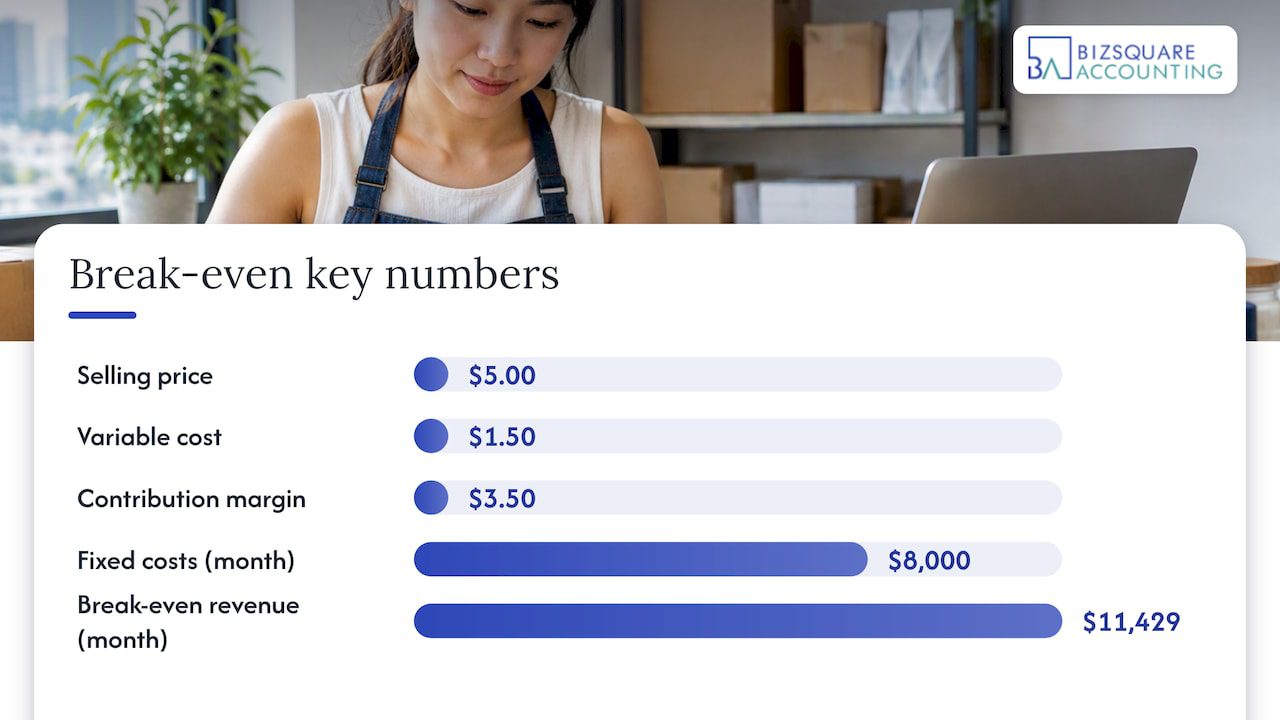
Say a small café has fixed costs of $8,000 a month, sells coffee at $5 and spends $1.50 in variable cost per cup. Contribution margin per cup is $3.50, so break-even units equal $8,000 divided by $3.50, which comes to 2,286 cups when rounded up.
The café must sell roughly 2,286 cups a month, or generate $11,429 in revenue, before any profit begins. This arithmetic is straightforward. A Yale School of Management teaching primer notes that the real value lies in what you do with the number once it is calculated, not in the calculation itself.
Always round units upward, never down, because a partial unit still requires the full fixed cost to be covered. For revenue figures, round to the nearest whole currency unit for clarity in reports.
Retail and service examples you can apply to your own numbers
A retail example makes the unit formula concrete. Picture a small boutique with $6,000 in monthly fixed costs, selling scarves at $25 each, with a variable cost of $10 per scarf. Contribution margin per scarf is $15, so break-even units equal $6,000 divided by $15, which is 400 scarves a month.
A service business works slightly differently because output is measured in revenue rather than physical units. A bookkeeping consultancy with $5,000 in monthly fixed costs and an average client fee of $400, with $80 in variable delivery cost per client, has a contribution margin of $320 per client. Break-even is $5,000 divided by $320, which rounds up to 16 clients a month.
- Retail businesses should track variable costs per unit closely, since even small packaging changes shift the break-even point.
- Service businesses should track billable hours or client delivery costs, since these substitute for a physical product cost.
- Both business types benefit from reviewing contribution margin whenever supplier prices or fee structures change.
A small price increase changes the picture more than most owners expect. If the boutique raises scarf prices from $25 to $28, contribution margin rises to $18, and break-even units drop from 400 to 334.
Pro Tip: Re-run your break-even calculation every time you adjust pricing, even by a small margin, since the effect on required volume is rarely proportional.
Multi-product break-even: using the composite-unit method
Most SMEs sell more than one product, which means a single break-even formula no longer applies directly. The solution is the composite-unit method, which blends your products into one “bundle” based on their sales mix, the typical ratio in which they sell relative to each other.
A composite-unit approach calculates a weighted contribution margin across all products, then finds how many bundles you need to sell to break even.
- Determine the sales mix ratio, for example, three units of product A for every two units of product B.
- Calculate the contribution margin for each product individually.
- Multiply each product’s contribution margin by its proportion in the mix, then sum the results for the composite contribution margin.
- Divide total fixed costs by the composite contribution margin to find break-even composite units.
- Multiply the composite break-even units by each product’s mix ratio to get individual product targets.
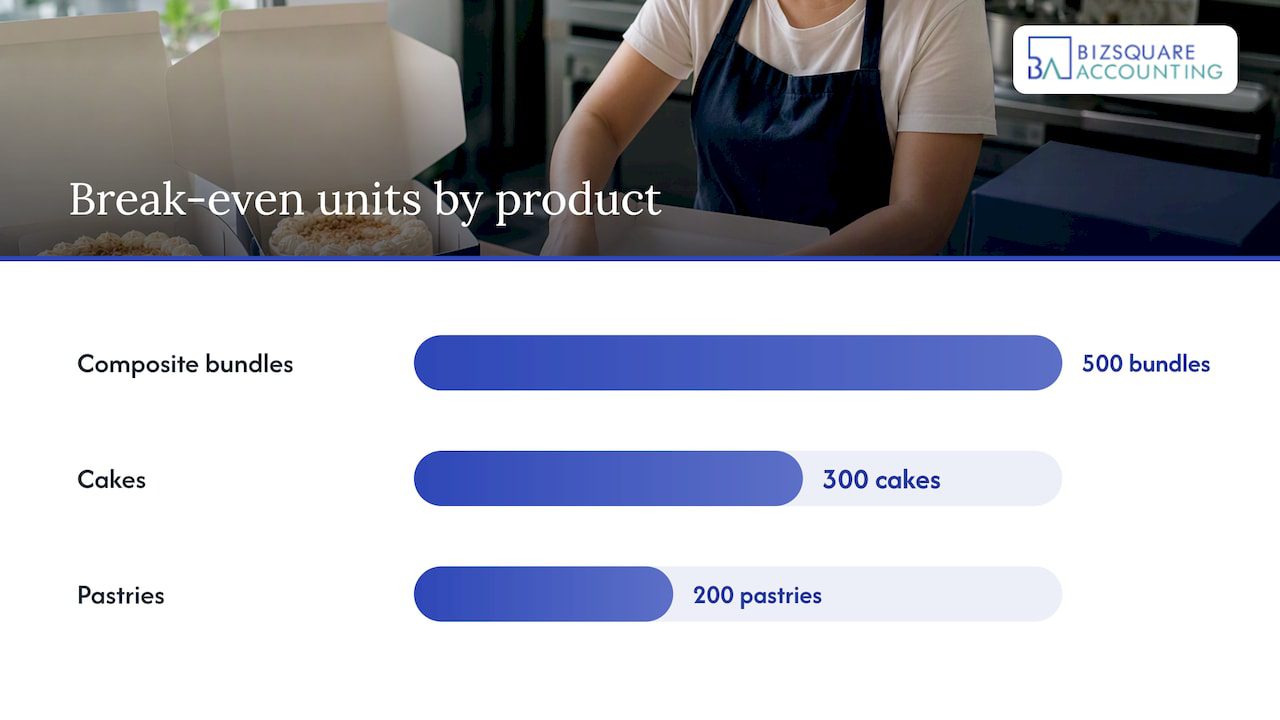
If a bakery sells cakes and pastries in a 3:2 ratio, with a composite contribution margin of $12 per bundle and fixed costs of $6,000, it needs 500 composite units. That translates to 300 cakes and 200 pastries a month. A shift in sales mix changes everything, since promoting a lower-margin item raises the overall break-even point even when total sales stay flat. Re-run this calculation whenever your product mix shifts noticeably, such as after a seasonal menu change.
Turning break-even numbers into pricing, staffing and funding decisions
A break-even figure only earns its keep when it shapes real decisions. Once you know your break-even point, you can calculate your margin of safety, which is the gap between your current sales and that threshold, showing how much revenue could drop before you stop covering costs — try the Business Loan Calculator SG to estimate repayments that align with your break-even planning.
- Set sales targets above break-even with a buffer for seasonal dips or slow months.
- Test small price changes on paper first, since even a modest increase can lower required volume noticeably.
- Use break-even figures to judge whether a new hire’s output will cover their added fixed cost.
- Include break-even and margin of safety figures in lender or investor summaries to show financial discipline.
Lenders and investors respond well to a business that can explain its numbers clearly. Presenting your break-even point alongside a margin of safety calculation signals that you understand your own cost structure, which strengthens any funding conversation.
Common pitfalls that make break-even figures unreliable
Break-even analysis only works when the inputs behind it are accurate, and several recurring mistakes undermine that accuracy.
- Misclassifying a fixed cost as variable, or the reverse, skews every formula that follows.
- Assuming costs stay perfectly linear ignores supplier discounts at volume or seasonal price swings.
- Treating selling price as fixed overlooks discounts, bundling and seasonal promotions that change contribution margin.
- Working from outdated or unreconciled bookkeeping produces a contribution margin that no longer reflects reality.
Seasonal businesses in particular should recalculate break-even for peak and low periods separately, rather than relying on one annual average. Clean, current bookkeeping remains the simplest fix for most of these issues, since every formula is only as reliable as the numbers feeding it.
A monthly routine to keep your break-even number current
Break-even analysis works best as a living habit rather than a once-a-year exercise. A short monthly routine keeps the figure trustworthy and ready whenever a pricing or hiring decision comes up.
- Reconcile bank statements and expense records within the first week of the new month.
- Re-check fixed and variable cost classifications for any new expenses added that month.
- Recalculate contribution margin and break-even units or revenue using the latest figures.
- Compare actual sales against the break-even threshold to see how much margin of safety remains.
- Have an owner or finance lead sign off on the updated figures before they inform decisions.
Clear ownership matters here, since a number nobody reviews quickly becomes stale. Our guide on bookkeeping accuracy for SMEs walks through the reconciliation habits that feed directly into this routine, and our financial modelling resource offers a ready-made structure for building these calculations into a spreadsheet template.
Pro Tip: Assign one person to own the monthly break-even update, even in a small team, so the figure never falls through the cracks.
Why break-even deserves a permanent place in your planning calendar
Most owners only reach for break-even analysis when a decision feels urgent, such as a pricing change or a new hire. That timing is backwards. The number is far more useful when it is already sitting in front of you, updated and current, before the pressure of a decision arrives.
A monthly review, owned by one person and checked against reconciled books, turns break-even from a one-off calculation into a genuine planning habit. Reviewing it before each pricing or staffing decision, rather than after, is where the real return lies. Outsourcing that routine to a finance partner is one practical way to keep it consistent.
— Vandro
How Bizsquare keeps your break-even numbers accurate and current
Running a reliable break-even analysis depends on clean books and realistic cost forecasts, which is exactly where our accounting and bookkeeping services come in. We reconcile your records, classify fixed and variable costs correctly and keep your financial statements ready for the calculations that matter.

For businesses that want ongoing financial modelling and strategic input, our outsourced CFO and corporate advisory services build break-even tracking directly into your monthly reporting cycle. This frees up the hours you would otherwise spend untangling spreadsheets, and it gives you a second set of eyes on every pricing or hiring decision. Reach out through our Bizsquare homepage to discuss which service fits your business stage.
This article is general information, not a substitute for advice from a qualified financial advisor. Consult a qualified financial professional about your own circumstances before acting on anything here.
FAQ
What are the 5 components of break-even analysis?
The core components are fixed costs, variable costs, selling price per unit, contribution margin and the break-even point itself in units or revenue. Each component feeds directly into the formulas, so an error in any one of them changes the final result.
What is break-even analysis in business?
Break-even analysis is the calculation that identifies the sales level where total revenue equals total costs, leaving no profit or loss. It helps owners understand the minimum performance needed before a product or service starts generating profit.
What is the purpose of a break-even analysis?
The purpose is to guide pricing, product-mix and planning decisions by showing exactly how much you need to sell to cover costs. It also supports lender and investor conversations by demonstrating that you understand your own cost structure.
How do you calculate breakeven analysis?
Divide total fixed costs by the contribution margin per unit to get break-even units, or divide fixed costs by the contribution margin ratio to get break-even revenue. Our step-by-step method above walks through each input with a worked example.
How often should an SME recalculate its break-even point?
A monthly recalculation keeps the figure useful, particularly after any change in pricing, supplier costs or product mix. Seasonal businesses benefit from separate calculations for peak and low periods rather than one yearly average.
Does break-even analysis work for a business with multiple products?
A shift in that mix changes the break-even point even when total sales volume stays the same.
How does GST registration affect break-even planning for an SME?
Businesses must register for GST/gst-registration-deregistration/do-i-need-to-register-for-gst) once taxable turnover exceeds S$1 million over a 12-month period, which can affect how revenue is planned and priced. This threshold matters when forecasting sales targets alongside your break-even figures.
Do small companies need an audit if they are tracking break-even internally?
A private company qualifies for audit exemption when it meets at least two of three criteria on revenue, assets or employee count. Even without a statutory audit, reliable management accounts remain essential for running accurate monthly break-even checks.
What happens if fixed and variable costs are misclassified?
Misclassifying costs changes the contribution margin, which then skews both the unit and revenue break-even figures. Reviewing cost categories every quarter helps catch shifts, such as a cost moving from variable to fixed as your team grows.
Can software help calculate break-even automatically?
Cloud accounting platforms such as Xero, QuickBooks and MYOB can generate the reports needed to feed a break-even calculation once your books are reconciled. They do not replace the judgement needed to classify costs correctly, but they speed up data collection considerably.
What is margin of safety and how does it relate to break-even?
Margin of safety is the gap between your current sales level and your break-even point, expressed in units or revenue. A wider margin means more room to absorb a slow month without dropping into a loss.
Should a service business calculate break-even differently from a retail business?
Service businesses typically calculate break-even in revenue or client numbers rather than physical units, since there is no inventory to count. The underlying formula is the same, using contribution margin per client or per billable hour in place of per unit.
Sources
- Audit exemptions: Small company concept | Accounting and Corporate Regulatory Authority
- Multi-product breakeven analysis – Financial and Managerial Accounting (PSU)
- A primer on breakeven analysis (Yale SOM)
- Breakeven point: definition, examples, and how to calculate | Investopedia