
A Singapore company can legally incorporate with just one issued share and S$1 in paid-up capital, according to ACRA. Most founders choose to set a higher figure once banks, licences, or daily operations enter the picture. You record or change that amount through ACRA’s Bizfile system, and getting it right early saves paperwork later.
TL;DR:
- The minimum legal share capital for a Singapore private company is one share with S$1 paid-up, but most banks and licensed sectors require higher amounts for practical purposes.
- During incorporation, companies should set a paid-up amount reflecting actual initial operating costs and sector-specific licensing requirements instead of defaulting to S$1.
- Corrections to share capital figures after registration require filing a return of allotment or updating paid-up amounts on Bizfile, which ACRA processes instantly and without fees.
- Non-cash contributions need proper valuation documents, and the process of issuing or reducing shares involves specific filings, approvals, and potentially complex procedures.
- Consulting with professional services like Bizsquare can ensure the share structure aligns with legal, banking, and sector needs from the start, avoiding costly errors.
Table of Contents
- What share capital, issued capital and paid-up capital mean in Singapore
- Legal minimums and sector exceptions you must check in Singapore
- How to enter share capital during incorporation using Bizfile
- Changing share capital after incorporation: allotment, updating paid-up amounts and reduction
- Practical guidance: choosing a paid-up amount that works for banking, licences and operations
- Getting the paid-up figure right the first time
- Let Bizsquare handle your share capital filings correctly
- Primary sources and official guidance to check
- Sources
- FAQ
What share capital, issued capital and paid-up capital mean in Singapore
These three terms confuse many first-time founders, and the confusion often costs them time at the bank or with ACRA filings.
Share capital refers to the total value of shares a company is authorised to issue, based on its constitution. Issued capital is the portion of that total actually allotted to shareholders. Paid-up capital is the amount shareholders have actually paid for those shares, which can be less than the issued value if shares are only partly paid.
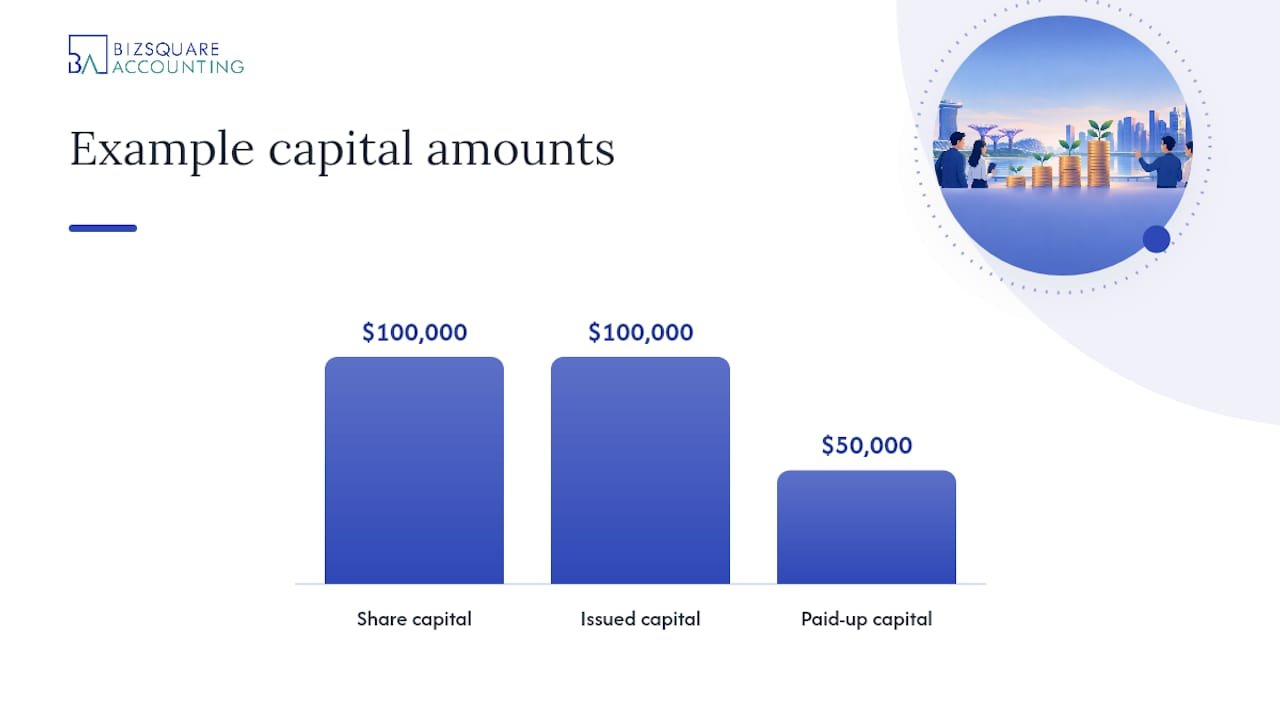
ACRA gives a clear working example. A company issues 100,000 shares at $1 each. Shareholders pay $50,000 upfront, leaving $50,000 unpaid, according to ACRA’s guidance on share capital and share types. That $50,000 shortfall remains a legal debt owed to the company, not a loose obligation.
The distinction matters for two reasons:
- Legally, paid-up capital is what appears on your company’s official records and determines shareholder liability exposure.
- For accounting purposes, unpaid capital sits on your balance sheet as a receivable, affecting how your financial statements read to banks or investors.
Get these terms right before you file, because correcting them afterwards means additional Bizfile transactions and possible delays.
Legal minimums and sector exceptions you must check in Singapore
The statutory floor is simple. Under the Companies Act (Cap. 50), a private company limited by shares needs a minimum of one issued share, and ACRA confirms that share can be worth as little as S$1 in paid-up capital.
One share, S$1 paid-up. That is the entire legal minimum ACRA requires to incorporate a Singapore private limited company holding share capital, as confirmed in ACRA’s official guidance.
That figure does not apply universally across every industry. Regulated sectors frequently demand far more. Fund management activities, for instance, fall under MAS licensing rules that set base capital thresholds well above the nominal S$1. If you plan to operate in financial services, insurance, or another licensed activity, confirm your sector’s rules with the Monetary Authority of Singapore before assuming the statutory minimum applies to you.
Remember too that incorporation involves separate costs unrelated to share capital. ACRA charges S$15 to reserve your company name and S$300 to register the company itself. These filing fees sit outside your paid-up capital calculation entirely, so budget for them separately.
How to enter share capital during incorporation using Bizfile
Setting up share capital happens directly within the Bizfile incorporation form, and the process asks for several specific fields.
- Choose your currency. Most Singapore companies select Singapore dollars, though foreign currencies are permitted if your business genuinely needs them.
- Select the share class. Ordinary shares are standard, though your constitution may permit preference shares or other classes with different rights.
- Enter the number of shares. This is your issued share count, whether that is one share or one million.
- Enter the issued share capital amount. State the total value of shares being allotted at this stage.
- Enter the paid-up capital amount. This is how much shareholders are actually contributing now, which can equal or fall short of the issued amount.
- Select the payment method. ACRA recognises four options: entirely in cash, entirely otherwise than in cash, for no consideration, or a mix of cash and non-cash contribution.
Bizfile records currency, payment method, share class, number of shares, and both issued and paid-up figures as separate data points, per ACRA’s step-by-step registration guide. Getting one field wrong means a correction filing afterwards.
Pro Tip: Check your draft constitution before you touch Bizfile. Some constitutions restrict share classes or set pre-emption rights that affect how you should structure your allotment from day one.
Non-cash contributions, such as equipment or intellectual property transferred in exchange for shares, need supporting valuation documents. Keep these ready before you start the online form, since Bizfile will not accept incomplete non-cash allotments.
Changing share capital after incorporation: allotment, updating paid-up amounts and reduction
Companies rarely stay static. You might issue new shares to a co-founder, bring in an investor, or simply top up paid-up capital once revenue allows it.
Whenever you issue new shares, you must file a return of allotment with ACRA. This filing updates your Electronic Register of Members and is processed immediately once submitted, according to ACRA’s allotment filing guidance. Private companies rely on this filing heavily, since their register is maintained electronically through ACRA rather than kept privately.
If your shares remain partly paid and shareholders later settle the outstanding balance, use the Update Shares Information eService on Bizfile. This service lets you notify ACRA of paid-up capital changes without a fee, and ACRA processes these updates instantly.
Before any allotment or capital change, gather these:
- A board resolution or shareholder approval authorising the new shares or capital adjustment.
- Supporting valuation documents for any non-cash contribution.
- Updated share certificates reflecting the new allocation.
- Accurate records showing each shareholder’s paid and unpaid balance.
Reducing share capital follows a stricter path under the Companies Act, typically requiring a special resolution and, in some cases, court or creditor approval. Backdating these filings is generally not permitted, so file promptly once the decision is finalised.
Practical guidance: choosing a paid-up amount that works for banking, licences and operations
Banks rarely open a corporate account for a company holding only S$1 in paid-up capital, even though that figure satisfies ACRA entirely. Relationship managers look for evidence the business can sustain itself, and a token capital figure raises questions during account opening.
Most banks expect paid-up capital that reflects genuine early operating needs, often in the low thousands of dollars for a small services business, though the exact figure varies by bank and industry.
Before settling on a number, work through this checklist:
- Forecast your expenses for the first six to twelve months, including rent, salaries, and software subscriptions.
- Check if your industry carries a licensing capital minimum, such as those MAS sets for fund managers.
- Estimate your initial working capital, meaning cash needed before revenue starts arriving.
- Add a contingency buffer, typically ten to twenty percent, for unexpected costs.
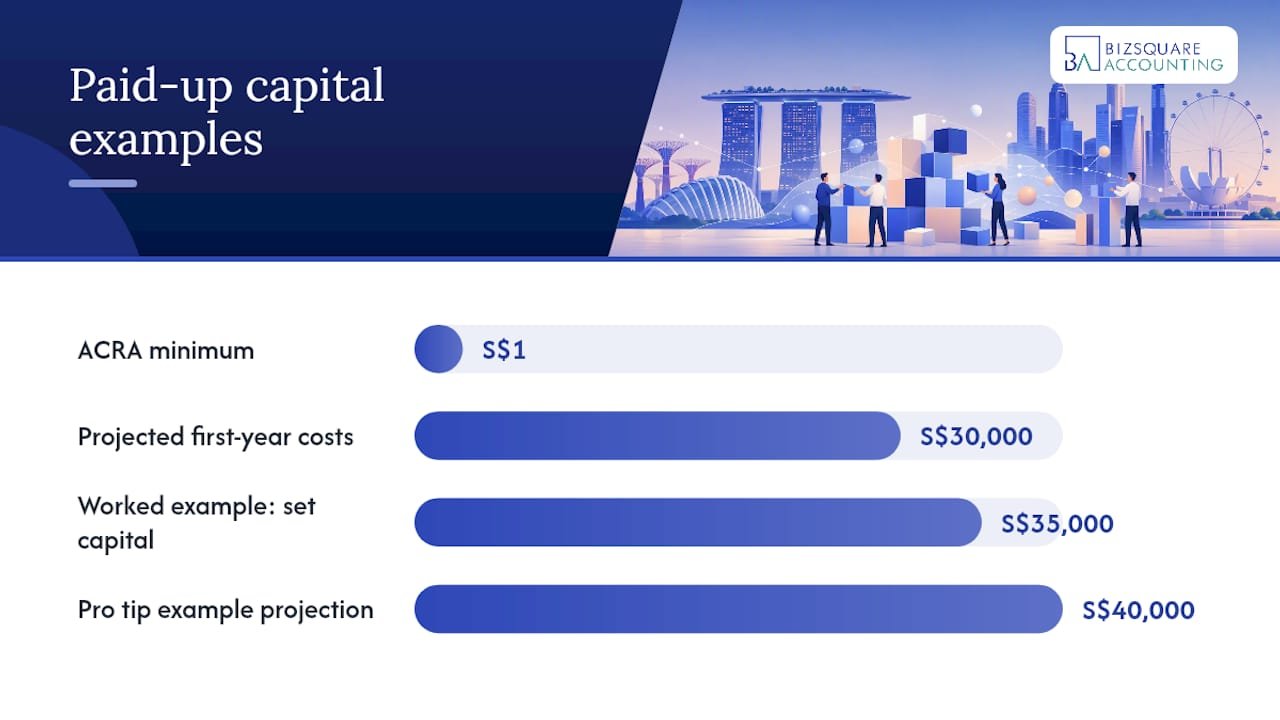
Pro Tip: If your projected first-year expenses total S$40,000, consider setting paid-up capital closer to that figure, or slightly above it, rather than defaulting to a round number that ignores your actual cash needs.
A simple worked example: a consultancy expecting S$30,000 in costs before its first invoice clears might set paid-up capital at S$35,000, covering expenses with a small buffer, rather than S$1, which would likely trigger questions from any bank compliance officer.
Getting the paid-up figure right the first time
Founders often treat share capital as an afterthought, filling in whatever number feels safe without connecting it to how the business will actually run. That is the most common mistake I see. A company registered with S$1 paid-up capital is legally sound, yet practically awkward the moment a bank, landlord, or supplier asks for evidence of financial substance.
The gap between legal compliance and commercial credibility is where most incorporation headaches begin. Before you finalise your figure, run three quick checks. Confirm your sector has no hidden licensing minimum. Match your paid-up amount to a realistic six-month expense forecast. Decide now how you will document any non-cash contribution, because retrofitting valuation paperwork later is painful.
Corporate secretarial support exists precisely to catch these details before they become filing errors.
— Vandro
Let Bizsquare handle your share capital filings correctly
Getting share capital right the first time avoids costly correction filings and awkward conversations with your bank later. Bizsquare’s company incorporation service walks you through choosing a paid-up figure that satisfies both ACRA and your bank, rather than defaulting to the bare legal minimum and hoping for the best.

Beyond incorporation, Bizsquare’s corporate secretarial services manage your return of allotment filings, shareholder resolutions, and paid-up capital updates through Bizfile as your business grows. If you need a registered office address or a nominee director to meet residency requirements, those services sit alongside incorporation support too. Founders juggling licensing capital thresholds, non-cash share contributions, or a co-founder buy-in all benefit from having someone who files these changes correctly the first time.
If you are incorporating soon or planning a capital increase, get in touch with Bizsquare to review your share structure before you submit anything to ACRA.
Primary sources and official guidance to check
Several official sources back the guidance in this article, and reading them directly gives you the full statutory detail.
- ACRA: Deciding on share capital and share types, covering the S$1 minimum and issued versus paid-up definitions.
- ACRA: Registering a local company via Bizfile, detailing the exact fields required at incorporation.
- ACRA: Filing a return of allotment of shares, explaining post-incorporation share issuance filings.
- Companies Act (Cap. 50) on Singapore Statutes Online, the statutory basis for share provisions and capital reduction.
- MAS fund management licensing guidance, for sector-specific capital thresholds.
Sources
- Step 4.4: Deciding on share capital & share types
- Step 4.6: Registering a local company via Bizfile
- Filing a return of allotment of shares — ACRA
- Companies Act (Cap. 50) — Singapore Statutes Online
- MAS guidance on fund management licensing
FAQ
What is the minimum share capital for a company in Singapore?
The legal minimum is one issued share and S$1 in paid-up capital, according to ACRA. Most banks and licensed sectors expect a higher figure in practice.
How do I increase share capital in ACRA?
You file a return of allotment through Bizfile after your shareholders approve the new shares. ACRA processes this filing immediately once it receives complete and accurate details, per its allotment filing guidance.
Can a company have zero share capital?
No. Every Singapore private company limited by shares must issue at least one share, meaning capital cannot be zero. The lowest permitted paid-up figure is S$1.
Is authorised share capital still required in Singapore?
No, Singapore abolished the concept of authorised share capital some years ago. Companies now only need to track issued and paid-up capital, both recorded through Bizfile.
What is the difference between issued capital and paid-up capital?
Issued capital is the total value of shares allotted to shareholders, while paid-up capital is what shareholders have actually paid. A company can have issued capital of $100,000 with only $50,000 paid up, leaving the rest as a legal debt.
Do I need to pay share capital in cash?
No. ACRA permits payment entirely in cash, entirely otherwise than in cash, for no consideration, or a mix of both. Non-cash contributions need supporting valuation documents when filed.
How much paid-up capital do banks expect for a corporate account?
Requirements vary by bank, but most expect an amount that reflects genuine early operating costs rather than the bare S$1 minimum. A short funding forecast helps justify your chosen figure during account opening.
Do foreign shareholders face different share capital rules?
The statutory minimum applies equally to local and foreign shareholders. Foreign shareholders should still confirm any sector-specific capital rules, such as those MAS sets for regulated financial activities.
What happens if shares remain partly paid?
The unpaid balance stays a legal debt owed to the company by the shareholder. You can update this later through Bizfile’s Update Shares Information eService once payment is settled.
Are there fees for filing share capital changes with ACRA?
Filing a return of allotment or updating paid-up capital through Bizfile carries no fee, and ACRA processes both immediately. Separate incorporation costs, such as the S$300 registration fee, remain unrelated to these updates.
What documents do I need for a non-cash share allotment?
You need valuation documents supporting the non-cash asset’s worth, along with a board resolution approving the allotment. ACRA’s Bizfile system will not accept incomplete non-cash filings.
Does Bizsquare help decide on paid-up capital during incorporation?
Yes. Bizsquare’s company incorporation service helps founders choose a practical paid-up figure and files the correct Bizfile forms from the start.
Can I reduce share capital after incorporation?
Yes, though it typically requires a special resolution and may need creditor or court involvement depending on the method used. The Companies Act sets out the formal procedure for capital reduction.