


Interest on shareholder and director loans is not automatically taxable, but the moment a loan is interest free or subsidised, IRAS treats the saving as a taxable benefit unless commercial terms apply. The Companies Act separately restricts certain loans to directors and connected persons without prior shareholder approval. Directors should document the loan’s capacity, rate and repayment terms in writing before the money moves, not after.
TL;DR:
- The benefit of interest-free or subsidized shareholder and director loans is taxable if commercial terms do not apply, with IRAS calculating this benefit monthly based on the outstanding balance and interest rate.
- Loans given to directors or employees that are linked to their employment are more likely to trigger benefit rules, especially if drawn around bonus or remuneration periods, whereas genuine shareholder loans without employment ties are assessed differently.
- Prior shareholder approval is mandatory for loans, quasi-loans, or guarantees involving directors or connected persons, with no retrospective approvals allowed under the Companies Act.
- Accurate documentation, such as signed agreements, interest rate rationale, repayment schedules, and quarterly reconciliations, is critical to defend the validity and tax treatment of shareholder loans.
- Since 2025, related-party domestic loans, including shareholder loans, must meet arm’s length interest rate expectations, requiring proper documentation and justification to avoid IRAS adjustments.
Table of Contents
- Shareholder loan interest Singapore: what IRAS actually taxes
- Companies Act rules on loans, quasi-loans and shareholder approval
- Is this a director loan or a shareholder loan?
- Working out the interest benefit and keeping your books straight
- Setting an arm’s length rate for related-party loans
- Directors’ duties and how loans should appear in the accounts
- Tax treatment for the borrower company
- Withholding tax on interest payments to shareholders
- What happens if you get it wrong
- Common pitfalls and how well run companies avoid them
- Regulatory changes directors should track
- Why documentation is the real risk control here
- Get your shareholder loan documentation reviewed properly
- Sources
- FAQ
Shareholder loan interest Singapore: what IRAS actually taxes
IRAS does not ban interest free loans between a company and its director or shareholder. What it does is treat the interest that was never charged as a quantifiable benefit, and that benefit can be taxed in the hands of the individual. This is the core of shareholder loan interest Singapore rules that most directors overlook until a tax query lands on their desk.
The logic is straightforward once you see it laid out. IRAS computes this benefit using a simple formula: outstanding balance at month end, multiplied by the interest rate, multiplied by one twelfth.
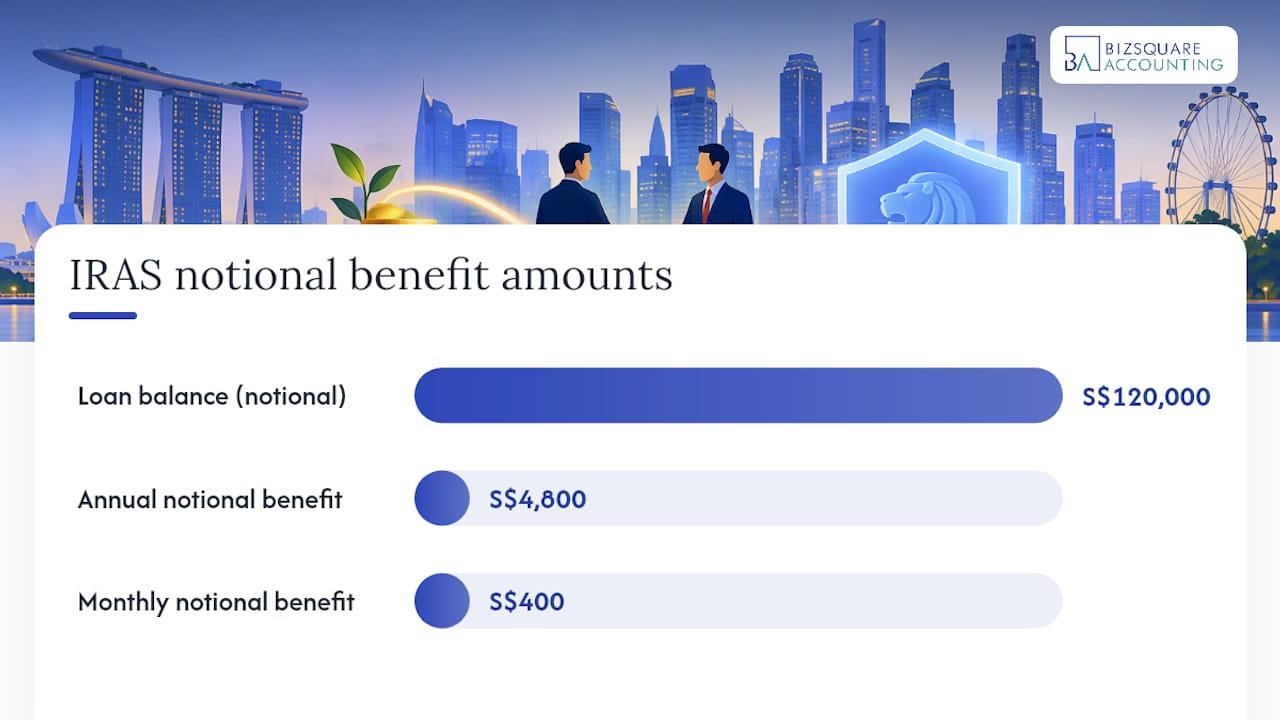
So for that S$120,000 loan at a notional 4% rate, the monthly benefit works out to S$120,000 × 4% × 1/12, which comes to S$400 a month, or S$4,800 across a full year if the balance stays flat.
This benefit is generally assessed when the loan is connected to employment, meaning the director also works for the company in an executive capacity. A few situations to watch:
- Loans given because someone is a director or employee, not purely because they hold shares, tend to trigger the employment benefit rules.
- Loans genuinely made in a shareholder capacity, with no employment link, are usually assessed differently and may fall outside this specific benefit charge.
- Subsidised loans, where some interest is charged but below market rate, are taxed on the shortfall, not the full amount.
Getting this classification wrong is one of the most common errors company directors make, and it is exactly the kind of query that benefits from a second pair of eyes before filing.
Companies Act rules on loans, quasi-loans and shareholder approval
The Companies Act does not treat director and shareholder loans as a private arrangement between a company and an individual. Certain loans, quasi-loans, credit transactions and guarantees involving directors or connected persons are unlawful unless shareholders approve them beforehand, under section 163 and related provisions of Singapore’s Companies Act.
A few practical points every director should hold onto:
- Approval must come before the loan is made or the guarantee given, not after the fact. The statute is explicit that retrospective sign off does not cure an unlawful transaction.
- Directors who are interested in the transaction, meaning they stand to benefit personally, are generally required to abstain from voting on the approval resolution.
- The rules extend beyond straightforward loans to cover quasi-loans, credit transactions and related guarantees or security arrangements.
- Breaching these provisions can expose the company and its directors to liability, and in some cases criminal penalties under the Act.
Smaller private companies sometimes assume these rules only apply to listed entities. They do not. Any Singapore incorporated company can fall foul of these provisions if a director simply draws funds without the correct board and shareholder process. When a proposed loan looks even slightly unusual, get legal advice before the transaction happens, not after auditors or IRAS start asking questions.
Is this a director loan or a shareholder loan?
The label on a loan agreement matters less than the facts behind it. IRAS and the courts look past the paperwork title to work out whether a payment was made because someone is an employee or director, or purely because they hold shares.
Here is how to read the signals correctly:
- Check the employment link. If the individual receives a salary or director’s fee and also works actively in the business, loans to them tend to be scrutinised as employment related benefits.
- Check the timing and purpose. A loan drawn shortly before or after a bonus decision, or timed around remuneration planning, points towards an employment benefit rather than a shareholder advance.
- Check the dividend policy. If the company has never declared dividends but regularly advances funds to shareholders, this pattern can suggest the “loan” is functioning as disguised remuneration or a distribution.
- Check the paper trail. A loan supported by a signed agreement, an agreed interest rate, and a repayment schedule looks far more like a genuine shareholder capacity loan than an undocumented drawdown.
Repayment history, and not the title on the document, tends to carry the most weight when IRAS or auditors assess the true nature of a transaction.
Pro Tip: Keep a single running ledger for every director or shareholder loan, updated monthly, showing the opening balance, drawdowns, interest accrued and repayments. It becomes your strongest evidence if IRAS ever asks questions.
Working out the interest benefit and keeping your books straight
The monthly formula IRAS uses is worth memorising: outstanding balance at month end × interest rate × 1/12. Apply it consistently and you avoid year end surprises.
The monthly benefit is S$200,000 × 4.25% × 1/12, which equals roughly S$708 a month. Multiply that across twelve months, assuming the balance stays constant, and the annual taxable benefit lands close to S$8,500.
A few bookkeeping notes that finance teams often get wrong:
- Every partial repayment reduces the outstanding balance from the following month, so the benefit calculation must be redone monthly, not just once a year.
- Interest actually received by the company should be recorded as taxable income, separate from any notional benefit calculation.
- Principal repayments are not income to the company and should never be recorded through the profit and loss account.
Reconcile the loan account against bank statements every quarter. Directors who leave this until year end often discover the accrued interest figure no longer matches the actual cash movements.
Setting an arm’s length rate for related-party loans
IRAS expects related-party domestic loans, including many director and shareholder loans, to carry an interest rate that reflects what unrelated parties would charge each other. This arm’s length principle sits at the heart of transfer pricing shareholder loans guidance, and it has become considerably more relevant since IRAS updated its expectations for domestic related-party loans made on or after 1 January 2025.
Practically, this means picking a rate you can defend with evidence, not one plucked from thin air.
- Reference published bank lending rates for comparable unsecured loans as a starting benchmark.
- Consider the borrower’s creditworthiness, the loan tenure and whether security was provided, since all three affect what a genuine lender would charge.
- Keep a short memo explaining how the rate was chosen, and retain it alongside the loan agreement.
The seventh edition of IRAS transfer pricing guidelines sets out the indicators IRAS uses to test whether a chosen rate holds up. Get this wrong, and IRAS can impute a market rate itself, adjusting taxable income upward regardless of what was actually charged.
Directors’ duties and how loans should appear in the accounts
Directors remain personally accountable for making sure financial statements give a true and fair view, a duty that sits under section 201 and is reinforced by ACRA’s guidance for directors. Hiring an accountant does not transfer that responsibility away from the board.
Loan balances owed by or to directors and shareholders need clear presentation, not buried inside a generic “other receivables” line.
- Show director and shareholder loan balances as a separate line item, distinguishing amounts owed to the company from amounts owed by it.
- Accrue interest benefits and interest income monthly, so the year end figure is a running total rather than a single estimate.
- Require monthly reconciliations between the loan ledger, bank records and the general ledger before board meetings, not just before the audit.
Directors who treat this as an annual afterthought tend to be the ones who face awkward questions from auditors or IRAS later.
Tax treatment for the borrower company
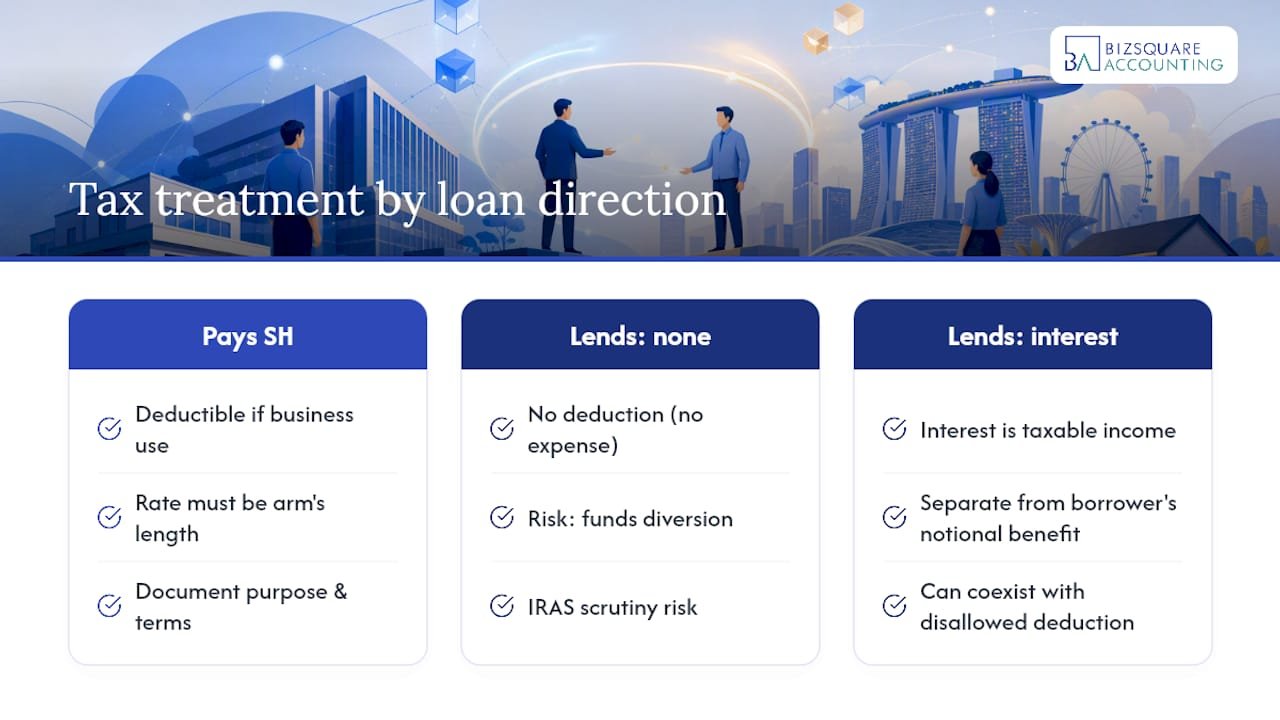
From the company’s side, shareholder loan interest sits differently depending on which way the money flows. If the company pays interest to a shareholder for a genuine loan it received, that interest is generally deductible against taxable income, provided the loan was used for business purposes and the rate reflects arm’s length terms.
If the company instead lends money to a director or shareholder and charges no interest, there is no deduction to claim, because no expense was incurred. Worse, if the loan is deemed non-trade or unrelated to the business, IRAS may query whether the company’s funds were diverted away from income producing activities, which can affect other deductions claimed elsewhere in the tax return.
Where the company does charge interest on money lent to a related party, that interest received counts as taxable income for the company, separate from any notional benefit assessed on the individual borrower. This dual treatment catches people out regularly. A company can simultaneously have taxable interest income on one loan and a disallowed deduction on another, depending on the direction of the cash and the commercial substance behind it.
The safest approach is to treat every related-party loan as if a bank were involved, avoiding common errors outlined in Overdrawn director’s loan accounts: common mistakes UK directors make. Charge a defensible rate, document the purpose, and keep the loan clearly separated from dividend planning. Companies that blur shareholder loans with profit distribution tend to attract closer scrutiny during a corporate tax review, and untangling that after the fact is far harder than getting it right at the outset.
Withholding tax on interest payments to shareholders
Withholding tax becomes relevant the moment interest is paid to a shareholder or lender who is not a Singapore tax resident. Singapore generally requires the paying company to withhold tax on interest paid to non-resident individuals or entities, and to account for that withholding to IRAS within the prescribed deadline after payment.
For interest paid to Singapore tax resident shareholders, withholding tax typically does not apply in the same way, though the interest still needs to be reported as income by the recipient and reflected correctly in the company’s own tax filings. The distinction between resident and non-resident lenders matters enormously here, and it is one of the first questions worth clarifying before any loan agreement between a Singapore company and an overseas shareholder is finalised.
Rates and exemptions can vary depending on the nature of the loan, whether a tax treaty applies, and the specific relationship between the parties. Because these rules turn on residency status and treaty positions that shift depending on the counterparty’s home jurisdiction, this is not an area to guess at. A withholding tax obligation missed at the point of payment can trigger penalties and interest charges that dwarf the original tax at stake, so confirming the correct treatment before the first interest payment leaves the company account is the only sensible approach.
What happens if you get it wrong
Non-compliance with either the tax rules or the Companies Act carries real consequences, and they tend to compound rather than stay isolated. On the tax side, understating a taxable interest benefit, or failing to report interest income correctly, can lead to additional tax assessments, penalties, and in more serious cases, prosecution for incorrect returns.
On the legal side, a loan made to a director or connected person without the required prior shareholder approval can be void or voidable under the Companies Act, meaning the company may be entitled to recover the funds, and the directors involved could face personal liability. Because prior approval must come before the transaction, a company cannot simply hold a shareholder meeting afterwards to fix an already completed loan.
Directors who repeatedly breach these provisions, or who knowingly authorise unlawful loans, can face disqualification from acting as a director in Singapore for a period, alongside potential fines. ACRA and IRAS do not need to act in isolation either. A tax audit that uncovers an undocumented director loan often prompts a closer look at whether the Companies Act approval process was followed at all, turning a tax query into a governance problem overnight.
Common pitfalls and how well run companies avoid them
The most frequent pitfall is treating a shareholder loan as informal, with no written agreement, no fixed rate and no repayment schedule. When IRAS or auditors later ask for evidence of a genuine debtor to creditor relationship, there is nothing to show beyond a bank transfer.
A second common mistake involves interest rates chosen without any supporting rationale. When the rate cannot be justified, IRAS can substitute its own figure, and that adjustment often surprises the company months after the loan was made.
A third pitfall sits in the accounts themselves. Loan balances get lumped into a general receivables or payables line, accrued interest is calculated once a year rather than monthly, and reconciliations against bank statements happen only when the auditor asks for them. This makes the numbers look tidy on paper while hiding real exposure underneath.
Companies that handle this well tend to share three habits. They put a signed loan agreement in place before any funds move. They review the applicable rate annually against current market benchmarks. They reconcile the loan ledger every quarter, not just at year end, so nothing drifts unnoticed for months.
Regulatory changes directors should track
The most significant recent shift affecting shareholder loan interest treatment is the IRAS update to transfer pricing guidance for domestic related-party loans, which now applies arm’s length expectations to loans entered into on or after 1 January 2025. Previously, transfer pricing scrutiny in Singapore focused heavily on cross-border related-party transactions. Domestic loans between local shareholders and their own companies received comparatively less attention.
That has changed. Domestic shareholder and director loans made from 2025 onward now sit squarely within IRAS’s transfer pricing expectations, meaning the rate charged, or not charged, needs documented justification in the same way a cross-border loan would.
Directors managing loans that predate this shift should not assume they are automatically grandfathered from scrutiny either. IRAS retains the ability to review historical arrangements as part of a routine audit, particularly where a loan remains outstanding and continues accruing benefit year after year. Keeping the transfer pricing documentation current, rather than treating it as a one-time exercise from whenever the loan started, is the safer position going into any future review.
Why documentation is the real risk control here
The pattern across every section of this guide points to the same conclusion. Tax and legal exposure on shareholder loans rarely comes from the loan itself. It comes from the absence of paperwork that would have proven the loan was genuine, priced fairly, and properly approved.
Many directors treat a written loan agreement as bureaucratic box ticking, something to draft later if IRAS ever asks. That mindset is backwards. The agreement, the board minutes, the repayment schedule and the bank evidence are what separate a defensible loan from one that looks, on paper, like disguised remuneration or an unlawful transaction under the Companies Act. In some cases, missing documentation can turn a straightforward loan into a drawn out dispute with auditors. Getting the paperwork right at the start costs far less than untangling it later.
— Vandro
Get your shareholder loan documentation reviewed properly
A practical alternative to piecing together loan compliance from scattered online guides is a proper review checking your actual loan agreement, interest rate and Companies Act approval trail against current IRAS rules, not generic templates.

A typical first engagement starts with a document review, where professionals check whether the loan agreement, board resolutions and repayment records actually support the tax position being claimed. From there, clients receive a tailored checklist covering what to fix, what to document going forward, and how the interest benefit or arm’s length rate should be calculated for specific figures. This sits alongside Bizsquare’s broader corporate tax filing and advisory services, which cover transfer pricing positions and IRAS correspondence when a loan arrangement needs defending. For companies still setting up their governance structure, corporate secretarial services can also help make sure board approvals for future loans follow the correct process from day one. If your company has an outstanding director or shareholder loan and you are not confident the paperwork would hold up under review, get in touch with Bizsquare through the company incorporation and corporate secretary page to arrange a review.
Sources
- Benefits Relating to Loans, IRAS
- Companies Act (section 163 and related provisions), Singapore Statutes Online
- Financial reporting duties for directors, ACRA
FAQ
What is the interest rate on a shareholder loan in Singapore?
There is no fixed statutory rate. Companies should apply a rate that reflects arm’s length market conditions, based on comparable unsecured lending rates and the borrower’s creditworthiness.
Do you have to pay interest on a shareholder loan?
There is no legal requirement to charge interest on a shareholder loan. However, if the loan is interest free or below market rate, IRAS may treat the shortfall as a taxable benefit for the borrower.
Is shareholder loan interest deductible?
Interest paid by a company on a genuine business loan from a shareholder is generally deductible, provided the funds were used for business purposes and the rate reflects arm’s length terms. Interest that is never charged on money lent out cannot be deducted, since no expense was actually incurred.
What is the current loan interest rate benchmark in Singapore?
There is no single official benchmark rate that applies to all shareholder loans. Directors typically reference prevailing bank lending rates for comparable unsecured facilities when setting a defensible rate for transfer pricing purposes.
Does a director loan need shareholder approval?
Certain loans, quasi-loans and credit transactions to directors or connected persons require prior shareholder approval under the Companies Act. Approval given after the loan is made does not satisfy this requirement.
How is the IRAS interest benefit calculated?
IRAS uses the formula outstanding balance at month end multiplied by the interest rate multiplied by one twelfth. This is recalculated monthly as the loan balance changes through repayments.
What documents prove a genuine shareholder loan?
A signed loan agreement, an agreed interest rate, a repayment schedule, board minutes approving the loan, and bank transfer evidence together support a genuine debtor to creditor relationship. Regular, verified repayments tend to carry more weight than the document’s title alone.
What happens if a director loan is made without shareholder approval?
The loan can be void or voidable under the Companies Act, and the company may be entitled to recover the funds. Directors involved can also face personal liability and potential penalties.
Is withholding tax charged on interest paid to shareholders?
Withholding tax generally applies to interest paid to non-resident shareholders or lenders, and the company must account for it to IRAS. Interest paid to Singapore tax resident shareholders typically does not attract withholding tax, though it must still be reported as income.
How do transfer pricing rules affect domestic shareholder loans?
Since 1 January 2025, IRAS expects domestic related-party loans, including many shareholder and director loans, to carry an arm’s length interest rate. Companies should document how the chosen rate was determined.
Can a company lend money to a shareholder interest free?
Yes, but the company should be aware that IRAS may assess the missed interest as a taxable benefit for the borrower if the loan is connected to employment. The loan should still be properly documented and approved.
What is the difference between a director loan and a shareholder loan for tax purposes?
A director loan is typically linked to an employment relationship and can trigger the IRAS interest benefit rules. A genuine shareholder loan, unconnected to employment, may be assessed differently, though the facts and documentation determine the classification.
How often should loan balances be reconciled?
Best practice is quarterly reconciliation between the loan ledger, bank statements and general ledger, rather than waiting until year end. This keeps accrued interest figures accurate and reduces audit risk.
Can Bizsquare help review an existing shareholder loan?
Yes, Bizsquare offers document review and tailored compliance checklists covering loan agreements, interest rates and Companies Act approval trails. Pricing for specific engagements is typically available upon request through the service provider’s website.