


A board resolution is a written record of a decision made by a company’s directors. Singapore companies need one to appoint a director, open a bank account, or approve an annual return. Prepare it in writing, get the directors to sign, keep a copy in your statutory records, and file any related ACRA form without delay.
TL;DR:
- Most written resolutions in Singapore are informal, relying on proper wording, quorum confirmation, and clear signatures to remain valid and enforceable.
- Conflicted directors must declare their interest and abstain from voting; failure to do so can invalidate the resolution and cause legal issues.
- Resolutions should include specific details such as company name, date, directors present or signing, and a clear statement starting with “RESOLVED THAT…” for acceptance by banks and authorities.
- Certain decisions, like changing the company’s constitution or issuing shares, require shareholder approval via special resolutions rather than board resolutions.
- Maintaining signed resolutions and audit trails in the minute book is crucial, as they are often requested by banks or ACRA during compliance or due diligence checks.
Table of Contents
- What is a board resolution in Singapore, and why does it matter?
- What types of resolutions does a Singapore company use?
- What legal checks come before you finalise a resolution?
- How do you write a board resolution that banks and ACRA will accept?
- How do you actually pass a resolution, meeting or written?
- Are electronic signatures valid on a board resolution?
- When do you need a shareholders’ resolution instead?
- What mistakes commonly invalidate a resolution?
- How Bizsquare helps with resolutions and filings
- What experienced directors know that new ones often miss
- Get your resolutions and filings handled properly
- Sources
- FAQ
What is a board resolution in Singapore, and why does it matter?
Under the Companies Act (Cap. 50), directors manage the company’s business, not the shareholders. Section 157A gives directors this authority, and a board resolution is simply how that authority gets documented. Every time directors approve something official, the resolution becomes proof the decision was made properly.
This matters more than most business owners realise. Banks ask for resolutions before opening accounts. ACRA may request them during compliance checks. Auditors expect to see them in your minute book. Without a paper trail, you cannot easily prove a decision was authorised at all.
A few things a board resolution typically covers:
- Appointing or removing a director or company secretary
- Opening or closing a corporate bank account
- Approving financial statements before filing
- Authorising a person to sign contracts on the company’s behalf
- Changing the registered office address
Board decisions differ from member decisions. Directors run daily operations. Shareholders vote on matters that affect ownership or the company’s constitution, such as changing the company name or issuing new shares.
What types of resolutions does a Singapore company use?
Singapore companies rely on a handful of resolution types, and knowing which one applies saves you from redoing paperwork later.
- Directors’ meeting resolutions. Passed during a physical or virtual board meeting, minuted, and signed by the chairperson.
- Written resolutions of directors. Circulated on paper or by email, signed by directors without holding a meeting, provided the company’s constitution allows it.
- Ordinary members’ resolutions. Passed by shareholders with a simple majority, typically over 50% of votes cast, for matters like approving director remuneration.
- Special members’ resolutions. Require a high level of shareholder approval typically required (for example, three-quarters). It is used for constitutional changes, reducing share capital, or changing the company name.
Most private companies in Singapore lean heavily on written directors’ resolutions for routine matters, since circulating a written resolution is usually the simplest route when the constitution permits it.
What legal checks come before you finalise a resolution?
Before anyone signs anything, run through a few non-negotiable checks. Skipping this is how resolutions get challenged later.
First, confirm your company’s constitution actually allows written resolutions. Most Singapore private companies use a model constitution that permits this, but older constitutions sometimes require physical meetings for certain decisions. Second, check your quorum requirements, meaning the minimum number of directors needed to validly pass a resolution. Third, think carefully about conflicts of interest.
- Does the constitution permit written directors’ resolutions?
- Is the quorum met, and can it be verified from attendance records?
- Does any director have a personal interest in the matter being decided?
- Should the conflicted director abstain from voting?
- Is there a clear paper trail showing who signed and when?
Quick fact: board resolutions are generally kept as internal statutory records rather than filed directly with ACRA, though ACRA can request copies during a compliance review or when a filing references a specific board decision.
Directors with a personal or financial stake in a decision should declare that interest before any vote takes place. Many constitutions bar conflicted directors from voting entirely, and ignoring this rule is one of the fastest ways to invalidate an otherwise sound resolution.
How do you write a board resolution that banks and ACRA will accept?
A well-structured resolution follows a predictable pattern, and once you have the template, most future resolutions take minutes to adapt. Practice across Singapore corporate secretarial work shows resolutions should include:
- The company’s full legal name and UEN
- The date and whether it was passed at a meeting or by written resolution
- Names of directors present, or signing if written
- A clear statement beginning “RESOLVED THAT…”
- Authorisation naming who will sign related documents
Here is a short template for appointing a new director:
For opening a bank account, banks typically want a resolution naming signatories and their signing authority limits. For changing a registered office address, state the old and new address clearly, alongside the effective date. For approving the annual return, reference the financial year end and confirm the directors have reviewed the accounts.
| Resolution type | Who signs | Typical use |
|---|---|---|
| Appoint director | All directors or as per constitution | Adding a new board member |
| Change registered office | Directors, per quorum | Updating ACRA records |
| Open bank account | Authorised signatories named in resolution | New corporate banking |
| Approve annual return | Directors present or all signing | Meeting statutory deadlines |
Pro Tip: Banks reject vague resolutions constantly. State exact names, exact amounts where relevant, and exact dates, rather than “the director” or “soon”.
How do you actually pass a resolution, meeting or written?
Choosing between a meeting and a written resolution usually comes down to urgency and how many directors need to weigh in.
- Check the constitution to confirm which method is permitted for the decision at hand.
- If holding a meeting, confirm quorum is met before any vote is taken.
- Appoint a chairperson to run proceedings and record minutes accurately.
- Ask any conflicted director to declare their interest and abstain where required.
- Record the vote outcome and have the chairperson or all directors sign.
- For written resolutions, circulate the document and collect signatures from all eligible directors.
Virtual meetings are widely accepted in Singapore now, and directors based overseas can participate by video call without issue, provided attendance and votes are properly recorded.
Are electronic signatures valid on a board resolution?
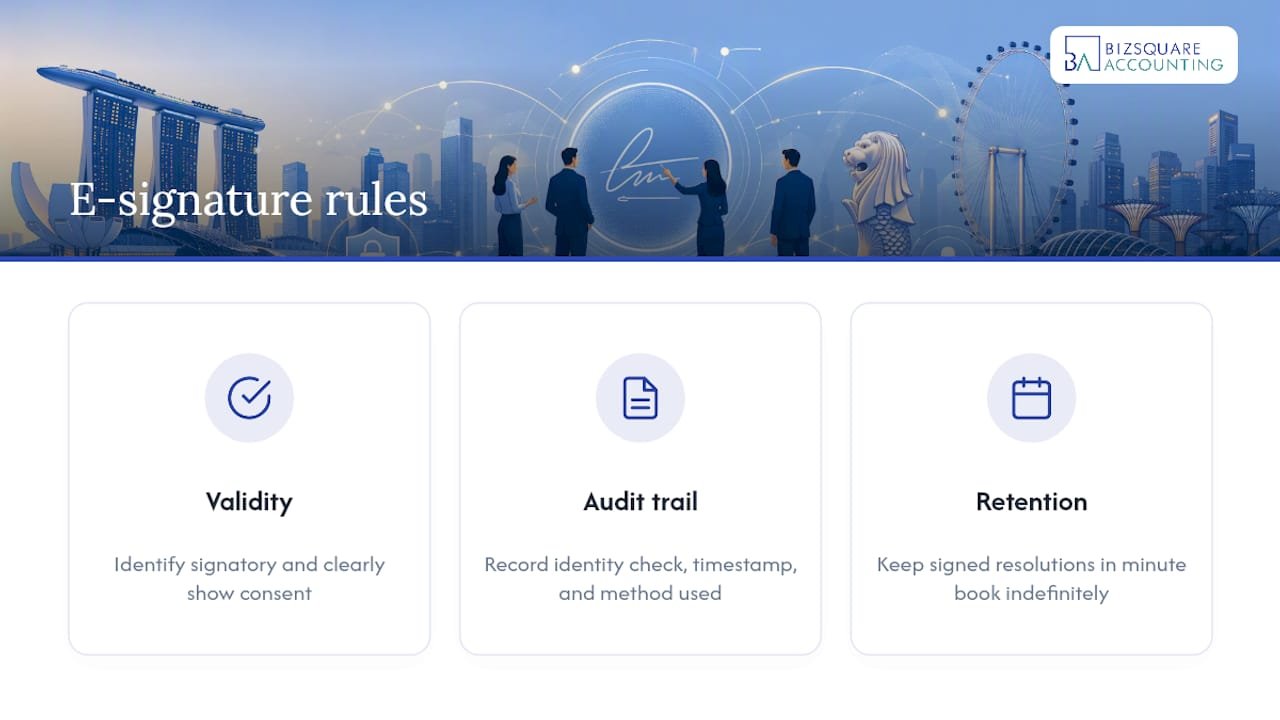
Yes. The Electronic Transactions Act recognises e-signatures as valid, provided the signatory can be identified and their consent is clearly demonstrated. This covers most e-signing platforms directors already use for other documents.
Pro Tip: Keep an audit trail alongside the signed document, showing each director’s identity check, the timestamp, and the signing method used. This protects you if a bank or ACRA ever questions the resolution’s authenticity.
Retain signed resolutions in your minute book indefinitely. Some banks and government agencies ask for certified extracts years later, particularly during due diligence for a sale or loan application.
When do you need a shareholders’ resolution instead?
Some decisions sit entirely outside the board’s authority, no matter how the directors vote.
- Changing the company’s constitution requires a special resolution, needing 75% shareholder approval.
- Changing the company name needs member approval, not just a board decision.
- Reducing share capital or winding up the company requires shareholder consent.
Using a board resolution for a matter that legally needs member approval creates a defective decision. ACRA or a bank may reject the filing outright, forcing you to redo the process correctly. When both approvals are needed, pass the board resolution first to recommend the action, then convene the members’ meeting or circulate the shareholders’ written resolution.
What mistakes commonly invalidate a resolution?
The same handful of errors show up again and again in disputes over board resolutions, and most are entirely avoidable with a quick check beforehand.
- Failing to meet quorum before the vote was taken
- Allowing a conflicted director to vote without declaring their interest
- Using vague wording that does not clearly state what was resolved
- Passing a board resolution for a matter requiring a shareholders’ special resolution
- Missing signatures from directors who should have signed
| Common mistake | Fix |
|---|---|
| Quorum not met | Reschedule and confirm attendance beforehand |
| Conflicted director voted | Declare interest, exclude from vote, re-pass if needed |
| Vague wording | Rewrite using specific names, dates, and amounts |
| Wrong approval type used | Redo as a shareholders’ resolution where required |
If a resolution turns out defective, the fix is usually straightforward. Directors simply re-pass it correctly, this time following quorum and voting rules properly.
How Bizsquare helps with resolutions and filings
Drafting a resolution correctly is one thing. Keeping every filing, minute book entry, and statutory deadline in order across a full year is another matter entirely. Bizsquare’s corporate secretarial services handle exactly this, from drafting resolutions to maintaining your minute book and lodging Bizfile forms.
For companies still setting up, company incorporation support includes the initial governance documents new directors need from day one. A template works fine for routine, low-stakes matters. Complex transactions, such as share transfers or constitutional amendments, are where professional review genuinely earns its keep.
What experienced directors know that new ones often miss
Three habits separate boards that stay compliant from those that scramble every time ACRA asks a question.
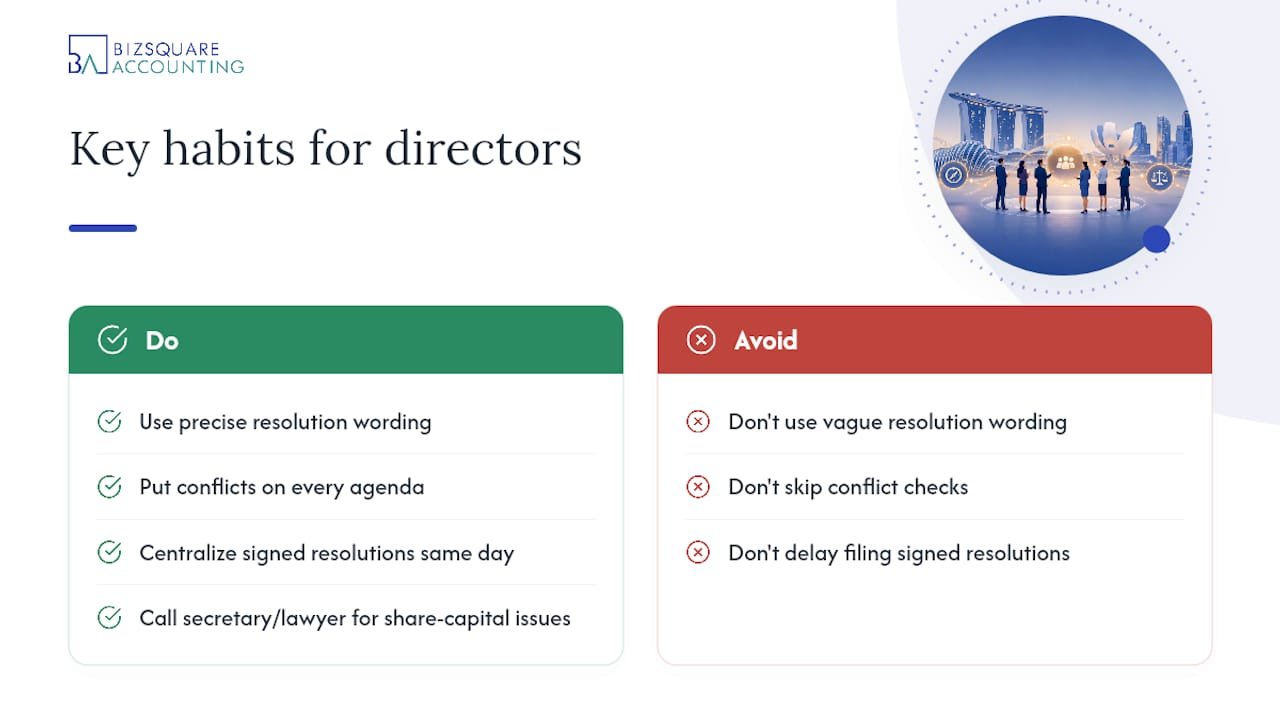
First, never let a resolution’s wording stay vague to save time. Vague wording is what gets contracts rejected by banks months later. Second, treat conflicts of interest as a standing agenda item, not an afterthought. Directors who skip this step create resolutions vulnerable to challenge from other shareholders. Third, keep signed resolutions and their audit trails in one place, updated the same day they are signed, not weeks later.
When a decision touches share capital, constitutional changes, or anything involving minority shareholder rights, stop and call a corporate secretary or lawyer.
— Vandro
Get your resolutions and filings handled properly
Drafting a resolution yourself works for a straightforward director appointment or a bank mandate update. Where things get harder is staying on top of every deadline, every minute book entry, and every ACRA form that a growing company generates across a full year, and that is where Bizsquare’s corporate secretarial team takes the workload off your desk.

Bizsquare provides resolutions drafted correctly the first time, annual return filings, AGM support, and statutory record keeping handled by experienced professionals. If you are incorporating a new company, our company incorporation service sets up your governance documents from the start, including nominee director and registered office options where needed. Existing companies can hand over ongoing compliance entirely through our corporate secretary service. Get in touch with Bizsquare today to have your next board resolution drafted, filed, and safely on record.
Sources
For further reading, consult the Companies Act (Cap. 50) for statutory director powers, the Electronic Transactions Act for e-signature validity, and a sample board resolution template for common wording. Corporate compliance partners such as T-Ledgers offer additional context on broader filing obligations.
This article is general information, not a substitute for advice from a qualified lawyer. Consult a qualified legal professional about your own circumstances before acting on anything here.
- Companies Act (Cap. 50) — Singapore Statutes Online
- Free board resolution template (Singapore Pte Ltd) — Helmself
FAQ
What is a board resolution in Singapore?
A board resolution is a written record of a decision made by a company’s directors, used to authorise actions like appointing a director or opening a bank account.
Do I need a lawyer to draft a board resolution?
No, routine resolutions can be drafted using a standard template, though complex matters like share transfers benefit from professional review.
Is an electronic signature valid on a board resolution in Singapore?
Yes, the Electronic Transactions Act recognises e-signatures as valid, provided the signatory is identifiable and consent is clearly shown.
What is the difference between a director’s resolution and a shareholder’s resolution?
Directors approve operational matters like bank accounts, while shareholders approve constitutional changes and matters affecting ownership, usually needing 75% approval for special resolutions.
Does ACRA need to see every board resolution?
No, board resolutions are generally kept as internal statutory records, though ACRA may request copies during a compliance check.
Can a written resolution replace a board meeting?
Yes, provided the company’s constitution permits written resolutions and all eligible directors sign it.
What happens if a director with a conflict of interest votes anyway?
The resolution risks being invalidated, and banks or ACRA may refuse to rely on it until it is corrected.
How long should signed board resolutions be kept?
Indefinitely, as banks and government agencies sometimes request certified extracts years later during due diligence or audits.
What should a board resolution include at minimum?
The company name and UEN, the date, attendance or signatures, and a clear statement beginning “RESOLVED THAT”.
Can Bizsquare help draft board resolutions for my company?
Yes, Bizsquare’s corporate secretarial service drafts resolutions, maintains minute books, and handles related ACRA filings for Singapore companies.
What is the quorum requirement for a board resolution?
Quorum requirements are set out in each company’s constitution, so directors should confirm the minimum number required before any vote.
Can a resolution be passed if not all directors are physically present?
Yes, virtual meetings are widely accepted, and directors overseas can join by video call if attendance is properly recorded.
What is a special resolution and when is it needed?
A special resolution needs a high level of shareholder approval typically required (for example, three-quarters) and is required for constitutional changes, name changes, or capital reductions.
What is the most common mistake that invalidates a board resolution?
Vague wording and quorum failures are the most frequent issues, followed by allowing conflicted directors to vote without declaring interest.