

Every credible valuation rests on three approaches: income, market, and asset. Most defensible estimates combine two of these and reconcile the results into a single range. Before anything else, pull together three years of accounts, normalise your EBITDA, and draft a simple forecast. Those three steps determine whether your final number holds up under scrutiny.
TL;DR:
- Most valuation methods incorporate at least two approaches, such as income and market or asset and earnings, to create a credible final range.
- For asset-heavy businesses, the asset approach is primary, while high-growth firms rely more on discounted cash flow, and stable companies favor the market approach.
- Using reliable, normalized accounting data and clear forecasts is essential before applying valuation methods, especially for small private companies.
- Owners tend to overestimate their business’s value when anchoring to competitor exits, risking undervaluation and negotiation delays.
- Combining methods and documenting the reasoning is crucial for a defensible valuation acceptable to buyers, lenders, and authorities alike.
Table of Contents
- What are the three primary business valuation methods?
- Six common business valuation methods, explained with worked examples
- How do you choose and reconcile valuation methods?
- A practical preparation template you can use today
- Why most owners overestimate what their business is worth
- Get valuation-ready with Bizsquare Accounting
- Sources
- FAQ
What are the three primary business valuation methods?
The European Business Valuation Standards (EVS-BV) set out three principal approaches, and valuers must select methods that fit the purpose and the data available. Understanding these three business valuation approaches is the first real step in learning how to value a business properly.
The income approach values a company based on the cash it can generate in future. This suits businesses with predictable, recurring revenue, such as service contracts or subscription models. It becomes the primary approach when historical earnings are a reliable guide to what comes next.
The market approach compares your business against similar companies that have sold, or against public companies trading at known multiples. This works well when there is a reasonable pool of comparable transactions in your sector, giving you a market-tested benchmark rather than a theoretical projection.
The asset approach adds up the value of what a company owns, then subtracts what it owes. This becomes primary for asset-heavy businesses, such as property holding companies or manufacturers with substantial equipment, and it also serves as a floor value, a check to ensure the business is worth more running than closing down.
A quick way to map your situation:
- Asset-heavy business (property, manufacturing plant): asset approach as primary, income approach as a cross-check.
- High-growth business (technology, scaling services): income approach as primary, since future cash flow matters more than current book value.
- Mature, stable dividend payer: market approach as primary, using peer multiples to validate income-based projections.
A quick mapping of business type to method, based on cash flow predictability and asset intensity, helps decide which approach carries the most weight before you commit to a final figure.
Six common business valuation methods, explained with worked examples
Learning specific techniques for valuing a business turns abstract theory into numbers you can actually defend to a buyer, a bank, or a tax authority. Here are six methods you are likely to encounter, each with a short calculation.
Discounted cash flow (DCF). This method values a company as the present value of future cash flows, though it is highly sensitive to the terminal value and discount rate you choose. For a small private company, use a shorter forecast window of around five years, apply a conservative terminal growth rate, and cross-check the result against a multiples-based terminal value. Say a business generates $200,000 in free cash flow, growing 5% annually, discounted at 12% over five years, with a terminal value calculated at a 3% perpetual growth rate. The sum of discounted cash flows plus the discounted terminal value might land around $1.8 million. Change the discount rate by even one percentage point and that figure can shift by tens of thousands of dollars, which is why DCF demands careful, conservative assumptions.
Capitalisation of earnings. This suits stable businesses with flat or slow growth. Take normalised annual earnings, say $150,000, and divide by a capitalisation rate of 15%. That gives a value of $1 million. The cap rate reflects risk and expected growth combined into a single number, simpler than DCF but less precise for businesses with changing cash flows.
Guideline public company method. Here you apply an EV/EBITDA multiple drawn from comparable public companies to your own adjusted EBITDA. Multiples like EV/EBITDA are widely used in private-company valuation, though the applicable band depends heavily on industry and size. Select comparables that match your sector, revenue scale, and growth profile as closely as possible. If your adjusted EBITDA is strong and the sector multiple is typical for your industry, you can estimate the indicated value by applying the relevant multiple.
Pro Tip: Public company multiples often need discounting for private-company illiquidity, since a public share can be sold in seconds and a private business cannot.
Precedent transactions (deal comps). This method looks at actual sale prices of similar businesses. It captures real-world negotiating dynamics, including any control premium a buyer paid to secure a majority stake. If comparable deals closed at 4.5x to 6x EBITDA, and yours sits mid-range at 5x, that anchors your estimate against genuine market behaviour rather than theoretical projections.
Net asset value (book value adjusted). Start with the balance sheet, then adjust for fair market value. A company with $800,000 in book assets might hold property actually worth $1.1 million once revalued, plus $50,000 in obsolete inventory written down to zero. The adjusted net asset value becomes roughly $1.15 million minus liabilities.
Liquidation value. This estimates what remains if the business closed and sold off assets quickly, typically at a discount to fair market value. It matters mainly for distressed companies or as the absolute floor beneath any going-concern valuation.
Industry and company-specific factors, including recurring revenue and customer concentration, can shift effective EBITDA multiples by 1.0x to 3.0x, so the same business could be worth noticeably more or less depending on how it scores against these drivers.
How do you choose and reconcile valuation methods?
Running one method rarely satisfies a serious buyer, lender, or tax authority. A defensible valuation commonly applies at least two methods from different approaches and reconciles the indicated values into a final range, rather than presenting a single point figure as gospel.
Standards such as AICPA’s SSVS require valuers to consider multiple approaches and document the reasoning behind the final reconciliation. That documentation matters just as much for a small private company sale as it does for a formal audit.
Practical pairing by business type:
- Owner-operated small business ($1M to $5M revenue): use seller’s discretionary earnings (SDE) alongside a market multiple. Practitioners in this size band often run both SDE and EBITDA side by side for comparison.
- Professionally managed SME: pair DCF with the guideline public company method.
- Asset-heavy or distressed company: pair net asset value with liquidation value as a floor check.
Adjusted EBITDA sits at the heart of nearly every method above. It should normalise owner compensation, one-off items, and non-recurring revenue or expenses, because buyers compare cash-generating power, not accounting quirks. Common add-backs include above-market owner salary, one-off legal fees, a single bad debt write-off, or a personal vehicle run through the company.
Working capital and capital expenditure assumptions must align across methods too. If your DCF assumes $30,000 annual CAPEX to sustain growth, your multiples-based valuation should reflect a business that can actually support that spending. Recurring revenue, low customer concentration, and reduced owner dependency all push multiples upward, sometimes by whole turns of EBITDA, while a business reliant on one client for a large portion of revenue typically sees multiples compressed.
Sound bookkeeping underpins every adjustment above. Reliable accounting methods make normalisation far easier when the underlying records are clean from the start.
A practical preparation template you can use today
Before approaching an adviser, gather this checklist:
- Three years of statutory accounts and management reports.
- Bank reconciliations and confirmation of outstanding liabilities.
- Key customer and supplier contracts, particularly any with concentration risk.
- A 12 to 24 month forecast with clear assumptions.
A simple one-page DCF input template needs these fields: annual revenue, cost of goods sold, operating expenses, normalised EBITDA, forecast growth rate, discount rate, and terminal growth assumption.
| Input | What it captures |
|---|---|
| Normalised EBITDA | Earnings after add-backs for owner pay and one-offs |
| Discount rate | Reflects business risk and cost of capital |
| Growth forecast | Realistic revenue trajectory over 3 to 5 years |
| Terminal growth | Conservative long-term growth beyond the forecast |
Bizsquare Accounting supports this groundwork through bookkeeping, adjusted EBITDA calculations, and outsourced CFO services that keep your numbers audit-ready.
Why most owners overestimate what their business is worth
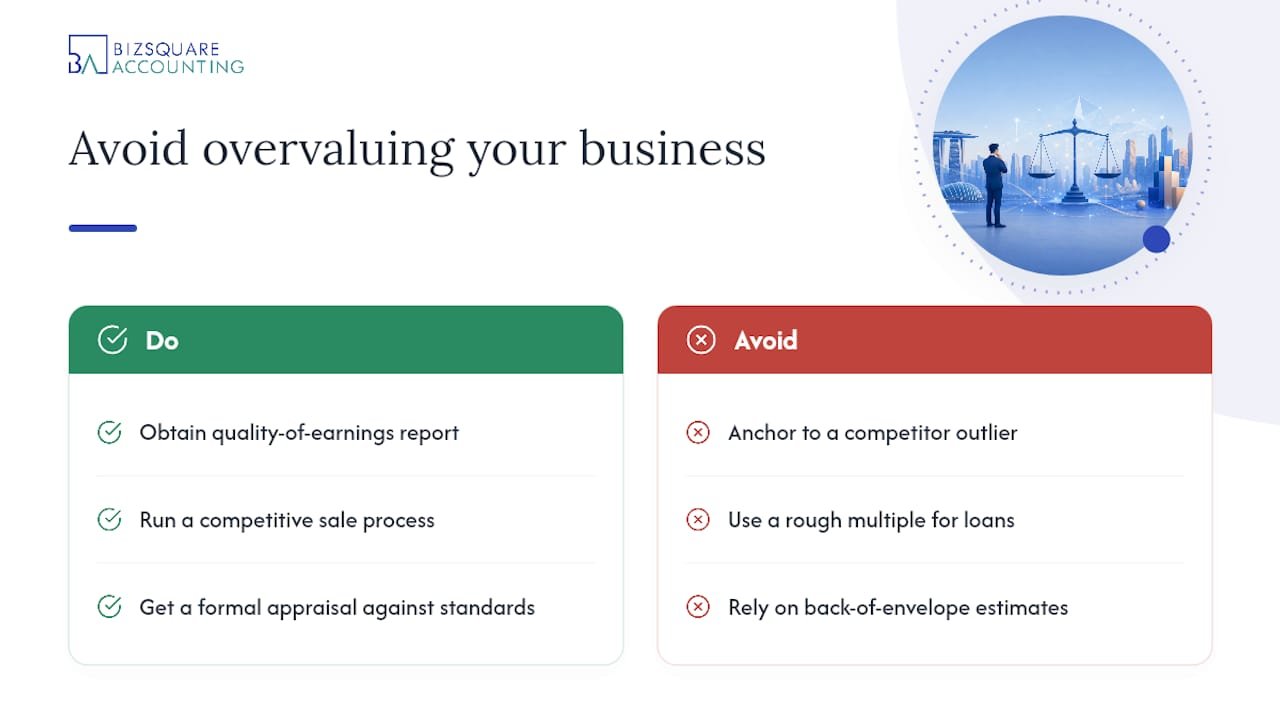
Owners routinely anchor their expectations to the biggest number they have ever heard about a competitor’s exit, then treat that figure as a floor rather than an outlier. This is the single most common mistake in business worth assessment, and it wastes months of negotiation when the eventual offer lands far below hopeful expectations.
A quality-of-earnings report and a genuinely competitive sale process tend to deliver a measurable premium on achieved multiples, because buyers pay up when they trust the numbers and sense competing interest. A rough multiple scribbled on the back of an envelope suffices for an owner testing internal appetite for a sale. It does not suffice for a bank loan application, a shareholder dispute, or an actual transaction, where a formal appraisal, prepared against recognised standards, becomes essential.
— Vandro
Get valuation-ready with Bizsquare Accounting
Consider a practical alternative to hiring a formal valuer before validating your numbers. Instead of guessing at adjusted EBITDA yourself, have your figures normalised first, so any valuation method applied later starts from clean, defensible data.

Our accounting and bookkeeping services handle the reconciliations and reporting that underpin every valuation approach above, while our outsourced CFO and corporate advisory team helps you build the forecast and normalisation work a serious buyer or lender expects to see. If you are incorporating a new entity as part of restructuring before a sale, our company incorporation service covers that groundwork too. Contact Bizsquare Accounting today to request a valuation preparation checklist tailored to your business stage, and take the guesswork out of getting your numbers in order before you talk to any adviser.
Sources
The Harvard Business School guide to company valuation explains DCF mechanics and terminal value risk. The EVS-BV standards define the three principal approaches. Investopedia’s valuation overview covers market multiples, and Windsor Drake’s EBITDA multiples report quantifies how value drivers move multiples. You can also try Tickerplace’s enterprise value calculator for a quick computed estimate.
FAQ
What are the five methods of valuation?
Common lists include DCF, capitalisation of earnings, guideline public company multiples, precedent transactions, and net asset value, drawn from the three broader approaches of income, market, and asset.
What are the top three valuation methods?
DCF, guideline public company multiples, and net asset value are used most often, because they each represent one of the three core approaches: income, market, and asset.
What are the six methods of valuation?
The six covered here are DCF, capitalisation of earnings, guideline public company method, precedent transactions, net asset value, and liquidation value.
Is DDM or DCF better for valuing a business?
DCF suits most operating companies because it values total free cash flow, while the dividend discount model (DDM) fits businesses valued mainly on dividend payouts, such as mature financial firms.
What is the difference between EBITDA and adjusted EBITDA?
EBITDA is earnings before interest, tax, depreciation, and amortisation, while adjusted EBITDA strips out owner compensation, one-off costs, and non-recurring items to reflect true cash-generating power.
How do I know which valuation approach to use?
Match the approach to your business type: income for predictable cash flows, market for sectors with comparable transactions, and asset for asset-heavy or distressed companies.
Why do valuers use more than one method?
A single method rarely withstands scrutiny from buyers or tax authorities, so most defensible valuations apply two methods and reconcile the results into one range.
What is a good EBITDA multiple for a small business?
Multiples vary widely by industry and size, and factors such as customer concentration and recurring revenue can shift the applicable multiple by whole turns of EBITDA.
How does cost of capital affect a DCF valuation?
The discount rate, built from your cost of capital, directly shapes present value, so a one percentage point change can shift the final figure by tens of thousands of dollars.
What is seller’s discretionary earnings (SDE)?
SDE is the preferred earnings base for small, owner-operated businesses, adding back owner salary and perks, while EBITDA is standard for professionally managed companies.
Can I value my business without hiring a professional?
A rough multiple works for testing internal appetite for a sale, but formal transactions, loans, or disputes generally require a properly documented appraisal.
How does a quality-of-earnings report affect the sale price?
A quality-of-earnings report, paired with a competitive sale process, tends to raise achieved multiples because buyers trust verified numbers and sense genuine competition.
What role does customer concentration play in valuation?
Heavy reliance on one or two clients increases perceived risk and typically compresses the multiple a buyer is willing to pay.
How can Bizsquare help prepare my business for valuation?
Bookkeeping and EBITDA figures can be normalised through accounting and outsourced CFO services, providing any later valuation method a clean, defensible starting point.