

Late annual returns cost $300 within three months and $600 after that, while other overdue filings cost $50 or $200. Repeated breaches can trigger composition offers, court fines up to $5,000, or director disqualification. Lodge the overdue filing on Bizfile immediately, then consider an appeal or extension of time, and bring in corporate secretarial support to stop it happening again.
TL;DR:
- Filing an annual return more than three months late results in a fee increasing from $300 to $600, depending on how long the delay lasts.
- Other late filings, such as changing company address or updating officers, incur penalties of $50 within three months, rising to $200 afterward.
- Persistent breaches can lead to court prosecution with fines up to $5,000 and disqualification of directors convicted of three or more offences within five years.
- Applying for an extension of time requires submission at least 14 working days before the deadline, accompanied by a $200 non-refundable fee.
- Maintaining an up-to-date statutory calendar and engaging a corporate secretary can prevent most late filing penalties and ensure compliance.
Table of Contents
- What is the ACRA late filing penalty for annual returns?
- What penalties apply to other late ACRA filings?
- When does ACRA escalate beyond a standard penalty?
- How do you appeal an ACRA penalty or apply for an extension?
- How can directors prevent ACRA late filing penalties?
- Why do so many Singapore companies still get caught out?
- Keep your company compliant without chasing deadlines yourself
- Sources
- FAQ
What is the ACRA late filing penalty for annual returns?
Since 14 January 2022, ACRA has run a two-tier penalty structure for late annual return filing. File within three months of the due date and you pay $300. File later than that, and the fee doubles to $600. This applies to due dates on or after that January date, so older breaches may sit under a different, now retired, scale.
The rule covers Singapore incorporated private companies, and it extends to variable capital companies and limited liability partnerships where the relevant filing obligations apply to them. Sole proprietorships and general partnerships fall under a separate registration regime, so this specific penalty structure does not touch them.
Pro Tip: Check your company’s financial year end and count backwards. Annual returns are due within seven months of that date for private companies, so mark the deadline the moment your financial year closes.
Picture a private company with a financial year ending 31 December 2025. Its annual return falls due by seven months after that date in the following year, which is typically July 2026. Miss that date by six weeks, and Bizfile will charge $300 automatically at the point of lodgement. Leave it past the three month mark, and the system charges $600 instead. There is no manual review at this stage. The two tiers apply as follows:
- Filed within three months of the due date: $300
- Filed more than three months after the due date: $600
What penalties apply to other late ACRA filings?
Not every filing obligation falls under the annual return penalty. Changes to your registered office address, updates to directors or other position holders, and several other ad hoc filings carry a separate, smaller penalty scale. Since 9 December 2024, these late lodgment penalties sit at $50 for filings made within three months of the deadline, rising to $200 after that.
This lower tier reflects the administrative nature of these filings compared with the annual return, which carries heavier compliance weight. Common examples that fall under this scale include:
- Notifying a change of registered office address
- Updating particulars of directors, secretaries, or other officers
- Filing annual declarations for limited liability partnerships
- Lodging changes to shareholding or other statutory particulars
As with annual returns, Bizfile calculates and displays the penalty amount the moment you attempt the lodgement. You will see the exact fee before you confirm submission, so there is no ambiguity about what you owe.
When does ACRA escalate beyond a standard penalty?
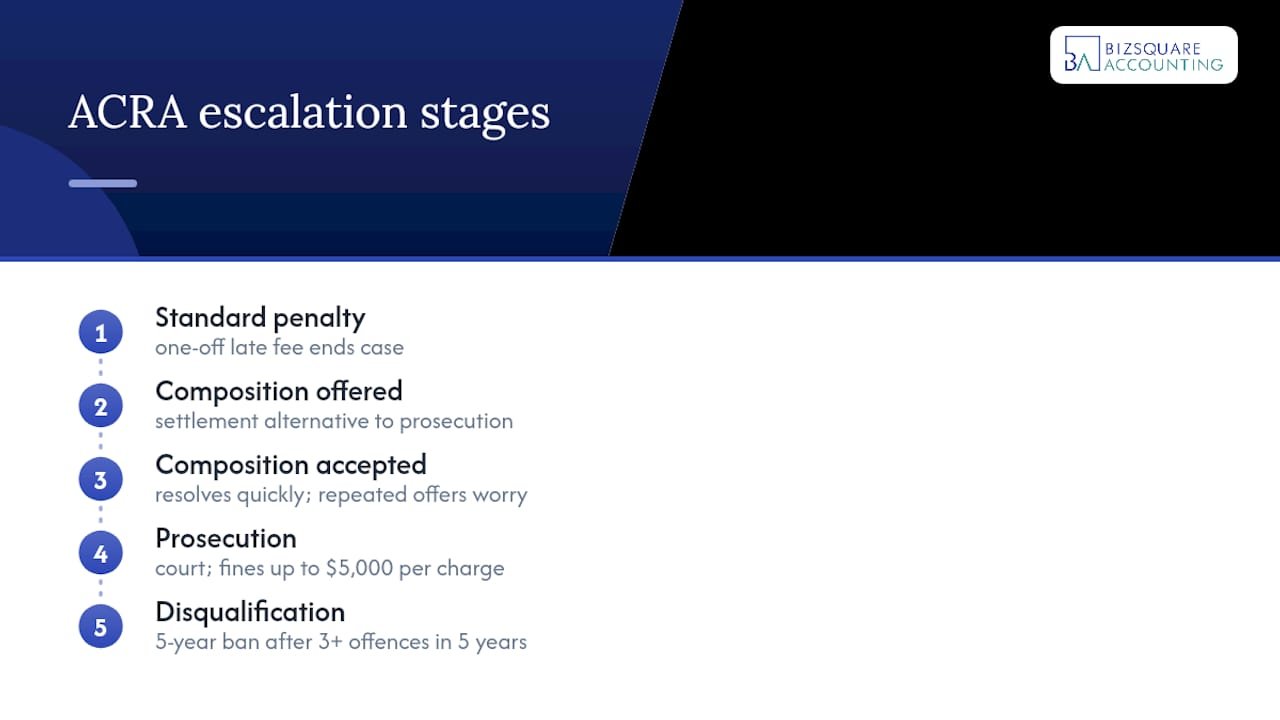
A one off late filing usually ends with the standard fee. Persistent or serious breaches move into a different category entirely, and this is where directors face real financial and legal exposure.
ACRA can offer a composition sum as a settlement alternative to prosecution. This is often used when a late annual general meeting causes a late annual return, and ACRA sometimes bundles both breaches into one composition to close the matter without going to court. Accepting a composition offer resolves the case quickly, but repeated offers signal a pattern that ACRA takes increasingly seriously.
Where composition is not offered or not accepted, the matter proceeds to court prosecution. Conviction can bring fines of up to $5,000 per charge, and a company with multiple outstanding filings can face multiple charges at once. Beyond financial cost, directors convicted of three or more filing offences within five years face disqualification under Section 155A of the Companies Act.
A five year disqualification bars a director from managing any Singapore company during that period, which affects every business the individual is involved with, not just the one that offended.
How do you appeal an ACRA penalty or apply for an extension?
Two separate routes exist for directors who believe a penalty is unfair, or who need more time before a deadline arrives. They serve different situations, so it helps to know which one applies before you act.
- Submit the ACRA Late Filing Appeal Form if a penalty has already been charged and you believe there were extenuating circumstances. Attach supporting documents such as medical certificates or evidence of system errors. Appeals are assessed on merit and typically take about four weeks to review.
- Apply for an extension of time (EOT) before your deadline passes, not after. Submit at least 14 working days before the due date, pay the $200 non-refundable fee, and expect processing to take up to 14 working days.
- Continue complying with any court summons issued in relation to the breach, even while an appeal or EOT request is pending, since neither process automatically halts legal proceedings.
Pro Tip: Do not wait until the week before your deadline to consider an EOT. Once the due date passes, the online application option disappears, and last minute requests are rarely successful.
How can directors prevent ACRA late filing penalties?
Most late filings are not caused by defiance. They come from weak internal tracking, a financial year end nobody flagged early enough, or an AGM that slipped past its window. A short checklist closes most of that gap:
- Maintain an up to date statutory register, including directors, members, and registered office details.
- Set an internal deadline two weeks ahead of the actual Bizfile due date, never on the day itself.
- Use calendar reminders tied to your financial year end, not just generic annual alerts.
- Confirm all supporting financial documents are ready at least 30 days before the annual return is due.
ACRA does send electronic reminders, but responsibility for tracking deadlines rests with company officers, not with the regulator. That distinction matters when things go wrong, because “I did not receive a reminder” is not a valid basis for an appeal.
This is exactly the gap a corporate secretary fills in practice. A competent secretary tracks every statutory deadline across a client portfolio, prepares the required resolutions and registers in advance, and lodges the return on Bizfile before the window closes. Picture a small trading company with a December year end. Its secretary flags the AGM requirement in March, chases financial statements from the accountant by June, and lodges the annual return in July, weeks ahead of the July deadline. No penalty, no drama, no last minute scramble.

Pro Tip: Ask whoever handles your compliance to send you a written deadline calendar every January. If nobody can produce one, that is a warning sign worth acting on.
Why do so many Singapore companies still get caught out?
Late filing rarely comes from ignorance of the rules. It comes from accounts finished too late, an AGM nobody scheduled properly, or a calendar reminder that got buried under other priorities. Bizsquare sees the same three failure points across most cases that reach us after a penalty has already landed.
We typically fix this by rebuilding the client’s internal deadline calendar and taking over the actual lodgement process, so the fix outlasts the immediate crisis. A quick audit of your last two years of filings, checking dates against actual submission times, usually reveals whether your current process is reliable or quietly exposed.
— Vandro
Keep your company compliant without chasing deadlines yourself
Bizsquare gives Singapore directors a fixed, predictable way to stay ahead of ACRA deadlines, without hiring in house staff or relying on scattered reminders that get missed. Rather than tracking annual returns, AGM dates, and ad hoc filings yourself, a dedicated corporate secretary manages the entire calendar and lodges every return before it becomes a penalty.

Our corporate secretary service covers statutory register maintenance, annual filing preparation, AGM support, and proactive deadline tracking tailored to your financial year end. If you are setting up a new entity rather than fixing an existing one, our company incorporation service builds compliant structures from day one, so the filing habits start correctly rather than needing a rescue later.
If you already have overdue filings, contact Bizsquare now to review your compliance calendar and lodge outstanding returns before penalties escalate further.
FAQ
What is the penalty for filing accounts late with ACRA?
There is no separate accounts penalty. Late accounts usually cause a late annual return, which carries a $300 fee within three months and $600 after that.
What is the penalty for late submission of an annual return?
The penalty is $300 if filed within three months of the due date, rising to $600 after three months, for due dates on or after 14 January 2022.
What is the penalty for late lodgement of an annual return for other filings, like a change of address?
Non-annual-return filings such as address or officer changes carry a separate scale of $50 within three months and $200 after that, effective from 9 December 2024.
What is the ACRA filing deadline for private companies?
Private companies must file their annual return within seven months of their financial year end, following the AGM or written resolutions where applicable.
Can a company be prosecuted for late ACRA filing?
Yes, persistent non-compliance can lead to court prosecution, with fines of up to $5,000 per charge for the company or its officers.
Can a director be disqualified for late filing?
Directors convicted of three or more filing offences within five years face disqualification under Section 155A of the Companies Act for five years.
How do I appeal an ACRA late filing penalty?
Submit the ACRA Late Filing Appeal Form with supporting documents. ACRA assesses appeals on merit and reviews typically take about four weeks.
How do I apply for an extension of time with ACRA?
Apply at least 14 working days before your due date, pay the $200 non-refundable fee, and allow up to 14 working days for processing.
Is the EOT fee refundable if my application is rejected?
No, the $200 extension of time fee is non-refundable regardless of the outcome, so apply only when genuinely needed.
Does ACRA calculate the penalty automatically?
Yes, Bizfile calculates and displays the exact penalty amount the moment you attempt to lodge an overdue filing, before you confirm submission.
What happens if I ignore an ACRA composition offer?
Ignoring or rejecting a composition offer typically leads to court prosecution, which carries higher fines and a formal conviction record.
Do limited liability partnerships face the same ACRA penalties?
LLPs face the ad hoc filing penalty scale for annual declarations and other lodgements, at $50 within three months and $200 after that.
How can I avoid ACRA late filing penalties permanently?
Maintain a written compliance calendar, confirm documents 30 days before deadlines, and consider outsourcing to a corporate secretary who tracks every filing date.
Does a late AGM also trigger a penalty?
A late AGM often causes a late annual return, and ACRA sometimes settles both breaches together through a single composition offer.
What is the difference between ACRA and IRAS late filing penalties?
ACRA penalises late corporate filings like annual returns, while IRAS separately penalises late tax filings, with its own composition and prosecution process.