

A 13-week cash flow is a rolling, weekly forecast built on the direct method, tracking actual cash inflows and outflows rather than accounting profit. It anchors every week to your verified bank balance, giving you line-of-sight on liquidity roughly three months out. That short runway is precisely what makes it useful. You can spot a shortfall early enough to act, whether that means chasing receivables, delaying a purchase, or drawing on a credit line.
TL;DR:
- A 13-week cash flow forecast relies on confirmed transactions and actual bank data, delivering high accuracy for the first two weeks.
- The model should be updated weekly by replacing the last week’s actuals and appending a new week, ensuring it remains a living, accurate tool.
- Keeping the forecast to about 8 to 12 line items prevents clutter and maintains decision-making clarity.
- Reconciliation of opening balances against bank statements is crucial to avoid drift, with errors often stemming from misaligned starting points.
- Manual spreadsheets work for simple setups, but growth beyond one or two bank accounts warrants dedicated treasury software to improve accuracy and reduce error risk.
Table of Contents
- What is a 13-week cash flow model and why does the horizon matter?
- Core components: what belongs in a 13-week model
- How to build a 13-week cash flow forecast, step by step
- How often should you update it, and how accurate should it be?
- Spreadsheets, templates and when to move beyond Excel
- Checklist and the mistakes that undo good forecasts
- Who should own the 13-week model, and why discipline beats sophistication
- How Bizsquare keeps your 13-week forecast running week after week
- Sources
- FAQ
What is a 13-week cash flow model and why does the horizon matter?
A 13-week cash flow forecasting model projects cash movement across a rolling window, updated every week so the forecast never goes stale. As one week closes, you drop it off the front and add a new week 13 at the back. The model always looks 13 weeks forward, no matter when you check it.
The method matters as much as the horizon. Short-term forecasts use the direct method, drawing on actual bank transactions, confirmed invoices and payment schedules. Medium and long-term forecasts tend to rely on the indirect method, which starts from net profit and adjusts for non-cash items. The indirect method suits annual budgeting. It is far too imprecise for the week-by-week decisions a cash-tight business needs to make.
Thirteen weeks strikes a deliberate balance:
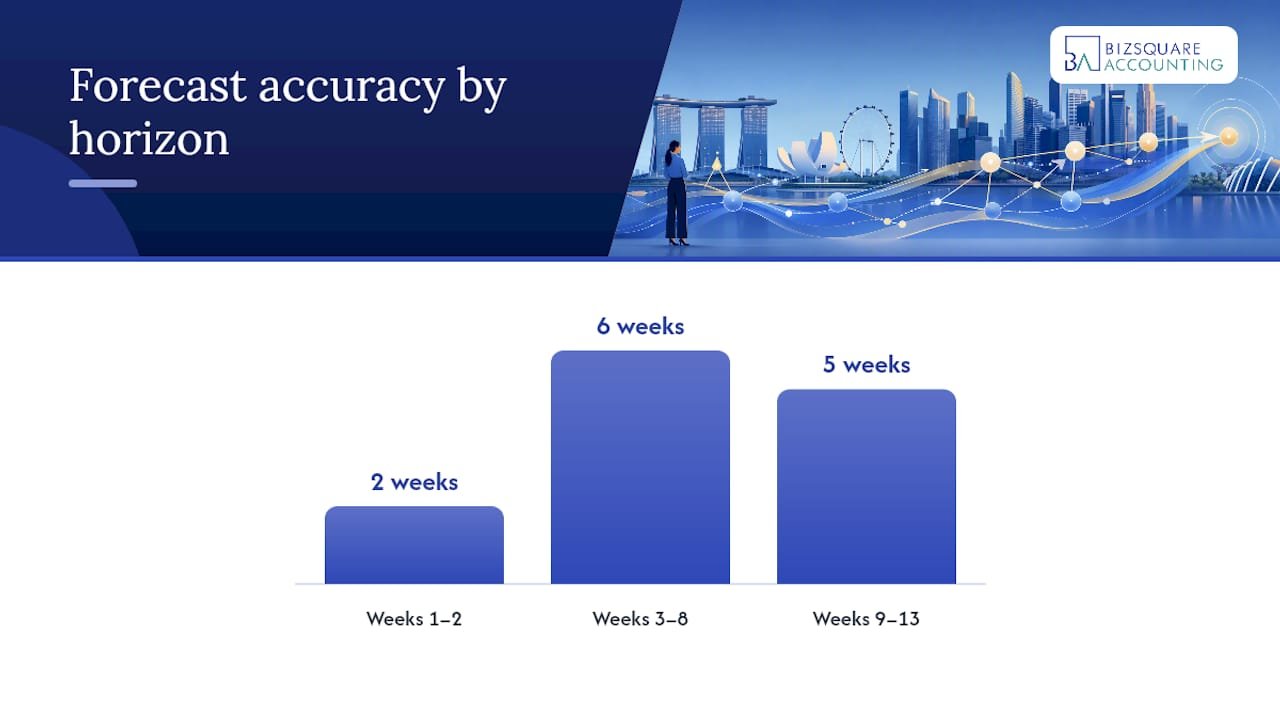
- Weeks one and two are highly accurate, built on confirmed transactions and known payment dates.
- Weeks three through eight give enough runway to negotiate with suppliers, adjust hiring, or arrange finance.
- Weeks nine through 13 are directional, useful for spotting trends rather than exact figures.
- The horizon is long enough to plan, but short enough that every number stays grounded in real data.
Core components: what belongs in a 13-week model
A working model rests on five structural elements, each feeding directly into the next week’s opening figure.
- Opening cash balance. This must match your actual bank statement for that week, not a carried-forward estimate. Reconciliation happens before anything else gets entered.
- Cash inflows. Customer receipts, loan draws, asset sales and any other confirmed cash coming in, mapped to the week it actually lands.
- Cash outflows. Payroll, supplier payments, rent, tax instalments, debt service and any other confirmed cash leaving, again mapped to the week of payment.
- Net cash flow. Total inflows minus total outflows for that week, a formula pulled straight from standard [cash flow forecasting practice](https://www.ibm.com/think/tutorials/how-to forecast-cash-flow).
- Closing balance. Opening balance plus net cash flow, which becomes next week’s opening figure once you roll the model forward.
Resist the urge to build dozens of granular categories. Practical guidance from Accordion’s CFO playbook recommends keeping the model to somewhere between 8 and 12 line items. Anything smaller than that clutters the report without adding decision value.
How to build a 13-week cash flow forecast, step by step
Start by defining scope. Decide whether the forecast covers one entity, one bank account, or a consolidated group. Mixing entities without separating them is one of the fastest ways to lose control of the model.
Next, gather your inputs:
- Verified opening bank balances for every account included in scope.
- Accounts receivable ageing, so you can map expected collections to the week they are likely to clear, not the invoice date.
- Accounts payable schedules, including supplier terms and any negotiated payment dates.
- Payroll calendars and statutory contribution deadlines.
- Debt service schedules, covering principal, interest and any covenant-related payments.
With data gathered, assign every cash item to the specific week it will actually hit the bank. This is the discipline that separates a genuine 13-week model from a rough monthly estimate stretched across 13 columns. Where timing is genuinely uncertain, such as a customer who might pay early or late, build a best case and a worst case rather than guessing a single number.
The formulas stay simple throughout. Net cash flow equals total inflows minus total outflows for the week. Closing balance equals opening balance plus that net figure, as IBM’s forecasting guide sets out in its standard treasury framework. That closing figure becomes next week’s opening balance once reconciled against the bank statement.
For businesses in the early stages of setting this up, a structured step-by-step forecasting approach can help establish the right categories before habits calcify around a messy spreadsheet.
Once built, the weekly deliverable to leadership should be short: current cash position, the coming four weeks in detail, and any variance flags against last week’s projection.
Pro Tip: Build your model so week one always equals actual bank data, never a projection. If week one doesn’t match the statement exactly, every week after it is compounding an error you haven’t found yet.
How often should you update it, and how accurate should it be?
Update the model every week, without exception. Replace the week that just closed with actual figures, then append a fresh week 13 to the end. This roll-forward process is what keeps the forecast a living tool rather than a one-off exercise.
Anchor each new opening balance to the reconciled bank statement, never to last week’s projected closing figure. This single habit, emphasised throughout Accordion’s practical guide, prevents small errors from compounding silently across the model.
Track variance line by line, comparing forecast to actual for every category, not just the total. A total that looks accurate can hide a receivables miss offset by a lucky payroll delay.
Weeks one and two typically show the tightest accuracy, since they rest on confirmed transactions. Accuracy naturally loosens toward weeks 11 through 13, where estimation replaces certainty. That drift is expected, not a build failure.
Set clear action triggers. A few sensible defaults:
- If projected closing cash in any of the next four weeks falls below your minimum operating threshold, escalate immediately.
- If actual collections miss forecast by more than a set percentage two weeks running, review the AR process, not just the number.
- If a single line item swings the total variance by more than a defined amount, investigate before the next update cycle.
Spreadsheets, templates and when to move beyond Excel
A well-built spreadsheet can run a 13-week model for a long time before it becomes a liability. Structure it properly from the start:
- Link the opening balance cell directly to a bank statement import or manual entry field, never a hardcoded number.
- Use lookup tables for recurring categories so line items stay consistent week to week.
- Protect the formula cells for net cash and closing balance, leaving only inputs editable.
The trouble starts when a business runs multiple entities, multiple bank accounts, or needs frequent bank feed reconciliation. At that point, manual consolidation eats hours every week and error risk climbs. JPMorgan’s treasury guidance notes that dedicated forecasting technology automates data collection and improves the audit trail, which matters once a spreadsheet is being touched by more than one person.
A middle step works well for many growing businesses: keep the core model in Excel, but connect it to bank or ERP feeds rather than manual exports. Subscription and SaaS businesses often reach this point earlier than most, given how recurring revenue timing complicates cash forecasting.

Checklist and the mistakes that undo good forecasts
Before trusting any weekly output, confirm four things: opening cash matches the bank statement, line items stay under roughly a dozen, one person owns the weekly update, and a variance log runs alongside the forecast itself.
The most common failure is treating the model as a monthly report squeezed into weekly columns, rather than genuinely mapping transactions to the week they clear. The second is losing bank-balance discipline once results feel busy.
Pro Tip: If a shortfall surprises you, check your opening balance reconciliation first. Drift almost always starts there, not in the forecast itself.
Who should own the 13-week model, and why discipline beats sophistication
The forecast belongs with finance, whether that is an in-house controller or an outsourced CFO function, because ownership requires weekly consistency, not occasional attention. A model reviewed sporadically loses its value fast, since cash flow management depends on habitual tracking rather than periodic clean-up. Outsourced bookkeeping and CFO support work well here precisely because they build the weekly cadence into someone’s actual job, rather than leaving it as a task that slips when things get busy.
— Vandro
How Bizsquare keeps your 13-week forecast running week after week
Building a 13-week model is straightforward. Running it properly, every week, for months on end, is where most businesses lose momentum. Bizsquare’s outsourced CFO and corporate advisory service exists precisely for this gap, giving you a dedicated team that owns the weekly reconciliation, variance tracking and management reporting so the model never goes stale.

Our accounting and bookkeeping services handle the unglamorous groundwork that any accurate forecast depends on, including bank reconciliations, AR ageing and payable schedules kept current rather than reconstructed in a rush each month end. For businesses newly incorporated in Singapore or scaling past the point where a spreadsheet owner has time to spare, pairing forecasting discipline with proper company incorporation support gets the financial foundation right from day one. If you want a finance team that treats your 13-week forecast as a standing discipline rather than a crisis document, get in touch with Bizsquare to discuss outsourced CFO support tailored to your cash position.
Sources
For deeper method detail, Accordion’s CFO guide and IBM’s forecasting tutorial cover formulas and governance in more depth.
This article is general information, not a substitute for advice from a qualified financial advisor. Consult a qualified financial professional about your own circumstances before acting on anything here.
- What is 13-Week Cash Flow Forecasting?
- 13-Week Cash Flow Forecasting: A CFO’s Practical Guide
- How to forecast cash flow
- How to create cash flow forecasts and projections
- What Is a 13-week Cash Flow Model? A Key Leadership Discipline
FAQ
What is a 13-week cash flow forecast?
It is a rolling, weekly forecast of cash inflows and outflows using the direct method, updated every week as actual data replaces earlier estimates.
Is there a template for the 13-week cash flow forecast?
A basic template needs five rows: opening balance, inflows, outflows, net cash flow and closing balance, repeated across 13 weekly columns with 8 to 12 line-item categories underneath.
How do you do a 12-month cash flow forecast?
A 12-month forecast typically uses the indirect method, starting from projected profit and adjusting for non-cash items, updated monthly rather than weekly.
What is a 12-month rolling forecast?
It is a forecast that always looks 12 months ahead, dropping the oldest month and adding a new one each period, similar in structure to how a 13-week model rolls weekly.
Why use 13 weeks instead of a monthly forecast?
Thirteen weeks gives near-term precision from confirmed transactions while still covering roughly a quarter, long enough to act on a problem before it becomes urgent.
How accurate should a 13-week forecast be?
Weeks one and two are usually highly accurate since they rest on confirmed bank and invoice data, while weeks 11 to 13 involve more estimation.
What causes the biggest errors in a 13-week model?
Carrying forward a projected balance instead of reconciling against the actual bank statement is the single most common source of drift.
How many line items should a 13-week model include?
Most practical models stay within 8 to 12 categories, enough to isolate meaningful variances without becoming unmanageable to update weekly.
Should small businesses bother with a 13-week cash flow?
Yes. The model provides governance value as a standing discipline, not only during a crisis or restructuring, helping any business spot liquidity risk early.
How often should the forecast be updated?
Every week, without exception, replacing the closed week with actuals and adding a new week 13 to keep the rolling window intact.
Can Excel handle a 13-week cash flow model?
Yes, for a single entity with one or two bank accounts, provided the opening balance links to actual bank data and formulas stay protected from manual edits.
When should a business move from Excel to dedicated software?
Once multiple entities, several bank accounts, or frequent reconciliation work make manual consolidation slow, dedicated treasury technology improves accuracy and the audit trail.
Who should be responsible for maintaining the forecast?
A single owner within finance, whether in-house or an outsourced CFO function, should hold weekly responsibility so the update never lapses.