

File Unaudited Financial Statements in Singapore in 14 Days
Most small private companies in Singapore can file unaudited financial statements once they meet the small company test, but every company, audit exempt or not, must still prepare and file financial statements with ACRA. If you qualify, the next step is preparing the statements against SFRS and filing through BizFinx or approved software in XBRL format. When you are unsure whether you qualify, a quick review with your accountant beats a guess.
Overview:
Companies that qualify for small company status must prepare and file unaudited financial statements in full compliance with SFRS, labeled “unaudited,” regardless of exemption.
The small company test looks back over two consecutive years and considers revenue, assets, and employee thresholds, which must be below $10 million and 50 employees respectively.
Preparing the statements involves reconciling source documents, matching data to ACRA’s requirements, drafting AGM reports, and obtaining directors’ sign-offs before submission.
Filing is done via BizFinx, approved software, or through a service provider, with validation steps and a 14-day window post-upload to complete the submission.
Common errors include mismatched totals and inconsistent documents, which can be avoided by thorough reconciliation, sign-offs, and using official templates or professional assistance when needed.
What counts as unaudited financial statements in Singapore?
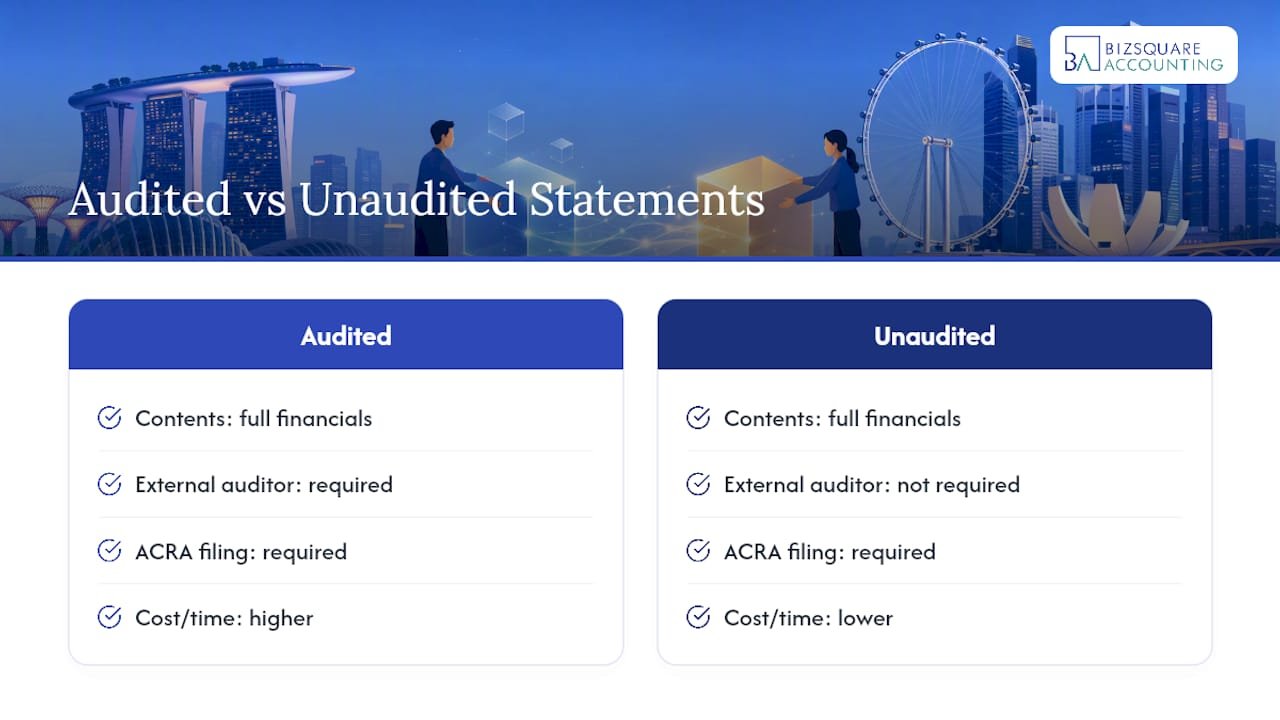
Unaudited financial statements are financial reports prepared without an external auditor checking them. They cover the same ground as audited accounts, the balance sheet, profit and loss, cash flows and notes, but no auditor has verified the figures independently. Singapore permits this shortcut for companies that qualify under the small company concept, a rule the Accounting and Corporate Regulatory Authority (ACRA) set out to ease compliance costs for smaller businesses.
Qualifying for audit exemption does not mean skipping financial reporting altogether. Every Singapore incorporated company must still file financial statements with ACRA, whether audited or not, as part of its annual return. The distinction matters for directors weighing cost against compliance obligations. Audited statements involve a licensed auditor’s opinion, which adds cost and time. Unaudited statements skip that step but still demand accuracy, proper structure and timely submission.
Who qualifies for audit exemption (small company concept)
A private company qualifies for audit exemption if it meets at least two of these three criteria, for the past two consecutive financial years:
- Total annual revenue below a certain threshold
- Total assets below a certain threshold
- A limited number of employees
This is known as the small company concept, and it applies specifically to private companies, not public ones. The assessment looks backwards over two consecutive financial years, so a company cannot claim exemption purely on one strong or weak year. If your company belongs to a group, the group’s total figures matter too. A subsidiary that looks small on its own can still fail the test if the wider group exceeds the thresholds.
Dormant companies have their own simplified rules and, in some cases, narrower filing obligations. Even so, dormant status does not automatically remove the need to file something with ACRA each year. Many directors assume audit exemption also removes directors’ declarations and statutory reports. It does not, and that misunderstanding causes late corrections during filing season more often than most people expect.
What to include: components of unaudited financial statements
Unaudited financial statements in Singapore still need the full structure that SFRS and ACRA expect, just without an auditor’s signature. A complete set typically includes:
- Directors’ statement, confirming the accounts give a true and fair view
- Statement of financial position (the balance sheet)
- Statement of comprehensive income (profit and loss)
- Statement of changes in equity
- Cash flow statement, where applicable
- Notes to the accounts, covering accounting policies and disclosures
Each page should be labelled clearly as “unaudited” where no assurance has been given, so readers, whether bank officers, investors or ACRA reviewers, understand exactly what level of checking the numbers received. For the specific line items and disclosure notes expected, ACRA’s minimum requirement list and the Singapore Financial Reporting Standards set the baseline every private company should follow.
Step-by-step preparation workflow for unaudited financial statements
Preparing unaudited financial statements works best as a sequence, not a scramble in the final week before your annual return is due. Here is a practical order to follow:
- Gather source documents. Pull bank statements, invoices, receipts, payroll records and loan agreements together, then reconcile every account and prepare a trial balance.
- Map the data to SFRS disclosures. Match your trial balance figures against the ACRA minimum requirement list, so nothing mandatory gets left out.
- Draft the AGM copy. Write out the full set of statements exactly as they will appear at the annual general meeting.
- Get directors’ sign-off. Directors must sign the directors’ statement, and the AGM copy must match the version submitted to ACRA, word for word.
- Decide the engagement level. Choose between plain preparation, a compilation, or a review engagement, and label the statements accordingly.
Pro Tip: If your company plans to approach a bank for financing soon, consider a compilation or review engagement instead of plain preparation. Lenders often want at least limited assurance, even from an audit-exempt company, according to guidance on audited versus unaudited statements.
Filing with ACRA: XBRL, BizFinx and the submission workflow
Directors have three practical routes to file financial statements in XBRL format with ACRA: the free BizFinx preparation tool, an ACRA-approved accounting software package, or a corporate service provider who handles submission on your behalf.
BizFinx lets preparers build XBRL files directly from Word or Excel source documents, and its auto-tagging feature maps line items to the ACRA minimum requirement list automatically. This cuts down on manual data entry considerably.
The minimum requirement list itself covers roughly 350 unique elements that preparers must consider, out of a full taxonomy of around 1,800 elements in total. That gap explains why mapping, not typing numbers, is usually the slowest part of the whole exercise.
Once your file is ready, a few practical steps remain:
- Run the file through BizFinx’s offline validation before uploading
- Upload to the BizFinx server and check for outstanding warnings
- File your annual return within 14 days of uploading your financial statements, and note that not every validation warning gets flagged automatically for correction
For a deeper technical walkthrough of the whole XBRL process, Bizsquare’s XBRL filing guide covers the mechanics step by step.
Common mistakes, validation errors and a pre-filing checklist
Most filing problems trace back to a handful of recurring errors. Mismatched totals between the main statements and the supporting notes cause a large share of validation queries. Missing directors’ statements, incorrect mapping to the minimum requirement list, and AGM copies that differ slightly from the ACRA submission round out the usual suspects.
Run through this checklist before you submit:
- All accounts reconciled and trial balance finalised
- Directors’ statement signed and dated
- AGM financial statements identical to the version uploaded to ACRA
- XBRL file passed validation, or all warnings reviewed and understood
- Statements clearly labelled “unaudited” where relevant
| Mistake | Consequence | Quick fix |
|---|---|---|
| Mismatched totals between statements and notes | Validation failure or ACRA query | Reconcile notes against the trial balance before mapping |
| Missing directors’ statement | Rejected or incomplete submission | Confirm sign-off before uploading |
| AGM copy differs from ACRA filing | Compliance breach | Use one master file for both purposes |
Where to find templates and sample unaudited financial statements
You do not need to design your statements from scratch. Several reliable sources offer ready-made structures:
- The ISCA illustrative financial statements are the standard reference for disclosure note wording and layout, kept current with SFRS changes.
- Accounting firms often publish their own sample templates, useful for seeing how notes and headings look in practice.
- ACRA’s taxonomy templates and minimum requirement list give the exact structure needed for XBRL mapping, which pairs well with the ISCA layout for the narrative sections.
Professional accountants tend to check their disclosure notes against the ISCA templates specifically because they reflect current practice, which reduces the risk of missing a mandatory item.
A practitioner’s view on common pitfalls
Mapping to the ACRA minimum requirement list almost always takes longer than directors expect, mainly because the taxonomy language does not match everyday bookkeeping terms. A compilation or review engagement earns its cost when a bank, investor or tender board wants more than bare figures. As a general rule, if your company deals with external financing or overseas partners, weigh assurance levels carefully before defaulting to plain preparation.
Get your unaudited financial statements prepared and filed correctly
Specialist service providers can handle the parts of this process that eat up directors’ time the most: reconciling accounts, mapping figures to the ACRA minimum requirement list, and pushing the finished XBRL file through validation before submission.

Rather than wrestling with BizFinx auto-tagging rules or double checking whether your AGM copy matches your ACRA upload, you can hand the whole workflow to accountants who file these statements every reporting season. Bizsquare’s accounting and bookkeeping services cover reconciliation and statement preparation, while the corporate secretary services handle directors’ statements, AGM documentation and statutory sign-offs in one coordinated process. If your company is still in the incorporation stage, Bizsquare’s company incorporation service can set your reporting structure up correctly from day one, saving you avoidable mapping headaches later. Get in touch for a proposal tailored to your company’s filing deadline.
Sources
- BizFinx preparation tool user manual
- ISCA illustrative financial statements resources
- Financial statements: Filing requirements & exemptions
FAQ
1.) What are the requirements for unaudited financial statements in Singapore?
A private company must meet at least two of three tests, revenue under $10 million, assets under $10 million, or 50 or fewer employees, over the past two financial years, then prepare a full set of statements labelled “unaudited” and file them with ACRA.
2.) What are unaudited financial statements?
They are financial statements prepared without an external auditor’s review, covering the same statements as audited accounts but without an independent opinion on the figures.
3.) Can you provide a sample of unaudited financial statements for Singapore?
The ISCA illustrative financial statements offer the most widely used template for structure and disclosure notes, and accounting firms also publish their own sample sets.
4.) Who is required to submit unaudited financial statements?
Any audit-exempt private company that still needs to file with ACRA can submit unaudited statements, provided it meets the small company criteria for the relevant two-year period.
5.) Does audit exemption mean I do not need to file anything with ACRA?
No. Every Singapore incorporated company must still file financial statements with ACRA, audit-exempt or not, though the format and depth of filing can differ.
6.) What is BizFinx and do I need it?
BizFinx is ACRA’s free tool for preparing and validating XBRL financial statements before filing them as part of your annual return.
7.) How long do I have to file after preparing my XBRL statements?
You generally need to file your annual return within 14 days of uploading your financial statements to the BizFinx server.
8.) What happens if my group company exceeds the small company thresholds?
If your company belongs to a group, the group’s combined figures are assessed too, so a small subsidiary can still lose exemption if the group as a whole exceeds the limits.
9.) Are dormant companies exempt from filing financial statements?
Dormant companies have simplified obligations in some cases, but they are not automatically exempt from filing something with ACRA each year.
10.) Should I choose a compilation or review engagement instead of plain preparation?
Consider it if you expect to approach a bank or investor soon, since third parties often want at least limited assurance beyond a plain unaudited statement.
11.) What is the ACRA minimum requirement list?
It is a set of roughly 350 mandatory data elements that XBRL filings must address, drawn from the full taxonomy of around 1,800 elements.
12.) Can I prepare unaudited financial statements myself without an accountant?
Yes, if you are comfortable with SFRS disclosures and XBRL mapping, though many directors find outsourcing preparation faster and less error prone.
13.) What is the most common reason XBRL filings get rejected?
Mismatched totals between the main statements and the supporting notes cause a large share of validation failures during ACRA review.


1 Comment
Why prepare a cash flow statement for your business
October 13, 2026, at 10:51 am[…] Add a third column for the prior period to enable month-on-month comparison. Bizsquare’s guide on preparing unaudited financial statements in Singapore provides a complementary preparation […]