


Make Boards Decide Faster: Board Reporting With 3–5 Questions
The single most effective change a company can make is opening every board report with a decision-first executive summary that answers three to five critical questions directly. This one shift, backed by governance research into question driven insight, shortens meetings and sharpens decisions. Boards spend less time hunting for the point and more time deciding what to do about it.
Overview:
Most board packs should be limited to four to six pages, with detailed data included in appendices rather than the main report.
An effective executive summary answers three to five prioritised questions clearly and ends with a specific action, such as approve, note, or advise.
Use six or fewer well-explained KPIs, focusing on trends and variance explanations, to support decision-making rather than overwhelming with data.
Distribute the full report five to seven business days before the meeting, and include a short cover memo highlighting urgent or new items.
Assign a clear owner for each section and verify all figures against sources before distribution to maintain trust and accuracy.
Board reporting best practices every author should apply now
Good habits compound. Once a reporting team adopts a few firm rules, every future pack gets easier to write and easier to read. These are the conventions worth locking in immediately, regardless of company size or industry.
- Cut anything that isn’t decision relevant. Operational detail belongs in management reports, not board packs.
- Open with a short executive summary. State the question, the answer, and whether input is needed.
- Add an explicit “input sought” line on every major item: approve, note, or advise.
- Distribute the full pack five to seven business days before the meeting, giving directors real preparation time, a rule confirmed by board reporting guidance.
- Check every number against its source before the pack goes out. A mismatched figure in one section undermines trust in the whole document.
These aren’t stylistic preferences. Board packs are growing longer and more expensive to produce, yet Board Intelligence’s research found most directors still rate them weak for actual decision making. Length is not the problem. Focus is.
What a board report must include
A board pack that works follows a predictable structure. Directors know where to look, authors know what to write, and nothing critical gets buried in the wrong section. Here is the canonical order, section by section.
- Cover page and purpose statement. State what the paper is for and what decision, if any, the board must make. This single line, sometimes called “input sought,” tells directors immediately whether they’re reading for approval, for awareness, or to offer advice.
- Executive summary built on prioritised questions. The strongest reports use the Question Driven Insight principle, framing the paper around three to five critical questions that are mutually exclusive and collectively exhaustive, as set out in Effective board reporting guidance from the Chartered Governance Institute. Each question gets answered immediately, not buried three paragraphs down.
- Financial dashboard with variance commentary. Budget versus actual, forecast against plan, and a short explanation for every meaningful gap. Numbers without commentary force directors to guess why performance moved.
- Strategic update and project highlights. Tie every update back to a decision the board previously made or must now make. Avoid narrating progress for its own sake.
- Risk and compliance snapshot. Set materiality thresholds so only risks above a defined level appear here, with a clear owner and mitigation status for each.
- Appendices for supporting data. Detailed schedules, historical comparisons, and granular figures belong at the back, cross referenced from the main body rather than repeated in it.
A CEO’s written report in particular should carry concise dashboards across financial, strategic, risk, and CEO performance, each with variances explained, according to guidance published in the Ivey Business Journal. Reliable financials underpin every one of these sections, and getting the underlying figures right starts with sound accounting practices long before the report is drafted.
How to write an executive summary boards will actually read
The executive summary is the only part of the pack most directors read in full before the meeting. Treat it as a standalone document, not a preview of what follows.
Start by applying the Question Driven Insight principle properly. List three to five questions the board genuinely needs answered this cycle, phrased the way a director would ask them. Then answer each question immediately, in the same sentence or the next one, followed by a single line of rationale. Never make the reader wait for the answer.
Close with an explicit ask. State whether the board needs to approve a decision, simply note an update, or advise on a direction the executive team is considering. Ambiguity here wastes meeting time on clarifying questions that a clearer summary would have avoided.
- Limit the summary to one page, roughly 200 words, for standard items.
- Lead with the answer, then the rationale, never the reverse.
- Use plain language. Save technical detail for the dashboard or appendix.
- End every item with a stated action: approve, note, or advise.
A one-page summary that states clearly why the paper matters and what the board must do measurably increases the odds the board reads and acts on it, according to DiliTrust’s board reporting guidance.
Pro Tip: Draft the “input sought” line first, before writing the rest of the summary. It forces clarity about what you actually need from the board, and everything else in the paper should support that single ask.

Choosing metrics and dashboards that support decisions
More metrics rarely mean better governance. Directors consistently prefer a small set of well explained numbers over a wall of data they must interpret themselves.
Cap governance KPIs at six or fewer per report, and favour trend over single-point snapshots. A revenue figure on its own tells a director little. The same figure alongside three prior periods, with a one-line note on why it moved, tells them everything they need for a decision.
Directors consistently favour concise dashboards, clear variance explanations, and decision focused commentary over long operational narratives, according to Limelight’s governance research.
Present budget versus actual figures with the variance stated as a percentage or amount, followed by a short explanation, never a bare number. Traffic light indicators work well for status at a glance, provided each one carries a takeaway sentence beside it rather than standing alone.
- Choose six or fewer KPIs and track them consistently cycle to cycle.
- Pair every chart or traffic light with one sentence explaining what it means.
- State clearly whether a figure is live data or a snapshot, and as of when.
- Reference the source system for any number a director might want to verify independently, aided by effective review management for Singapore SMBs.
- Include a rolling forecast where possible. Forward-looking scenario analysis adds real governance value beyond a static historical view, a point emphasised in Limelight’s research into reporting frameworks.
Getting these dashboards right depends on the quality of the underlying bookkeeping. A step-by-step approach to preparing financial statements helps ensure the figures feeding the dashboard are accurate before they ever reach a boardroom.
Briefing authors and running a tight production process
Most board pack problems start weeks before the meeting, not the night before. A structured briefing and production process prevents the last-minute scramble that produces inconsistent, error-prone papers.
- Issue a short author brief covering the paper’s purpose, its intended audience, and exactly which data sources to use. Ambiguity at this stage causes rewrites later.
- Set internal deadlines tied to month-end close, with a built-in verification checkpoint before any figures are finalised.
- Assign one clear owner per section, and nominate a single source of record for each metric so two authors never quote different numbers for the same figure.
- Run a sign-off checklist before distribution, confirming every cross-referenced figure matches and every “input sought” line is present.
Clarity at the briefing stage pays off directly. Organisations that give authors a full, structured brief produce noticeably stronger papers, yet Chartered Governance Institute research found only 56% of organisations give authors a complete brief, and just 43% provide structured feedback on the papers they submit. That gap is fixable with a template and a feedback loop, not a bigger team.
Pro Tip: Keep the author brief to one page. If it takes longer than five minutes to explain what a section needs, the report structure itself probably needs simplifying, not the brief.
Reliable internal controls make this whole process easier to sustain. Reviewing accounting best practices for SMEs is a practical starting point for tightening the verification steps behind every dashboard figure.
Getting distribution timing and meeting flow right
When a pack lands matters almost as much as what’s in it. Directors who receive materials too late arrive underprepared, and the meeting drifts into reading time rather than decision time.
- Distribute the full pack five to seven business days before the meeting. This window gives directors enough time to read, question, and prepare, a standard confirmed across multiple governance sources including Limelight’s reporting framework.
- Attach a short cover memo highlighting what’s new, what’s urgent, and where input is required.
- Use consent agendas for routine items, reserving live discussion time for genuinely strategic matters.
- Check virtual meeting logistics in advance if any directors are joining remotely, and flag sensitive topics for pre-reads.
- Invite brief pre-meeting queries on controversial items, so contentious debate happens before the meeting rather than derailing it.
Boards that plan meetings with timed agenda items and structured consent agendas consistently run more efficiently, a pattern confirmed by governance guidance from the Council of Nonprofits. Post-meeting feedback on the pack itself, even informal, improves the next cycle’s papers considerably.
Common mistakes and red flags to watch for
Certain errors show up in board packs again and again, and each one erodes trust a little more than the last. Recognising them early saves a governance team from repeating the same fix every quarter.
- Burying the real message. If the key ask is on page four of a narrative section, most directors won’t find it before the meeting.
- Inconsistent figures across sections. A revenue number in the summary that doesn’t match the dashboard undermines confidence in everything else in the pack.
- Too much operational detail. Day-to-day management information belongs in internal reports, not board papers.
- Late distribution. Sending the pack two days before the meeting defeats the purpose of the five to seven day window entirely.
- Missing resolutions. If the board is expected to approve something formally, the exact resolution wording should appear in the pack, not be improvised in the room.
- No action tracking. Decisions without a named owner and a deadline tend to quietly disappear until someone asks about them months later.
Most of these mistakes trace back to the same root cause: reports built around what management wants to report, rather than what the board needs to decide. The mismatch is well documented. Board Intelligence’s research into reporting effectiveness found many packs still fail to serve priority decision-making, despite growing steadily longer.
A checklist and template you can adapt this cycle
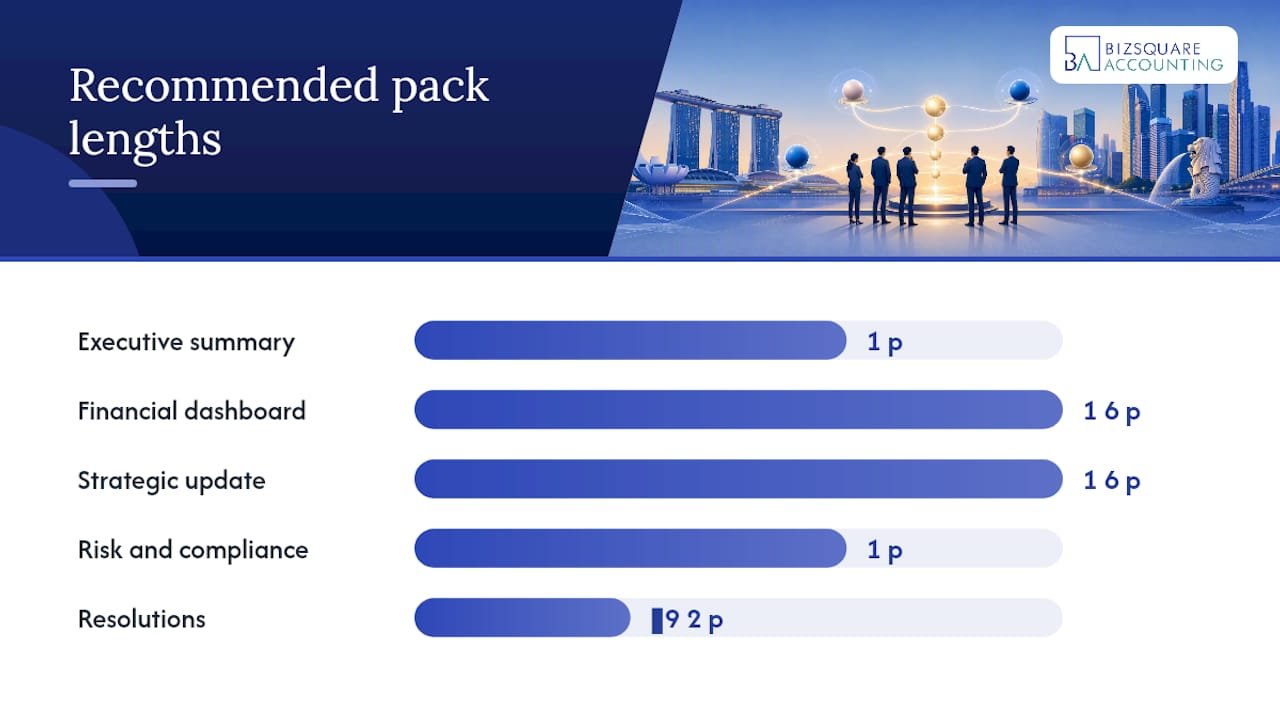
A reliable template removes guesswork from every future report. Use the structure below as a starting point, then adjust it for committees or one-off special items where a lighter version may suit better.
Pre-distribution verification checklist:
- Executive summary answers three to five prioritised questions directly.
- Every figure in the summary matches its corresponding dashboard entry.
- “Input sought” is stated clearly for each major item.
- Pack length sits within the recommended range for the item type.
- Risk section applies a stated materiality threshold.
- Sign-off obtained from each section owner before distribution.
| Pack element | Recommended length | Purpose |
|---|---|---|
| Cover page | Half a page | State purpose and input sought |
| Executive summary | One page, about 200 words | Answer key questions and state the ask |
| Financial dashboard | One to two pages | Show variance against budget and forecast |
| Strategic update | One to two pages | Link progress to prior board decisions |
| Risk and compliance | One page | Flag items above materiality threshold |
| Resolutions | Half a page | State exact wording for approval |
Standard items should stay within four to six pages total, with anything more detailed pushed into an annex and cross-referenced rather than inserted into the main body. Committees handling specialised matters, audit or remuneration for example, can extend the dashboard section but should keep the executive summary format identical, so directors serving on multiple committees aren’t relearning a new structure each time.
Bizsquare’s view on adopting these habits quickly
Companies rarely need to overhaul their entire reporting process at once. The fastest wins come from cutting pack length first, then fixing the executive summary, then tightening the metrics. In that order, not the reverse.
Most teams we speak with try to fix dashboards before fixing structure, and end up with a beautifully designed pack that still buries the actual decision. Structure first. Design later.
Specialist consultants work with growing companies to build the financial reporting backbone that good board packs depend on, from clean bookkeeping through to CFO-level dashboard design. A workable starting plan looks like this: audit your last three board packs for length and clarity this month, rewrite one executive summary using the Question Driven Insight format next month, then standardise the template across every recurring agenda item the month after. Small, sequenced changes beat a full rebuild that nobody finishes.
Get help building board reports that drive decisions
Certain firms provide growing companies a faster route to board-ready financial reporting than building the function in-house from scratch, without the months of trial and error most teams spend getting dashboards right on their own.

Our outsourced CFO and corporate advisory services help finance leads and company secretaries design dashboards, tighten variance reporting, and structure executive summaries that boards actually read cycle after cycle. If your board packs are drowning in operational detail or arriving too close to the meeting date, our team can review your current template and recommend a leaner structure within days. For companies still formalising governance structure altogether, our company incorporation service sets up the compliance foundation that good board reporting sits on top of. Get in touch to request a review of your next board pack before it goes out.
Sources
- Effective board reporting
- How to report properly to a corporate board
- Effective Board Reporting — The findings
- Board report: How to write one, template & examples
FAQ
1.) What are board reporting best practices in simple terms?
They are the conventions that make packs decision focused, including a short executive summary, verified figures, a limited set of KPIs, and distribution five to seven business days before the meeting.
2.) How long should a standard board report be?
Standard items should run four to six pages, with detailed data pushed into appendices rather than the main body.
3.) What is the Question Driven Insight principle?
It means structuring a report around three to five critical, non-overlapping questions the board needs answered, then answering each one directly and immediately.
4.) How many KPIs should a board report include?
Six or fewer governance KPIs per report, chosen for trend relevance rather than volume, works best for most boards.
5.) When should the board pack be distributed?
Five to seven business days before the meeting, with a short cover memo highlighting urgent or new items.
6.) What should an executive summary include?
Three to five prioritised questions with direct answers, a one-line rationale for each, and an explicit “input sought” statement.
7.) What does “input sought” mean in a board report?
It tells the board exactly what’s needed for that item, whether that’s approval of a decision, simple awareness, or advice on a direction.
8.) What is a consent agenda?
It’s a bundled set of routine, non-controversial items approved together in one vote, freeing meeting time for genuinely strategic discussion.
9.) What are common mistakes in board reporting?
Burying the key message, inconsistent figures across sections, excessive operational detail, late distribution, and missing formal resolutions.
10.) How do you present financial variances in a board report?
State the budget versus actual gap as a number or percentage, then add one line explaining the cause.
11.) Who should own each section of a board report?
Assign one named owner per section and one single source of record per metric, so figures never conflict across the pack.
12.) How can a company improve its board reporting process quickly?
Start by cutting pack length and rewriting the executive summary using the Question Driven Insight format, then standardise the template. Bizsquare’s accounting and bookkeeping services can help ensure the financial data feeding these reports is accurate from the outset.
13.) Should board reports include forward-looking forecasts?
Yes. Rolling forecasts and scenario analysis add real governance value beyond static historical figures alone.
14.) What belongs in the appendix of a board report?
Detailed schedules, historical comparisons, and granular supporting data that would clutter the main narrative, cross-referenced clearly from the body.
15.) How often should board reporting templates be reviewed?
Review the template at least once a year, and gather informal director feedback after each meeting to refine it sooner if needed.


1 Comment
Six business valuation methods: examples plus a one page template
September 19, 2026, at 7:29 pm[…] Make Boards Decide Faster: Board Reporting With 3–5 Questions […]