

Directors’ 14 Day Checklist for Striking Off a Company in Singapore
Striking off suits a company with no assets, no liabilities, no charges and no ongoing legal proceedings. If that describes your business, the next move is simple: prepare your final accounts, settle every tax matter with IRAS, and file the application through BizFile+. Directors still carry liability for unresolved debts even after the company is dissolved.
Overview:
A company with no assets, liabilities, charges, or ongoing legal issues qualifies for striking off, which is faster and cheaper than liquidation.
Eligibility checks require confirming zero residual cash, no charges, no tax issues, and accurate current information, as misstatements lead to investigation risks.
The application process is entirely online via BizFile+ and must include endorsements from all directors within 14 days to avoid lapses.
Post-application, ACRA reviews the case, and if uncontested, publishes a Gazette notice; objections can delay or block dissolution.
Unresolved tax issues or outstanding debts can cause application delays, and liabilities remain even after company registration is removed.
What is striking off a company in Singapore?
Striking off a company in Singapore is the process of asking the Accounting and Corporate Regulatory Authority (ACRA) to remove a business entity from the official register. It is designed for companies that are no longer trading and have nothing left to wind down, no debts, no assets, and no disputes in progress.
This differs from winding up by liquidation, which involves appointing a liquidator to formally realise assets and pay creditors. Striking off is faster and cheaper, but it only works for companies that are genuinely dormant. If your company still holds property, owes money, or faces a lawsuit, striking off will be rejected. You would need liquidation instead, which handles complicated financial situations that striking off was never built for.
Before you apply: eligibility and essential pre-filing checks
ACRA will only accept a striking off application if your company meets a strict checklist. Getting this wrong wastes time and can trigger a rejection or, worse, an investigation into false declarations.
Before submitting anything, confirm your company meets these conditions:
- No outstanding assets or liabilities on the books, including loans from directors or shareholders
- No charges registered against the company with ACRA
- No ongoing court proceedings, whether the company is suing or being sued
- No outstanding tax returns, GST filings, or notices from IRAS or other government bodies
- Accurate and current company information on the register, including registered address and officer details
Once eligibility is confirmed, work through the practical clean-up. Prepare final management accounts showing zero balances, close all corporate bank accounts, and distribute any remaining cash to shareholders through a board resolution. Update your registered office address if it has changed, since ACRA will send correspondence there throughout the process.
Pro Tip: Do not assume dormancy equals eligibility. ACRA specifically checks for residual cash balances, so even $50 sitting in a forgotten bank account can hold up your application.
Submitting a declaration that misstates your company’s financial position is a serious matter. ACRA can investigate directors who file inaccurate information, and the consequences extend well beyond a rejected application.
How to apply: step by step through BizFile+
The entire process of striking off a business Singapore runs through BizFile+, ACRA’s online filing portal. There is no government fee for this application, which makes it one of the more accessible compliance processes available to directors.
Here is how the filing typically proceeds:
- Log in to BizFile+ using Singpass or Corppass and locate the “Apply to Strike Off Business Entity” eService.
- Select the company you wish to strike off and confirm its Unique Entity Number (UEN).
- State the reason for cessation clearly, such as “company has ceased operations and has no assets or liabilities.”
- Enter the cessation date and submit the declaration confirming eligibility.
- Wait for the system to route the application to all directors and, where applicable, shareholders for endorsement.
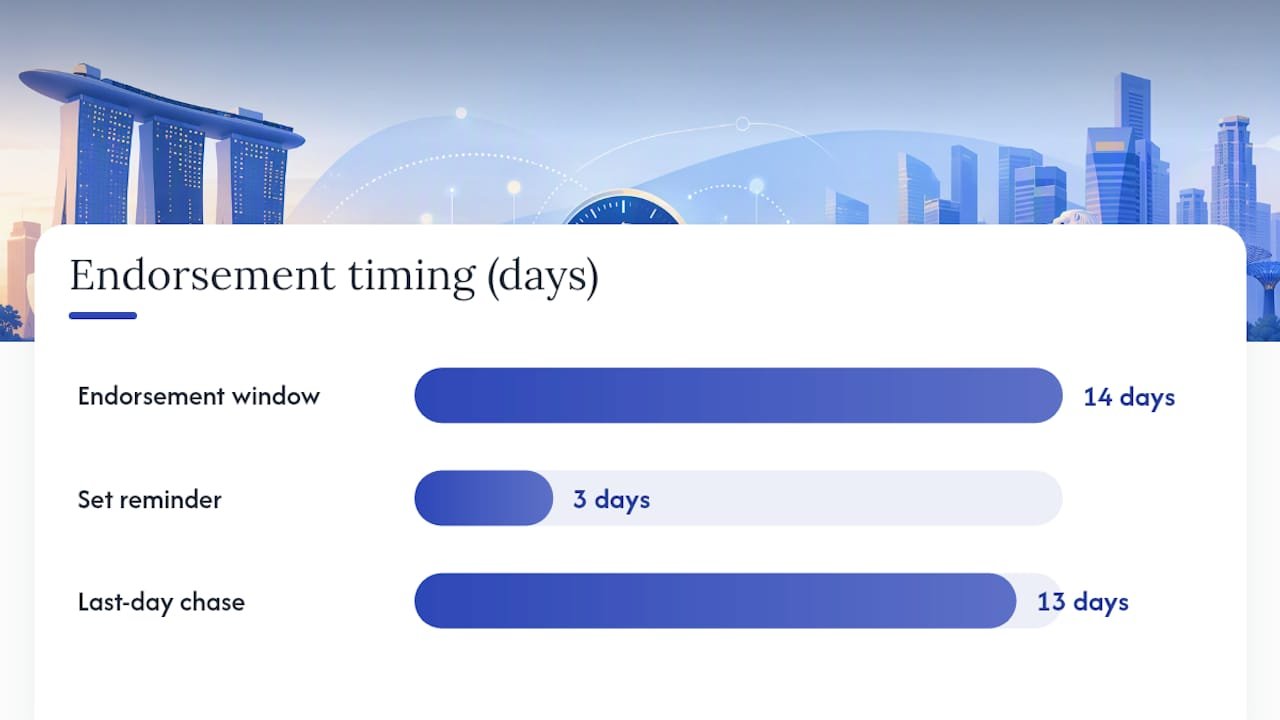
Every position holder named in the application must endorse it within 14 days, or the application lapses and you must start again. Companies using a corporate service provider sometimes qualify for exceptions to this rule, so check with your filing agent if endorsements are proving difficult to collect.
Pro Tip: Set a calendar reminder the day you submit. Chasing a co-director for an endorsement on day 13 is far more stressful than a gentle nudge on day 3.
The most common pitfall is a director travelling or being unreachable during the endorsement window. Monitor your Corppass notifications closely, and confirm each director has received and understood the request before the clock runs out.
What happens after you apply: ACRA review and Gazette notices
Once your application clears endorsement, ACRA reviews it against its internal checklist. If satisfied, ACRA sends a letter to the company and publishes the first notice in the Government Gazette, starting a formal objection window.
From this point, three outcomes are possible:
- Successful dissolution: no objections arrive within 60 days, ACRA publishes a final Gazette notice, and the company is struck off the register.
- Objection raised: a creditor, government agency, or another party objects, pausing the process until the issue is resolved.
- Application lapses: unresolved objections or missing information cause the application to fail, requiring a fresh submission.
Under section 344 of the Companies Act 1967, the Registrar holds the power to publish these notices and formally remove the company once the objection period closes without challenge. Dissolution does not erase liabilities. Directors and former shareholders can still be pursued for outstanding debts, and any leftover tax credits transfer to the Insolvency and Public Trustee’s Office (IPTO) for shareholders to claim later, subject to processing fees.
Withdrawing an application or restoring a struck-off company
Circumstances change, and ACRA allows you to withdraw a pending application through BizFile+ before the Gazette process concludes. Withdrawal takes effect almost immediately once submitted, halting the notice period and returning the company to active status.
If the company has already been struck off and you discover unfinished business, such as an unresolved contract or forgotten asset, restoration is still possible. Under section 344, any interested party can apply to the court for restoration within six years of dissolution. Once granted, the court order is lodged with ACRA, and the company is treated as if it had never been struck off. Courts typically direct how outstanding matters, such as costs or notifications to creditors, should be handled.
Tax matters: how IRAS objections cause delays
The Inland Revenue Authority of Singapore (IRAS) is one of the most common reasons striking off applications stall. IRAS will object if a company has outstanding tax returns, unresolved assessments, or unclaimed tax credits sitting on file.
Practitioners consistently observe that the biggest cause of delay is unresolved tax or compliance matters, not ACRA’s own processing time.
Before you file, work through this checklist with IRAS:
- File all outstanding Form C or Form C-S corporate tax returns
- Submit final accounts covering the period up to cessation of business
- Notify IRAS directly that the company has ceased operations
- Provide a contact person IRAS can reach if questions arise during review
If IRAS raises an objection, clear it fully before reapplying. Reapplying with the same unresolved issue simply repeats the delay. Many directors find it worthwhile to consult a tax adviser or work through corporate tax filing requirements properly before submitting, rather than risk a second lapse.
How long does striking off actually take?
Most companies should expect a minimum of around three months from ACRA approval to the final Gazette notice and dissolution. This accounts for the standard 60-day objection period plus administrative processing on either side.
Several factors commonly stretch this timeline further. An IRAS objection is the most frequent culprit, and each one can add weeks while you resolve outstanding returns or assessments. Unresolved creditor claims work the same way, pausing the clock until settled. Endorsement lapses, where a director misses the 14-day window, force a full resubmission and restart the process from scratch.
Directors should check BizFile+ notifications weekly during the objection period, rather than assuming silence means progress. A quick call to your corporate secretary or tax adviser at the first sign of delay usually resolves matters faster than waiting for ACRA to follow up.
Pre-filing checklist and document template
Before opening BizFile+, gather everything in one sitting. It saves you from starting the application, discovering a gap, and having to pause halfway through.
- Prepare final management accounts showing a zero balance across all accounts.
- Close every corporate bank account and confirm zero balance in writing from the bank.
- Distribute any remaining cash to shareholders via board resolution before closing accounts.
- Obtain written consent from all directors confirming they agree to the striking off.
- Update the registered office address on ACRA’s records if it has changed recently.
For documents, keep your final financial statements, your company’s UEN, board minutes or a resolution authorising closure, and confirmation of any outstanding Form C filings with IRAS ready to reference.
When entering the reason for striking off, keep the wording plain: “Company has ceased business operations, holds no assets or liabilities, and directors consent to closure.” For the cessation date, use the date operations genuinely stopped, not the date you happen to be filing.
Pro Tip: Photograph or scan your bank closure confirmation letters. ACRA or IRAS sometimes asks for evidence of zero balances well after you thought the paperwork was done.
What happens to intellectual property and licences after striking off?
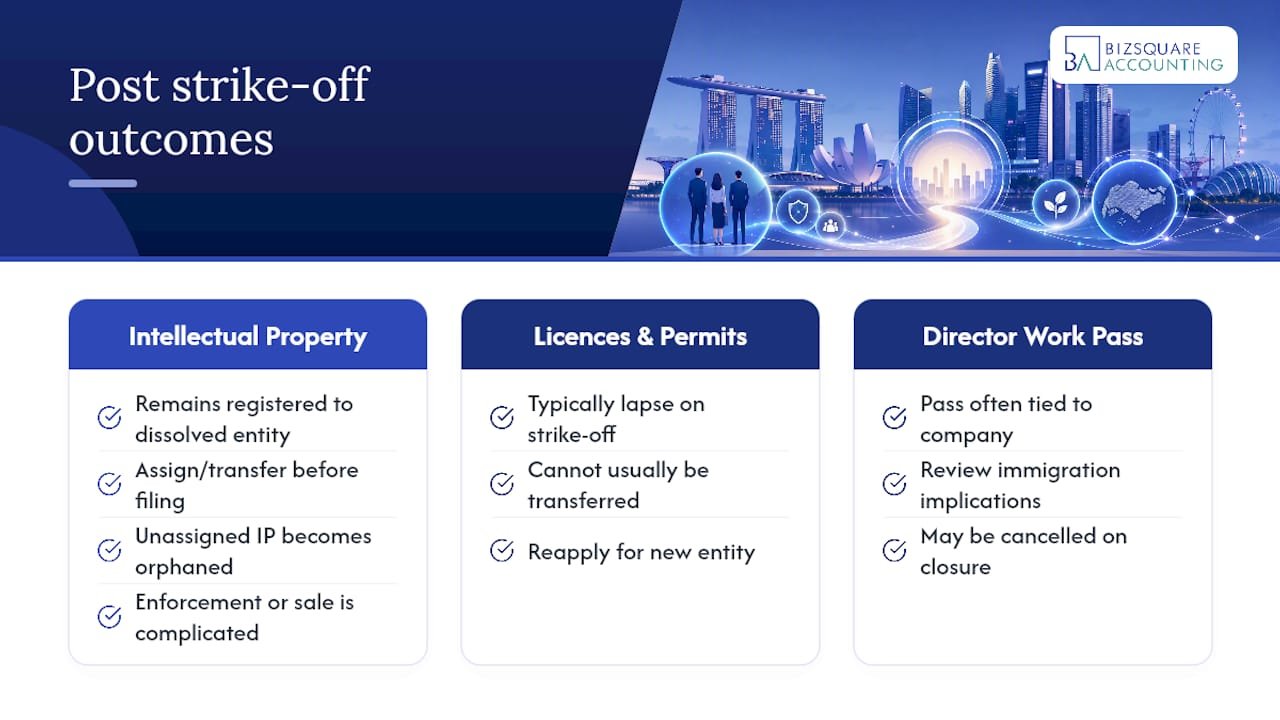
Striking off does not transfer or protect intellectual property automatically. Trademarks, patents, and copyrights registered to the company remain registered to a now-dissolved legal entity, which creates practical problems if anyone later wants to use, sell, or licence that IP.
Before filing, directors should assign or transfer any valuable trademarks, patents, or domain names to a shareholder, another company, or a holding entity. Leaving IP unassigned means it effectively becomes orphaned once the company disappears from the register, complicating any future attempt to enforce or sell those rights.
Business licences and permits, such as those issued by trade associations or sector regulators, typically lapse automatically once the underlying company is struck off. If you plan to continue similar activities under a new entity, you will usually need to reapply for these licences from scratch rather than transferring them. Directors holding an EntrePass or other work pass tied to the company should also review the immigration implications of closing a Singapore business before proceeding, since pass conditions are often linked to the company remaining active.
A practitioner’s view on where directors go wrong
Most directors treat striking off as a formality rather than a compliance exercise. That assumption causes the delays. The real risk is not ACRA’s review, it is unresolved tax positions and forgotten bank balances that surface months after directors thought the matter was closed.
Professional advisers can assist directors with secretarial filings, final accounts, and tax clearance before closure. The most useful habit is synchronising bank account closure with Corppass monitoring, and confirming your IRAS position in writing before you submit anything. When your situation involves multiple shareholders, foreign directors, or unresolved contracts, bringing in a corporate secretary or tax adviser early prevents a lapsed application later.
Let Bizsquare Accounting handle the closure paperwork for you
Closing a company properly takes more coordination than most directors expect, tax clearance, bank closures, endorsement chasing, and Gazette monitoring all happening at once. Specialist firms can manage the process of striking off a business in Singapore on your behalf, ensuring nothing slips through while you focus on winding down operations.

Such teams review eligibility checklists against ACRA’s requirements, prepare final accounts, manage director endorsements within the 14-day window, and liaise with IRAS to clear outstanding tax matters before submission. We also handle the corporate secretary filing itself, monitoring notifications on your behalf so a missed email never causes an application to lapse. If you are planning a fresh start afterwards, our company incorporation service makes re-registering straightforward. Contact a professional consultancy to book a consultation and get your closure filed correctly the first time.
Sources
- Companies Act 1967, section 344 — power of Registrar to strike defunct company off register
- Companies applying for strike off / to cease registration | IRAS
FAQ
1.) What happens when a company is struck off in Singapore?
The company is removed from ACRA’s register and legally ceases to exist as a corporate entity. Directors and shareholders can still be pursued for any unresolved debts despite the dissolution.
2.) How long does it take to strike off a company in Singapore?
Expect a minimum processing time from ACRA approval to final dissolution that includes the statutory Gazette objection period plus processing time.
3.) How can I object to the striking off of a company by ACRA?
Creditors, government agencies, or other interested parties can lodge an objection with ACRA during the 60-day window following the first Gazette notice.
4.) What happens if you strike off a company that still has debts?
ACRA will reject the application if outstanding liabilities are disclosed. If liabilities surface after dissolution, creditors can still pursue directors personally or apply to restore the company.
5.) Is there a fee to strike off a company in Singapore?
No. ACRA does not charge a fee for the voluntary striking off application submitted through BizFile+.
6.) Can a struck-off company be restored?
Yes. Under section 344 of the Companies Act, an interested party can apply to the court for restoration within six years of dissolution.
7.) What is the difference between striking off and winding up?
Striking off suits dormant companies with no assets or liabilities, while winding up by liquidation handles companies with debts, assets, or disputes that need formal resolution.
8.) Why would IRAS object to a striking off application?
IRAS objects when a company has outstanding tax returns, unresolved assessments, or unclaimed tax credits still on file at the time of application.
9.) Do all directors need to endorse the striking off application?
Yes, all position holders named in the application must endorse it within 14 days, or the application lapses and must be resubmitted.
10.) What documents do I need before applying to strike off a company?
Gather final financial statements, your company’s UEN, board resolutions authorising closure, and confirmation that all Form C filings with IRAS are complete.
11.) Can I withdraw a striking off application once submitted?
Yes, you can withdraw a pending application through BizFile+ before the Gazette objection period concludes, and the company returns to active status.
12.) What happens to a company’s intellectual property after striking off?
Trademarks, patents, and other IP remain registered to the dissolved entity unless transferred beforehand, so directors should assign valuable IP before filing.