
Most Singapore entities must identify their ultimate beneficial owners and maintain a Register of Registrable Controllers, then file required details with ACRA within prescribed timelines. Companies, foreign entities, LLPs and VCCs must keep internal registers current and submit specific information to the central register.
TL;DR:
- Most entities must identify UBOs and keep internal registers updated within one month of any change, with annual confirmation required since June 2025.
- Control can be established through ownership, director appointment rights, contractual influence, or indirect links exceeding 25 percent ownership.
- Exemptions apply mainly to listed companies, government-controlled entities, and certain regulated financial institutions; nominee arrangements require identifying the actual controller.
- Gathering comprehensive, verified personal documents and ownership charts upfront simplifies compliance and allows swift response during audits or reviews.
- Non-compliance can lead to fines up to S$25,000, personal liability for officers, and mandatory record retention of at least five years after any change.
Table of Contents
- What is a UBO in Singapore and when does control count?
- Who must file, and are there exemptions?
- Registers and filing mechanics: RORC, ROND and RONS explained
- What information and documents do you need for each UBO?
- Timelines, confirmations and penalties: what happens if you miss a deadline?
- How to identify UBOs in practice: a step by step checklist
- Perspective from Bizsquare: common mistakes we see and quick fixes
- How Bizsquare can help with UBO compliance
- Sources
- FAQ
What is a UBO in Singapore and when does control count?
An ultimate beneficial owner, often called a registrable controller under Singapore law, is the natural person who genuinely owns or controls an entity. This person sits behind the paperwork, even when shares are registered under someone else’s name.
The most common test is straightforward. But ownership isn’t the only route to control, and this catches many business owners off guard.
Control can also arise through:
- The right to appoint or remove a majority of directors
- Significant influence via contractual arrangements, such as a shareholders’ agreement
- Indirect ownership through a chain of companies, where the ultimate person still crosses the 25% mark
Consider a simple example. Guidance from Commenda confirms this layered approach is standard practice for tracing beneficial ownership.
Who must file, and are there exemptions?
Singapore casts a wide net when it comes to beneficial ownership disclosure. Most locally incorporated entities carry this obligation, regardless of size or industry.
Entities required to maintain registers and file with ACRA include:
- Private companies incorporated in Singapore
- Foreign companies registered here
- Limited liability partnerships (LLPs)
- Variable capital companies (VCCs)
Certain entities are exempted, including companies listed on the Singapore Exchange, wholly government owned entities, and financial institutions already regulated by MAS with equivalent transparency obligations. Nominee arrangements don’t remove your obligation either. If a shareholder holds shares as a nominee, the company must still identify and record the actual person giving instructions, not just the name on the share certificate.
Registers and filing mechanics: RORC, ROND and RONS explained
Understanding where information lives, and how it reaches ACRA, is where many company officers get stuck. Here’s the practical breakdown.
- Maintain the Register of Registrable Controllers (RORC). This internal record must be kept at your registered office or with your company secretary. ACRA requires every company to build and update this register continuously, not just at incorporation.
- Submit controller information to ACRA’s central register. Beyond the internal RORC, companies must lodge registrable controller details through ACRA’s online filing portal, typically via BizFile+.
- Keep separate registers for nominee directors and shareholders. The Register of Nominee Directors (ROND) and Register of Nominee Shareholders (RONS) capture anyone acting on someone else’s instructions. ACRA’s guidance on ROND and RONS sets out specific start dates for when these registers must be created and updated after any change in nominee status.
Missing a filing window here isn’t a minor administrative slip. It’s a compliance gap that regulators actively check for during reviews.
What information and documents do you need for each UBO?
Gathering the right paperwork upfront saves considerable frustration later. Each registrable controller’s file needs specific, verifiable details.
Collect these personal details for every UBO:
- Full legal name and any aliases
- Date of birth and nationality
- Residential address
- National ID or passport number and issuing country
- Nature and extent of their control (percentage or arrangement type)
For verification, you’ll also need certified copies of identity documents, recent proof of address, share certificates, and where ownership runs through multiple companies, a clear ownership chart showing each layer. Stripe’s guidance on Singapore UBO requirements confirms these data fields align closely with what financial institutions and payment platforms request during their own checks.
Pro Tip: Name your files consistently, such as “UBO_Surname_DocType_Date”, and store everything in one secure folder per entity. When ACRA or a bank asks for evidence during a review, you’ll find it in seconds rather than hours.
Timelines, confirmations and penalties: what happens if you miss a deadline?
The compliance clock starts the moment your company incorporates. You must set up your RORC promptly, then update it within one month of any change to controller information.
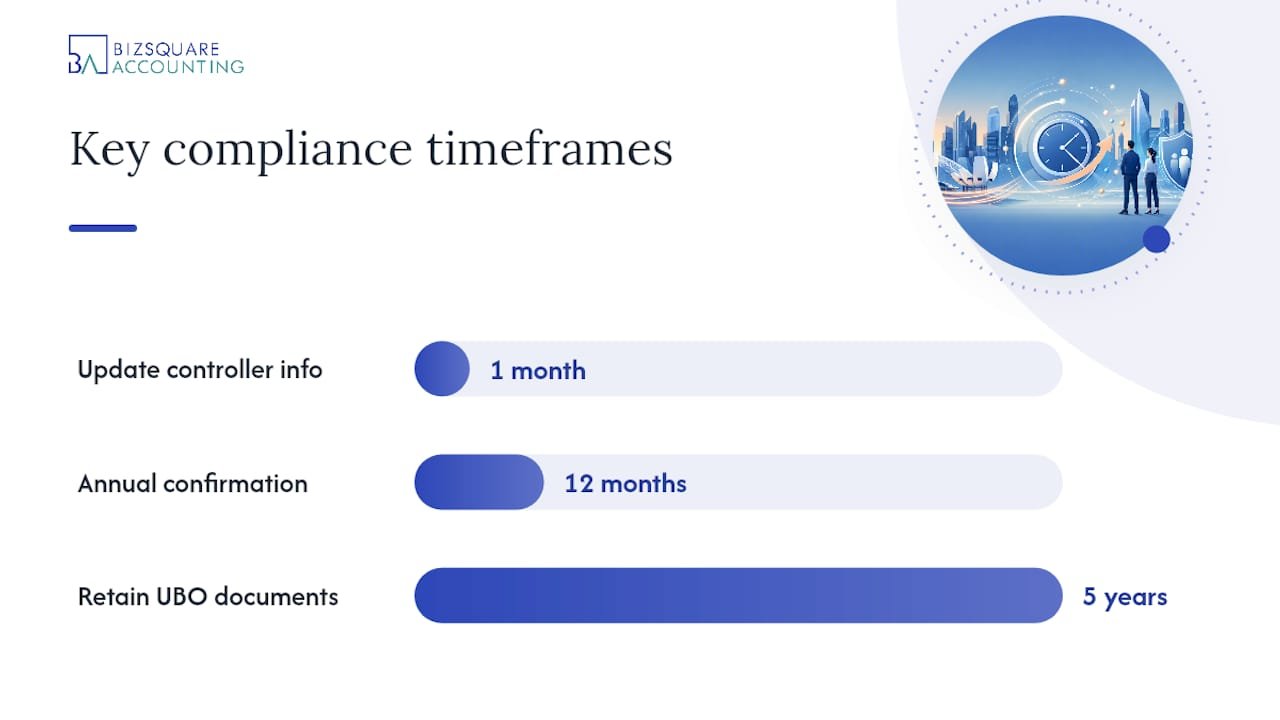
Since the Companies and Limited Liability Partnerships (Miscellaneous Amendments) Act 2024 came into effect on 16 June 2025, companies also face an annual confirmation obligation, requiring registrable controllers to reconfirm their details each year.
Non-compliance carries real financial and legal consequences:
- Maximum fines for register breaches have risen to as much as S$25,000 under the CLLPMA amendments
- Directors and company officers can face personal liability for failing to maintain accurate registers
- The Registrar can issue production orders demanding immediate access to your records
Retain all UBO documentation for at least five years after any change, even after an entity is struck off, since the Registrar can request historical records during investigations.
How to identify UBOs in practice: a step by step checklist
Tracing beneficial ownership properly takes more than a quick glance at your share register. Follow this sequence to build a defensible, accurate record.
- Map legal ownership first. List every shareholder, their percentage, and whether they hold shares directly or through another entity.
- Interview shareholders directly. Ask plainly whether they hold shares on someone else’s behalf. Nominee arrangements rarely show up on paper alone.
- Gather verification documents. Collect certified ID, proof of address, and ownership charts for any corporate shareholder layers, tracing the chain until you reach a natural person.
For structures involving multiple jurisdictions or trusts, apply enhanced due diligence in line with MAS’s risk based approach, which calls for deeper checks only where money laundering or terrorism financing risk is genuinely elevated. Trust beneficiaries, for instance, often require additional evidence such as trust deeds and settlor identification.
Pro Tip: Build a simple internal template with columns for name, control type, verification status and last review date. Update it every time a shareholder changes, not just once a year.
Complex cases, particularly layered offshore structures, are best referred to a corporate secretary or a firm such as Bizsquare, rather than handled with guesswork.
Perspective from Bizsquare: common mistakes we see and quick fixes
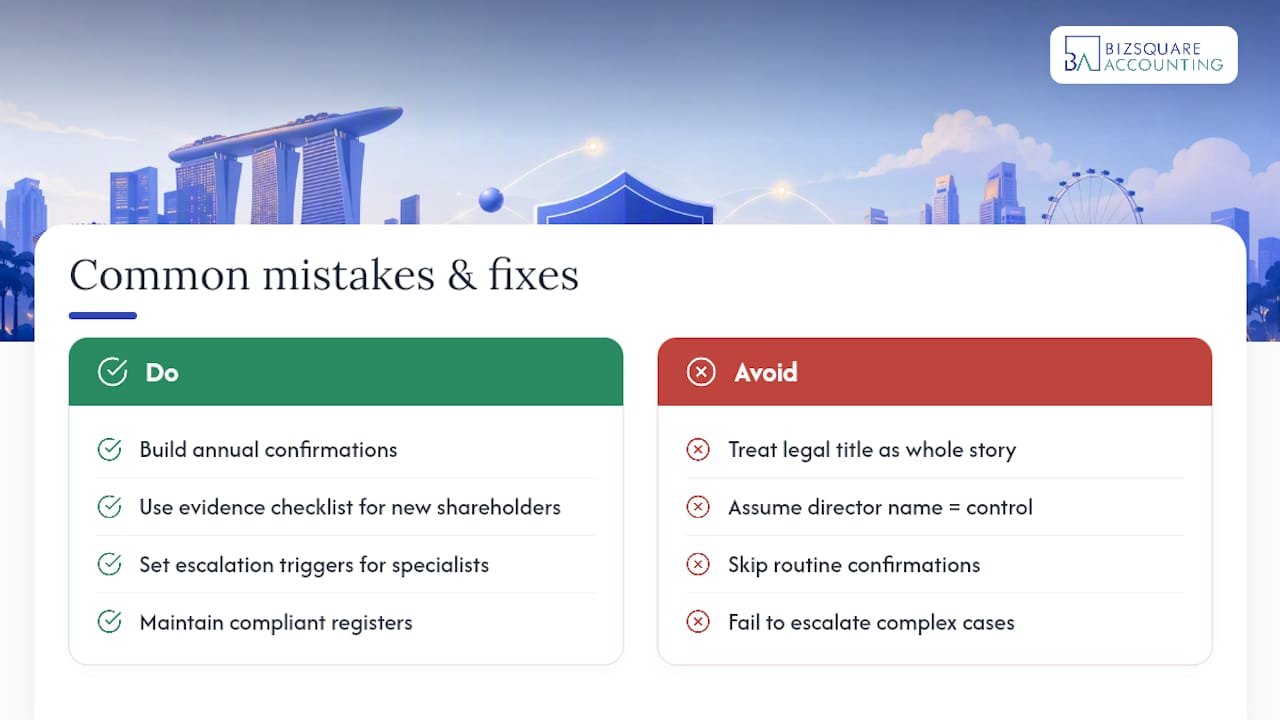
The most frequent error we encounter is treating legal title as the whole story. A director’s name on a share certificate rarely tells you who truly calls the shots, and assuming otherwise creates gaps regulators notice quickly.
The fix is disciplined routine. Build an annual confirmation habit, apply a standard evidence checklist to every new shareholder, and set clear triggers for when a case needs escalation to a specialist. Bizsquare has helped numerous Singapore companies build compliant registers that survive scrutiny during bank reviews and regulatory audits alike.
— Vandro
How Bizsquare can help with UBO compliance
Bizsquare is the practical alternative to piecing UBO compliance together yourself across spreadsheets, emails and guesswork. We handle company incorporation, corporate secretarial duties, document verification and annual confirmation filings under one roof, so your registers stay accurate without you chasing deadlines alone.

Our team sets up your Register of Registrable Controllers correctly from day one, verifies each UBO’s documentation against ACRA’s standards, and manages your ongoing filing calendar so nothing slips past the CLLPMA’s annual confirmation window. For entities with layered ownership, we can also work alongside specialist legal counsel, such as Beyond Horizons, when a structure needs deeper legal untangling.
Most engagements are scoped and running within a week of your first call. If you’re setting up a new entity or need your existing registers brought up to standard, get in touch with Bizsquare’s company incorporation team today and get your UBO compliance handled properly, from the first filing onward.
Sources
- Register of registrable controllers, ACRA
- Amendments to enhance transparency of beneficial ownership, Rajah & Tann Asia
- Guidelines to MAS Notice SFA04-N02 on prevention of money laundering and countering the financing of terrorism, MAS
FAQ
What are the requirements for UBO identification and verification?
Companies must collect full name, date of birth, nationality, residential address and identification number for each controller, backed by certified documents and ownership charts for corporate layers.
Who needs to declare beneficial ownership?
Private companies, foreign companies registered in Singapore, LLPs and VCCs must all declare beneficial ownership, unless they fall under a specific exemption such as being listed or wholly government owned.
What is the Register of Registrable Controllers?
The RORC is an internal record every company must keep at its registered office, listing all natural persons who qualify as registrable controllers under Singapore law.
When did the CLLPMA amendments take effect?
The Companies and Limited Liability Partnerships (Miscellaneous Amendments) Act 2024 provisions on beneficial ownership transparency came into effect on 16 June 2025.
What happens if a company fails to maintain its UBO register?
Companies risk fines of up to S$25,000, and directors can face personal liability for failing to keep accurate controller information.
Do foreign companies registered in Singapore need to comply with UBO rules?
Yes, foreign companies registered here must maintain and file registrable controller information just like locally incorporated private companies.
Are listed companies exempt from UBO filing requirements?
Yes, companies listed on the Singapore Exchange are generally exempt, along with wholly government owned entities and certain MAS regulated financial institutions.
How often must UBO information be confirmed?
Since the CLLPMA amendments, registrable controllers must reconfirm their details annually, in addition to updating records within one month of any change.
What are ROND and RONS?
ROND and RONS are registers tracking nominee directors and nominee shareholders respectively, which companies must maintain internally and file with ACRA.
Can Bizsquare help set up a UBO register for a new company?
Yes, Bizsquare handles company incorporation alongside corporate secretarial support, including building a compliant Register of Registrable Controllers from the outset.
How do trusts affect UBO identification?
Trust structures require identifying beneficiaries, settlors and trustees, often demanding trust deeds and additional verification under enhanced due diligence practices.
What documents are needed to verify a UBO’s identity?
Certified copies of a passport or national ID, recent proof of residential address, and, for corporate shareholders, an ownership chart tracing the full chain.
How long should companies retain UBO records?
Companies should retain UBO documentation for at least five years after any change, since the Registrar can request historical records during investigations.