

For most Singapore SMEs, the right move is a local bank account from DBS, OCBC or UOB for full-service banking, paired with a trust bank account Singapore if you invoice overseas clients. Banks give you lending and branch access. Fintechs give you transparent FX pricing and faster onboarding. Most founders end up using both.
TL;DR:
- Traditional local banks like DBS, OCBC, and UOB are required for access to trade financing, overdrafts, and cheque services.
- Fintech providers such as Wise and Airwallex offer transparent FX margins and faster online onboarding, ideal for FX-heavy transactions.
- Getting corporate documents and UBO information up-to-date and certified prior to application significantly reduces onboarding delays.
- Online account opening is typically available for wholly Singapore-owned companies, but foreign ownership often necessitates branch visits or notarised paperwork.
- Comparing total landed costs involves assessing monthly fees, fall-below charges, transaction fees, and FX spread to choose the most cost-effective option.
Table of Contents
- Choosing a corporate bank account Singapore SMEs actually need
- How top Singapore business accounts compare
- What each shortlisted provider offers and who should pick it
- How do you pick the right account for your business?
- Required documents: the definitive Singapore checklist
- Opening the account: process and timelines
- Understanding fees, FX margins and hidden costs
- Bizsquare’s bank readiness checklist for smoother onboarding
- What the conventional advice on business banking gets wrong
- How Bizsquare gets your company bank-ready
- Where to confirm rules and live offers
- Sources
- FAQ
Choosing a corporate bank account Singapore SMEs actually need
Every business registered with ACRA needs somewhere to separate company money from personal funds. A corporate bank account isn’t optional paperwork, it keeps your books clean and makes tax season far less painful. GoBusiness confirms this is a required step for newly incorporated businesses, and it directly supports your income tax filing later.
The trouble is choice. Singapore has three heavyweight local banks, a handful of MAS-licensed fintechs, and several digital-first accounts all competing for your custom. Some entrepreneurs assume a “business account” is a business account, full stop. It isn’t. A traditional bank and a payment institution operate under different licences, offer different protections, and suit entirely different business models.
This guide walks through what each option actually offers, what documents you’ll need, and how to avoid the KYC delays that trip up most first-time applicants. We’ll also flag where Bizsquare’s corporate secretary and incorporation services can smooth the process before you even submit an application.
How top Singapore business accounts compare
Before picking a provider, it helps to see fees, currency support and eligibility side by side. The table below covers the account types most SMEs shortlist, drawn from published product pages and market comparisons.
| Provider | Account type | Monthly/maintenance fees | Multi-currency support | Ease of opening | Best for |
|---|---|---|---|---|---|
| DBS | Bank | Fees vary by bundle; some waived for local ownership | 13 currencies | Online for eligible local companies, branch for others | SMEs wanting full banking plus lending |
| OCBC | Bank | Fall-below fees apply below minimum balance | Multi-currency options available | Singpass-enabled online opening for eligible firms | Cost-conscious SMEs needing branch access |
| UOB | Bank | Fees vary by account tier | Multi-currency options available | Online and branch, depending on entity structure | Established SMEs needing trade finance |
| CIMB | Bank | Published on CIMB’s digital business account page | Multi-currency options available | Online application for eligible companies | SMEs wanting digital-first banking with branch backup |
| Airwallex | MAS-licensed payment institution | No monthly fee on base plan (check current terms) | Multi-currency wallets | Fully online | High-volume cross-border SMEs |
| Wise Business | MAS-licensed payment institution | No monthly fee | Wide range of currency wallets | Fully online | SMEs wanting transparent FX margins |
| Aspire | MAS-licensed payment institution | No monthly fee on basic plan | Multi-currency support | Fully online | Startups needing expense controls |
| Revolut | MAS-licensed payment institution | Tiered plans | Multi-currency support | Fully online | Digital-first SMEs |
| WorldFirst | MAS-licensed payment institution | No monthly fee on standard tier | Multi-currency support | Fully online | Exporters and marketplace sellers |
Three things to keep in mind when reading this table. First, “bank” and “payment institution” are different MAS licence categories, and only banks offer cheque books, overdrafts and most lending products. Second, online opening usually requires the company to be wholly Singapore-owned; foreign shareholding often means a branch visit. Third, fee tables change often, so always confirm current terms on the provider’s own page before applying.
A few quick takeaways worth noting:
- Local banks remain the only route to trade financing, overdraft facilities and cheque services.
- MAS-licensed fintechs like Wise and Airwallex typically undercut banks on FX margins.
- Singpass-enabled online opening, as offered by DBS and OCBC, can cut onboarding from weeks to days for eligible local firms.
What each shortlisted provider offers and who should pick it
DBS Business Multi-Currency Account suits SMEs that want one relationship covering everything from day-to-day transactions to future borrowing. It supports 13 currencies, offers starter bundles for new companies, and integrates with the DBS IDEAL platform for online banking. Locally owned companies can often apply online; others typically need a branch visit.
OCBC’s Business Growth Account appeals to founders who want branch access without heavy fees. Eligible Singapore-registered companies can open it entirely online using Singpass, and OCBC publishes clear fee tables including fall-below charges, so there’s no guesswork on minimum balances.
UOB offers eBusiness and standard Business Accounts geared towards SMEs that expect to need trade finance or working capital lines down the road. Its branch network suits founders who still value face-to-face banking relationships.
CIMB’s digital business current account targets SMEs comfortable managing everything online while retaining branch support if needed.
Maybank FlexiBiz and Youbiz round out the local bank and digital-account options, generally positioned for smaller SMEs wanting straightforward day-to-day banking without complex product bundling.
The MAS-licensed fintechs work differently. They aren’t banks, so they can’t offer cheque books, overdrafts or most lending. What they do offer is speed and pricing transparency.
- Wise Business publishes its FX margin upfront and supports a wide range of currency wallets, ideal if you invoice clients in multiple countries.
- Airwallex suits businesses moving large transaction volumes across borders, with multi-currency wallets and competitive FX pricing.
- Aspire focuses on startups that want built-in expense cards and spend controls without monthly fees on its basic plan.
- Revolut Business and WorldFirst both offer fully digital onboarding, useful if your directors are based overseas and can’t easily visit a branch.
Market comparisons consistently note that fintechs win on FX cost but lose on lending access, so most growing SMEs end up holding both a bank account and a fintech wallet.
How do you pick the right account for your business?
Start with a simple checklist before comparing providers:
- How often do you send or receive foreign currency payments?
- Will you need an overdraft, trade financing, or a business loan within the next two years?
- Do you run local payroll through GIRO, and does the provider support it?
- Does the account integrate with your accounting software?
- Do you or your directors need branch access, or is fully digital fine?
As a rule, pick a bank first if you expect to borrow, need cheque facilities, or run payroll through established GIRO arrangements. Pick a MAS-licensed fintech first if your business is FX-heavy and you want to avoid bank spreads eating into margins.
When you meet a bank or fintech, ask these questions directly:
- What documents do you need from directors and UBOs?
- What’s the minimum average balance, and what’s the fall-below fee?
- What’s your FX margin on major currency pairs?
- Are there per-transaction fees for local transfers, GIRO or telegraphic transfers?
- Is the account covered under the Singapore Deposit Insurance Scheme?
- How long does KYC typically take for foreign-owned companies?
- Can I open the account without visiting a branch?
- What transaction limits apply monthly?
- Do you support integration with accounting software?
- What happens if a director is based overseas?
Pro Tip: Ask for the fee schedule in writing before applying. Verbal quotes from relationship managers sometimes differ from the published terms.
Required documents: the definitive Singapore checklist
Banks and fintechs both draw from a similar document list, though fintechs often accept digital uploads while banks may require certified copies.
- ACRA business profile (typically no older than one month)
- Certificate of Incorporation
- Company constitution
- Board resolution authorising the account opening and naming signatories
- Completed bank or fintech application forms
- Certified true copies of identification for all directors, signatories and ultimate beneficial owners
- Proof of residential address for the same individuals, usually a recent utility bill or bank statement
GoBusiness confirms this document set as standard across most banks. Certification can usually be done by a company secretary, a practising lawyer, or a notary public, which matters most for overseas directors who can’t sign in person. Where eligible, Singpass and MyInfo can pre-fill some of this information for locally owned companies, cutting paperwork significantly.
Opening the account: process and timelines
The process generally follows a predictable path, though timelines vary sharply depending on ownership structure.
- Gather and certify all required documents in advance.
- Choose a provider based on your priority, whether that’s lending, FX cost or branch access.
- Submit the application online or at a branch.
- Wait for the bank’s KYC and AML checks, which focus heavily on verifying ultimate beneficial owners.
- Receive account activation and initial login credentials.
For wholly Singapore-owned companies applying online, activation can happen within days. Where foreign shareholders or complex ownership structures are involved, expect several weeks, since banks and payment institutions run deeper verification on non-resident UBOs.
If directors are overseas and can’t visit a branch, three options usually work: notarised documents sent by courier, signing at an overseas branch of the same bank group, or switching to a MAS-licensed fintech that supports fully remote onboarding.
Understanding fees, FX margins and hidden costs
Corporate accounts carry several fee categories worth understanding before you commit. Monthly or maintenance fees apply regardless of activity. Fall-below fees kick in when your average daily balance dips under the required minimum, and maintaining that minimum balance avoids a cost that quietly erodes thin margins over a year. Per-transaction fees apply to GIRO, cheques and telegraphic transfers, while overseas wires often carry correspondent bank charges on top of the sender’s fee.
FX margin is where the real cost difference shows up. Banks typically build a spread into their exchange rate, while fintechs like Wise and Airwallex publish a transparent margin on top of the mid-market rate. Say you’re sending $50,000 to a supplier in the US. That gap adds up fast if you pay overseas suppliers monthly.
- Always ask for the exact FX margin, not just “competitive rates.”
- Compare total landed cost, not just the headline transfer fee.
- Check MAS’s register to confirm a provider’s licence status before moving large sums, since MAS regulates both banks and payment institutions differently.
Bizsquare’s bank readiness checklist for smoother onboarding
Bizsquare prepares clients for bank onboarding by first tidying up ACRA filings, confirming UBO records are current, and drafting board resolutions correctly formatted for bank submission. Clean, up-to-date corporate secretary records reduce the KYC back-and-forth that delays most applications. Founders who arrange company incorporation through a service that also handles secretarial compliance typically walk into bank applications with every document already certified and ready.
What the conventional advice on business banking gets wrong
Most guides treat this as a straightforward “best bank” ranking, and that framing misses the point. Singapore’s smartest SMEs don’t pick one account, they build a small stack: a local bank for lending and branch access, plus a fintech wallet for FX-heavy transactions. Chasing a single “winner” ignores that banks and payment institutions solve different problems entirely.
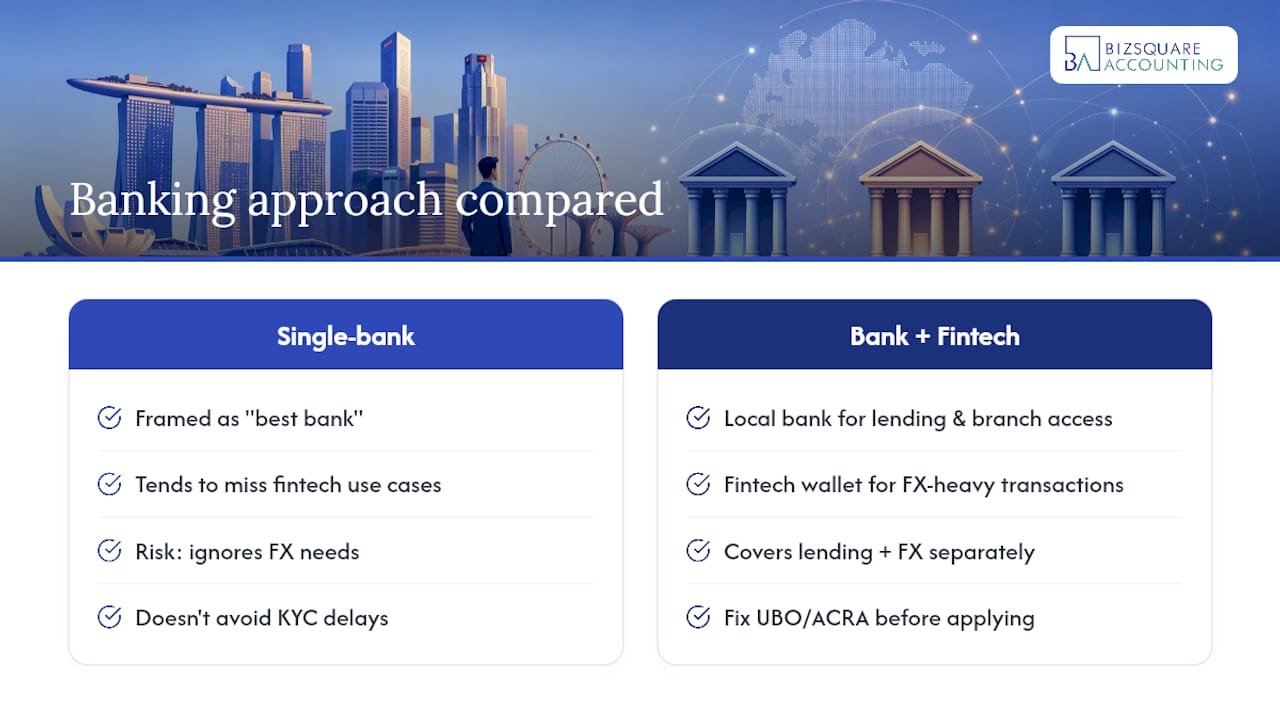
The conventional wisdom also underplays UBO verification. Founders assume a strong personal banking history speeds things up. It doesn’t. Banks run entity-level checks separate from your personal record, and outdated ACRA filings are the single biggest cause of delay. Fix your company records before applying, not after a rejection.
If there’s one priority worth acting on first, it’s this: get your corporate documents and UBO details airtight before you touch an application form. Everything else, whether that’s FX margins or account bundles, matters far less than passing KYC on the first attempt.
— Vandro
How Bizsquare gets your company bank-ready
Sorting out ACRA records, UBO declarations and board resolutions is the part most founders underestimate, and it’s exactly where applications stall for weeks. Bizsquare handles incorporation, corporate secretary duties and bookkeeping together, so your documents arrive at the bank already certified and consistent, cutting out the back-and-forth that causes most KYC delays.

One common error we see is founders applying with an outdated ACRA business profile, which triggers an automatic request for revised documents and adds another one to two weeks to onboarding. Bizsquare’s company incorporation service builds your bank-readiness into the setup process from day one, rather than treating it as an afterthought. If you’re incorporating a new company or tidying up an existing one before approaching a bank, get in touch with Bizsquare to prepare your documents correctly the first time.
Where to confirm rules and live offers
Bank fees, promotions and eligibility rules change regularly, so verify directly before applying. Check GoBusiness for the official checklist, MAS for licensing status, and each bank’s own product page for current terms and offer end dates.
Sources
- Step 6: Open a corporate bank account | GoBusiness
- Business Account, Corporate Bank Account Singapore | DBS SME Bank
- Business Growth Account – Corporate Bank Account | OCBC Singapore
- 6 traditional banks in Singapore: Fees, pros and cons | WorldFirst SG
- Monetary Authority of Singapore
FAQ
Which bank is best for a business account in Singapore?
There’s no single best bank, it depends on your priorities. DBS, OCBC and UOB all suit SMEs needing lending and branch access, while fintechs like Wise and Airwallex suit FX-heavy businesses better.
Can I open a corporate bank account as a foreign-owned company?
Yes, but expect a longer process. Foreign ownership usually means branch visits and deeper KYC checks, sometimes taking several weeks rather than days.
Which bank is the best for corporate banking overall?
Among traditional banks, DBS, OCBC and UOB all offer strong SME product ranges, so the right choice depends on whether you prioritise multi-currency support, branch access or trade finance.
What is the difference between a personal bank account and a corporate bank account?
A corporate bank account is registered under your company’s legal entity and requires ACRA documents, while a personal account only requires individual ID. Corporate accounts also undergo separate entity-level KYC checks.
How long does it take to open a corporate bank account in Singapore?
Locally owned companies applying online can sometimes get approved within days. Foreign-owned or complex structures typically take several weeks due to deeper verification requirements.
What documents do I need to open a corporate bank account?
You’ll need your ACRA business profile, Certificate of Incorporation, company constitution, board resolution, and certified ID and address proof for directors and UBOs.
Do I need to visit a branch to open a business account?
Not always. Eligible wholly Singapore-owned companies can often open accounts online using Singpass, while foreign-owned companies usually need a branch visit or notarised documents.
What is a MAS-licensed payment institution?
It’s a non-bank platform, such as Wise or Airwallex, licensed by the Monetary Authority of Singapore to handle payments and multi-currency accounts, though without full banking services like loans.
Why was my corporate bank account application rejected?
Common reasons include outdated ACRA records, incomplete UBO declarations, or missing certified documents. Updating your company secretarial records before applying reduces this risk.
Are corporate bank deposits insured in Singapore?
Many banks participate in the Singapore Deposit Insurance Scheme, but coverage details vary by provider, so confirm directly with the bank or check MAS’s records.
Can Bizsquare help me prepare for a bank application?
Yes, Bizsquare’s corporate secretary and incorporation services ensure your ACRA filings, UBO records and resolutions are accurate and current before you approach a bank.
What fees should I compare between corporate accounts?
Compare monthly fees, fall-below fees, per-transaction charges, and FX margins on international transfers, since these vary significantly between banks and fintechs.