


How to convert a sole proprietorship to a Pte Ltd in Singapore
No, Singapore does not allow a direct statutory conversion from sole proprietorship to Pte Ltd. Instead, you incorporate a new private limited company through ACRA’s BizFile system, transfer your business assets, contracts and licences, then formally cease the sole proprietorship. The main agencies you will deal with are ACRA, IRAS and CPF, each covering a distinct part of the process.
Overview:
- Converting from a sole proprietorship to a Pte Ltd requires setting up a new company, transferring assets and contracts, and ceasing the old registration, without a direct statutory conversion.
- You must incorporate the company through ACRA with a reserved name, appoint a resident director and secretary, and decide on GST registration early in the process.
- Licensing or permits tied to the sole proprietorship often need separate approval or new applications, requiring careful planning to maintain compliance.
- Transferring contracts and bank accounts involves reassignments, with most banks and insurers requiring company-stamped documents before updating records.
- After incorporation, it is essential to establish a separate company bank account, register as an employer if hiring staff, and stay on top of statutory filing requirements to remain compliant.
Why convert a sole proprietorship to a Pte Ltd, and what to decide first
Most owners who look into how to register a Pte Ltd are chasing one thing: protection. A sole proprietorship offers none. If the business runs into debt or gets sued, your personal savings, your car and even your home are fair game. A private limited company draws a legal line between the business and you as an individual, so your exposure is generally limited to what you have invested in shares.
There are other reasons owners make the switch. A Pte Ltd often enjoys more favourable corporate tax treatment than a sole proprietorship taxed at personal income rates. Banks, government tenders and larger clients also tend to trust a registered company more readily than a one-person outfit. Unlike a sole proprietorship, which legally ends when the owner dies or retires, a Pte Ltd has perpetual succession, so it can continue under new ownership or management.
None of this comes free; for example, you may need to secure a professional license with a local agent if your business activities require it. A Pte Ltd must appoint a company secretary, keep statutory registers, hold annual filings and maintain proper accounting records, obligations a sole proprietorship never faces. During the changeover period, you may also find yourself reporting income under both structures for part of the transition, which adds a temporary layer of bookkeeping.
Before you start the paperwork, settle a few decisions:
- Confirm your new company name and check it is not already taken on BizFile.
- Decide on shareholding, whether it is just you, a co-founder, or family members.
- Appoint at least one director who is ordinarily resident in Singapore.
- Decide early whether you will register for GST at incorporation or wait until turnover requires it.
- Decide whether to keep your existing trading name as the company’s name, which can help retain brand recognition.
Pro Tip: Reserve your company name on BizFile before you touch anything else. Names get taken quickly, and rebuilding a marketing plan around a last-minute name change is a headache you can avoid entirely.
Steps to convert your business type: sole proprietorship to Pte Ltd
Converting a sole proprietorship to a Pte Ltd is really four separate projects stitched together. Miss the order and you risk gaps in licensing or invoicing continuity.
Step 1: Check your licences and secure any no-objection letters
Not every trade needs this step, but many regulated ones do. If you hold a food licence, a moneylending licence, or certain professional certifications, the regulator overseeing that licence may need to approve the transfer before you incorporate. The GoBusiness licensing e-adviser confirms that Singapore law does not permit a sole proprietorship to convert directly into a company, so you must close the old entity and open a new one, and any licence tied to your old registration needs fresh action too. Common examples include food shop licences, import and export permits, and childcare or healthcare-related certifications.
Step 2: Incorporate the new Pte Ltd through ACRA and BizFile
This is the step most people picture when they think about how to register a Pte Ltd. You will need:
- A reserved company name.
- At least one resident director and a company secretary appointed within six months.
- A registered office address in Singapore.
- Details of shareholders and initial share capital, which can be as low as $1.
- A constitution document, often based on a standard template.
Filings happen through BizFile (ACRA), and ACRA publishes the exact statutory requirements for officers, share structure and ongoing filing duties. Approval for straightforward applications typically comes through within a day once documents are in order, though anything requiring referral to another agency takes longer.
Step 3: Transfer assets, contracts and payment systems

This is where the real migration work sits, and it is also where owners underestimate the effort involved. You need to novate or reassign existing contracts, move invoicing details over to the company name, and open a company bank account. Practitioner guidance from SingaporeLegalAdvice points out that banks and insurers usually require company-stamped documents before they will update records, so do not assume a merchant account or an insurance policy carries over automatically. Update your payment processor, your supplier agreements, and any lease or hire purchase arrangement tied to the old business name.
Step 4: Cease the sole proprietorship
Once the new company is trading and the handover is stable, file for cessation of the sole proprietorship on BizFile and notify IRAS of the closure. Keep evidence of every step, incorporation certificate, transfer letters, and cessation confirmation, in case any authority queries the timeline later.
| Step | Main authority | Typical timeframe |
|---|---|---|
| Licence check / no-objection letters | GoBusiness, sector regulator | 1 to 3 weeks |
| Company incorporation | ACRA / BizFile | 1 day to 2 weeks |
| Asset and contract transfer | Banks, suppliers, processors | 4 to 8 weeks |
| Cessation of sole proprietorship | BizFile, IRAS | 1 to 2 weeks |
What to do after incorporation to stay compliant
Forming the company is only half the job. The protection only becomes real once your operations actually run through the new entity, not the old one.
Start with a dedicated company bank account and keep it entirely separate from your personal finances. Mixing funds undermines the very liability protection you incorporated to gain, and it makes bookkeeping unnecessarily messy.
If you plan to hire staff, or you are moving existing helpers onto the company payroll, you must register as an employer with CPF and set up monthly contributions correctly. The CPF employer guide covers registration steps and explains Skills Development Levy obligations that apply to every employer, regardless of company size.
Check your GST position early. If your taxable turnover has crossed, or is likely to cross, the registration threshold, IRAS guidance on GST registration sets out the application process and the deadlines for notifying the authority once you become liable.
Other tasks to lock in during the first few weeks:
- Appoint a company secretary and prepare statutory registers of members, directors and shareholders.
- Set your financial year end and mark the annual return filing date on BizFile.
- Update all invoices, contracts and marketing collateral to reflect the new company name and UEN.
- Confirm corporate tax obligations with a proper filing calendar in place.
Owners often assume they have three years of grace before annual filing kicks in. In reality, ACRA expects the first annual general meeting and annual return within specific statutory windows from incorporation, so this is not a task to leave until year-end scrambling begins.
Why local advisers matter when you convert sole proprietorship to Pte Ltd
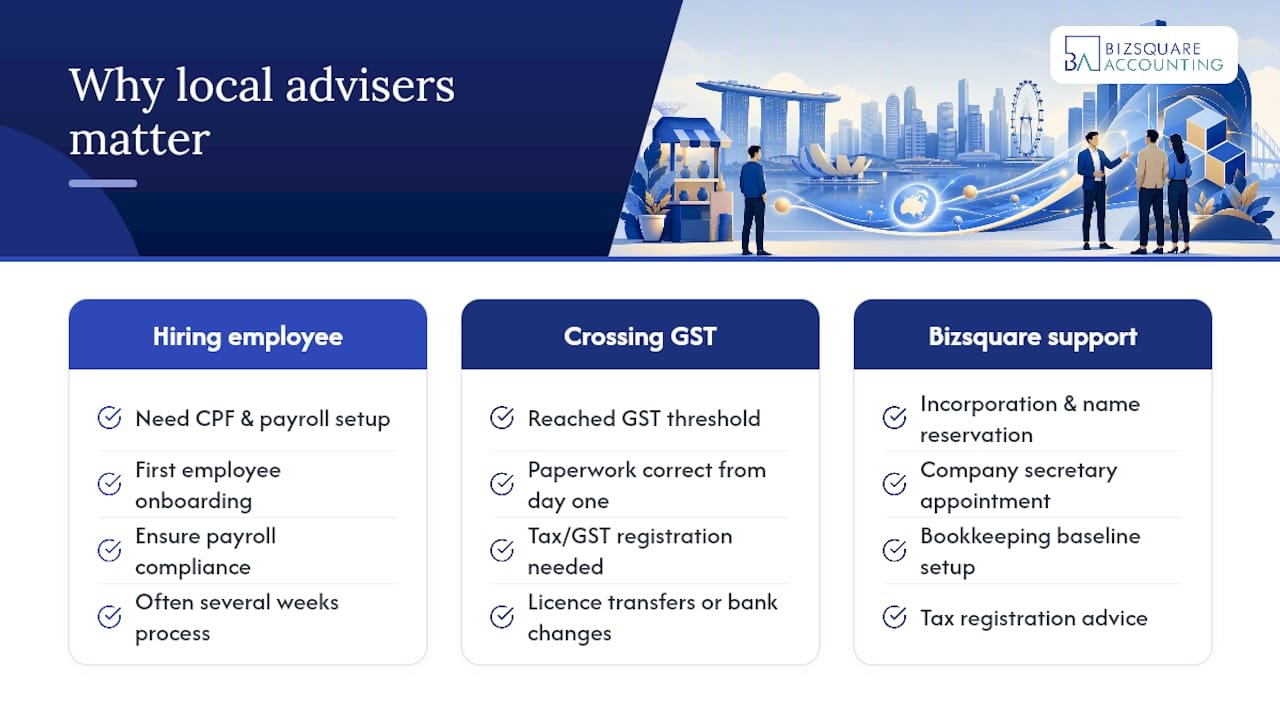
Owners who reach out for help with this migration tend to fall into two groups: those hiring their first employee and needing CPF and payroll sorted properly, and those crossing the GST threshold who want the paperwork handled correctly from day one.
Bizsquare supports each stage of the process, from incorporation and name reservation, through company secretary appointment, to setting up a clean bookkeeping baseline and advising on tax registration and licence transfers. A straightforward case usually takes several weeks from incorporation to full operational cutover, with additional time needed if licence transfers or bank account changes are involved. The typical checklist Bizsquare delivers to clients covers incorporation documents, statutory registers, a bookkeeping starting point, and a tax registration status summary, helping ensure a smooth process.
Start your incorporation and migration with Bizsquare
Bizsquare gives sole proprietors a faster, cleaner route through this changeover than piecing it together alone, because one team handles incorporation, secretarial duties and bookkeeping setup together instead of leaving you to coordinate three separate providers.

To get started, you will typically need your proposed company name options, details of directors and shareholders, and copies of any existing licences tied to your sole proprietorship. Bizsquare’s company incorporation service handles the ACRA filing, prepares your statutory registers, and sets up an accounting baseline so your books are audit ready from month one. If bookkeeping accuracy has been a weak spot in your sole proprietorship, it is worth reviewing how proper bookkeeping practices protect you once you are running a company with statutory reporting duties. Request a quote today and Bizsquare will map out your incorporation and migration timeline before you commit to a date.
This article is general information, not a substitute for advice from a qualified financial advisor. Consult a qualified financial professional about your own circumstances before acting on anything here.
Sources
- Expanding your home-based business, GoBusiness licensing e-adviser
- BizFile (ACRA)
- ACRA official site
- IRAS guidance on GST registration
FAQ
1.) Can I convert a sole proprietorship to a private limited company directly?
No. Singapore law does not permit a direct conversion, so you must incorporate a new Pte Ltd and separately cease the sole proprietorship.
2.) How do I convert my sole proprietorship to a company?
You incorporate a new Pte Ltd through BizFile, transfer assets, contracts and licences to the new entity, then file cessation for the sole proprietorship.
3.) Can a sole proprietorship be converted to a corporation in Singapore?
The term “corporation” is not used locally, but the same principle applies: no statutory conversion exists, so you form a new company and wind down the old registration.
4.) What should I do when changing from sole trader to limited company?
Check your licences first, incorporate the new company, move your bank accounts and contracts over, then cease the old registration with BizFile and IRAS.
5.) How long does the whole conversion process take?
A straightforward case typically takes four to eight weeks from incorporation to full operational cutover, longer if licence transfers or bank changes are involved.
6.) Do I need a new company bank account?
Yes. Keep company funds entirely separate from personal accounts to preserve the liability protection a Pte Ltd is meant to provide.
7.) Will my existing contracts automatically transfer to the new company?
No, most contracts need to be novated or reassigned, and banks or insurers often require company-stamped documents before updating records.
8.) Do I need to register for GST when I incorporate?
Only if your taxable turnover has crossed or is expected to cross the GST threshold; check current requirements with IRAS before applying.
9.) Can I keep my sole proprietorship’s trading name for the new Pte Ltd?
Often yes, provided the name is available on BizFile and meets ACRA’s naming rules.
10.) What happens to my existing business licences?
Many licences require a fresh application or a no-objection letter from the relevant regulator, which the GoBusiness e-adviser can help identify.
11.) Do I need a company secretary immediately?
You must appoint one within six months of incorporation, though many owners arrange this at the same time as incorporation.
12.) What CPF obligations apply once I convert?
If you hire staff or move existing helpers onto the company payroll, you must register as an employer with CPF and meet contribution and levy duties.
13.) Is it cheaper to stay a sole proprietorship?
Running costs are lower, but the lack of liability protection and less favourable tax treatment often outweigh the savings as the business grows.
14.) Can Bizsquare handle the entire migration for me?
Yes, Bizsquare covers incorporation, company secretary duties, bookkeeping setup and tax advisory as part of a single coordinated process.