


Start with the Gov, then contact your local authority to confirm what applies to your specific location and activity. That two-step approach covers the majority of business licence requirements for UK entrepreneurs.
Three things to do today:
- Visit GOV.UK ‘Find a licence’ and search using your business activity keywords.
- Check whether your activity falls under a national regulator such as the Financial Conduct Authority (FCA), UK Visas and Immigration (UKVI), the Environment Agency, the Gambling Commission, or the Food Standards Agency.
- Assemble your core documents: proof of identity, premises plans, insurance certificates and any sector-specific qualifications listed on GOV.UK and your council’s licensing page.
Note that company registration with Companies House and operational licences are two separate legal obligations. Registering your company does not automatically grant permission to trade in regulated activities.
Key takeaways
The most reliable approach to UK business licensing is to use the GOV.UK ‘Find a licence’ tool first, confirm requirements with your local authority, and gather all required documents before submitting any application.
| Point | Details |
|---|---|
| Start with GOV.UK | Use the ‘Find a licence’ tool to identify applicable licences, then confirm with your local council. |
| Company registration is separate | Companies House registration costs £100 online and does not replace operational licences. |
| Food businesses: 28-day rule | Register with your local authority at least 28 days before opening any food premises. |
| Sponsor licence documents | Submit supporting documents to UKVI promptly after the online application. |
| Bizsquare for compliance support | Bizsquare provides corporate advisory and compliance guidance for businesses managing complex regulatory obligations. |
Table of Contents
- How do you identify which licences your business needs?
- What are the most common UK business licences?
- How do you apply for a UK business licence, step by step?
- What documents and checks do most licence applications require?
- What should you expect on fees, processing times, and renewals?
- How does compliance, inspection, and enforcement work after a licence is granted?
- Where do you go for authoritative help on specialist licences?
- A practical checklist and the most common application mistakes
- Bizsquare helps businesses get compliance right from the start
- Sources
- FAQ
How do you identify which licences your business needs?
A repeatable method saves time and prevents costly oversights. Follow these steps in order.
Use the GOV.UK licence finder. Go to Gov and enter your business activity. The tool covers hundreds of licences maintained by the Department for Business and Trade. Treat the results as a starting point, not a definitive list, because local councils sometimes hold additional or bespoke permits that the national tool does not capture.
Confirm with your local authority. Once you have a shortlist, contact your council’s licensing department directly. Many council licensing pages hold application forms, fee schedules, and local policy details that affect processing times and licence conditions. A five-minute phone call can prevent a rejected application weeks later.
Check relevant national regulators for sectoral licences. Activities such as financial services, immigration sponsorship, gambling, environmental operations, and food production each have a dedicated national regulator with its own application portal and eligibility criteria.
Consult trade associations or a specialist adviser for grey areas. If your activity sits between two categories, or if you are combining regulated and unregulated services, a trade association often publishes sector-specific guidance. For complex cases, a specialist licensing adviser or a business consultant familiar with choosing business consultants can map your obligations accurately.
Pro Tip: Before you search the GOV.UK tool, write down every primary and secondary activity your business carries out, including ancillary ones such as food preparation, waste handling, or employing overseas workers. Searching each activity separately returns more complete results than a single broad search.
Using Standard Industrial Classification (SIC) codes alongside plain-language activity keywords also improves search accuracy. Your SIC code appears on your Companies House registration and signals to regulators which sector you operate in.
What are the most common UK business licences?
The table below maps common licence types to their typical triggers, issuing body, and the first application step. It is not exhaustive; always verify with GOV.UK and your local council.
| Licence type | When it is typically required | Who issues it | First step to apply |
|---|---|---|---|
| Premises licence (alcohol and regulated entertainment) | Selling alcohol, providing live music, late-night refreshment | Local authority | Apply via council licensing portal; Licensing Act 2003 governs the process |
| Personal licence | Authorising alcohol sales at a licensed premises | Local authority | Apply to your local council with a licensing qualification and DBS check |
| Food business registration | Operating any food premises | Local authority | Register at least 28 days before opening |
| Food premises approval | Handling products of animal origin | Local authority / Food Standards Agency | Apply to your local authority; FSA guidance applies |
| Street trading licence | Selling goods from a stall or vehicle on a public street | Local authority | Check council street trading page for local rules |
| Taxi and private hire licence | Operating a taxi or private hire vehicle | Local authority | Apply to your council’s licensing team |
| Waste carrier licence | Transporting, buying or selling waste | Environment Agency | Register via the Environment Agency portal |
| Environmental permit | Operating activities with environmental impact (e.g. waste sites, certain manufacturing) | Environment Agency | Apply via the Environment Agency’s online permitting service |
| Gambling operating licence | Running a casino, betting shop, bingo hall, or online gambling service | Gambling Commission | Apply via the Gambling Commission portal |
| Sponsor licence (skilled worker or student) | Employing overseas workers or sponsoring international students | UKVI (Home Office) | Apply via the UKVI sponsorship management system |
| Animal activity licence | Breeding, boarding, selling or exhibiting animals | Local authority | Apply to your local council |
| Tattoo and beauty premises licence | Operating a tattoo studio, acupuncture, or skin-piercing business | Local authority | Apply to your local council’s environmental health team |
| SIA-linked CCTV licence | Operating a CCTV system in a public-facing licensed premises | Security Industry Authority (SIA) | Check SIA guidance; some roles require an SIA licence |
A few points worth noting:
- GOV.UK alcohol licensing guidance covers mandatory conditions, the role of the Designated Premises Supervisor, and how local licensing policies affect decisions.
- Food businesses must register with their local authority at least 28 days before opening. Certain activities involving animal-origin products require a separate approval.
- Sponsor licence applicants must appoint an Authorising Officer and a Level 1 user before submitting. Supporting documents must reach UKVI within five working days of the online application, or the application may be treated as invalid.
How do you apply for a UK business licence, step by step?
The application process follows a broadly consistent pattern across most licence types, though the detail varies by licence and issuing authority.
Identify the correct licence and issuing authority. Use the GOV.UK finder and your council page to confirm you are applying for the right licence. Applying for the wrong category is one of the most common and avoidable mistakes.
Obtain and complete the correct form or portal. Most local authorities now offer online application portals. Council guidance pages typically provide step-by-step completion advice and list the supporting evidence required for a valid application.
Pay the application fee. Fees vary by licence type and council. Pay at the point of submission unless the authority specifies otherwise.
Attend a hearing if representations are received. If a responsible authority or an individual objects, the licensing authority schedules a hearing. The applicant presents their case, and the authority decides whether to grant, modify, or refuse the licence.
Await the decision and comply with conditions. Once granted, a licence typically comes with mandatory and discretionary conditions. Read them carefully before trading.
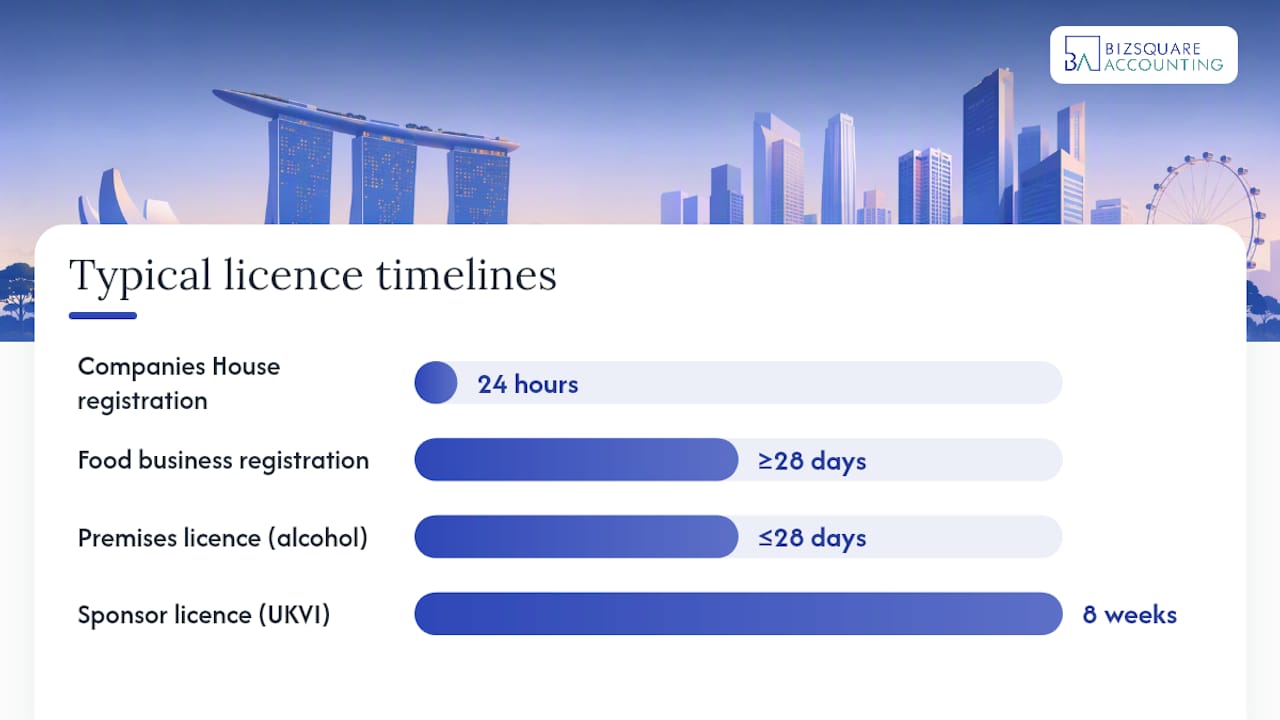
Typical timelines to plan around:
- Food business registration: submit at least 28 days before opening.
- Premises licence (alcohol): allow up to 28 days for the consultation period, plus additional time if a hearing is required.
- Sponsor licence: UKVI aims to process straightforward applications within eight weeks, though complex cases take longer.
- Companies House online registration: typically costs £100 and can complete within 24 hours, though this is company formation, not an operational licence.
Pro Tip: Prepare and validate all required documents before you open the online application form. Many council portals time out or reject submissions with missing attachments. Having everything ready in a single folder, with files named clearly, prevents the frustration of a failed submission.
What documents and checks do most licence applications require?
Gathering documents in advance is the single most effective way to avoid delays. The list below covers the items most commonly requested across UK licence applications.
Identity and eligibility:
- Government-issued photo ID (passport or driving licence).
- Proof of right to work or right to operate in the UK, where required.
- DBS (Disclosure and Barring Service) check: required for personal licences, certain animal activity licences, and roles working with vulnerable groups. The level of check (basic, standard, or enhanced) depends on the licence type.
Premises and planning:
- Scaled premises plan showing the layout, exits, and areas covered by the licence.
- Planning permission evidence, where the proposed use requires a change of use consent.
- Proof of lease or ownership of the premises.
Sector-specific qualifications and certificates:
- Food hygiene certificate (Level 2 Award in Food Safety is the standard minimum for food businesses).
- Personal licence qualification (Award for Personal Licence Holders) for alcohol licensing.
- Relevant professional qualifications for regulated activities such as financial services or healthcare.
Insurance:
- Public liability insurance certificate, typically required for premises-based and public-facing licences.
- Employer’s liability insurance if you employ staff.
For sponsor licences specifically, UKVI requires named key personnel documents, evidence of genuine trading, and HR system details. These must be submitted within five working days of the online application, as set out in the UKVI sponsor guidance.
Most councils accept scanned copies of documents uploaded through their portal. Some require certified copies for high-risk licence categories. Always check the specific submission requirements on your council’s licensing page before uploading.

What should you expect on fees, processing times, and renewals?
Fees and processing times vary considerably by licence type and issuing authority. There is no single national fee schedule for most local authority licences, so checking your specific council’s published fee schedule is the only reliable approach.
What the data shows for specific licences:
Registering a private limited company online with Companies House costs £100 and typically completes within 24 hours. This is a useful benchmark for understanding that company formation is fast and inexpensive, but it is a separate obligation from the operational licences your business may also need.
For premises licences, fees are set by the Licensing Act 2003 fee bands, which are linked to the rateable value of the premises. Higher-rateable-value premises attract higher application fees. Annual fees also apply for premises licences.
For food business registration, there is no application fee. However, some food premises approvals carry a charge, and local authorities may charge for inspections in certain circumstances.
Key point: Always check the fee schedule on your issuing authority’s website before budgeting. Fees change, and using an outdated figure can result in a rejected application.
Renewals and record-keeping:
Many licences require annual renewal. Premises licences under the Licensing Act 2003 do not expire automatically but are subject to annual fees; failure to pay results in the licence lapsing. Taxi and private hire licences typically require renewal every one to three years depending on the council. Waste carrier registrations require renewal every three years.
Keep copies of all licence documents, correspondence with the issuing authority, and any conditions attached to the grant. These records support renewal applications and demonstrate compliance during inspections. Budget for professional support costs, particularly for complex licences such as sponsor licences or environmental permits, where specialist advisers add measurable value.
How does compliance, inspection, and enforcement work after a licence is granted?
A licence grant is the beginning of an ongoing compliance obligation, not the end of the process. Most licences come with conditions that must be met continuously.
Common ongoing duties include:
- Maintaining a register of licensed activities, staff training records, and incident logs.
- Designating a responsible person for the licence, such as a Designated Premises Supervisor for alcohol licences or an Authorising Officer for sponsor licences.
- Notifying the issuing authority of changes to the business, premises, or key personnel.
- Displaying the licence or a summary at the premises where required.
If you receive an enforcement notice or face a review:
- Read the notice carefully and note the response deadline.
- Seek legal or specialist advice promptly, particularly for premises licence reviews under the Licensing Act 2003.
- Gather evidence of compliance: training records, CCTV footage, staff rotas, and incident logs.
- Attend any hearing and present your case clearly. The Licensing Act 2003 sets out the grounds for review and the appeal process.
- If the authority modifies or revokes the licence, you may appeal to the Magistrates’ Court within 21 days of the decision.
Preparing for routine inspections:
Keep your premises plan, licence document, and staff training certificates accessible at all times. Environmental health officers, licensing officers, and sector-specific inspectors can visit with or without prior notice for certain licence types. A well-organised compliance file demonstrates good faith and often results in a shorter inspection.
Where do you go for authoritative help on specialist licences?
For most entrepreneurs, the first call is to the right authority. Here is a practical list of first-stop contacts.
- GOV.UK ‘Find a licence’: Start here for any licence search. Use it to identify the issuing body and find links to application portals.
- Your local council licensing team: Contact them by phone or email to confirm requirements, check local policy, and obtain application forms. When you call, ask specifically: “Does my activity require a licence from the council, and are there any local conditions I should know about?”
- Food Standards Agency: For food hygiene ratings, food premises approvals, and guidance on handling animal-origin products.
- Environment Agency: For waste carrier registrations, environmental permits, and abstraction licences.
- Gambling Commission: For operating and personal licences for gambling activities.
- UKVI (Home Office): For sponsor licences and right-to-work compliance.
- Financial Conduct Authority (FCA): For financial services authorisation, credit broking, and insurance distribution.
When to hire a specialist adviser:
Higher-risk activities, such as financial services authorisation, environmental permitting, or sponsor licences, attract more rigorous checks than routine administrative licences. In these cases, a specialist adviser or an accountancy firm with compliance experience, such as Keystone Financial Advisory, can help prepare documentation, liaise with regulators, and reduce the risk of rejection. Trade associations in your sector often publish member guidance and can recommend vetted advisers.
A practical checklist and the most common application mistakes
Use this checklist before submitting any licence application. Print it, tick each item, and keep it with your application records.
Pre-submission checklist:
- [ ] Correct licence type identified via GOV.UK and confirmed with the local authority.
- [ ] Correct application form or portal located.
- [ ] Proof of identity prepared (passport or driving licence).
- [ ] Premises plan drawn to scale and clearly labelled.
- [ ] Planning permission evidence obtained where required.
- [ ] Public liability insurance certificate obtained.
- [ ] DBS check initiated or completed where required.
- [ ] Sector-specific certificates obtained (food hygiene, personal licence qualification, etc.).
- [ ] Correct fee amount confirmed on the issuing authority’s current fee schedule.
- [ ] Public notice requirements checked and scheduled where applicable.
- [ ] All documents saved as clear, legible scans in the required file format.
Common mistakes and how to fix them:
- Using the wrong licence form. Always download the form directly from the issuing authority’s current page. Outdated forms are a frequent cause of rejection.
- Missing public notice requirements. For premises licences, the public notice must be displayed and advertised before the application period closes. Missing this step invalidates the application.
- Unclear premises descriptions. Vague descriptions of the licensed area cause delays. Use a scaled plan and describe the area precisely in the application text.
- Inadequate supporting plans. Plans must show exits, fire safety equipment, and the boundaries of the licensed area. A hand-drawn sketch is rarely sufficient.
- Incorrect fee category. Premises licence fees are banded by rateable value. Check the current band for your premises before paying.
Pro Tip: For novel or high-risk activities, contact the regulator before submitting. Many licensing authorities offer a pre-submission check or informal guidance call. This is particularly valuable for environmental permits, financial services authorisation, and sponsor licences, where a single missing document can delay the process by weeks.
The licence process is more manageable than it looks
Many entrepreneurs approach the licensing process with more anxiety than the process itself warrants. The GOV.UK tools and local council pages are genuinely well-organised, and most straightforward applications, such as food business registration or a street trading licence, follow a clear, predictable path.
The more important distinction to understand early is the difference between company registration and operational licences. Registering your company with Companies House is a one-time administrative step. Operational licences, by contrast, are ongoing legal permissions tied to specific activities, premises, and personnel. A business can be fully incorporated and still be trading illegally if it has not obtained the correct operational licences.
Proactive contact with your council and the relevant national regulator, before you start trading, is the most reliable way to avoid enforcement action. Regulators generally respond well to businesses that ask questions early. The cost of a pre-submission call is zero; the cost of trading without the correct licence can include fines, prosecution, and closure.
Bizsquare helps businesses get compliance right from the start
Running a business in a regulated environment means managing two parallel obligations: company formation and ongoing operational compliance. Most entrepreneurs handle the first step confidently and underestimate the second.
Bizsquare is a business management consultancy that helps entrepreneurs and SMEs manage the compliance and administrative obligations that sit alongside day-to-day operations. From company incorporation and corporate secretary services to accounting, tax advisory, and outsourced CFO support, Bizsquare provides the structured guidance that prevents compliance gaps from becoming costly problems. The team works with business owners who need accurate financial records, properly maintained statutory registers, and clear advice on their regulatory obligations, without the overhead of a full in-house compliance function.
For entrepreneurs who want to get the administrative foundation right from the outset, contact Bizsquare to discuss how the firm’s corporate advisory services can support your business.
This article is general information, not a substitute for advice from a qualified lawyer. Consult a qualified legal professional about your own circumstances before acting on anything here.
Sources
Bookmark these pages and return to them whenever your business activities change.
- Gov
- Sponsor guidance Part 1: Apply for a licence – version 05/26
- Food business registration
- Gov
- Guidance for licensing applications
- Gov
To find your local council’s licensing page, go to gov.uk/find-local-council and enter your postcode. The results page links directly to your council’s website, where the licensing section is usually listed under “Business” or “Licences and permits.”
FAQ
What licence do I need to start a business in the UK?
The licences you need depend entirely on your business activity and location. Use the GOV.UK ‘Find a licence’ tool as the first step, then confirm requirements with your local council and any relevant national regulator.
How much does a business licence cost in the UK?
Costs vary by licence type and issuing authority. Companies House online registration costs £100. Premises licence fees are set by rateable value bands under the Licensing Act 2003. Food business registration carries no fee. Always check the current fee schedule on your council’s licensing page before applying.
What are the mandatory conditions for a premises licence?
Mandatory conditions under the Licensing Act 2003 include requirements such as age verification for alcohol sales and the appointment of a Designated Premises Supervisor. Full details are set out in GOV.UK alcohol licensing guidance.
What happens if I trade without the correct licence?
Trading without a required licence can result in fines, prosecution, and in serious cases, closure of the business. Enforcement action is taken by the relevant licensing authority or regulator, depending on the licence type.
Can I transfer a licence if my business changes ownership?
Most licences are not automatically transferable. For premises licences, the new owner must apply for a transfer or a new licence. For sponsor licences, a change of ownership or structure requires notification to UKVI and may require a new application. Always notify the issuing authority promptly when ownership or key personnel change.
How do I appeal a refused licence application?
For premises licences, appeals are made to the Magistrates’ Court within 21 days of the licensing authority’s decision, as set out in the Licensing Act 2003. For other licence types, the appeal route is specified in the refusal notice. Seeking specialist legal advice before appealing is strongly recommended.
When does a food business need to register with the local authority?
A food business must register with its local authority at least 28 days before opening. Registration is free, and most councils accept online applications. Certain activities involving animal-origin products require a separate food premises approval.
What is the difference between a personal licence and a premises licence?
A premises licence authorises a specific location to sell alcohol or provide regulated entertainment. A personal licence authorises an individual to authorise alcohol sales at a licensed premises. Both are typically required for a business selling alcohol, and both are issued by the local authority.
Do I need a DBS check for a business licence?
A DBS check is required for personal licences, certain animal activity licences, and roles involving work with vulnerable groups. The level of check required, basic, standard, or enhanced, depends on the specific licence type and the applicant’s role.
What should I do if my business activities change after a licence is granted?
Notify the issuing authority promptly. Most licences require the holder to inform the authority of material changes to activities, premises, or key personnel. Failing to notify can result in the licence being reviewed or revoked. For sponsor licences, changes must be reported to UKVI through the sponsorship management system.