

Effectively Connected Income (ECI) is U.S.-source income tied to a trade or business conducted in the United States. The IRS requires foreign persons to report it using specific forms and withholding procedures. Understanding ECI tax filing requirements is the first step toward staying compliant.
Three immediate actions to take right now:
- Confirm you are engaged in a U.S. trade or business and that your income connects to it.
- Gather your financial records, including income statements, expense receipts, and any existing U.S. tax identification numbers.
- Supply the correct certificate to your withholding agent, typically Form W-8ECI, before any payment is made.
Key forms to expect in the ECI tax return process:
- Form W-8ECI for certifying ECI status to a withholding agent
- Form 1040-NR for nonresident alien individuals filing an annual U.S. return
- Form 1120-F for foreign corporations reporting ECI
- Forms 8804 and 8805 for partnerships with foreign partners
Table of Contents
- What counts as ECI and how does the IRS decide?
- Who must report ECI and when does it arise?
- How ECI is taxed: net basis, deductions, and treaty effects
- Which IRS forms do you need and when must you provide them?
- How withholding works and what withholding agents must do
- Step-by-step ECI filing checklist and key deadlines
- Common mistakes to avoid and practical tips for Singapore-based filers
- Key takeaways
- A practitioner’s view on ECI compliance
- Authoritative sources to consult
- How Bizsquare helps foreign entities manage ECI compliance
- FAQ
What counts as ECI and how does the IRS decide?
IRS Publication 519 sets out the framework for characterising income as ECI. The starting point is always the U.S. trade or business test.
The three core tests:
- U.S. trade or business test: The foreign person must be engaged in a trade or business in the United States. Regular, continuous, and substantial activity generally satisfies this test. A single isolated transaction rarely does.
- Asset-use test: Income from assets used in, or held for use in, the conduct of a U.S. trade or business qualifies as ECI. Rental income from a U.S. property used in the business is a common example.
- Business-activities test: Income that arises directly from the activities of the U.S. trade or business also qualifies. Fees earned by a foreign consultant performing services in the United States fall squarely here.
ECI versus FDAP income:
ECI and Fixed, Determinable, Annual, or Periodical (FDAP) income are the two main categories of U.S.-source income for foreign persons. FDAP income, such as dividends, interest, and royalties, is generally subject to a flat 30% withholding tax with no deductions allowed. ECI, by contrast, is taxed on a net basis after allowable deductions, at graduated rates. The distinction matters enormously in practice because the tax burden on ECI can be significantly lower once deductions reduce the taxable base.
Common examples of ECI:
- Wages and fees earned by a nonresident alien performing services in the United States
- Business profits from a U.S. office or fixed place of business
- Gains from the sale of inventory through a U.S. office
- Income from the disposition of U.S. real property interests, which falls under FIRPTA rules but is treated as ECI
Who must report ECI and when does it arise?
Not every foreign person with U.S.-source income has an ECI tax filing obligation. The obligation arises specifically when a foreign person is engaged in a U.S. trade or business.
Foreign persons commonly required to report ECI:
- Nonresident alien individuals who perform services or conduct business activities in the United States
- Foreign corporations with a U.S. branch, office, or fixed place of business
- Foreign partnerships conducting business in the United States
- Foreign partners in a U.S. or foreign partnership that has ECI allocable to them
When does ECI arise?
ECI arises in the tax year the income is earned or realised in connection with the U.S. trade or business. Income realised in a different year from when the underlying activity occurred can still be treated as ECI if the connection to the U.S. trade or business is established.
Practical scenarios to test your liability:
- A Singapore-based consultant signs a contract to deliver services in New York for three months. The fees earned are ECI.
- A foreign corporation opens a U.S. sales office. Profits attributable to that office are ECI.
- A foreign partner receives an allocation of income from a U.S. partnership. That allocation is ECI to the foreign partner.
- A nonresident alien sells U.S. real property. The gain is treated as ECI under FIRPTA.
ITIN and EIN requirements:
Foreign individuals must obtain an Individual Taxpayer Identification Number (ITIN) from the IRS before filing. Foreign corporations and partnerships must obtain an Employer Identification Number (EIN). Both registrations take time, so applying early is critical to meeting ECI filing deadlines.
How ECI is taxed: net basis, deductions, and treaty effects
ECI is taxed on a net basis. This means the foreign person can deduct allowable business expenses from gross ECI to arrive at taxable net ECI, which is then subject to U.S. tax at the applicable rates.
Net basis taxation and deductions:
Allowable deductions include ordinary and necessary business expenses directly connected to the ECI-generating activity. These may include salaries, rent for U.S. office space, depreciation on U.S. assets, and professional fees. The deduction must be properly allocated and apportioned to the ECI.
Applicable tax rates:
| Taxpayer type | Tax basis | Rate applied |
|---|---|---|
| Nonresident alien individual | Net ECI | Graduated U.S. individual rates |
| Foreign corporation | Net ECI | U.S. corporate rate |
| Foreign partner (individual) | Net ECI allocation | Graduated U.S. individual rates |
| Foreign partner (corporate) | Net ECI allocation | U.S. corporate rate |
Tax treaties between the United States and a foreign person’s country of residence can reduce or eliminate U.S. tax on ECI. Treaty benefits must be claimed on the relevant return, and the foreign person must meet the treaty’s residency and limitation-on-benefits requirements.
Contrast with FDAP:
FDAP income is subject to a flat 30% withholding tax on the gross amount. No deductions are permitted. A foreign person receiving FDAP income cannot reduce the tax by claiming expenses. This is why correctly classifying income as ECI rather than FDAP can produce a materially lower tax liability.
Worked example:
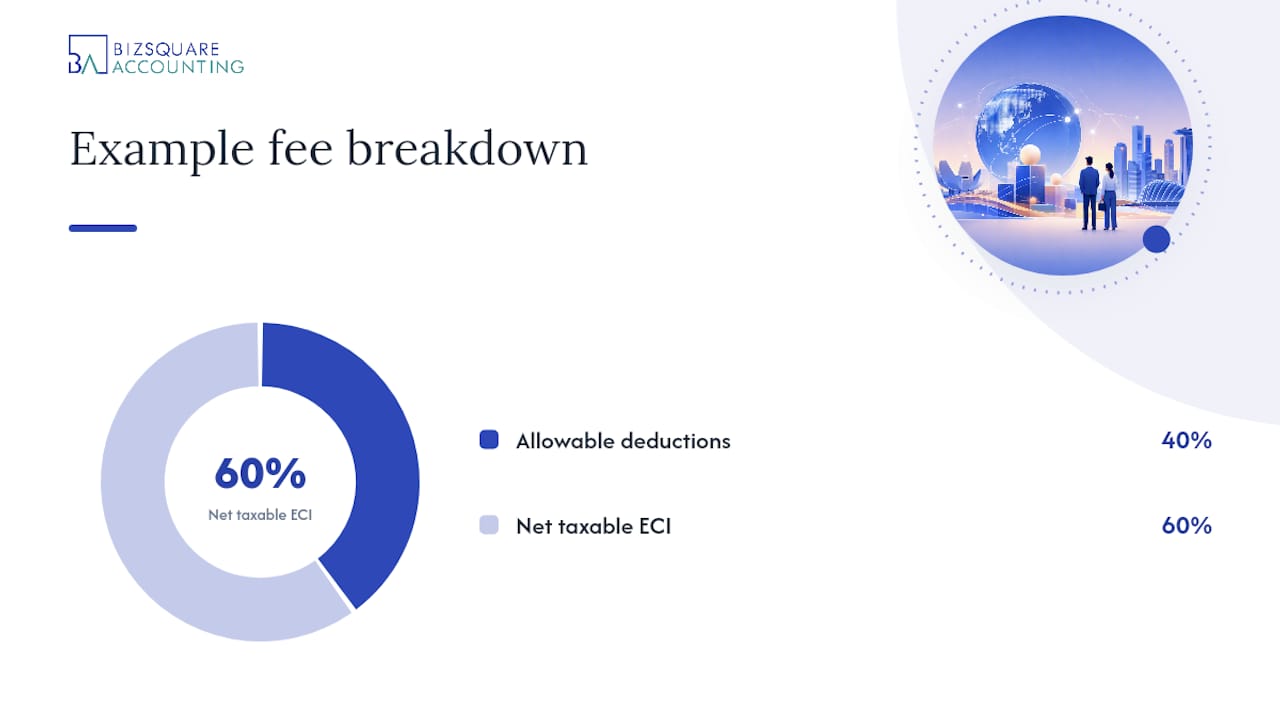
A nonresident alien consultant earns USD 100,000 in fees from U.S. clients. Allowable deductions total USD 40,000 (travel, professional fees, office costs). Net taxable ECI is USD 60,000. U.S. graduated rates apply to that USD 60,000, not to the gross USD 100,000.
Pro Tip: Claim all allowable deductions before computing net ECI. Many foreign filers leave deductions on the table by treating ECI like FDAP and paying tax on the gross amount.
Which IRS forms do you need and when must you provide them?
The ECI tax filing requirements involve several distinct forms, each serving a different purpose in the compliance chain.
Form W-8ECI: certificate for withholding agents
Form W-8ECI is the certificate a foreign person provides to a withholding agent or payer to confirm that the income received is ECI. Providing this form correctly removes the obligation for the withholding agent to apply chapter 3 or chapter 4 withholding on that income. The form must be signed by the beneficial owner or an authorised agent. An agent acting under a power of attorney must supply proper documentation alongside the form. Electronic signatures are accepted under certain conditions. The form must be renewed when circumstances change or when the withholding agent requests a new certificate.
The Instructions for Form W-8ECI set out the full signature and documentation requirements, and all filers should read them before completing the form.
Form 1040-NR: annual return for nonresident alien individuals
Form 1040-NR is the U.S. Nonresident Alien Income Tax Return. Nonresident alien individuals use it to report ECI, claim allowable deductions, and compute the U.S. tax due. The standard due date is 15 April for individuals who receive wages subject to U.S. withholding, and 15 June for those who do not.
Form 1120-F: annual return for foreign corporations
Foreign corporations with ECI file Form 1120-F, the U.S. Income Tax Return of a Foreign Corporation. The return is due by the 15th day of the fourth month after the close of the corporation’s tax year. A six-month extension is available on request.
Forms 8804 and 8805: partnership withholding
Forms 8804 and 8805 cover partnership withholding for foreign partners. Form 8804 is the Annual Return for Partnership Withholding Tax, and Form 8805 is the Foreign Partner’s Information Statement of Section 1446 Withholding Tax. Partnerships must file these forms when they have effectively connected taxable income allocable to foreign partners.
Pro Tip: Provide Form W-8ECI to the withholding agent before the first payment is made. A late submission means the agent must withhold at the default rate, and recovering over-withheld amounts requires filing a return and waiting for a refund.
How withholding works and what withholding agents must do
ECI that is properly documented is not a withholdable payment under chapter 4 of the Internal Revenue Code. However, separate withholding regimes can still apply, so documentation is not a complete exemption from all withholding.
General rule and documentation:
- Income that is, or is deemed to be, ECI is exempt from withholding under sections 1441 and 1442, provided the foreign person supplies a valid Form W-8ECI to the withholding agent.
- The withholding agent must retain the form and rely on it in good faith. If no valid certificate is on file, the agent must withhold at the default 30% rate.
- The withholding agent bears responsibility for correct withholding. A foreign person who fails to provide documentation on time creates a withholding obligation for the payer.
Section 1446 partnership withholding:
Partnerships with foreign partners must withhold on each foreign partner’s allocable share of effectively connected taxable income. The withholding rate depends on the partner’s status, individual or corporate. The partnership files Forms 8804 and 8805 to report and pay this withholding. A foreign partner cannot simply provide Form W-8ECI to the partnership to eliminate section 1446 withholding entirely, as different rules govern that regime.
FIRPTA and section 1445:
The Foreign Investment in Real Property Tax Act (FIRPTA) imposes withholding under section 1445 when a foreign person disposes of a U.S. real property interest. The gain is treated as ECI, but the FIRPTA withholding mechanism operates separately from the general ECI withholding exemption. The buyer or transferee acts as the withholding agent and must withhold a percentage of the amount realised.
Practical steps to satisfy a withholding agent:
- Obtain your ITIN or EIN before approaching the withholding agent.
- Complete Form W-8ECI accurately, including the U.S. taxpayer identification number.
- Submit the form before the first payment date.
- Notify the withholding agent promptly if your circumstances change and a new certificate is needed.
Step-by-step ECI filing checklist and key deadlines
The ECI tax return process follows a clear sequence. Completing each step in order reduces the risk of errors and late filings.
Filing sequence:
- Register for ITIN or EIN — Apply to the IRS well in advance of the first filing deadline. ITIN applications use Form W-7; EIN applications use Form SS-4.
Key filing deadlines:
| Form | Taxpayer type | Standard due date | Extension available |
|---|---|---|---|
| Form 1040-NR (wages withheld) | Nonresident alien individual | 15 April | Yes, 6 months |
| Form 1040-NR (no wages withheld) | Nonresident alien individual | 15 June | Yes, 6 months |
| Form 1120-F | Foreign corporation | 15th day, 4th month after year end | Yes, 6 months |
| Forms 8804/8805 | Partnership | 15th day, 4th month after year end | Yes |
Missing a deadline triggers interest on unpaid tax and potential penalties. Filing for an extension buys time to complete the return accurately, but it does not extend the time to pay any tax due.
Recordkeeping expectations:
Retain all supporting documents for at least six years. The IRS can assess additional tax beyond the standard three-year limitation period in certain circumstances, so thorough recordkeeping is a practical safeguard.
Common mistakes to avoid and practical tips for Singapore-based filers
Foreign persons, including Singapore-resident business owners with U.S. operations, make predictable errors in the ECI tax return process. Knowing these in advance prevents costly corrections.
Common errors:
- Delivering the wrong form. Providing Form W-8BEN instead of Form W-8ECI to a withholding agent means the agent will apply 30% withholding on the full gross amount.
- Failing to claim treaty benefits. Singapore has a tax treaty with the United States. Failing to claim applicable treaty benefits on the return means paying more tax than required.
- Missing partnership withholding obligations. Foreign partners sometimes assume that providing Form W-8ECI to the partnership eliminates all withholding. Section 1446 operates differently and requires separate compliance.
- Late ITIN or EIN application. Applying for a tax identification number after the first payment has been made means the withholding agent must withhold at the default rate, creating a refund claim process.
- Misunderstanding the Singapore ECI filing waiver. For Singapore corporate tax purposes, IRAS requires ECI to be filed within three months from the end of the financial year-filing). The filing waiver applies only when annual revenue is S$5 million or below and ECI is nil. Both conditions must hold simultaneously. Many companies incorrectly assume that meeting one condition is sufficient.
Practical tips for Singapore-based filers:
- Singapore companies filing ECI with IRAS must do so through the myTax Portal using Corppass credentials. Only an Approver role can submit the filing. Confirm the Approver is registered and active well before the deadline.
- Accurate bookkeeping throughout the year reduces estimation errors and the risk of discrepancies with the final Notice of Assessment.
- For U.S. filings, engage a U.S.-qualified tax adviser early. Cross-border tax positions, particularly treaty claims and FIRPTA compliance, require specialist knowledge.
Pro Tip: Register for your ITIN or EIN at least three months before your first U.S. payment date. IRS processing times can extend beyond eight weeks, and a missing identification number delays every subsequent step in the ECI filing process.
Key takeaways
ECI is taxed on a net basis at graduated U.S. rates, and foreign persons must supply the correct IRS form to their withholding agent before the first payment to avoid unnecessary 30% withholding.
| Point | Details |
|---|---|
| ECI is taxed net, not gross | Allowable deductions reduce gross ECI to taxable net ECI before graduated rates apply. |
| Form W-8ECI removes chapter 3/4 withholding | Submit it to the withholding agent before the first payment; late submission triggers default 30% withholding. |
| Different forms for different filers | Individuals use Form 1040-NR; foreign corporations use Form 1120-F; partnerships file Forms 8804 and 8805. |
| Singapore ECI waiver requires two conditions | IRAS waives filing only when revenue is S$5 million or below AND ECI is nil, both must hold simultaneously. |
| Bizsquare supports cross-border compliance | Bizsquare’s corporate tax filing and advisory services help Singapore companies manage ECI obligations accurately. |
A practitioner’s view on ECI compliance
The most consistent error in ECI compliance is not a technical one. It is timing. Foreign persons and their advisers routinely underestimate how long it takes to obtain a U.S. tax identification number, gather properly allocated expense records, and coordinate with withholding agents across different time zones. By the time the first U.S. payment arrives, the window to provide Form W-8ECI has already closed, and the withholding agent has no choice but to apply the default rate.
The practical answer is to treat ECI compliance as a pre-activity exercise, not a year-end one. Confirm the U.S. trade or business position before the first contract is signed. Apply for the ITIN or EIN immediately. Engage a qualified adviser to assess treaty positions and FIRPTA exposure before any real property transaction completes. For Singapore-based companies managing both IRAS ECI filings and U.S. federal obligations simultaneously, the coordination burden is real and the cost of errors, in penalties, interest, and over-withheld tax, is material. Professional support at the outset costs far less than correcting a filing that went wrong.
Authoritative sources to consult
The following IRS and IRAS resources provide the primary guidance for ECI tax filing requirements. Each link leads directly to the relevant official page.
- Estimated Chargeable Income (ECI) filing | IRAS
- Effectively connected income (ECI) | Internal Revenue Service
- Instructions for Form W-8ECI (Rev. October 2021) | Internal Revenue Service
- About Form W-8 ECI | Internal Revenue Service
- About Form 1040-NR | Internal Revenue Service
- Publication 519 | Internal Revenue Service
- About Form 8805 | Internal Revenue Service
- Withholding exemption on effectively connected income | Internal Revenue Service
For a practical corporate tax filing checklist tailored to Singapore businesses, Bizsquare’s resource library covers the key compliance steps in detail.
How Bizsquare helps foreign entities manage ECI compliance
Foreign entities managing U.S. ECI obligations alongside Singapore corporate tax requirements face a dual compliance burden that demands precision on both fronts. Bizsquare’s corporate tax filing and advisory services are built for exactly this situation, providing Singapore-incorporated companies and foreign entities with structured support across bookkeeping, tax estimation, and cross-border advisory.
Bizsquare’s team helps clients maintain the accurate financial records that underpin a defensible ECI position, coordinates IRAS filings through the myTax Portal, and advises on the interaction between Singapore corporate tax obligations and U.S. reporting requirements. For companies that need to establish a Singapore presence as part of a broader international structure, Bizsquare also handles company incorporation in Singapore, ensuring the entity is set up correctly from the outset.
To discuss your ECI compliance position and how Bizsquare can support your next filing cycle, contact the team directly through bizsquareaccounting.com.
FAQ
What does ECI stand for in a U.S. tax context?
ECI stands for Effectively Connected Income. It refers to U.S.-source income that is connected to a trade or business conducted in the United States, and it is taxed by the IRS on a net basis at graduated rates.
Is it necessary to file an ECI return?
A foreign person engaged in a U.S. trade or business must file a U.S. tax return to report ECI, even if no tax is ultimately due. Individuals file Form 1040-NR; foreign corporations file Form 1120-F.
How do you know if you have ECI?
Income is ECI if it passes the U.S. trade or business test and either the asset-use test or the business-activities test. Common indicators include fees earned for services performed in the United States and profits attributable to a U.S. office or branch.
What does the Singapore ECI filing requirement mean for local companies?
In Singapore, IRAS requires companies to file Estimated Chargeable Income within three months from the end of their financial year. The filing waiver applies only when annual revenue is S$5 million or below AND ECI is nil, both conditions must be met at the same time.
Can a tax treaty reduce or eliminate U.S. tax on ECI?
Yes. Tax treaties between the United States and a foreign person’s country of residence can reduce the applicable tax rate or provide an exemption. Treaty benefits must be claimed on the relevant U.S. return, and the filer must satisfy the treaty’s residency and limitation-on-benefits requirements.