


Why Form a Private Limited Company in Singapore
Overview:
- Forming a private limited company in Singapore provides limited liability, a legal identity, and access to attractive tax incentives. It is the preferred structure for entrepreneurs seeking to raise funds, hire staff, and protect personal assets from business risks.
Forming a private limited company in Singapore gives owners limited liability, a separate legal identity, and better access to funding. These three advantages, recognized by the Accounting and Corporate Regulatory Authority (ACRA), explain why most serious entrepreneurs choose the Pte Ltd structure over simpler alternatives. IRAS, Singapore’s tax authority, also offers corporate-level tax incentives that sole proprietors simply cannot access. Bizsquare works with founders at every stage of this process, from name reservation to annual filing.
Incorporation is usually the right move when:
- You plan to hire staff and need to separate personal from business liability.
- You are approaching investors or banks for funding.
- You want to protect personal assets from business debts or legal claims.
Table of Contents
- What does a private limited company actually mean under Singapore law?
- Main benefits of forming a private limited company for Singapore businesses
- How a private limited company compares with sole proprietorship and partnership
- Key legal requirements and ongoing compliance for a Singapore Pte Ltd
- Step-by-step: how to form a private limited company in Singapore
- What does incorporation and first-year compliance actually cost?
- Common pitfalls new private limited companies face and how to avoid them
- How Bizsquare Accounting helps with forming and running a private limited company
- Key Takeaways
- Why structure choice shapes every growth decision you make
- Bizsquare Accounting: your incorporation partner in Singapore
- Useful sources and further reading
- FAQ
What does a private limited company actually mean under Singapore law?
A private limited company, or Pte Ltd, is a separate legal entity distinct from its owners. It can own property, sign contracts, open bank accounts, and sue or be sued, all in the company’s own name. Shareholders enjoy limited liability, meaning personal savings and property stay protected if the business runs into debt.
Key structural facts every founder should know:
- Shareholders: A Pte Ltd may have 1 to 50 shareholders. Most small businesses qualify as exempt private companies, which carry lighter reporting obligations.
- Directors: At least one director must be ordinarily resident in Singapore.
- Company secretary: A qualified company secretary must be appointed within six months of incorporation.
- Share capital: There is no minimum paid-up capital requirement under Singapore law, though S$1 is the standard starting point.
- Perpetual succession: The company continues to exist regardless of changes in ownership or management.
A simple example: if a founder invests S$10,000 in share capital and the company later owes S$200,000 to a creditor, the founder’s personal exposure is capped at S$10,000, not the full debt.
Main benefits of forming a private limited company for Singapore businesses
The advantages of forming a limited company extend well beyond liability protection. They touch on credibility, tax planning, and long-term growth capacity.
Limited liability and personal asset protection. Suppose a product defect leads to a lawsuit. In a sole proprietorship, the owner’s home and savings are at risk. In a Pte Ltd, personal assets stay protected because the company is the liable party, not the individual.
Separate legal identity. The company can hold assets, enter supplier agreements, and build a credit history in its own name. Banks and institutional clients treat a Pte Ltd as a more stable counterparty, which often translates to better loan terms and contract opportunities.

Fundraising and share structure. A Pte Ltd can issue different classes of shares, making it possible to bring in investors without surrendering voting control. Founders can also offer Employee Stock Option Plans (ESOPs) to attract senior talent, an option not available to sole proprietors or partnerships.
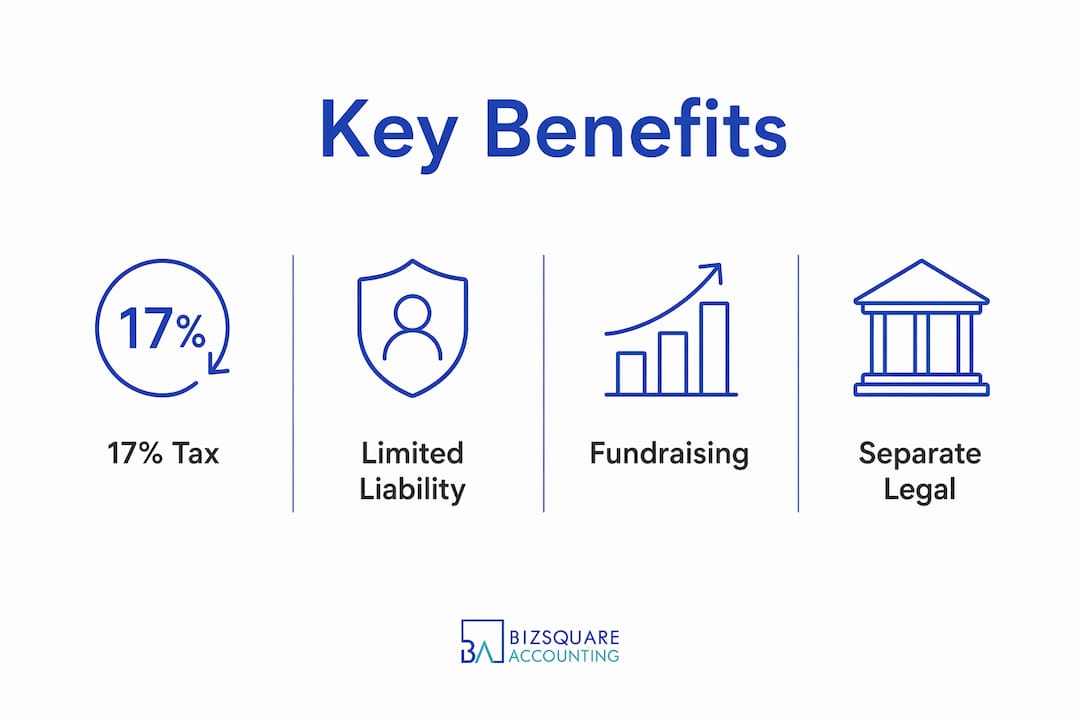
Corporate tax benefits. Singapore’s corporate tax rate is currently 17% on chargeable income. New companies may qualify for the Start-Up Tax Exemption scheme under IRAS, which reduces the effective rate significantly in the first three years. These corporate tax incentives are available only to incorporated entities.
Pro Tip: Founders who plan to raise a seed round should incorporate early. Investors almost always require a Pte Ltd structure before committing capital, and restructuring later adds cost and delay.
How a private limited company compares with sole proprietorship and partnership
The decision between structures often comes down to five practical dimensions. This sole trader vs limited company comparison from an accounting advisory perspective is a useful reference for the trade-offs involved.
| Dimension | Sole Proprietorship / Partnership | Private Limited Company (Pte Ltd) |
|---|---|---|
| Personal liability | Unlimited, personal assets at risk | Limited to amount invested in shares |
| Tax treatment | Personal income tax rates apply | Corporate tax at 17%, with IRAS exemptions available |
| Admin and compliance | Minimal filing, simpler records | Annual return, AGM, corporate tax filing required |
| Capital raising | Difficult, no share structure | Can issue shares and attract equity investors |
| Continuity | Dissolves on owner’s death or exit | Perpetual succession, continues regardless of ownership changes |
When to prefer a Pte Ltd:
- You plan to hire staff and need to separate personal from business liability.
- You need a bank loan or equity investment.
- You want the business to outlast your personal involvement.
- You are a foreign national incorporating in Singapore.
Resident director note for foreign-owned companies: At least one director must be ordinarily resident in Singapore. Foreign founders who do not live in Singapore must appoint a resident director to satisfy this requirement before ACRA will register the company.
Key legal requirements and ongoing compliance for a Singapore Pte Ltd
Mandatory set pieces at incorporation:
- At least one director ordinarily resident in Singapore.
- A qualified company secretary appointed within six months.
- A registered office address in Singapore (not a P.O. box).
- Minimum paid-up capital of S$1 (no upper statutory minimum for private companies).
Recurring obligations every founder must budget for:
- ACRA annual return: Filed via BizFile+ within five months of the financial year end for companies not holding an AGM, or within one month after the AGM.
- AGM: Private companies may dispense with the AGM if all members agree in writing, but the option must be formally documented.
- Corporate tax filing with IRAS: The Estimated Chargeable Income (ECI) must be filed within three months of the financial year end. The full corporate tax return (Form C or Form C-S) is due by November 30 each year.
- Statutory records: Minutes of meetings, share registers, and director registers must be maintained and kept at the registered office.
Pro Tip: Missing the ECI deadline triggers late filing penalties from IRAS. Set a calendar reminder for three months after your financial year closes, and engage an accountant if your team does not have in-house tax expertise.
Staying current with Singapore corporate compliance changes in 2026 is also advisable, as ACRA periodically updates filing requirements.
Step-by-step: how to form a private limited company in Singapore
The entire process runs through ACRA’s BizFile+ portal and typically completes within one to three business days once all documents are ready.
- Reserve a company name. Search BizFile+ to confirm the name is available. ACRA approves most names within one hour, though names requiring additional review may take longer.
- Prepare the company constitution. This document sets out the rules governing the company. ACRA provides a model constitution, which most founders adopt with minor changes.
- Appoint directors and company secretary. Confirm that at least one director is ordinarily resident in Singapore. The company secretary must be appointed within six months of incorporation.
- Decide on share structure. Determine the number of shares, share classes, and allocation among founders. This decision affects voting rights and future fundraising.
- Submit the incorporation application on BizFile+. The filing fee is S$315, payable online. ACRA typically approves the application within one to three business days.
- Open a corporate bank account. Most Singapore banks require the Certificate of Incorporation, the company constitution, and director identification documents.
- Register for GST if applicable. Companies with annual taxable turnover exceeding S$1 million must register for Goods and Services Tax with IRAS.
Decisions to make before filing:
- Share allocation and percentage ownership among co-founders.
- Director roles and signing authority.
- Financial year end date (affects tax filing deadlines).
Engaging Bizsquare’s incorporation services at step one reduces errors and speeds up the process considerably.
What does incorporation and first-year compliance actually cost?
| Item | Typical Cost (SGD) |
|---|---|
| ACRA incorporation filing fee | S$315 |
| Professional incorporation assistance | S$300 – S$800 |
Timeline benchmarks:
- Name approval: same day to 24 hours.
- Incorporation approval: 1 to 3 business days.
- First ECI filing: within 3 months of financial year end.
- First annual return: within 5 months of financial year end (if no AGM).
Tips to manage costs without cutting compliance corners:
- Bundle corporate secretary and accounting services with one provider to reduce coordination overhead.
- Use Form C-S (simplified) for tax filing if annual revenue is S$5 million or below.
- Consider professional bookkeeping from the start; correcting messy records later costs more than maintaining them properly.
Common pitfalls new private limited companies face and how to avoid them
New founders encounter a predictable set of problems. Knowing them in advance prevents expensive corrections.
- No resident director at incorporation. ACRA will reject the application. Foreign founders must arrange a resident director before submitting.
- Late ACRA or IRAS filings. Both authorities impose financial penalties for late submissions. Assign clear internal ownership for each deadline.
- Inaccurate statutory records. Share registers and minutes that are incomplete or unsigned create legal risk during audits or investor due diligence.
- Unclear share transfer provisions. Without pre-emption clauses in the constitution, a departing co-founder can sell shares to an outside party without offering them to existing shareholders first.
- Mixing personal and company finances. Using a personal bank account for company transactions undermines the separate legal identity and complicates tax filing.
Pro Tip: Outsourcing the company secretary role to a qualified firm removes the most common compliance risk for new founders. A professional secretary tracks all ACRA and IRAS deadlines and maintains statutory records on the company’s behalf. Learn more about outsourcing your company secretary.
How Bizsquare Accounting helps with forming and running a private limited company
Bizsquare offers a full suite of services that map directly to the steps and obligations described above.
- Company incorporation: End-to-end BizFile+ filing, name reservation, constitution preparation, and share structure advice.
- Corporate secretary services: Statutory records maintenance, annual return filing, AGM support, and ACRA compliance monitoring.
- Accounting and bookkeeping: Monthly or quarterly financial reporting, GST compliance, and investor-ready accounts.
- Corporate tax filing and advisory: ECI preparation, Form C-S or Form C submission, and IRAS correspondence.
- Outsourced CFO: Strategic financial planning, cash flow management, and fundraising documentation for growing companies.
Foreign founders, in particular, benefit from Bizsquare’s corporate secretary support for foreign-owned companies, which addresses the resident director requirement and ongoing ACRA obligations in one engagement.
Pro Tip: Founders who engage Bizsquare at the incorporation stage avoid the most common first-year compliance errors and arrive at their first annual filing with clean records already in place.
Key Takeaways
Forming a private limited company in Singapore is the most practical structure for entrepreneurs who plan to hire, raise capital, or protect personal assets from business risk.
| Point | Details |
|---|---|
| Limited liability protection | Personal assets are capped at the amount invested in shares, not total company debt. |
| Up to 50 shareholders | A Pte Ltd can issue multiple share classes, supporting equity fundraising and ESOPs. |
| Corporate tax advantages | Singapore’s 17% corporate rate and IRAS Start-Up Tax Exemption are available only to incorporated entities. |
| Compliance is manageable | Annual return, ECI, and corporate tax return are the core recurring obligations, with clear ACRA and IRAS deadlines. |
| Bizsquare covers the full cycle | From incorporation through annual filing, Bizsquare’s services reduce founder time and compliance risk. |
Why structure choice shapes every growth decision you make
Most founders treat incorporation as an administrative box to tick. That framing misses the point. The structure you choose on day one determines who can invest in your company, how your profits are taxed, what happens if a co-founder exits, and how credible you appear to banks and enterprise clients. A sole proprietorship is not a stepping stone to a Pte Ltd; it is a fundamentally different legal and commercial position. Founders who incorporate early, maintain clean records, and engage qualified professionals from the start build companies that are easier to fund, easier to sell, and easier to hand over. Those who delay incorporation to save a few hundred dollars often spend multiples of that amount restructuring later. The decision is not about paperwork. It is about which version of the business you are building. For deeper guidance, Bizsquare’s Types of Business Structures in Singapore: 2026 Guide is a practical next read.
Bizsquare Accounting: your incorporation partner in Singapore
Bizsquare gives Singapore entrepreneurs a faster, lower-risk path to a properly incorporated Pte Ltd, without the back-and-forth of managing ACRA filings, statutory records, and tax deadlines across multiple providers.
The company incorporation package covers name reservation, BizFile+ submission, constitution preparation, and first-year corporate secretary support in a single engagement. Accounting, bookkeeping, and corporate tax advisory are available as add-ons, so founders can scale the support as the business grows. Foreign founders get dedicated guidance on the resident director requirement and ongoing compliance obligations from day one.
To get started, visit Bizsquare’s incorporation page and schedule a consultation with the team.
Useful sources and further reading
- ACRA: Choosing a business structure — The primary Singapore authority on Pte Ltd requirements, shareholder limits, and how company structures differ from sole proprietorships. Supports the BLUF, what_is, and compare sections.
- ACRA: Choosing a company type — Explains exempt private company versus private company limited by shares, and the reporting obligations for each. Supports the requirements section.
- Bizsquare: Complete guide to filing corporate tax in Singapore — Covers ECI deadlines, Form C-S eligibility, and IRAS filing procedures in detail.
- Bizsquare: Corporate secretary services for foreign-owned companies — Explains how Bizsquare addresses the resident director requirement and ongoing ACRA obligations for foreign founders.
- Bizsquare: Company incorporation in Singapore — The primary landing page for Bizsquare’s incorporation services, with package details and next steps.
FAQ
1.) What is a private limited company in Singapore?
A private limited company (Pte Ltd) is a separate legal entity registered with ACRA. It provides shareholders with limited liability and can have 1 to 50 shareholders.
2.) Why form a private limited company instead of a sole proprietorship?
A Pte Ltd limits personal liability to the amount invested in shares, allows equity fundraising, and qualifies for corporate tax incentives that sole proprietors cannot access.
3.) What are the main tax benefits of a private limited company in Singapore?
Singapore’s corporate tax rate is 17%, and new Pte Ltd companies may qualify for the IRAS Start-Up Tax Exemption, which reduces the effective rate in the first three years.
4.) How long does it take to incorporate a private limited company in Singapore?
ACRA typically approves incorporation applications within one to three business days after all documents are submitted via BizFile+.
5.) Do foreign founders need a resident director?
Yes. At least one director must be ordinarily resident in Singapore. Foreign founders who do not reside in Singapore must appoint a resident director before ACRA will register the company.
6.) What is the minimum paid-up capital for a Singapore Pte Ltd?
There is no statutory minimum beyond S$1. Most founders start with S$1 and increase share capital as the business grows.
7.) What annual filings does a Pte Ltd need to submit?
The core obligations are the ACRA annual return, the IRAS Estimated Chargeable Income (ECI) within three months of the financial year end, and the corporate tax return by November 30 each year.
8.) Can a Pte Ltd have only one shareholder and one director?
Yes. A single person can be both the sole shareholder and the sole director, provided that person is ordinarily resident in Singapore.
9.) What happens to a Pte Ltd if the founder passes away?
The company continues to exist due to perpetual succession. Shares and directorship can be transferred to a successor or beneficiary without dissolving the company.
10.) How much does it cost to incorporate a Pte Ltd in Singapore?
The ACRA filing fee is S$315. Professional incorporation assistance typically adds S$300 to S$800, with ongoing corporate secretary and accounting fees billed annually.
11.) When should a founder engage a corporate secretary?
A company secretary must be appointed within six months of incorporation. Engaging one at the point of incorporation is advisable to ensure statutory records are set up correctly from the start.
12.) Can a private limited company issue different classes of shares?
Yes. A Pte Ltd can issue ordinary shares, preference shares, and other classes, giving founders flexibility to structure investor rights and voting control separately.
13.) What is the difference between an exempt private company and a private limited company?
An exempt private company has 50 or fewer shareholders and no corporate shareholders. It benefits from lighter audit and reporting obligations under ACRA rules.


1 Comment
How to convert a sole proprietorship to a Pte Ltd in Singapore
August 28, 2026, at 5:05 pm[…] Why Form a Private Limited Company in Singapore […]