


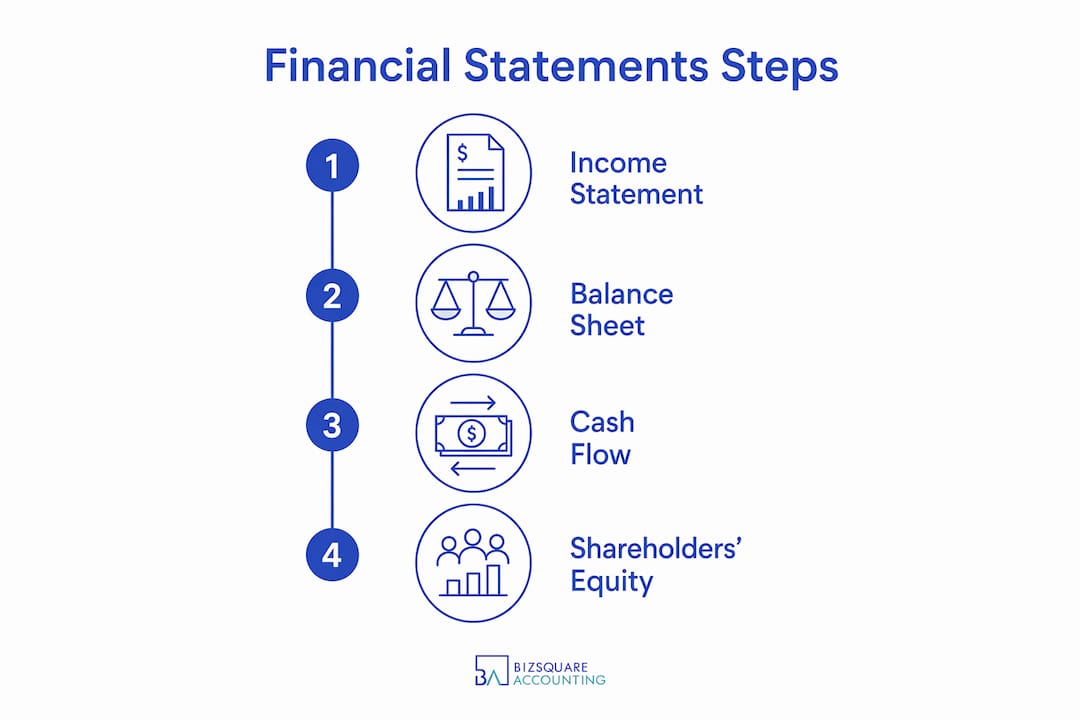
Financial statement preparation is the process of compiling four core documents, namely the income statement, balance sheet, cash flow statement, and statement of shareholders’ equity, following U.S. GAAP standards set by the Financial Accounting Standards Board (FASB). These documents together give a complete, transparent picture of a business’s financial health at any given point in time.

The correct preparation order matters. Start with the income statement, because net income flows directly into retained earnings on the balance sheet. Then build the balance sheet, leaving the cash line open. Complete the cash flow statement last, so the ending cash balance closes the loop on the balance sheet. This linked three-statement model is the standard approach for ensuring consistency across all reports.
Before drafting any statement, gather and organize the following foundational data:
- Trial balance: A listing of all general ledger account balances before adjustments
- Adjusting entries: Accruals, deferrals, and corrections that align revenue and expenses to the correct period
- Source documents: Invoices, bank statements, payroll records, and receipts
- Prior period statements: For comparative figures and retained earnings carry-forwards
- Chart of accounts: The master list of account categories used throughout the period
Accurate financial reports are not just an accounting requirement. They are strategic tools that help business owners evaluate liquidity, profitability, and overall financial health, and avoid common pitfalls like reporting paper profits without the corresponding cash.
Table of Contents
- What each financial statement actually reports
- How to prepare an income statement, step by step
- How to prepare a balance sheet correctly
- How to prepare a cash flow statement
- How to prepare a statement of shareholders’ equity
- Key accounting principles for financial statement preparation in the U.S.
- Which accounting software tools help you prepare financial statements?
- Bizsquare makes financial reporting manageable for growing businesses
- Key Takeaways
- FAQ
What each financial statement actually reports
The four main financial statements each serve a distinct purpose, and understanding that purpose before you start compiling data saves significant time and reduces errors.
Income statement: Reports revenues, costs, and expenses over a defined period, such as a quarter or fiscal year. The bottom line is net income or net loss. This figure feeds directly into retained earnings on the balance sheet and serves as the starting point for the cash flow statement.
Balance sheet: A point-in-time snapshot of what a business owns (assets), what it owes (liabilities), and what remains for owners (equity). The fundamental equation, Assets = Liabilities + Equity, must always hold. Any imbalance signals an error somewhere in the preparation process.
Cash flow statement: Shows actual cash inflows and outflows during the period, classified into three activities: operating, investing, and financing. This statement reconciles net income to real cash movement, which is critical because profitable companies can still run out of cash.
Statement of shareholders’ equity: Tracks changes in equity components over the reporting period, including common stock, additional paid-in capital, retained earnings, and treasury stock. It explains how net income, dividends, and equity transactions moved equity from the opening balance to the closing balance.
Each statement connects to the others. Net income links the income statement to both the equity statement and the cash flow statement. The ending cash balance on the cash flow statement matches the cash line on the balance sheet. Breaking any of these links produces unreliable reports.
How to prepare an income statement, step by step
The income statement is always the first document to complete. It establishes net income, which every other statement depends on. Follow these steps carefully.
Define the reporting period. Confirm the start and end dates, such as January 1 through December 31. All revenue and expense data must fall within this window.
Gather revenue data. Pull all sales revenue, service income, and any other operating revenue from the trial balance. Verify figures against invoices and bank deposits.
Identify the cost of goods sold (COGS). For product-based businesses, COGS includes direct materials, direct labor, and manufacturing overhead. Service businesses may have minimal or no COGS.
Calculate gross profit. Subtract COGS from total revenue. This figure shows how much the business earns before operating expenses.
List all operating expenses. Include salaries, rent, utilities, marketing, depreciation, and amortization. Group them logically by category.
Calculate operating income. Subtract total operating expenses from gross profit.
Add non-operating items. Include interest income, interest expense, gains or losses on asset sales, and any other items outside normal operations.
Apply income tax expense. Calculate the tax liability based on pre-tax income and the applicable corporate tax rate.
Arrive at net income. Net income is the final figure after all expenses and taxes. This number transfers directly to the statement of shareholders’ equity and the cash flow statement.
Review adjusting entries. Confirm that accrued revenues, accrued expenses, prepaid items, and deferred revenues have been properly recorded before finalizing the statement.
Pro Tip: Categorize transactions correctly from the very first day of the period. Mixing operating and non-operating items, or misclassifying COGS as an operating expense, creates errors that compound across all three statements and are time-consuming to trace later.
How to prepare a balance sheet correctly
The balance sheet is built after the income statement is finalized, because retained earnings depend on net income. Follow these steps to build it accurately.
List current assets. Start with cash, then accounts receivable, inventory, prepaid expenses, and other assets expected to convert to cash within 12 months. Pull figures from the adjusted trial balance.
List non-current assets. Include property, plant, and equipment (net of accumulated depreciation), intangible assets, long-term investments, and goodwill.
Calculate total assets. Add current and non-current assets together. This is the left side of the accounting equation.
List current liabilities. Include accounts payable, accrued liabilities, short-term debt, deferred revenue, and the current portion of long-term debt.
List non-current liabilities. Include long-term loans, bonds payable, deferred tax liabilities, and lease obligations extending beyond 12 months.
Calculate total liabilities. Add current and non-current liabilities.
Calculate retained earnings. Use this formula:
Complete the equity section. Add common stock, additional paid-in capital, and ending retained earnings. Subtract treasury stock if applicable.
Leave the cash line open until the cash flow statement is done. This is a common sequencing error. Finalizing the balance sheet before completing the cash flow statement often produces a cash figure that does not reconcile, breaking the accounting equation.
Verify the equation. Total Assets must equal Total Liabilities plus Total Equity. Any discrepancy requires reconciliation before the statement is considered complete.
A frequent pitfall is omitting working capital adjustments, such as changes in accounts receivable or inventory, which shifts balances between the balance sheet and the cash flow statement and causes the equation to break.

How to prepare a cash flow statement
The cash flow statement is built last, starting from net income and working backward to explain the actual movement of cash. Small businesses typically use the indirect method, which is the most common approach under U.S. GAAP.
Start with net income. Pull this figure directly from the completed income statement.
Add back non-cash charges. Depreciation and amortization reduce net income but do not involve cash outflows. Add them back in full.
Adjust for changes in working capital. This is where most errors occur. Apply the following logic:
- Increase in accounts receivable: subtract (cash not yet collected)
- Decrease in accounts receivable: add (cash collected exceeds revenue recognized)
- Increase in inventory: subtract (cash spent on stock)
- Increase in accounts payable: add (cash not yet paid out)
- Decrease in accounts payable: subtract (cash paid out)
Arrive at cash from operating activities. This subtotal shows how much cash the core business generated or consumed.
Record investing activities. Include purchases of property, equipment, or investments as outflows. Include proceeds from asset sales or investment maturities as inflows.
Record financing activities. Include loan proceeds as inflows. Include debt repayments, dividend payments, and share buybacks as outflows.
Calculate the net change in cash. Add operating, investing, and financing cash flows together.
Reconcile to the balance sheet. Add the net change in cash to the opening cash balance. The result must match the cash line on the balance sheet. If it does not, a linking error exists somewhere across the three statements.
Depreciation is one of the most consequential figures in this process. It reduces net income on the income statement, reduces the net book value of assets on the balance sheet, and must be added back in the operating section of the cash flow statement. Treating it inconsistently across any of these three statements breaks the model.
How to prepare a statement of shareholders’ equity
The equity statement is often the shortest of the four documents, but it plays a critical role in explaining how ownership interests changed during the period.
Identify the opening balances. Pull the beginning-of-period balances for each equity component: common stock, additional paid-in capital, retained earnings, and treasury stock.
Record net income. Add net income from the income statement to retained earnings. This is the primary driver of equity growth for most businesses.
Record dividends declared. Subtract dividends declared from retained earnings. Note that dividends reduce retained earnings regardless of whether they have been paid in cash yet.
Record equity transactions. If the company issued new shares during the period, add the proceeds to common stock and additional paid-in capital. If the company repurchased shares, increase treasury stock (which reduces total equity).
Calculate ending balances. Sum each column to arrive at the closing balance for every equity component.
Confirm the ending retained earnings figure matches the balance sheet. The retained earnings line on the equity statement and the balance sheet must be identical. Any discrepancy indicates a missed transaction or an arithmetic error in step 7 of the balance sheet preparation.
Adjusting entries for the period, particularly those related to prior-period corrections or changes in accounting estimates, must be reflected in the opening retained earnings balance before the statement is built. Skipping this step produces a misleading equity roll-forward.
Key accounting principles for financial statement preparation in the U.S.
Accurate financial reports rest on a clear set of principles and practices. Adhering to them is not optional for U.S. businesses, and GAAP compliance ensures that stakeholders, lenders, and investors can compare performance reliably across companies and reporting periods.
Core principles to follow:
- Consistency: Apply the same accounting methods from period to period. Changing depreciation methods or revenue recognition policies mid-stream distorts comparisons.
- Accuracy: Every figure must trace back to a source document. The IRS requires businesses to maintain adequate records to support all income and deduction claims.
- Transparency: Disclose material accounting policies, estimates, and contingencies in the notes to the financial statements. Notes are not optional footnotes; they are an integral part of GAAP-compliant reporting.
- Matching principle: Expenses must be recognized in the same period as the revenue they helped generate, regardless of when cash changes hands.
- Going concern: Prepare statements on the assumption that the business will continue operating unless there is evidence to the contrary.
Best practices for internal controls and documentation:
- Maintain a dedicated assumptions tab or working file that documents every estimate, rate, and policy decision used in the statements.
- Reconcile every account on the trial balance before beginning statement preparation. Unreconciled accounts are the leading source of balance sheet imbalances.
- Use a validation checklist: confirm that net income matches across the income statement and equity statement, that ending retained earnings matches across the equity statement and balance sheet, and that ending cash matches across the cash flow statement and balance sheet.
- Segregate duties where possible. The person recording transactions should not be the same person reconciling accounts or approving adjustments.
- Archive all supporting workpapers, journal entries, and source documents for a minimum of seven years, consistent with IRS recordkeeping guidance.
A note on linking errors: Failing to properly connect the three primary statements is one of the most common preparation mistakes. When the link between net income, retained earnings, and the cash balance breaks, the fundamental equation Assets = Liabilities + Equity no longer holds, and the entire set of reports becomes unreliable. Build validation checks into the preparation process from the start.
Financial statements also serve a purpose well beyond tax compliance. They are strategic management tools that reveal whether a business is genuinely profitable, whether it generates enough cash to sustain operations, and where capital is being deployed most effectively.
Which accounting software tools help you prepare financial statements?
Manual preparation using spreadsheets is possible for very simple businesses, but dedicated accounting software reduces errors, automates reconciliations, and produces GAAP-formatted reports far more efficiently. The following tools are widely used by small businesses and finance professionals in the United States.
QuickBooks Online is the most widely adopted small business accounting platform in the U.S. It generates income statements, balance sheets, and cash flow statements automatically from transaction data, and supports multi-user access for bookkeepers and accountants working collaboratively.
Xero is a cloud-based alternative with strong bank reconciliation features and a clean interface suited to businesses that want real-time visibility into their financials. Its reporting module produces all four primary statements and allows custom date ranges and comparative periods.
FreshBooks is designed primarily for service-based businesses and freelancers. It handles invoicing, expense tracking, and profit and loss reporting well, though its balance sheet and cash flow reporting is less detailed than QuickBooks or Xero for complex entities.
Sage Intacct targets mid-market companies with more complex reporting needs, including multi-entity consolidations, project accounting, and dimensional reporting. It is a strong choice for businesses that have outgrown entry-level platforms.
Wave is a free accounting tool suited to very small businesses and sole proprietors. It covers income and expense tracking, invoicing, and basic financial reporting, though it lacks some of the automation and integration depth of paid platforms.
Microsoft Excel or Google Sheets remain practical options for businesses with straightforward financials, particularly when using a structured three-statement model template. The risk is manual error, so validation formulas and locked reference cells are necessary safeguards.
For businesses seeking professional guidance on bookkeeping accuracy and software selection, working with an experienced accounting firm ensures the chosen tool is configured correctly from the outset, which prevents costly rework later.
Bizsquare makes financial reporting manageable for growing businesses
Preparing financial statements accurately takes time, technical knowledge, and a clear understanding of GAAP requirements. For many business owners, the real cost is not the accounting software subscription; it is the hours spent reconciling accounts, tracing errors, and second-guessing whether the reports are correct.

Bizsquare offers professional accounting and bookkeeping services designed specifically for entrepreneurs, SMEs, and growing companies. The team handles the full preparation cycle, from organizing source documents and posting adjusting entries to producing GAAP-compliant income statements, balance sheets, cash flow statements, and equity reports. Clients receive accurate, audit-ready financials without needing to manage the process themselves.
Beyond statement preparation, Bizsquare’s corporate advisory and outsourced CFO services translate those reports into strategic insight, helping owners understand what the numbers mean for cash flow planning, tax positioning, and growth decisions. For businesses at the incorporation stage, getting the accounting foundation right from day one is the most cost-effective approach, as explained in this law firm financial statement explained for owners. Contact Bizsquare to discuss how the team can support your financial reporting needs.
Key Takeaways
Preparing financial statements correctly requires following the income statement, balance sheet, cash flow, and equity statement sequence in order, with each document feeding verified figures into the next.
| Point | Details |
|---|---|
| Preparation order matters | Complete the income statement first; net income feeds retained earnings and the cash flow statement. |
| Balance sheet comes second | Leave the cash line open until the cash flow statement is finalized to ensure reconciliation. |
| Cash flow statement closes the loop | Start with net income, add back non-cash charges, and adjust for working capital changes. |
| GAAP compliance is non-negotiable | FASB standards require consistency, accuracy, and full disclosure in notes to the financial statements. |
| Bizsquare supports the full cycle | Bizsquare’s accounting and outsourced CFO services cover statement preparation, reconciliation, and financial analysis for SMEs. |
FAQ
What are the steps to prepare financial statements?
Start with the income statement to calculate net income. Then update retained earnings on the balance sheet, complete the cash flow statement using the indirect method, and finalize the statement of shareholders’ equity. Each statement must reconcile to the others before the set is considered complete.
What are the four main financial statements?
The four primary statements are the income statement, balance sheet, cash flow statement, and statement of shareholders’ equity. Together, they provide a complete view of a business’s profitability, financial position, cash generation, and changes in ownership interests.
Is preparing financial statements difficult for a small business owner?
The process follows a logical sequence and becomes manageable with organized records and a clear trial balance. The most common difficulty is correctly linking the three primary statements so that net income, retained earnings, and ending cash all reconcile across documents.
What is the difference between the income statement and the cash flow statement?
The income statement reports revenues and expenses on an accrual basis, meaning it records transactions when they occur, not when cash moves. The cash flow statement adjusts for non-cash items and working capital changes to show actual cash received and paid during the period.
What accounting software is best for preparing financial statements?
QuickBooks Online and Xero are the most widely used platforms for small businesses in the U.S. Both generate GAAP-formatted income statements, balance sheets, and cash flow statements automatically from transaction data, reducing manual preparation time significantly.
What is the accounting equation and why does it matter?
The accounting equation is Assets = Liabilities + Equity. Every transaction recorded in a double-entry system must keep this equation in balance. If the balance sheet does not balance after preparation, a recording or linking error exists somewhere in the statements.
What are adjusting entries and when are they needed?
Adjusting entries are journal entries made at the end of a reporting period to record accrued revenues, accrued expenses, prepaid items, and deferred revenues that have not yet been captured in the regular transaction record. They are required before any financial statement is finalized.
What is the indirect method for the cash flow statement?
The indirect method starts with net income and adjusts for non-cash charges such as depreciation and for changes in working capital accounts such as receivables, inventory, and payables. It is the standard approach for most small businesses preparing GAAP-compliant cash flow statements.
What are notes to the financial statements?
Notes are disclosures that accompany the four primary statements and explain the accounting policies used, significant estimates, contingent liabilities, and other material information. Under U.S. GAAP, notes are a required component of a complete financial statement package.
How does Bizsquare help with financial statement preparation?
Bizsquare provides end-to-end accounting and bookkeeping services, covering transaction recording, adjusting entries, reconciliation, and the preparation of all four GAAP-compliant financial statements. The team also offers outsourced CFO services to help business owners interpret and act on the reports produced.
How long should financial records be kept?
The IRS recommends keeping records that support income, deductions, and credits for at least three years from the date the return was filed, and up to seven years in cases involving bad debt deductions or losses from worthless securities. Maintaining complete records is also essential for accurate financial statement preparation in future periods.
What is a trial balance and how is it used?
A trial balance is a listing of all general ledger account balances at a specific date, before adjusting entries are posted. It serves as the starting point for financial statement preparation, confirming that total debits equal total credits before any statement is drafted.
Can a business prepare financial statements without an accountant?
A business with straightforward transactions and organized records can prepare basic financial statements using accounting software. However, for businesses with complex transactions, multiple revenue streams, or external reporting requirements, working with a qualified accountant reduces the risk of material errors and GAAP non-compliance.