
Business Expense Tracking Guide for Small Business Owners
Business expense tracking is the systematic recording, categorizing, and reviewing of every cost your business incurs. Done correctly, it protects you during tax audits, reveals where money leaks, and gives you the financial clarity to make confident decisions. For Singapore SMEs, accurate expense tracking also satisfies obligations under the Inland Revenue Authority of Singapore (IRAS) and supports clean corporate tax filings year after year.
Here is why every small business owner needs a reliable tracking system:
- Tax compliance: Properly categorized expenses support deduction claims and reduce your tax liability under both IRS guidelines and IRAS rules.
- Audit readiness: Organized records mean you can respond to any audit request without scrambling through shoeboxes of receipts.
- Budget control: Tracking actual spending against your budget reveals overspending before it becomes a cash flow problem.
- Fraud detection: Regular reconciliation surfaces unauthorized charges and duplicate payments early.
- Financial clarity: Accurate expense data feeds your profit and loss statement, giving you a true picture of business health.
- Investor and lender confidence: Clean books signal credibility to banks and investors reviewing your financials.
How to track business expenses step by step
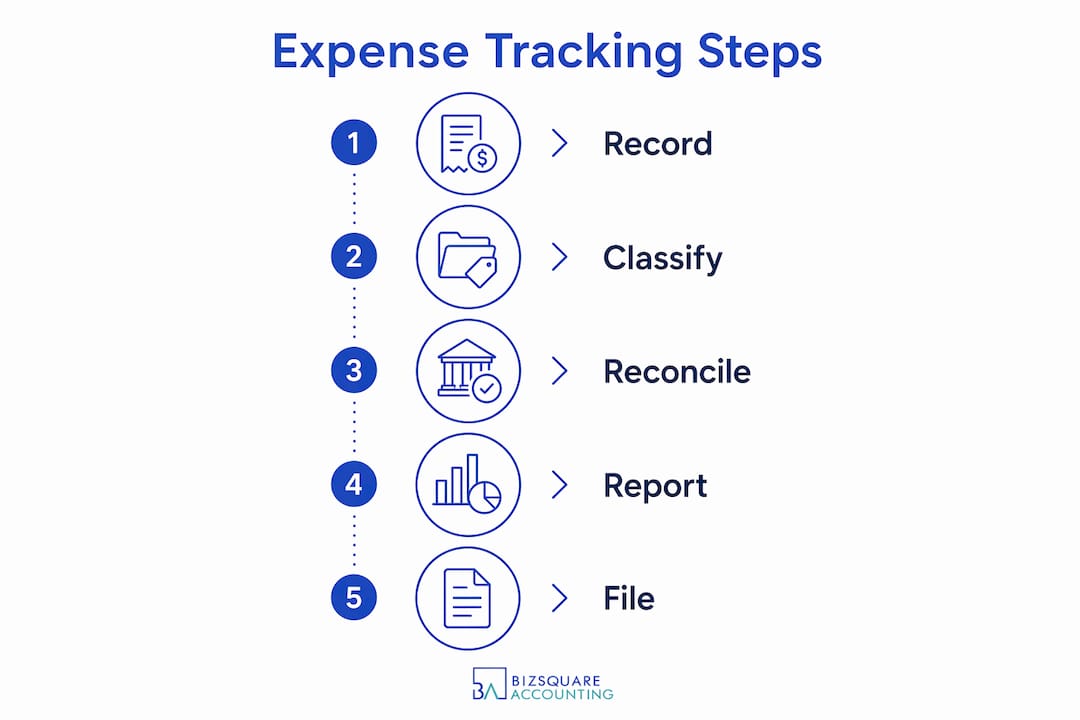
A reliable expense tracking system does not happen by accident. It requires deliberate setup and consistent habits. Follow these steps to build one that works for your business.
- Open a dedicated business bank account and credit card. Mixing personal and business expenses creates difficult manual reconciliation and errors. A dedicated business account eliminates roughly 80% of tracking errors by keeping transactions cleanly separated from the start.
- Choose your tracking method. Small businesses typically start with a spreadsheet, then graduate to accounting software as transaction volume grows. Manual ledgers work for very early-stage sole proprietors, but they do not scale. Cloud-based accounting platforms that link directly to your bank feed are the most effective method for reducing data entry errors.
- Record expenses as they occur. Waiting until month-end to enter expenses leads to missed items and a painful backlog. Capture each transaction the same day, or at the latest within 48 hours, using a mobile app or your accounting platform.
- Categorize every expense consistently. Assign each transaction to a fixed category, such as rent, utilities, travel, or software subscriptions. Consistent categorization makes tax preparation faster and ensures your reports are comparable month over month.
- Digitize and store all receipts and invoices. Scan paper receipts immediately after a purchase. The IRS accepts legible digital copies for audits, but thermal paper fades quickly, so do not rely on the original alone.
- Reconcile your records against bank statements monthly. Compare every line in your expense tracker against your bank and credit card statements. Discrepancies caught early are far easier to resolve than those discovered during an annual audit.
- Review expense data monthly for cost insights. Monthly analysis transforms bookkeeping from a compliance chore into a profit management tool. Look for categories that are trending upward and ask whether the spending is generating proportional value.
- Archive records for the required retention period. Keep all supporting documents for at least three years, and for up to seven years in the case of significant capital asset purchases, as recommended by the IRS.
Pro Tip: Schedule a fixed 30-minute appointment every Friday to review and categorize that week’s transactions. Blocking it in your calendar treats it like a client meeting, and you will never face a month-end backlog again.
What types of business expenses should you track?
Knowing what counts as a business expense, and how to classify it, directly affects your tax deductions and the accuracy of your financial reports. The IRS defines a deductible business expense as one that is both ordinary (common in your industry) and necessary (helpful for your business). IRAS applies a similar “wholly and exclusively” test for Singapore companies.
Core expense categories every small business should track:
- Operating costs: Rent, utilities, office supplies, and insurance premiums that keep the business running day to day.
- Payroll and contractor fees: Salaries, CPF contributions for Singapore employees, and payments to freelancers or consultants.
- Travel and transportation: Airfare, hotel stays, ground transport, and mileage for business trips. The IRS sets an annual standard mileage rate for vehicle use, so track every business kilometer.
- Meals and entertainment: Only a portion of meal expenses qualifies as deductible under IRS rules. Singapore’s IRAS allows entertainment deductions at 50% in most cases, so accurate records are critical.
- Software subscriptions and SaaS tools: Monthly fees for accounting platforms, project management tools, and communication software. Assign clear ownership of each subscription to a department or cost center to maintain visibility, especially as SaaS and AI tool costs grow in 2026.
- Capital assets: Equipment, machinery, and computers. These are not fully expensed in the year of purchase; instead, they are depreciated over their useful life.
- Employee reimbursements: Out-of-pocket costs your staff incur on behalf of the business, such as client meals or travel advances.
- Professional services: Accounting, legal, and consulting fees paid to external advisors.
Non-deductible expenses include personal living costs, fines and penalties, and capital expenditure claimed in full in the year of purchase (outside of approved schemes). Misclassifying a non-deductible item as a business expense is one of the most common audit triggers, so categorize carefully.
Which tools and software options work best for expense tracking?
The right tool depends on your transaction volume, team size, and how tightly you need expense data to connect with your accounting records. There is no single best answer, but there is a clear progression.

Manual methods and spreadsheets suit sole proprietors with fewer than 20 transactions per month. A well-structured Google Sheets or Microsoft Excel template can handle basic categorization and monthly totals. The limitation is that manual entry is error-prone and does not scale once you add employees or multiple revenue streams.
Cloud-based accounting software is the standard for growing SMEs. Platforms that link bank feeds directly to your accounting records reduce manual data entry errors significantly. Automated data collection through bank feed integration is the most effective tracking method available to small businesses today. Look for software that supports multi-currency transactions if your Singapore business deals in USD, SGD, or other currencies.
Receipt scanning apps let you photograph paper receipts on your phone and extract the data automatically using optical character recognition (OCR). This is particularly useful for field staff and traveling employees who accumulate receipts away from the office.
AI-powered expense tools are gaining traction in 2026. Some platforms now flag anomalous spending patterns, suggest expense categories automatically, and generate compliance-ready reports. For Singapore SMEs, look for tools that support GST tracking and IRAS-compliant reporting formats.
Enterprise approval platforms such as Stampli add a structured approval workflow on top of expense capture. Stampli centralizes invoice and expense approvals, giving finance teams a clear audit trail for every payment. This level of control suits businesses with multiple approvers or complex procurement processes.
Key features to evaluate when choosing a tool:
- Bank feed integration for automatic transaction import
- Receipt capture via mobile camera or email forwarding
- Customizable expense categories aligned with your chart of accounts
- Multi-currency support for cross-border transactions
- GST or VAT tracking for Singapore and international compliance
- Role-based access controls so employees can submit without seeing sensitive financial data
- Export formats compatible with your accounting software or tax filing system
- Approval workflows for reimbursable employee expenses
Pro Tip: Before committing to any software, run a free trial using one full month of real transactions. A tool that looks good in a demo may not handle your specific expense mix, currency needs, or approval structure.
What are the record-keeping requirements for small businesses?
Proper documentation is not optional. Both the IRS and IRAS set minimum retention periods, and failing to produce records during an audit can result in disallowed deductions or penalties.

IRS requirements for U.S. businesses:
The IRS recommends keeping business records for at least three years from the date you filed the return, which covers the standard audit window. For capital assets such as property or equipment, retain records for up to seven years, because depreciation schedules span multiple tax years. If you fail to report income that exceeds 25% of your gross income, the IRS can audit up to six years back.
Singapore IRAS requirements:
Singapore companies must retain business records, including invoices, receipts, bank statements, and contracts, for a minimum of five years from the end of the financial year to which they relate. This applies to both physical and electronic records. The five-year rule is stricter than the U.S. standard, so Singapore SMEs should build their retention policy around the longer period.
Best practices for documentation:
- Digitize every paper receipt immediately after the transaction. The IRS accepts digital copies as long as they are legible and complete, so a clear smartphone photo is sufficient.
- Do not rely on thermal paper receipts alone. The ink fades within months, leaving you with a blank slip that cannot support a deduction claim.
- Store digital files in a cloud folder organized by year and expense category, with a consistent naming convention such as YYYY-MM-DD_vendor_amount.
- Back up your records to at least two locations, for example, a cloud storage service and an external hard drive.
- For Singapore businesses, refer to the Bizsquare guide on business record-keeping for a detailed breakdown of IRAS-specific obligations.
Statistic callout: The IRS requires documents to be kept for at least three years, and up to seven years for capital assets. Singapore’s IRAS requires a minimum five-year retention period for all business documents.
What are the most common expense tracking mistakes, and how do you fix them?
Even experienced business owners make recurring errors in expense management. Recognizing these pitfalls early saves time, money, and stress during tax season.
Common challenges and practical fixes:
- Mixing personal and business expenses: This is the single most damaging habit. Open a dedicated business account from day one. A separate business bank account removes the guesswork from reconciliation.
- Delayed expense entry: Transactions entered days or weeks after the fact are often miscategorized or forgotten entirely. Use a mobile app to capture expenses at the point of purchase.
- Poor receipt management: Losing receipts means losing deductions. Photograph every receipt immediately and upload it to your accounting system before you leave the vendor.
- Inconsistent categorization: Assigning the same type of expense to different categories across months makes your reports unreliable. Create a written category list and share it with anyone who submits expenses.
- Ignoring small transactions: Coffee meetings, parking fees, and small supply purchases add up. Track every transaction, regardless of size.
- Failing to review monthly: Expense data reviewed only at year-end offers no opportunity to course-correct. Monthly review, as recommended by expense management best practices, turns your data into a decision-making tool.
- No written expense policy: Without a policy, employees make inconsistent spending decisions. A clear written policy reduces unauthorized spending and creates accountability across the team.
Pro Tip: Set a recurring calendar reminder every Monday morning to review the previous week’s transactions. Five minutes of weekly attention prevents the two-hour scramble at month-end.
For a deeper look at the errors Singapore SMEs make most often, the common bookkeeping mistakes guide from Bizsquare covers the patterns that consistently cause compliance problems.
How do you create an expense tracking policy for your business?
A written expense policy is the foundation of any reliable tracking system. Without one, every employee makes independent decisions about what to spend, how to document it, and when to submit it. The result is inconsistent data, delayed reimbursements, and audit risk.
What a good expense policy covers
Start with the basics: define which expenses the business will reimburse, set spending limits by category, and specify the documentation required for each claim. For example, your policy might state that all meals over $50 require a receipt and a note identifying the business purpose and attendees.
Next, establish a submission timeline. Employees should submit expense reports within a set number of days after the expense occurs, typically five to ten business days. Late submissions create reconciliation problems and distort monthly reports.
Assign approval authority clearly. Specify who approves expenses at each level, for instance, a direct manager for routine costs and a finance director for anything above a defined threshold. This prevents unauthorized spending from slipping through.
Finally, address reimbursement timing. Employees who wait weeks for reimbursement lose confidence in the process and sometimes stop submitting altogether. A predictable payment cycle, such as reimbursement on the 15th of each month, builds trust and compliance.
Steps to build your policy
- List every expense category your business incurs regularly.
- Set a per-transaction spending limit for each category.
- Define required documentation: receipt, invoice, or bank statement.
- Specify the submission window and the approval chain.
- State the reimbursement schedule and payment method.
- Communicate the policy to all staff in writing and store it in an accessible location.
- Review and update the policy annually, or whenever your business structure changes.
A written policy does more than reduce errors. It signals to employees, auditors, and investors that your business manages money with discipline.
How does expense tracking connect to accounting and tax filing?
Expense tracking does not exist in isolation. It feeds directly into your accounting records, which in turn form the basis of your tax filings. A gap anywhere in this chain creates problems that compound over time.
The flow from transaction to tax return
Every expense you record enters your general ledger, where it is classified against the relevant account in your chart of accounts. Your accounting software uses this data to generate your profit and loss statement, balance sheet, and cash flow report. At tax time, these reports provide the figures your accountant or tax advisor needs to prepare your return.
For Singapore companies, the annual tax filing cycle runs to the corporate income tax return submitted to IRAS. Accurate expense records directly reduce your chargeable income, because deductible expenses lower the profit on which tax is calculated. Errors in expense categorization, such as claiming a capital purchase as an operating expense, can trigger IRAS queries or adjustments.
Why bank feed integration matters
Linking your bank account to your accounting software automates the first step of this chain. Transactions flow directly into your ledger, reducing the risk of manual entry errors. Automated bank feed integration cuts manual errors and saves meaningful time each month. Your accountant then works from a cleaner data set, which reduces the time and cost of preparing your financial statements and tax return.
GST tracking for Singapore businesses
Singapore companies registered for Goods and Services Tax (GST) must track input tax on purchases separately from the expense amount. Your accounting software should allow you to tag each transaction with the applicable GST rate, so your quarterly GST return can be generated directly from your records. Mixing GST and non-GST transactions without proper tagging is a common source of errors in Singapore SME filings.
For professional support with corporate tax filing in Singapore, Bizsquare provides advisory and filing services tailored to SME needs.
How should you handle reimbursable expenses and employee submissions?
Reimbursable expenses, those your employees pay out of pocket and then claim back from the business, require a separate process from direct company spending. Without a clear system, reimbursements become a source of disputes, delays, and accounting errors.
Setting up a reimbursement process
The first step is to give employees a simple, consistent way to submit claims. A digital submission form or expense management platform works better than email chains or paper forms, because it captures all required fields: date, vendor, amount, category, business purpose, and receipt attachment.
Require employees to submit claims within a defined window, typically within ten business days of the expense. Claims submitted after 30 days should require manager approval with a written explanation. This discipline keeps your monthly accounts accurate and prevents surprise reimbursement requests from distorting your cash flow.
Approval and payment workflow
Every reimbursement claim should pass through at least one approval step before payment. The approver checks that the expense falls within policy limits, that the receipt is attached, and that the business purpose is documented. Platforms like Stampli provide a structured approval workflow with a full audit trail, which is particularly useful for businesses with multiple approvers or remote teams.
Once approved, process reimbursements on a fixed schedule. Paying on the 15th and last day of each month, for example, gives employees predictability and keeps your accounts payable organized.
Preventing common reimbursement problems
- Require a receipt for every claim above a minimum threshold, such as $10.
- Disallow claims for personal expenses even when they occur during a business trip.
- Flag duplicate submissions automatically using your expense platform.
- Reconcile reimbursement payments against your bank statement each month to confirm every approved claim was paid and no unapproved payment went through.
For freelancers and sole proprietors tracking their own reimbursable costs, the same discipline applies. Keep a separate log of out-of-pocket business expenses, attach receipts, and record them in your accounting system on the same day they occur.
Key Takeaways
Effective business expense tracking requires consistent habits, the right tools, and clear policies, all working together to keep your financial records accurate and audit-ready.
| Point | Details |
|---|---|
| Separate accounts from day one | A dedicated business bank account eliminates roughly 80% of tracking errors by keeping transactions cleanly separated. |
| Retain records for the right period | The IRS requires records to be kept for at least three years, and up to seven years for significant assets; Singapore IRAS requires a minimum of five years. |
| Digitize receipts immediately | The IRS accepts legible digital copies for audits, but thermal paper fades, so photograph receipts at the point of purchase. |
| Review expenses monthly | Monthly analysis turns expense data into a profit management tool, not just a compliance record. |
| Write down your expense policy | A clear written policy reduces inconsistent spending and creates accountability across your entire team. |
FAQ
1.) What is the best way to keep track of business expenses?
The most effective method is to link your business bank account to cloud-based accounting software, so transactions import automatically. Capture receipts digitally at the point of purchase, categorize every transaction consistently, and reconcile your records against your bank statement each month.
2.) How long do I need to keep business expense records?
The IRS requires you to keep records for at least three years, and up to seven years for capital assets. Singapore’s IRAS requires a minimum of five years from the end of the relevant financial year.
3.) Are digital receipts acceptable for tax purposes?
Yes. The IRS accepts legible digital copies of receipts for audit purposes. Photograph paper receipts immediately after purchase, because thermal paper ink fades and the original may become unreadable within months.
4.) What expense categories are tax-deductible for small businesses?
Ordinary and necessary business expenses are generally deductible. Common deductible categories include rent, utilities, payroll, travel, software subscriptions, professional services, and business meals at the applicable deductible rate. Capital purchases are depreciated over time rather than deducted in full in the year of purchase.
5.) Do freelancers and sole proprietors need to track expenses the same way?
Yes. Freelancers and sole proprietors face the same IRS documentation requirements as incorporated businesses. A dedicated business account, consistent categorization, and digital receipt storage apply equally. The scale may be smaller, but the discipline is identical.
6.) What is Stampli used for in expense management?
Stampli is an invoice and expense approval platform that centralizes the approval workflow and creates a full audit trail for every payment. It suits businesses with multiple approvers or complex procurement processes.
7.) How does GST affect expense tracking for Singapore businesses?
Singapore companies registered for GST must record the input tax on each purchase separately from the net expense amount. Your accounting software should tag each transaction with the applicable GST rate so your quarterly GST return can be generated directly from your records.
8.) What should a written expense policy include?
A written expense policy should define which expenses are reimbursable, set spending limits by category, specify required documentation, establish a submission timeline, name the approval chain, and state the reimbursement schedule.
9.) How do I connect expense tracking to my tax filing?
Every recorded expense flows into your general ledger, which feeds your profit and loss statement. Your accountant uses this statement to calculate chargeable income and prepare your tax return. Accurate categorization directly reduces your tax liability by ensuring all legitimate deductions are captured.
10.) Can I use a spreadsheet instead of accounting software?
A spreadsheet works for very early-stage businesses with low transaction volumes. As your business grows, manual entry becomes error-prone and time-consuming. Cloud-based accounting software with bank feed integration is more reliable and scales with your business.
11.) What happens if I mix personal and business expenses?
Mixing personal and business expenses creates reconciliation errors, risks disallowed tax deductions, and complicates any audit. The IRS and IRAS both require that business expense claims relate exclusively to business activity, so personal transactions in a business account create immediate compliance risk.
12.) How often should I reconcile my expense records?
Monthly reconciliation against your bank and credit card statements is the minimum standard. Businesses with high transaction volumes benefit from weekly reconciliation to catch errors before they accumulate.
13.) What is the difference between bookkeeping and expense tracking?
Expense tracking is one component of bookkeeping. Bookkeeping covers the full recording of all financial transactions, including income, liabilities, and equity, while expense tracking focuses specifically on recording and categorizing outgoing costs. For a detailed comparison, the bookkeeping vs. accounting guide from Bizsquare explains how the two functions relate.
Let Bizsquare handle your books so you can focus on your business
Tracking every expense, reconciling bank statements, and staying current with IRAS requirements takes consistent effort. For many Singapore SME owners, that time is better spent on clients, products, and growth.
Bizsquare provides professional accounting and bookkeeping services designed specifically for Singapore companies. From setting up your chart of accounts and expense categories to preparing your corporate tax filing, the Bizsquare team handles the financial infrastructure so your records stay clean, compliant, and audit-ready all year.
Ready to take the complexity out of expense management? Visit bizsquareaccounting.com to speak with a consultant and find the right service package for your business.