


Legal Requirements for Company Setup in Singapore
Overview:
Setting up a company in Singapore requires meeting legal requirements under the Companies Act, including director appointments, share capital, and registered address. Foreigners can own 100% of a Singapore company, but at least one director must be ordinarily resident in Singapore. Continuous compliance, such as appointing a company secretary and filing annual returns, is essential to avoid penalties.
Setting up a company in Singapore means meeting a defined set of legal requirements for company setup under the Companies Act, administered by the Accounting and Corporate Regulatory Authority (ACRA). These obligations cover everything from director appointments and share capital to registered office addresses and company constitutions. Singapore’s regulatory framework is structured, transparent, and designed to support entrepreneurs who want to build compliant businesses from day one. Getting these steps right from the start protects the company and its directors from penalties and operational disruptions.
What are the mandatory company formation regulations in Singapore?
Company formation regulations in Singapore apply to all locally incorporated entities, with the private limited company (Pte. Ltd.) being the most common structure for entrepreneurs and SMEs.
Types of companies and ownership rules
Singapore recognizes private and public companies under the Companies Act. A private limited company can have 1 to 50 shareholders, and shareholders can be individuals or corporate entities. Foreign nationals and foreign companies can own 100% of a Singapore company, making it one of the most open incorporation environments in the world.
The minimum paid-up capital for a Singapore company is S$1. This low threshold removes a major financial barrier for new entrepreneurs. Capital can be increased after incorporation as the business grows.
Director requirements
Every Singapore company must appoint at least one director who is ordinarily resident in Singapore. This means the director holds Singapore citizenship, permanent residency, or an Employment Pass. Directors must be at least 18 years old and must not be bankrupt or convicted of malpractice. There is no maximum number of directors, and companies can appoint both local and foreign directors simultaneously.

Registered office address rules
Every company must maintain a local registered office address that is a physical location, not a P.O. box. The office must be operational and accessible during normal business hours. Entrepreneurs who work from home can use a residential address under the HDB Home Office Scheme, but prior approval from HDB is required before listing that address with ACRA.
- At least one Singapore-resident director, aged 18 or above, with no bankruptcy or malpractice record
- Minimum of one shareholder (maximum 50 for private companies)
- Paid-up capital of at least S$1
- A physical registered office address in Singapore
- A company secretary appointed within 6 months of incorporation
Pro Tip: If you do not yet have a local director, a nominee director service through a registered filing agent can satisfy ACRA’s residency requirement while you secure your own Employment Pass.
How to prepare and submit essential documents for business registration
The business registration requirements in Singapore center on three core documents: the company constitution, the incorporation application, and the company name approval. Getting these right before submission prevents delays and rejection.
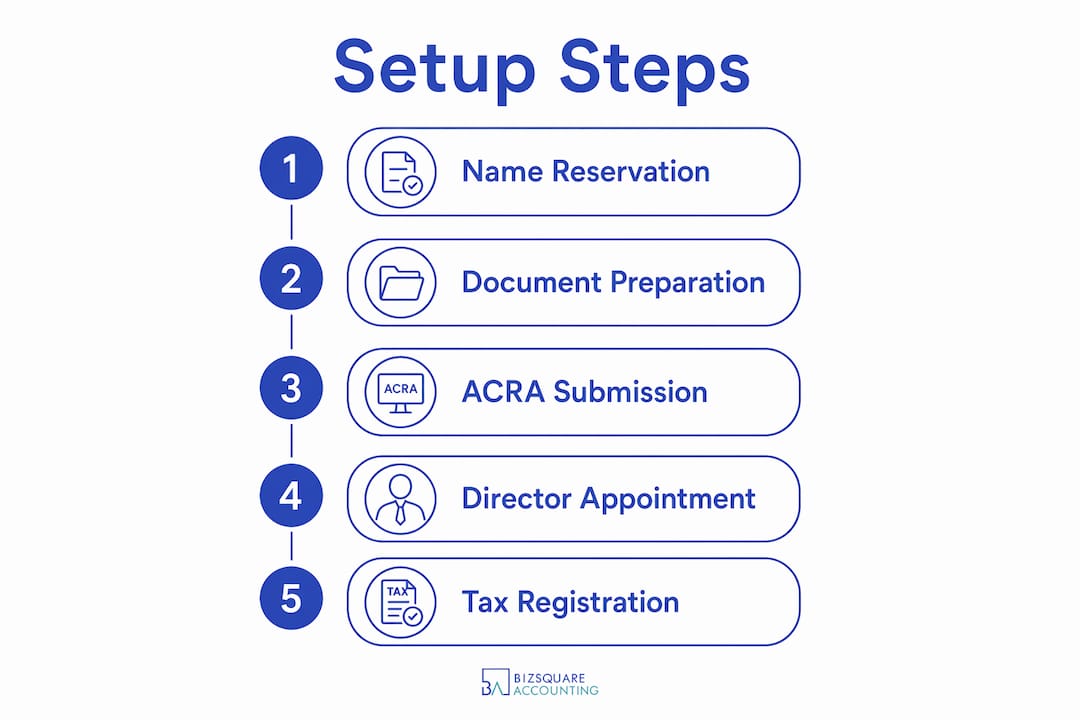
Step-by-step registration process on BizFile+
The incorporation process can be completed within 1–2 days using ACRA’s BizFile+ online system. Submissions require either a SingPass login or a registered filing agent acting on the applicant’s behalf.
- Reserve the company name. Submit the proposed name through BizFile+ for ACRA’s approval. The approved name is reserved for 120 days from the application date. If registration is not completed within that window, the reservation expires and the name must be reapplied for.
- Prepare the company constitution. The constitution governs internal management, shareholder rights, and company structure. It is the primary governance document reviewed by ACRA during incorporation. Entrepreneurs can adopt ACRA’s standard model constitution or draft a customized version with legal counsel.
- Compile director and shareholder details. Gather identification documents, residential addresses, and consent-to-act forms for all directors and shareholders. Foreign individuals must provide certified passport copies.
- Submit the incorporation application on BizFile+. Upload the constitution, director and shareholder particulars, and the registered office address. Pay the applicable government filing fee.
- Receive the Certificate of Incorporation. ACRA issues a digital certificate upon approval. This document confirms the company’s legal existence and includes the Unique Entity Number (UEN).
Company constitution and shareholder agreements
The company constitution submitted to ACRA is a mandatory document for all incorporated companies. It defines voting rights, dividend policies, and procedures for director appointments. Separately, shareholders may enter into a private shareholder agreement to address matters not covered in the constitution, such as exit rights, anti-dilution provisions, and dispute resolution. This agreement is not filed with ACRA but is legally binding between the parties.
Pro Tip: Do not rely solely on ACRA’s model constitution if you have multiple founders or investors. A customized constitution and a shareholder agreement together give your company a clearer governance structure from the start.
What are the ongoing compliance requirements after company incorporation?
Incorporation is the beginning, not the end, of a company’s legal obligations. Singapore’s Companies Act imposes continuous compliance duties that every company must meet to remain in good standing with ACRA.
Company secretary appointment
Every Singapore company must appoint a qualified company secretary within 6 months of incorporation. The company secretary must be a natural person ordinarily resident in Singapore. A sole director who is also the sole shareholder cannot serve as the company secretary. This rule prevents a conflict of interest in governance oversight.
The company secretary’s responsibilities include:
- Filing annual returns with ACRA on time
- Maintaining the company’s statutory registers, including the register of directors and register of members
- Organizing and documenting board and shareholder meetings
- Advising the board on compliance with the Companies Act
- Notifying ACRA of any changes to the company’s particulars, such as director changes or address updates
Entrepreneurs can learn more about company secretary requirements to understand the full scope of this role before making an appointment.
Annual filing and registered office obligations
Companies must file annual returns with ACRA each year, accompanied by financial statements for companies that are not exempt. The registered office must remain operational throughout the company’s existence. Failure to maintain a valid registered office or to file annual returns on time results in financial penalties and, in serious cases, court-ordered striking off.
Non-compliance with the Companies Act carries real consequences. ACRA can impose fines on directors and the company itself, disqualify directors from holding office, and initiate legal proceedings to wind up the company. Treating compliance as optional is a risk no entrepreneur should take.
Which licenses, permits, and tax registrations do new Singapore companies need?
Incorporation gives a company legal existence, but it does not automatically authorize all business activities. Certain industries require additional licenses and permits before operations can begin.
Industry-specific licenses and permits
The type of license required depends entirely on the business activity. A food and beverage business needs a food shop license from the Singapore Food Agency (SFA). A financial services firm requires a Capital Markets Services (CMS) license from the Monetary Authority of Singapore (MAS). An employment agency must hold a license from the Ministry of Manpower (MOM). Operating without the required license exposes the company and its directors to criminal liability.
| Business Activity | Licensing Authority | License Type |
|---|---|---|
| Food and beverage | Singapore Food Agency (SFA) | Food shop license |
| Financial services | Monetary Authority of Singapore (MAS) | Capital Markets Services license |
| Employment agency | Ministry of Manpower (MOM) | Employment agency license |
| Import and export | Singapore Customs | Customs account and TradeNet permit |
| Healthcare services | Ministry of Health (MOH) | Healthcare institution license |
Corporate tax registration and filing
Corporate tax registration and payment of compliance fees are separate legal steps required after incorporation. Singapore’s corporate tax rate is a flat 17%, and new companies may qualify for the Start-Up Tax Exemption (SUTE) scheme, which reduces the effective tax rate significantly in the first three years. Companies must register with the Inland Revenue Authority of Singapore (IRAS) and file annual corporate tax returns. Entrepreneurs who want to understand the full scope of corporate tax filing obligations can review IRAS guidelines or work with a tax advisory firm.
Goods and Services Tax (GST) registration is mandatory once a company’s taxable turnover exceeds S$1 million in a 12-month period. Voluntary registration is also available for companies that want to claim input tax credits before reaching that threshold.
Pro Tip: Apply for all required licenses before launching operations, not after. Regulatory approvals can take weeks or months, and operating without them creates liability that retroactive licensing cannot fix.
Key Takeaways
Meeting the legal requirements for company setup in Singapore requires satisfying ACRA’s statutory criteria at incorporation and maintaining continuous compliance obligations throughout the company’s life.
| Point | Details |
|---|---|
| Resident director is mandatory | At least one director must be ordinarily resident in Singapore at all times. |
| Paid-up capital starts at S$1 | The minimum share capital threshold is low, but capital can be increased post-incorporation. |
| Company secretary within 6 months | A qualified, Singapore-resident company secretary must be appointed within 6 months of incorporation. |
| Constitution governs the company | The company constitution filed with ACRA defines shareholder rights, voting rules, and director procedures. |
| Licenses are activity-specific | Industry licenses from SFA, MAS, MOM, or MOH are required before certain business activities can begin. |
The compliance details that most entrepreneurs miss
Most entrepreneurs focus on incorporation and then treat compliance as a background task. That approach creates real risk, and it is the pattern Bizsquare sees most often when companies come for help after receiving an ACRA notice.
The company secretary appointment is the most commonly delayed obligation. Founders assume they have time, and then six months pass without a qualified appointment in place. ACRA does not send reminders. The deadline is fixed, and missing it triggers penalties that are entirely avoidable.
The registered office requirement also catches people off guard. Using a friend’s address without proper authorization, or listing a virtual office that does not meet ACRA’s operational criteria, creates a compliance gap that can surface during audits or when official correspondence goes missing.
The company constitution deserves more attention than it typically receives. Many founders adopt the model constitution without reading it. That document governs how disputes between shareholders are resolved, how directors are removed, and how shares are transferred. Discovering its limitations during a shareholder dispute is the worst possible time to learn what it says.
The practical advice is straightforward: treat the legal steps to start a business as a checklist with deadlines, not a one-time event. Assign responsibility for each compliance obligation before incorporation is complete. Work with a firm that knows the Companies Act and can flag issues before they become penalties.
How Bizsquare helps entrepreneurs meet Singapore’s company setup requirements
Setting up a company correctly from the start saves time, money, and legal exposure. Bizsquare provides company incorporation services that cover the full registration process, from name reservation on BizFile+ to constitution preparation and ACRA submission.
Bizsquare also handles company secretary appointments and ongoing compliance management, so entrepreneurs do not have to track filing deadlines or statutory obligations on their own. The benefits of outsourcing your corporate secretarial function include reduced compliance risk, professional governance support, and more time to focus on building the business. Bizsquare’s team works with local entrepreneurs, SMEs, and foreign investors across all industries. Contact Bizsquare to get your company incorporated and compliant from day one.
FAQ
1.) What are the legal requirements for company setup in Singapore?
Singapore companies must have at least one Singapore-resident director, a minimum paid-up capital of S$1, a physical registered office address, a company constitution filed with ACRA, and a qualified company secretary appointed within 6 months of incorporation.
2.) How long does company incorporation in Singapore take?
The incorporation process typically takes 1–2 days when all documents are in order and submitted through ACRA’s BizFile+ system.
3.) Can a foreigner set up a company in Singapore?
Yes. Foreign nationals can own 100% of a Singapore company, but at least one director must be ordinarily resident in Singapore, which includes citizens, permanent residents, and Employment Pass holders.
4.) What is the minimum paid-up capital for a Singapore company?
The minimum paid-up capital is S$1. This amount can be increased after incorporation as the business grows.
5.) What happens if a company does not appoint a company secretary within 6 months?
ACRA can impose financial penalties on the company and its directors for failing to appoint a qualified company secretary within the 6-month statutory deadline.
6.) Do Singapore companies need a company constitution?
Yes. The company constitution is a mandatory document submitted to ACRA during incorporation. It governs internal management, shareholder rights, and director procedures.
7.) What licenses does a new Singapore company need?
License requirements depend on the business activity. Food businesses need an SFA license, financial services firms need a MAS license, and employment agencies need a MOM license. Companies must secure all required licenses before starting operations.
8.) What is the corporate tax rate in Singapore?
Singapore’s corporate tax rate is a flat 17%. New companies may qualify for the Start-Up Tax Exemption (SUTE) scheme, which reduces the effective tax rate in the first three years of operation.
9.) When must a Singapore company register for GST?
GST registration is mandatory when a company’s taxable turnover exceeds S$1 million in a 12-month period. Voluntary registration is available before reaching that threshold.
10.) Can the sole director also serve as the company secretary?
No. A sole director who is also the sole shareholder cannot serve as the company secretary. The Companies Act requires these roles to be held by different individuals.
11.) What is BizFile+ and how is it used for company registration?
BizFile+ is ACRA’s online portal for company registration and statutory filings. Entrepreneurs use it to reserve company names, submit incorporation applications, and file annual returns.
12.) What is the HDB Home Office Scheme?
The HDB Home Office Scheme allows approved residents to use their HDB flat as a registered business address. Prior approval from HDB is required before listing a residential address with ACRA.
13.) How much does it cost to incorporate a company in Singapore?
Government filing fees apply for name reservation and incorporation through BizFile+. The exact amounts are listed on ACRA’s official website and may vary depending on the type of company.
14.) What documents are needed for company incorporation in Singapore?
The essential documents for company setup include the company constitution, director and shareholder identification documents, consent-to-act forms, and the registered office address confirmation.
15.) What is the Unique Entity Number (UEN)?
The UEN is a unique identifier assigned to every Singapore company upon incorporation. It is used in all official communications with government agencies, including ACRA and IRAS.


1 Comment
30 November checklist for Singapore directors of dormant companies
August 29, 2026, at 9:31 am[…] depending on company type. If you are unsure which category your company falls into, a look at the legal requirements for company setup in Singapore is a good starting point before you approach BizFile+ […]