


Company Incorporation in Indonesia: 2026 Guide for Foreign Investors
Overview
Company incorporation in Indonesia involves registering a PT PMA, the only foreign-owned limited liability company. Proper planning of capital, sector classification, and document accuracy are essential for smooth registration and operational licensing.
Company incorporation in Indonesia is the formal process of legally registering a PT PMA, or Perusahaan Terbatas Modal Asing, which is the only limited liability company structure available to foreign investors. This structure grants foreign entrepreneurs the right to own and operate a business in Indonesia under Indonesian law. Foreign investors must meet specific capital thresholds, select the correct industry classification, and complete registrations across multiple government portals. The process involves the Ministry of Law and Human Rights, the Ministry of Investment (BKPM), and the Online Single Submission Risk-Based Approach system, known as OSS-RBA. Getting each step right from the start determines how quickly a company can begin operations.
What are the requirements for company incorporation in Indonesia?
Before filing a single document, foreign investors must understand the capital and classification requirements that govern PT PMA registration. Capital requirements are non-negotiable and set by Indonesian investment law.

Foreign investors establishing a PT PMA must plan a total investment exceeding IDR 10 billion and inject at least IDR 2.5 billion as paid-up capital. That threshold separates PT PMA from local PT structures and signals the government’s intent to attract serious, capitalized foreign investment. These figures apply per business entity, not per shareholder.
Understanding the Positive Investment List and KBLI codes
The Positive Investment List governs which sectors are open to foreign ownership and at what percentage. Every business activity in Indonesia carries a KBLI code, which is the Indonesian Standard Industrial Classification number. Selecting the correct KBLI code aligned with the Positive Investment List determines foreign ownership limits and sector eligibility. Misclassification may require full restructuring or block license acquisition entirely.
More than 200 business categories allow 100% foreign ownership without local partner requirements under the Positive Investment List. That means foreign entrepreneurs typically do not need a local partner unless their chosen sector carries ownership caps.
Documents required for PT PMA registration
The following documents are required before filing with the AHU Online portal or OSS-RBA:
- Deed of Establishment, notarized by a licensed Indonesian Notary
- Articles of Association, outlining company structure, share capital, and business scope
- Shareholder and director identification, including passports for foreign nationals
- Proof of paid-up capital, such as a bank statement showing the IDR 2.5 billion deposit
- Company name reservation, confirmed through the AHU Online portal before notarization
- Registered office address, located in a commercial zone with a valid Building Function Certificate
Pro Tip: Consult a regulatory advisor before selecting your KBLI code. Choosing a disallowed or mismatched sector is the single most common reason PT PMA applications stall or require expensive restructuring.
How do you register a company in Indonesia step by step?
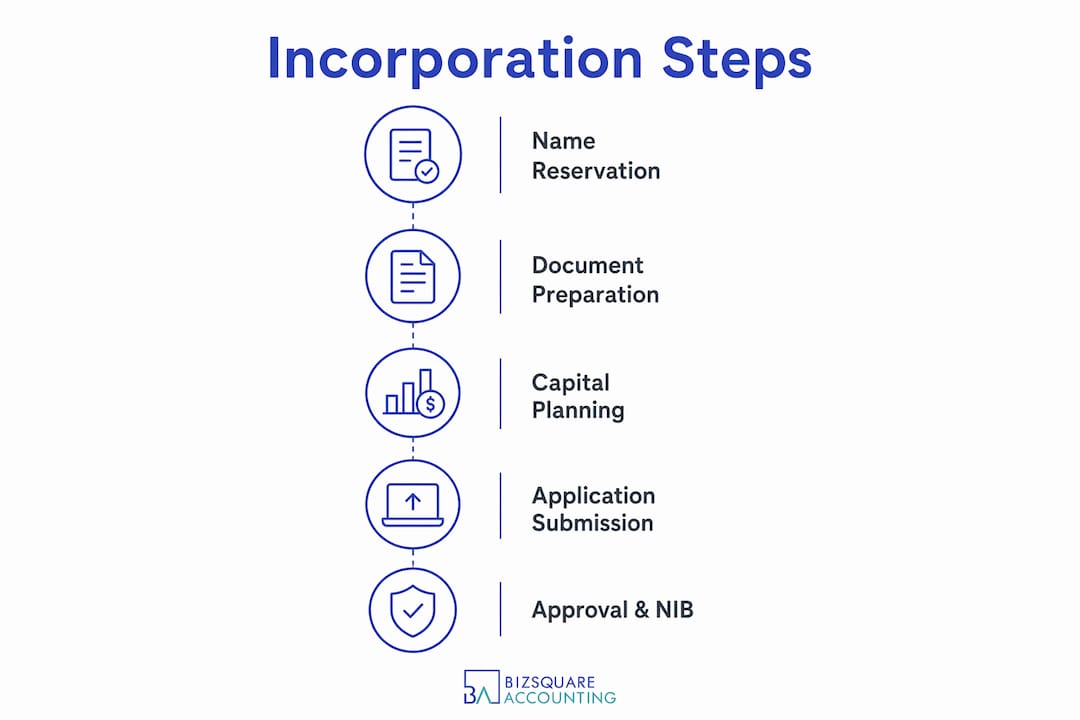
The business registration process in Indonesia follows a defined sequence across two primary digital portals. Company incorporation involves two main digital portals: AHU Online for legal entity establishment and OSS-RBA for obtaining the Business Identification Number (NIB) and operational licenses. Each step must be completed in order, as later stages depend on outputs from earlier ones.
The six-step incorporation process
- Confirm the company name via AHU Online. The Ministry of Law and Human Rights operates the AHU Online portal. Submit the proposed company name for availability check and reservation. The name must not duplicate existing registered entities and must comply with Indonesian naming conventions.
- Notarize the Deed of Establishment. An Indonesian Notary drafts and notarizes the Deed of Establishment, which includes the Articles of Association. The notary submits the deed electronically to the Ministry of Law for ratification. All shareholder and director information must be accurate and consistent with identification documents.
- Obtain Ministry of Law ratification. The Ministry of Law and Human Rights reviews the submitted deed and issues a ratification letter, formally recognizing the PT PMA as a legal entity. This step converts the company from a proposed structure into a recognized legal body under Indonesian law.
- Register for tax and activate the NPWP. The NPWP is the Indonesian Taxpayer Identification Number. Every PT PMA must register with the Directorate General of Taxes to receive an NPWP. This number is required for all subsequent government filings, banking, and contract execution.
- Obtain the NIB via OSS-RBA. The OSS-RBA portal issues the Business Identification Number, or NIB, which is a 13-digit number required for business operations. The NIB integrates multiple licenses into a single identifier and is the gateway to sector-specific operational permits.
- Upload office location for compliance verification. The OSS-RBA system requires proof of a valid office address. The address must fall within a designated commercial zone and carry a valid Building Function Certificate (PBG). Residential addresses cause automatic rejection at this stage.
Incorporation timeline
| Stage | Action | Estimated Duration |
|---|---|---|
| Name reservation | AHU Online submission | 1–2 business days |
| Deed notarization | Indonesian Notary drafting | 3–5 business days |
| Ministry of Law ratification | Legal entity recognition | 3–7 business days |
| Tax registration (NPWP) | Directorate General of Taxes | 1–3 business days |
| NIB issuance via OSS-RBA | Business Identification Number | 1–3 business days |
| Location compliance upload | Office address verification | 1–2 business days |
Registration timelines typically range from two to four weeks for low-risk activities, depending largely on document accuracy and classification consistency. Timely approvals depend on the quality of the submission, not just how quickly documents are filed.
What are the common compliance challenges during incorporation?
The Indonesia business setup process is more accessible than it was a decade ago, but accessibility does not mean simplicity. Document alignment across ministries requires meticulous preparation despite digital portals. Foreign investors who underestimate this step face delays that can extend the process by weeks.
Key compliance pitfalls to avoid
- KBLI code mismatches. The code entered in the AHU system must match exactly what is submitted in OSS-RBA. Any discrepancy between the two portals triggers a manual review, which stalls approval.
- Documentation inconsistencies. Shareholder names, passport numbers, and capital figures must be identical across the Deed of Establishment, Ministry of Law filings, and OSS-RBA submissions. Even minor typographical differences cause rejections.
- Invalid office addresses. Virtual offices are acceptable only if they are located in designated commercial zones with valid Building Function Certificates. Using a residential address leads to automatic rejection in the OSS system.
- Overlooking sector-specific licenses. Incorporation does not equal operation. Medium and high-risk sectors require a Standard Certificate or ministerial approval before business activities can begin.
- Missing post-incorporation registrations. After receiving the NIB, companies must register employees with BPJS Ketenagakerjaan (employment social security) and BPJS Kesehatan (health insurance) before hiring staff.
“Accessible does not mean simple. Document alignment across ministries requires meticulous preparation despite digital portals.” This reality defines the experience of most foreign investors navigating PT PMA registration for the first time.
Pro Tip: Engage a professional service provider with direct experience in Indonesian regulatory filings. The cost of professional assistance is far lower than the cost of restarting a rejected application or restructuring a misclassified entity.
How do you maintain operational readiness after incorporation?
Receiving the NIB marks the end of the legal incorporation phase, not the beginning of full operations. Incorporation does not equal operation. Additional sector and risk-based licenses may be required after obtaining the NIB before starting business activities. Foreign investors who treat the NIB as the finish line often find themselves unable to sign contracts, hire staff, or open bank accounts without completing the next phase.
Post-incorporation steps for operational readiness
- Obtain sector-specific licenses. Medium and high-risk sectors require a Standard Certificate or approval from the relevant ministry. The OSS-RBA portal identifies which licenses apply based on the KBLI code selected during registration.
- Secure a valid Building Function Certificate (PBG). A valid PBG for the office location is mandatory for OSS compliance. A valid Building Function Certificate or office location in a commercial zone is required. Residential addresses or improper virtual offices cause OSS application rejections.
- Register employees with BPJS. All companies hiring staff in Indonesia must register with BPJS Ketenagakerjaan and BPJS Kesehatan. These registrations are mandatory before the first payroll cycle.
- Activate corporate tax filing. The NPWP obtained during incorporation activates the company’s tax obligations. Monthly VAT reporting and annual corporate income tax filings begin from the first month of operations.
- Plan capital injections carefully. The IDR 2.5 billion paid-up capital requirement must be reflected in the company’s bank account and financial records. Future capital increases require notarial amendments and Ministry of Law re-ratification.
- Engage professional advisory services. Accounting, corporate secretarial, and compliance functions require ongoing attention. Outsourcing these to a qualified firm reduces the risk of missed deadlines and regulatory penalties.
The Indonesia business registration process does not end at the NIB. Operational readiness requires a second phase of licensing, registration, and compliance that is just as structured as the initial incorporation.
Key Takeaways
Successful company incorporation in Indonesia requires capital compliance, correct KBLI classification, and a two-phase approach covering both legal registration and operational licensing.
| Point | Details |
|---|---|
| Capital requirements are fixed | PT PMA requires IDR 10 billion total investment and IDR 2.5 billion paid-up capital. |
| KBLI code selection is critical | Misclassification blocks licensing and may require full entity restructuring. |
| Two portals govern registration | AHU Online handles legal entity status; OSS-RBA issues the NIB and operational permits. |
| NIB is not the finish line | Medium and high-risk sectors need additional licenses before operations can begin. |
| Document consistency is mandatory | All filings across ministries must match exactly to avoid rejection and delays. |
My take on what foreign investors consistently get wrong
Foreign investors often treat company formation in Indonesia as a paperwork exercise. It is not. The digital portals, AHU Online and OSS-RBA, create an impression of speed and simplicity. The reality is that the system rewards preparation, not speed.
The most costly mistake I see is KBLI code selection done without proper research. Entrepreneurs pick a code that sounds close to their business activity, submit it, and discover months later that the code carries ownership restrictions or requires licenses they did not plan for. Choosing the correct KBLI code early prevents costly restructuring and delays in licensing. That single decision shapes everything that follows.
The second mistake is underestimating post-incorporation licensing. Foreign investors celebrate the NIB and then discover their sector requires a Standard Certificate from a specific ministry before they can sign a single client contract. Incorporation is step one of a multi-phase process. Treating it as the destination creates operational paralysis.
My advice is direct: engage local professionals before you file anything. Not after the first rejection. Before. The cost of professional guidance at the start is a fraction of the cost of correcting a misclassified entity or restarting a rejected application. Indonesia is a genuinely attractive market for foreign investment, and the PT PMA structure gives foreign entrepreneurs real ownership rights. Respect the process, prepare thoroughly, and the system works.
How Bizsquare supports your Indonesia business registration
Foreign investors navigating PT PMA registration face a structured but demanding process. Bizsquare provides end-to-end support for Indonesia company incorporation, from KBLI code selection and document preparation to AHU Online filings and OSS-RBA submissions.

Bizsquare’s consultants handle tax registration, NPWP activation, and post-incorporation compliance, including BPJS registrations and corporate secretarial obligations. The team also provides ongoing accounting, bookkeeping, and corporate advisory services to keep your PT PMA fully compliant after operations begin. Contact Bizsquare to simplify your Indonesia business setup and avoid the delays that come from navigating this process without expert support.
FAQ
1.) What is a PT PMA in Indonesia?
A PT PMA, or Perusahaan Terbatas Modal Asing, is the limited liability company structure available to foreign investors in Indonesia. It grants foreign entrepreneurs the legal right to own and operate a business under Indonesian law.
2.) What is the minimum capital required for a PT PMA?
Foreign investors must plan a total investment exceeding IDR 10 billion and inject at least IDR 2.5 billion as paid-up capital. These thresholds are set by Indonesian investment law and apply per business entity.
3.) Do foreign investors need a local partner to register a PT PMA?
More than 200 business categories allow 100% foreign ownership without a local partner under the Positive Investment List. A local partner is only required if the chosen sector carries specific foreign ownership caps.
4.) What is the NIB and why does it matter?
The NIB, or Business Identification Number, is a 13-digit number issued through the OSS-RBA portal. It is required for all business operations and serves as the gateway to sector-specific operational permits.
5.) How long does PT PMA incorporation take?
Registration timelines typically range from two to four weeks for low-risk activities. Timely approvals depend on document accuracy and classification consistency across all ministry submissions.
6.) What is the KBLI code and why is it important?
The KBLI code is the Indonesian Standard Industrial Classification number that identifies a company’s business activity. Selecting the wrong code can block license acquisition or require full entity restructuring.
7.) Can a virtual office be used as a registered address for a PT PMA?
Virtual offices are acceptable only if they are located in designated commercial zones with valid Building Function Certificates. Residential addresses cause automatic rejection in the OSS-RBA system.
8.) What happens after receiving the NIB?
Receiving the NIB completes the legal incorporation phase but does not authorize operations. Medium and high-risk sectors require additional licenses or a Standard Certificate from the relevant ministry before business activities can begin.
9.) What taxes does a PT PMA need to register for?
Every PT PMA must register with the Directorate General of Taxes to receive an NPWP, the Indonesian Taxpayer Identification Number. Monthly VAT reporting and annual corporate income tax filings are mandatory from the first month of operations.
10.) What social security registrations are required after incorporation?
Companies hiring staff in Indonesia must register with BPJS Ketenagakerjaan for employment social security and BPJS Kesehatan for health insurance. These registrations must be completed before the first payroll cycle.
11.) What is the OSS-RBA system?
OSS-RBA stands for Online Single Submission Risk-Based Approach. It is the Indonesian government’s integrated digital portal for issuing the NIB and managing operational licenses based on business risk classification.
12.) What documents are needed to incorporate a PT PMA?
Required documents include the notarized Deed of Establishment, Articles of Association, shareholder and director identification, proof of paid-up capital, a reserved company name, and a valid registered office address in a commercial zone.
13.) What is the AHU Online portal used for?
The AHU Online portal, operated by the Ministry of Law and Human Rights, is used for company name reservation and submission of the Deed of Establishment. It is the first digital step in the PT PMA incorporation process.