
Business Compliance for 2026: Singapore’s Complete Guide
Overview
Business compliance in 2026 involves aligning with new tax, data, AI, and employment regulations. Missing deadlines or neglecting updates can result in stacking penalties, operational disruptions, and legal risks. A proactive, system-based approach ensures companies meet evolving obligations and avoid significant penalties.
Business compliance for 2026 is the process of aligning your company’s operations, tax filings, data handling, and workforce management with updated local and international regulations effective this year. Singapore businesses now face obligations that span IRAS tax deadlines, the EU AI Act, US state privacy laws, and employment classification rules. Missing any one of these can trigger stacking penalties up to 25% plus accrued interest. The 2026 compliance landscape is not a single checklist. It is a set of overlapping, fast-moving obligations that require a structured, year-round approach to manage effectively.
What are the key tax compliance obligations for Singapore businesses in 2026?
Tax compliance is the most immediate financial risk in 2026 corporate compliance. Singapore companies must meet IRAS deadlines for corporate income tax, GST, and withholding tax throughout the year. Missing these deadlines does not simply result in a flat fine. Penalties stack.

How tax penalties accumulate
Late filing penalties can reach 5% per month, capping at 25% of the outstanding tax amount, with 7% annual interest and an additional 0.5% monthly charge. A company that files and pays three months late on a $10,000 tax bill faces $1,500 in filing penalties, $150 in payment penalties, and accrued interest on top. That is a significant cost that most business owners do not anticipate until the notice arrives.
Singapore companies with international operations also face added complexity. Cross-border transactions, transfer pricing documentation, and BEPS-related reporting requirements from the OECD now affect mid-sized Singapore firms, not just multinationals. The IRAS tax compliance framework has expanded to reflect these international standards.
Key tax deadlines to track in 2026
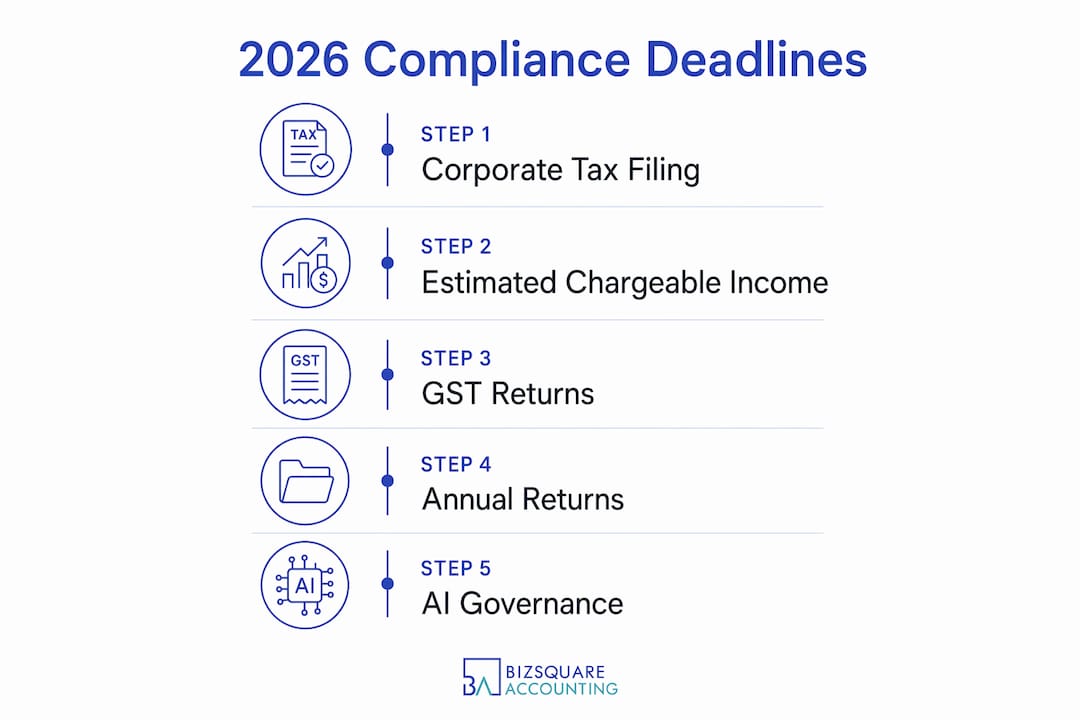
- Corporate Income Tax (Form C-S/C): Annual filing deadline falls on november 30 each year for companies using IRAS’s e-filing system.
- GST returns: Quarterly filings are due one month after each accounting period ends.
- Estimated Chargeable Income (ECI): Must be filed within three months of the company’s financial year end.
- Withholding tax: Due on the 15th of the second month following the date of payment to non-residents.
- Transfer pricing documentation: Must be prepared before the tax return filing date for companies meeting the threshold.
Pro Tip: Set up a digital compliance calendar with automated alerts at least 30 days before each deadline. This single action eliminates most penalty exposure for Singapore SMEs.
| Tax Obligation | Deadline | Penalty for Late Filing |
|---|---|---|
| Corporate Income Tax (Form C-S/C) | November 30 | 5% per month, up to 25% |
| GST Quarterly Return | 1 month after period end | Late payment penalties apply |
| Estimated Chargeable Income | 3 months after financial year end | Surcharge on unpaid tax |
| Withholding Tax | 15th of second month after payment | 5% penalty plus interest |
How are privacy, data security, and AI regulations affecting compliance in 2026?
Privacy and AI governance are now front-line compliance concerns for Singapore businesses, not just technology companies. US state privacy laws expanded in 2026 to cover 20 states with new data assessment and transparency obligations. Singapore companies that process data from US residents, operate US subsidiaries, or serve US customers are directly affected. COPPA updates also introduced strict compliance deadlines on april 22, 2026, for companies handling children’s data.
The EU AI Act adds another layer. Core obligations for high-risk AI systems take effect august 2, 2026, with watermarking requirements delayed until december 2, 2026. Lawmakers approved simplification measures in june 2026 to help companies transition. Singapore businesses that use AI tools in hiring, credit assessment, or customer profiling fall within the Act’s scope if they operate in or serve EU markets.
Regulators in 2026 reject policy-only compliance entirely. They expect verifiable operational controls, not just written policies. That means auditors will ask to see your AI system register, your data flow maps, and your documented risk assessments, not just your privacy policy PDF.
Steps to meet privacy and AI governance obligations
- Map all data flows. Identify every system that collects, stores, or transfers personal data, including third-party vendors.
- Build an AI system inventory. List every AI tool your company uses, its purpose, and the data it processes.
- Classify AI risk levels. Categorize each tool as high-risk, limited-risk, or minimal-risk under the EU AI Act framework.
- Document risk assessments. Prepare written assessments for each high-risk AI system before august 2, 2026.
- Review vendor contracts. Confirm that data processors and AI vendors meet the same compliance standards your company must meet.
- Update your privacy notices. Reflect new state-level rights such as opt-out of data sales and data portability.
Pro Tip: Map your data flows and AI tools now, before an audit request arrives. Operationalized AI compliance requires current inventories and documented classifications, not just a policy document.
What HR and workforce compliance must Singapore businesses focus on in 2026?
HR compliance violations are among the most expensive and most preventable risks in 2026. Employee misclassification is the leading cause of back-pay claims and legal liability. Classification must be based on actual job duties, not job titles. A worker labeled “manager” who performs non-exempt tasks is legally non-exempt, regardless of what the employment contract says.
Employment law scrutiny is also intensifying around AI-driven hiring tools. Regulators now examine whether automated screening tools introduce bias or violate equal opportunity standards. Singapore companies using AI in recruitment must document how those tools work and how decisions are reviewed by a human.
Core HR compliance requirements for 2026
- Employee classification audit: Review all roles against the Employment Act’s definitions of workmen, employees, and managers. Misclassification exposes companies to back-pay, CPF shortfalls, and MOM penalties.
- Anti-harassment policies: Anti-harassment policies are legally required for many headcount thresholds and protect employers against costly disputes. Singapore’s Workplace Fairness Legislation, expected to take effect in 2026, strengthens these obligations.
- Sick leave and annual leave records: Maintain accurate leave records for all employees. IRAS and MOM audits frequently check these records.
- Payroll documentation: Keep payroll records for at least five years. This covers CPF contributions, salary payments, and deductions.
- AI hiring tool review: Document the decision logic of any AI screening tool. Retain records of human review steps for each hiring decision.
- Headcount thresholds: Certain compliance obligations, such as mandatory grievance procedures and workplace safety committees, activate at specific headcount levels. Review your obligations as your team grows.
Workforce compliance is not a one-time review. Singapore’s Employment Act and related regulations update regularly. A quarterly review of HR policies keeps your company aligned with current requirements.
How can Singapore businesses manage ongoing compliance throughout 2026?
Ongoing compliance management requires a system, not just a calendar. A centralized digital compliance calendar with automated deadline alerts is the most effective method to prevent stacking penalties and missed filings. Most Singapore SMEs that face penalties do so not because they ignored a deadline, but because they did not know it had changed.
Quarterly compliance reviews are the second most important practice. Regulations change mid-year. The EU AI Act simplification measures in june 2026 are a clear example. A company that reviewed its AI obligations in january 2026 and never revisited them would have missed those updates entirely.
Tools and practices that reduce compliance risk
- Corporate secretary services: A qualified corporate secretary tracks statutory deadlines, files annual returns, and maintains the company register. This is a legal requirement under the Companies Act for all Singapore-incorporated entities. Bizsquare’s corporate secretary services cover these obligations end-to-end.
- Accounting and bookkeeping software: Cloud-based accounting systems generate audit-ready financial records and flag GST filing periods automatically.
- Tax advisory support: A tax advisor monitors IRAS updates and international tax changes that affect Singapore companies. The corporate tax service guide outlines the specific obligations for 2026.
- Compliance checklists: A structured business compliance checklist covering tax, HR, data, and corporate filings reduces the risk of overlooking obligations.
| Compliance Area | Recommended Tool or Practice | Review Frequency |
|---|---|---|
| Tax filings | Digital calendar with automated alerts | Monthly |
| HR policies | Annual policy review plus headcount checks | Quarterly |
| Data privacy | Data flow mapping and vendor audits | Semi-annually |
| AI governance | AI system inventory and risk assessments | Quarterly |
| Corporate filings | Corporate secretary oversight | Ongoing |
A common pitfall is treating compliance as a year-end exercise. Companies that review obligations only in november often discover missed quarterly filings, outdated HR policies, and unaddressed regulatory changes. Building compliance checks into monthly operations prevents this entirely.
Which industries in Singapore have specific 2026 compliance nuances?
Certain sectors in Singapore face compliance obligations that go beyond the standard corporate and tax requirements. Financial services, healthcare, and digital services companies carry the heaviest regulatory loads in 2026.
Sector-specific obligations to review
- Financial services: MAS-regulated entities must comply with updated Technology Risk Management guidelines, data localization requirements, and anti-money laundering reporting obligations. The MAS Notice on Cyber Hygiene applies to all financial institutions.
- Healthcare and life sciences: Companies handling patient data must comply with the Personal Data Protection Act (PDPA) and the Ministry of Health’s data governance frameworks. AI tools used in clinical decision support fall under the EU AI Act if the company serves EU patients.
- Digital services and e-commerce: Companies processing data from US residents must comply with applicable state privacy laws. Those serving EU customers must align with GDPR and the EU AI Act.
- Professional services: Law firms, accounting firms, and consultancies face anti-money laundering obligations under the Corruption, Drug Trafficking and Other Serious Crimes Act.
- Manufacturing and logistics: Companies with EU supply chain exposure must begin preparing for the EU’s 2040 emissions disclosure requirements. Downstream decarbonization obligations require Singapore businesses to update disclosure practices now.
Annual report fees and registration requirements also vary by jurisdiction for Singapore companies with overseas subsidiaries. Filing fees range from $0 to over $800 depending on the state or country, and failure to file can result in administrative dissolution. Reviewing the Singapore corporate compliance changes for 2026 helps companies identify which sector-specific rules apply to their operations.
Key Takeaways
Business compliance for 2026 requires Singapore companies to manage tax deadlines, AI governance, data privacy, HR classification, and sector-specific rules simultaneously, with penalties that compound quickly when any obligation is missed.
| Point | Details |
|---|---|
| Tax penalties stack fast | Late filings trigger up to 25% in penalties plus interest, making deadline management a financial priority. |
| AI and privacy rules are operational | Regulators require AI inventories and data flow maps, not just written policies, starting august 2026. |
| HR misclassification is costly | Employee classification must reflect actual duties, not titles, to avoid back-pay claims and CPF shortfalls. |
| Quarterly reviews prevent surprises | Regulations change mid-year, so reviewing compliance obligations every quarter keeps companies current. |
| Sector rules add complexity | Finance, healthcare, and digital services companies carry additional MAS, PDPA, and EU AI Act obligations. |
The compliance gap most Singapore businesses are not closing
The most underestimated compliance risk in 2026 is not a single missed deadline. It is the assumption that last year’s compliance program still works this year.
Regulations in 2026 are not static. The EU AI Act simplification measures passed in june 2026. US state privacy laws added new states mid-year. Singapore’s Workplace Fairness Legislation introduced new HR obligations. A company that built its compliance program in january and never revisited it is already behind.
The deeper issue is that most compliance programs are built around policies, not operations. A privacy policy document does not satisfy a regulator who wants to see your data flow map. An AI ethics statement does not replace a documented risk assessment for each high-risk system. The 2026 convergence of privacy and AI governance demands integrated compliance programs with real audit capabilities.
The businesses that manage this well share one trait: they treat compliance as an operational function, not a legal formality. They assign ownership, set review cycles, and build compliance checks into their monthly routines. They also use professional support, not because they cannot read a regulation, but because regulations change faster than any one person can track.
The offshore staffing and AI hiring risk checklist is one practical resource for companies managing workforce compliance across borders. For tax and corporate filings, professional advisory support from a firm like Bizsquare removes the guesswork entirely.
Compliance in 2026 is not about perfection. It is about having a system that catches changes before they become penalties.
How Bizsquare helps Singapore businesses stay compliant in 2026
Singapore businesses managing the full scope of 2026 compliance regulations need more than a checklist. They need a team that tracks regulatory changes, files on time, and flags risks before they become penalties.

Bizsquare provides corporate tax filing and advisory services that cover IRAS obligations, transfer pricing documentation, and cross-border tax reporting. The corporate secretary team manages annual returns, statutory registers, and compliance deadlines under the Companies Act. For businesses at the start of their Singapore operations, Bizsquare’s company incorporation services build compliance into the structure from day one. Accounting and bookkeeping support keeps financial records audit-ready year-round. Contact Bizsquare to review your 2026 compliance obligations and build a plan that keeps your business protected.
FAQ
1.) What is business compliance for 2026?
Business compliance for 2026 is the process of meeting all updated tax, employment, data privacy, and corporate governance obligations effective this year. For Singapore companies, this includes IRAS filings, the Companies Act, PDPA requirements, and applicable international regulations.
2.) What are the main tax deadlines for Singapore companies in 2026?
Singapore companies must file their Estimated Chargeable Income within three months of their financial year end, submit Form C-S or Form C by november 30, and file GST returns one month after each quarterly accounting period.
3.) What happens if a Singapore company misses a tax filing deadline?
Late filing penalties reach 5% per month up to 25% of the outstanding tax, plus 7% annual interest and an additional 0.5% monthly charge. Filing three months late on a $10,000 liability results in over $1,650 in penalties and interest.
4.) How does the EU AI Act affect Singapore businesses?
Singapore companies that use high-risk AI systems and operate in or serve EU markets must comply with EU AI Act obligations from august 2, 2026. This includes maintaining an AI system inventory, conducting risk assessments, and documenting human oversight procedures.
5.) What is employee misclassification and why does it matter?
Employee misclassification occurs when a worker is labeled as exempt or a contractor when their actual duties qualify them as a non-exempt employee. This triggers back-pay claims, CPF shortfalls, and MOM penalties for Singapore employers.
6.) What is the PDPA and how does it affect compliance in 2026?
The Personal Data Protection Act (PDPA) governs how Singapore businesses collect, use, and disclose personal data. Companies must appoint a Data Protection Officer, maintain a data protection policy, and respond to data breach notifications within prescribed timeframes.
7.) Do Singapore companies need to comply with US state privacy laws?
Singapore companies that process personal data from US residents, operate US subsidiaries, or serve US customers must comply with applicable state privacy laws. As of 2026, 20 US states have active data privacy laws with assessment and transparency obligations.
8.) What records must Singapore employers keep for HR compliance?
Singapore employers must retain payroll records, CPF contribution records, leave records, and employment contracts for at least five years. These records are subject to review by MOM and IRAS during audits.
9.) How often should a Singapore company review its compliance obligations?
A quarterly review cycle is the minimum standard for 2026. Regulations change mid-year, and a company that reviews compliance only annually risks missing updates to tax rules, employment law, and data privacy requirements.
10.) What is a corporate secretary and is one required in Singapore?
A corporate secretary is a qualified professional responsible for maintaining statutory registers, filing annual returns, and ensuring compliance with the Companies Act. Every Singapore-incorporated company is legally required to appoint one within six months of incorporation.
11.) How can small Singapore businesses manage compliance without a large team?
Small businesses can use a digital compliance calendar with automated alerts, engage a corporate secretary service, and work with an accounting firm that monitors regulatory changes. Bizsquare provides these services specifically for Singapore SMEs managing 2026 compliance obligations.
12.) What is the Workplace Fairness Legislation and when does it take effect?
Singapore’s Workplace Fairness Legislation strengthens protections against discrimination in hiring and employment. It is expected to take effect in 2026 and requires companies to implement fair employment practices and grievance procedures.
13.) What are the consequences of failing to file annual returns in Singapore?
Failure to file annual returns can result in financial penalties, director disqualification, and administrative dissolution of the company. Fees and penalties vary depending on how long the filing is overdue.