
Types of Tax Deductions in Singapore: 2026 Guide
Overview
Singaporeans and small business owners can reduce their tax bills by understanding and claiming specific deductions and reliefs within the S$80,000 cap for YA 2026. Proper documentation, strategic timing of contributions, and careful expense categorization are essential to maximize benefits and avoid rejection. Engaging tax professionals and maintaining organized records throughout the year ensures compliance and helps fully leverage available deductions.
Singapore’s tax system rewards those who understand it. For individuals and small business owners, knowing the types of tax deductions Singapore’s Inland Revenue Authority of Singapore (IRAS) allows can translate directly into lower tax bills and better financial outcomes. Yet the rules around eligibility, caps, and documentation are specific enough that many taxpayers either miss deductions they qualify for or make claims that get rejected. This guide breaks down every major category of tax deduction available in 2026, from personal reliefs to corporate expense deductions, with the practical context needed to claim them correctly.
Table of Contents
- Key takeaways
- 1. Understanding the types of tax deductions in Singapore
- 2. Eligibility criteria and the foundational rules
- 3. Personal tax deductions and reliefs for individuals
- 4. Tax deductions for self-employed persons and small business owners
- 5. Rental income deductions and other specialized reliefs
- 6. Comparing deduction types: choosing the right approach
- My perspective on tax deductions in Singapore
- How Bizsquareaccounting helps you maximize tax deductions
- FAQ
Key takeaways
| Point | Details |
|---|---|
| $80,000 personal relief cap | All personal income tax reliefs are subject to a cumulative annual cap; anything above S$80,000 is forfeited. |
| Business expense rule | Expenses must be wholly and exclusively incurred in income production to qualify as deductible. |
| Rental income options | Landlords can choose between actual expense itemization or a flat 15% deemed deduction depending on their situation. |
| Documentation matters | IRAS requires records to be kept for five years to support any deduction or relief claimed. |
| Strategic prioritization | Once the S$80,000 cap is reached, additional personal reliefs provide no further tax benefit, so sequencing matters. |
1. Understanding the types of tax deductions in Singapore
Before claiming anything, it helps to understand what the term “tax deduction” actually covers in Singapore’s tax system. IRAS uses three distinct mechanisms to reduce a taxpayer’s liability: deductions, reliefs, and rebates.
A tax deduction reduces the amount of income subject to tax by removing specific expenses from the gross income figure. A tax relief reduces the chargeable income directly through approved categories such as CPF contributions or family-related claims. A tax rebate, by contrast, is applied after the tax has been calculated and reduces the tax payable itself.
For most individuals, the primary mechanism is tax relief. For businesses and self-employed persons, the primary mechanism is the deduction of allowable business expenses. Understanding which category applies to a given claim determines both how it is filed and whether it qualifies.
2. Eligibility criteria and the foundational rules
Not every expense or relief applies to every taxpayer. Two overarching rules govern most claims, and understanding them prevents the most common filing errors.
The first is the “wholly and exclusively incurred” rule for business expenses. According to IRAS guidelines on business expenses, expenses must be wholly and exclusively incurred in the production of income to be deductible. Personal expenses disguised as business costs and capital expenditures do not qualify as direct deductions.
The second is the S$80,000 annual personal tax relief cap. Personal income tax reliefs in Singapore have a cumulative annual limit of S$80,000 for YA 2026. Any amount beyond this threshold is simply forfeited and cannot be carried forward to a future year of assessment.
Additional eligibility considerations include:
- Tax residency status. Most personal reliefs are only available to tax residents of Singapore, meaning individuals who live or work in Singapore for at least 183 days in the calendar year.
- Specific qualifying conditions per relief. Each relief type has its own set of conditions, such as income thresholds, age requirements, or dependency criteria.
- Common reasons claims are rejected. IRAS frequently rejects claims where supporting documents are absent, conditions are misread, or personal and business expenses are mixed without clear proportional allocation.
Pro Tip: Review the qualifying conditions for each relief category before filing, not after. Many rejections stem from a taxpayer assuming they qualify without checking the specific criteria IRAS publishes each year.
It is also worth distinguishing between deductions and reliefs early in the planning process. Reliefs reduce chargeable income through fixed or tiered amounts tied to social policy objectives. Tax experts note that many taxpayers miss qualifying conditions precisely because they overlook the social intent behind these reliefs, such as supporting family formation or retirement savings.
3. Personal tax deductions and reliefs for individuals
For employed individuals, personal reliefs represent the most accessible form of income tax relief in Singapore. The following are the primary categories available in YA 2026.
- Earned Income Relief. This applies automatically to individuals with employment or trade income. The amount varies by age: S$1,000 for those below 55, S$6,000 for those aged 55 to 59, and S$8,000 for those aged 60 and above. Persons with a disability receive higher amounts within each bracket.
- Spouse Relief. A taxpayer supporting a spouse who earned less than S$4,000 in the year may claim S$2,000 in spouse relief. If the spouse has a disability, the claim increases to S$5,500.
- Parent and Grandparent Caregiver Relief. Taxpayers who maintain parents, grandparents, or in-laws in Singapore may claim between S$5,500 and S$14,000 per dependent, depending on whether the dependent lives in the same household and whether they have a disability.
- Qualifying Child Relief (QCR). A relief of S$4,000 per child is available for each child who meets the qualifying criteria, including being unmarried and either below 16 years of age or in full-time education.
- Working Mother’s Child Relief (WMCR). This applies to Singapore citizen children born on or after January 1, 2024. The WMCR relief tiers stand at S$8,000 for the first child, S$10,000 for the second, and S$12,000 for the third and beyond, with a combined cap of S$50,000 per child when stacked with QCR.
- CPF Cash Top-Up Relief. Voluntary cash top-ups to a CPF account, whether the taxpayer’s own Retirement Account or a family member’s, qualify for relief. Top-ups to one’s own Special or Retirement Account are claimable up to S$8,000, with an additional S$8,000 for top-ups made to family members.
- Supplementary Retirement Scheme (SRS) Relief. Contributions to an SRS account reduce chargeable income dollar for dollar, up to the annual contribution limit (S$15,300 for Singapore citizens and permanent residents; S$35,700 for foreigners).
- Life Insurance Relief. This is claimable at up to S$5,000, but only if the taxpayer’s total CPF contributions for the year are below S$5,000. According to relief interaction rules, this relief and CPF contributions share a combined S$5,000 limit, which makes it relevant primarily for self-employed individuals or those with lower CPF activity.
Pro Tip: SRS contributions made before December 31 of the tax year count toward the current year’s deduction. Timing a contribution in late December is one of the most reliable ways to reduce chargeable income without changing spending habits.
Because these reliefs stack, a taxpayer with children, aging parents, and active retirement savings contributions can approach the S$80,000 cap faster than expected. Once that ceiling is reached, additional contributions or claims provide zero additional benefit.
4. Tax deductions for self-employed persons and small business owners
For self-employed individuals and small business owners, deductible expenses Singapore’s tax system allows are calculated differently than personal reliefs. The starting point is always the income generated by the business activity.
Commonly deductible business expenses include:
- Rent and utilities for business premises
- Employee salaries, CPF contributions, and staff benefits
- Professional fees such as accounting, legal, or consultancy costs
- Business insurance premiums
- Marketing and advertising expenditure
- Repairs and maintenance on business assets
Non-deductible expenses are equally important to understand. Capital expenditures, including the purchase of machinery, equipment, or property, are not deductible as direct expenses. Instead, they are claimed over time via capital allowances, which is a separate depreciation-based mechanism. Day-to-day operational costs are deducted immediately, but capital items follow a capital allowance schedule that may span three years or more depending on the asset category.
For self-employed individuals who find full expense itemization burdensome, IRAS offers the Fixed Expense Deduction Ratio (FEDR). The FEDR method allows eligible self-employed taxpayers to claim a standardized percentage of gross income as expenses without needing to document every individual cost.
A critical compliance requirement that affects many small business owners is record separation. Mixing personal and business accounts, even unintentionally, is one of the most common triggers for IRAS audits. Maintaining a dedicated business account, as discussed in resources on why separate business accounts matter, makes proportional claims far cleaner to justify.
“Wholly and exclusively” is not just a legal phrase. It is the standard IRAS applies when reviewing every business expense claim. If an expense serves both a business and personal purpose, only the business portion may be claimed, and that proportion must be documented clearly.
Additionally, Singapore offers double or enhanced deductions on qualifying expenditure such as research and development, certain overseas market promotion costs, and qualifying training programs. These are particularly relevant for SMEs looking to maximize corporate tax deductions beyond standard operating expenses.
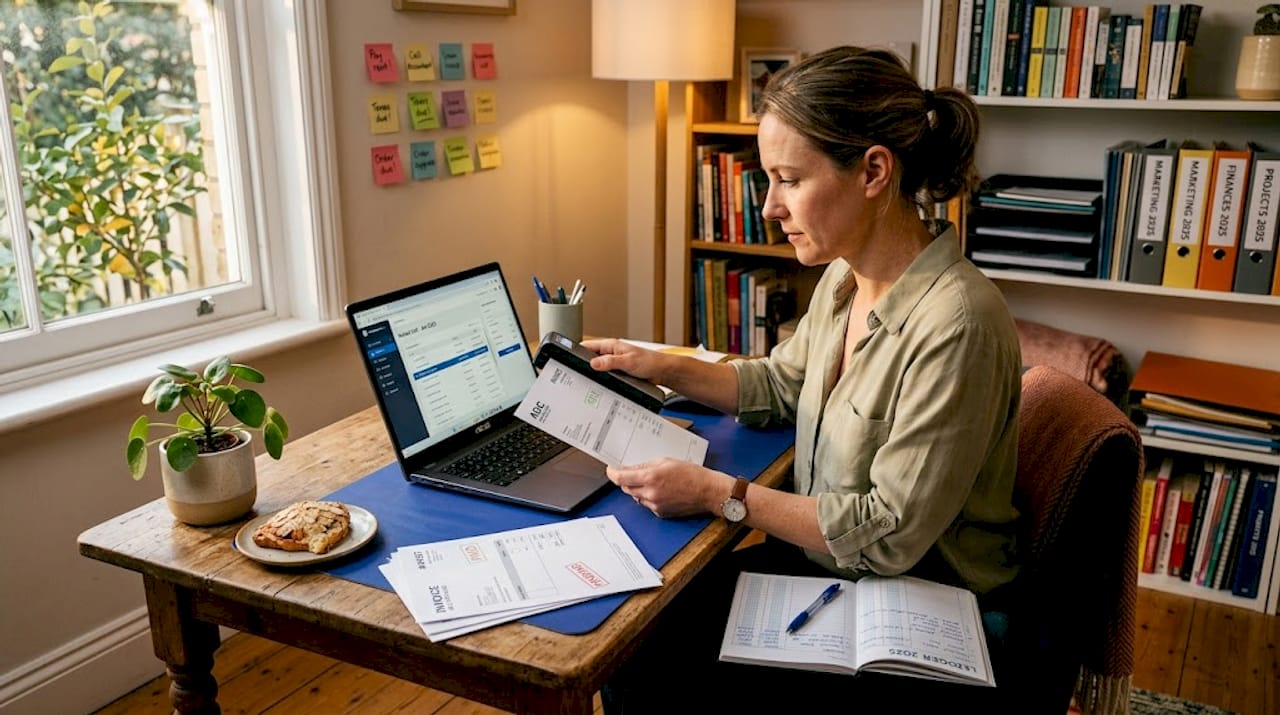
Bookkeeping accuracy is not optional for business deduction claims. IRAS requires that all documentation supporting deductible expenses be retained for five years, ready for inspection if an audit is initiated.
5. Rental income deductions and other specialized reliefs
Landlords and property owners in Singapore have their own set of tax deduction eligibility rules under the rental income framework. Rental income is taxable, but the deductions available can substantially reduce the chargeable amount.
IRAS offers two approaches for deducting rental-related expenses:
| Method | How it works | Best suited for |
|---|---|---|
| Actual expense deduction | Itemize all allowable expenses with receipts: mortgage interest, property tax, maintenance fees, fire insurance, repairs | Landlords with a mortgage or high maintenance costs |
| 15% deemed deduction | Claim a flat 15% of gross rental income as expenses, plus mortgage interest, with no receipt requirements for the 15% portion | Landlords with low expenses and no mortgage |
The 15% deemed deduction is a useful simplification for property owners who do not have significant deductible costs beyond the property itself. Landlords with active mortgage loans, however, often realize greater tax savings through actual expense claims, since mortgage interest alone can exceed the 15% flat rate. Landlords with mortgage interest typically benefit more from itemizing actual costs.
What landlords cannot deduct includes capital improvements, furniture and fittings, and depreciation of the property itself. These are capital in nature and must be excluded from direct deductions.
Other specialized relief options include:
- NSman Relief. National Servicemen (operationally ready and active) and their wives or parents may claim NSman relief ranging from S$1,500 to S$5,000 depending on the individual’s role and performance status.
- Donations. Cash and approved non-cash donations to institutions of a public character qualify for a 250% tax deduction, making charitable giving one of the most tax-efficient uses of funds available to individuals and businesses alike.
- Course Fees Relief (lapsed). This relief, which previously allowed individuals to claim up to S$5,500 for qualifying course fees, has lapsed with effect from YA 2026. Taxpayers who relied on this relief will need to adjust their planning accordingly.
Pro Tip: When deciding between the actual expense method and the 15% deemed deduction for rental income, calculate both figures before the filing deadline. The difference in tax outcomes can be meaningful, and the choice is made annually rather than locked in permanently.
6. Comparing deduction types: choosing the right approach
With several deduction categories available, both individuals and business owners benefit from understanding how these options interact, particularly under the S$80,000 relief cap.
| Deduction type | Who it applies to | Key limit | Documentation needed |
|---|---|---|---|
| Personal reliefs (CPF, SRS, family) | Tax-resident individuals | S$80,000 combined annual cap | CPF statements, birth certificates, dependency proof |
| Business expense deductions | Self-employed, sole proprietors, companies | Must be wholly and exclusively for income production | Invoices, receipts, payroll records |
| Rental income deductions | Landlords and property owners | Actual or 15% deemed; mortgage interest deducted separately | Tenancy agreements, mortgage statements, receipts |
| Donations | Individuals and companies | 250% deduction of eligible donation value | Official receipt from approved charity |
| Capital allowances | Companies and business owners | Varies by asset class and method | Asset register, purchase invoices |
The S$80,000 cap directly influences how individuals should prioritize personal reliefs. Maximizing reliefs beyond the cap yields no additional tax benefit, so the practical approach is to identify which reliefs provide the highest individual value and claim those first.
Practical steps for maximizing deductions legally and avoiding compliance risks:
- Separate all business and personal finances from the start of each financial year.
- Time SRS and voluntary CPF top-ups before December 31.
- Choose the rental deduction method that produces the better outcome by calculating both.
- Maintain five years of documentation for every deductible expense and relief claimed.
- Consult a qualified tax advisor when business structures are complex or deduction categories overlap.
For individuals with straightforward employment income and standard family reliefs, self-filing through myTax Portal is typically sufficient. For small business owners with multiple income streams, rental properties, and business expenses, professional guidance from qualified advisors like those at tax compliance experts becomes an asset rather than an overhead.
How Bizsquare helps you maximize tax deductions
Managing tax deductions effectively starts with having the right financial infrastructure in place. For individuals and business owners who want to capture every eligible deduction without the compliance risk of filing errors, Bizsquareaccounting offers structured support at every stage.
Bizsquare accounting and bookkeeping services are designed to maintain the documentation standards that IRAS audits demand, including five-year record retention, clean expense categorization, and separation of business and personal accounts. For business owners exploring deductions on operational expenses, staff costs, and capital allowances, Bizsquareaccounting’s corporate tax advisory team provides filing support and deduction strategy tailored to each company’s structure.
For entrepreneurs preparing to formalize a business to access corporate deductions, company incorporation in Singapore is a logical first step that unlocks a broader set of deductible expenses. Bizsquare also offers outsourced CFO services for growing companies that need strategic tax planning beyond standard compliance. Reach out for a FREE consultation and make informed decisions about your tax position before the next year of assessment begins.
FAQ
1.) What is the personal income tax relief cap in Singapore?
The cumulative annual cap for personal income tax reliefs in Singapore is S$80,000 for YA 2026. Any relief amount exceeding this cap is forfeited and cannot be carried forward.
2.) What expenses can a self-employed person deduct in Singapore?
Self-employed individuals can deduct expenses that are wholly and exclusively incurred in producing income, including rent, utilities, staff costs, and professional fees. Capital expenditures are not immediately deductible and must be claimed through capital allowances.
3.) Which rental deduction method is better for landlords?
Landlords can choose between itemizing actual expenses or claiming a flat 15% of gross rental income as a deemed deduction. Landlords with a mortgage typically benefit more from actual expense claims, while those with minimal expenses may find the 15% method simpler and equally effective.
4.) Is Course Fees Relief still available in 2026?
No. Course Fees Relief lapsed with effect from YA 2026 and is no longer available for individuals claiming professional development course expenses.
5.) How long must supporting documents be kept for tax purposes in Singapore?
IRAS requires taxpayers to retain all documentation supporting deductible expenses and relief claims for a minimum of five years, as records may be requested during an audit.