

Why Routine Secretarial Services Matter for Singapore Companies
Overview
Many Singapore companies treat the secretary role as a mere formality, risking legal non-compliance and operational issues. The law requires continuous appointment and active management of a qualified company secretary who maintains records, files documents, and ensures deadlines are met. Outsourcing secretarial services provides ongoing governance infrastructure, safeguarding companies’ legal standing, credibility, and operational efficiency.
Many Singapore business owners treat the company secretary role as a formality, something to check off during incorporation and revisit only when annual filings are due. This assumption carries serious legal and operational risk. Under the Companies Act, every locally registered company must maintain an active, qualified company secretary at all times, and the consequences of non-compliance extend well beyond a simple fine. Routine secretarial services form the structural backbone of corporate governance, keeping companies inspection-ready, financially credible, and legally protected throughout every stage of growth.
Table of Contents
- Legal requirements for company secretaries in Singapore
- Core responsibilities of routine secretarial services
- Routine secretarial services as compliance infrastructure
- Choosing between in-house, outsourced, or hybrid secretarial services
- Common pitfalls and expert tips for routine secretarial success
- Our perspective: Secretarial services as your business safety net
- Get expert secretarial support to keep your business compliant
- Frequently asked questions
Key Takeaways
| Point | Details |
|---|---|
| Compliance is mandatory | Every Singapore company must have a qualified company secretary to avoid legal penalties. |
| Secretarial work is ongoing | Routine secretarial services involve continuous record-keeping, filings, and governance—not just annual duties. |
| Audit-ready operations | Strong secretarial routines keep businesses prepared for audits and increase trust with banks and investors. |
| Professional support matters | Outsourcing secretarial tasks helps companies stay efficient and compliant as they grow. |
Legal requirements for company secretaries in Singapore
Now that we’ve addressed common misconceptions, let’s break down the legal backbone behind routine secretarial services in Singapore.
Singapore’s regulatory framework leaves no room for ambiguity when it comes to secretarial obligations. Appointing company directors and key officers is governed by the Accounting and Corporate Regulatory Authority (ACRA), which makes clear that companies in Singapore need routine secretarial services because a corporate secretary is a legal requirement for all local companies. This is not an optional administrative role. It is a statutory position that must be filled and maintained continuously.
The law specifies that a company secretary must be appointed within six months of company registration. The position cannot remain vacant for more than six months at any point during the company’s existence. Failure to comply with this requirement exposes directors to penalties and places the company at risk of regulatory action. Ensuring compliance with Corp Sec services is therefore not merely good practice. It is a legal obligation that demands ongoing attention.
Understanding company secretary requirements in full detail helps business owners appreciate the scope of what this role demands. Key statutory obligations under the Companies Act include:
- Maintaining accurate and up-to-date statutory registers, including the register of members, directors, and charges
- Filing required documents with ACRA within prescribed timeframes, including annual returns and changes to company particulars
- Ensuring the company holds its Annual General Meeting (AGM) within the required period, or applies for an exemption where applicable
- Notifying ACRA of any changes to the company’s registered address, share structure, or key officers within the required window
- Keeping minutes of all board meetings and general meetings in a format that satisfies statutory requirements
- Maintaining the company’s constitution and ensuring it remains current and consistent with actual governance practices
A critical point for directors to internalize: Non-compliance with secretarial obligations is not treated as a minor administrative lapse by Singapore’s regulators. ACRA has the authority to strike off companies that persistently fail to meet filing and governance requirements. Directors of non-compliant companies can face personal fines, and in serious cases, disqualification from serving as directors of other companies.
The cumulative weight of these obligations makes it clear that secretarial compliance is not a one-time event. It is a continuous, active process that requires professional systems and expertise to manage reliably.
Core responsibilities of routine secretarial services
Understanding the law sets the stage, but what does a company secretary actually do in everyday business? Let’s look at the core tasks.
The scope of routine secretarial services is considerably broader than most business owners initially realize. ACRA’s guidance confirms that company secretaries handle administrative work such as maintaining required information and registers, organizing meetings and taking notes, reminding directors about annual filing deadlines, and updating everyone on new rules. This description, while accurate, only captures part of the picture.
The essential company secretary roles span several interconnected areas of governance and administration. In practice, these responsibilities include:
- Statutory register maintenance: Keeping the register of members, register of directors, register of charges, and other required records current and accessible. These documents must reflect every change in ownership, directorship, or company structure in real time.
- ACRA document preparation and filing: Preparing and submitting all required forms and returns to ACRA accurately and on time. This includes annual returns, changes in share capital, updates to director or shareholder information, and notifications of significant transactions.
- Board and general meeting management: Drafting notices of meetings, preparing agendas, circulating board papers, and recording minutes that accurately capture resolutions passed and discussions held. These minutes serve as the legal record of company decisions.
- Regulatory deadline tracking: Monitoring all statutory deadlines relevant to the company and providing timely reminders to directors and management. Missing a single filing deadline can trigger penalties and create a compliance record that affects future dealings with banks and regulators.
- Governance advisory support: Keeping directors informed of changes to the Companies Act, ACRA guidelines, and other relevant regulations. The regulatory environment in Singapore evolves regularly, and directors are expected to govern in accordance with current law, not outdated assumptions.
- Share transfer and allotment processing: Managing the administrative process when shares change hands or new shares are issued, including updating registers and filing the necessary notifications.
Understanding the full role of the corporate secretary reveals why this position demands genuine expertise. A company secretary who lacks current knowledge of ACRA requirements or the Companies Act is not simply ineffective. They are a compliance liability.
Pro Tip: When evaluating a secretarial service provider, ask specifically about their process for tracking regulatory changes and how they communicate updates to clients. A provider with a proactive notification system is far more valuable than one that simply reacts to deadlines.

The administrative rhythm of secretarial services also supports better internal governance. When board meetings are properly organized and minutes are accurately recorded, directors have a clear, defensible record of their decision-making process. This protects individual directors as well as the company in the event of disputes or investigations.
Routine secretarial services as compliance infrastructure
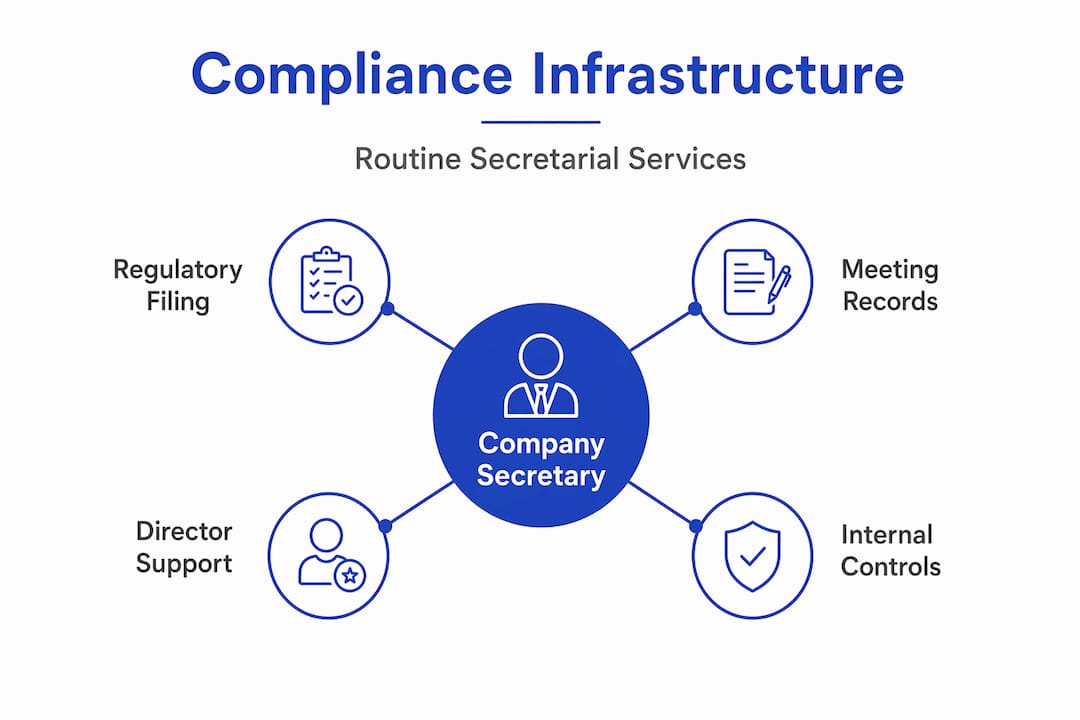
Beyond day-to-day tasks, let’s visualize how routine secretarial services form your company’s compliance infrastructure.
The most useful way to understand routine secretarial services is to think of them as compliance infrastructure rather than isolated administrative tasks. A practical way to think about routine secretarial services is as compliance infrastructure: not just one-off filings, but an ongoing governance and record-keeping system covering registers, minutes, and deadline tracking that keeps the company audit-ready for regulators, banks, and investors at all times.
This framing matters because it changes how business owners prioritize and resource the function. Infrastructure is not something you build once and forget. It requires maintenance, updates, and periodic review to remain effective. The same is true for secretarial compliance.
| Compliance area | Without proper secretarial infrastructure | With proper secretarial infrastructure |
|---|---|---|
| ACRA annual return filing | Risk of late filing penalties and strike-off | Filed accurately and on time, every year |
| Statutory registers | Outdated or incomplete, creating audit exposure | Current, complete, and audit-ready |
| Board meeting minutes | Missing or inadequate, creating governance gaps | Properly recorded and legally sound |
| Regulatory change response | Slow or uninformed, increasing non-compliance risk | Proactively managed with timely director updates |
| Bank and investor due diligence | Delays and credibility issues due to poor records | Smooth process with complete documentation |
| Share transfers and allotments | Errors and filing delays | Processed accurately with correct ACRA notifications |
The table above illustrates the tangible difference that robust secretarial infrastructure makes across key compliance areas. Each of these areas carries real consequences when managed poorly. Banks conducting credit assessments routinely request statutory registers and meeting minutes. Investors performing due diligence expect clean, complete records. Regulators auditing a company will examine the quality and accuracy of all statutory documentation.
A strong Singapore corporate secretary guide will emphasize that the value of secretarial services is cumulative. Each properly filed return, each accurately maintained register, and each well-documented board resolution adds to a body of evidence that the company is governed responsibly. Over time, this record becomes a genuine business asset.
Pro Tip: Before approaching a bank for a business loan or a new investor for funding, conduct an internal review of your statutory registers and recent filing history. Gaps or errors identified at this stage are far easier to address proactively than during an active due diligence process.
Secretarial infrastructure also supports faster internal decision-making. When records are organized and accessible, directors can retrieve historical resolutions, review past meeting decisions, and confirm the current state of the share register without delay. This operational efficiency has direct value in time-sensitive business situations.
Choosing between in-house, outsourced, or hybrid secretarial services
Knowing what secretarial services provide, how should your company actually staff this work? Let’s compare the options.
Singapore companies generally have three options for managing their secretarial function: hiring an in-house company secretary, engaging an outsourced secretarial service provider, or adopting a hybrid model that combines elements of both. Each approach has distinct advantages and limitations, and the right choice depends on the company’s size, complexity, and risk profile.
Company secretaries help the company comply with Companies Act requirements and ACRA filing and record-keeping obligations, regardless of who performs the function. The question is which model delivers the most reliable compliance at the most appropriate cost.
| Factor | In-house secretary | Outsourced provider | Hybrid model |
|---|---|---|---|
| Expertise currency | Depends on individual’s training | Typically high, with dedicated compliance teams | Moderate to high, depending on structure |
| Cost | Higher fixed cost (salary, benefits, training) | Lower variable cost, scalable to needs | Moderate, combines internal oversight with external expertise |
| Coverage continuity | Vulnerable to leave, resignation, or illness | Continuous coverage through provider’s team | Partial continuity risk at internal level |
| Regulatory update access | Requires ongoing self-education | Provider manages regulatory monitoring | Shared responsibility |
| Scalability | Limited by individual capacity | Scales easily with business complexity | Flexible but requires coordination |
| Control and oversight | High internal visibility | Requires clear communication protocols | Balanced oversight and flexibility |
Understanding the business need for corporate secretary services in the context of your specific company is the starting point for this decision. For early-stage startups and SMEs, the in-house model often proves impractical. Hiring a full-time, qualified company secretary represents a significant fixed overhead, and a single individual may lack the breadth of expertise needed to handle complex governance situations.
The benefits of outsourcing company secretary functions are well-documented among Singapore’s business community. Outsourced providers bring dedicated compliance teams, proprietary systems for deadline tracking, and current knowledge of ACRA requirements. They eliminate the continuity risk that arises when an in-house secretary resigns or is on extended leave. For growing companies, outsourcing also scales naturally as the volume and complexity of secretarial work increases.
Key factors to weigh when choosing a model include:
- Business size and transaction volume: Companies with frequent share transfers, complex ownership structures, or multiple subsidiaries may benefit from a dedicated in-house resource supported by an outsourced provider.
- Regulatory complexity: Companies operating in regulated industries or with cross-border structures face heightened compliance demands that favor professional outsourced expertise.
- Budget and cost efficiency: Startups and SMEs typically achieve better value through outsourcing, while larger enterprises may justify in-house investment.
- Risk tolerance: Companies with low tolerance for compliance lapses should prioritize providers with strong track records and systematic compliance management.
Common pitfalls and expert tips for routine secretarial success
With all options considered, it’s equally vital to avoid common traps and learn from proven, practical tips to ensure compliance at all times.
Even companies with good intentions frequently fall into avoidable compliance gaps. Recognizing these pitfalls in advance allows business owners to build systems that prevent them rather than remediate them after the fact.
The most common secretarial compliance failures in Singapore companies include:
- Missing the secretary appointment window. A secretary must be appointed within six months of registration and cannot be left empty for more than six months at any time. Newly incorporated companies sometimes delay this appointment, assuming it can wait until operations are fully established. This assumption is incorrect and legally risky.
- Failing to update statutory registers promptly. When a director resigns, a shareholder transfers shares, or the company’s registered address changes, the relevant statutory registers must be updated and ACRA must be notified within the prescribed timeframe. Delays in updating these records create discrepancies that can surface during audits or due diligence.
- Inadequate or missing board meeting minutes. Some companies hold board meetings but fail to produce proper minutes, or produce minutes that are too vague to serve as a legal record of decisions made. Inadequate minutes can create ambiguity about whether resolutions were validly passed.
- Relying on generic compliance checklists. Every company has a unique structure, shareholding arrangement, and operational profile. Generic checklists designed for a standard private limited company may miss obligations specific to your situation, such as requirements related to foreign shareholders, regulated activities, or group structures.
- Ignoring regulatory updates. Singapore’s Companies Act and ACRA’s guidelines are updated periodically. Companies that rely on outdated procedures risk non-compliance without realizing it. This is particularly relevant for requirements around beneficial ownership registers and the filing of financial statements.
- Treating annual filing as the only secretarial event. Many business owners engage a secretary only when the annual return is due and assume nothing else requires attention in between. In reality, secretarial obligations arise throughout the year in response to business events such as changes in directors, share issuances, and amendments to the company constitution.
Pro Tip: Build a shared compliance calendar that includes all statutory deadlines relevant to your company, with automated reminders set at least 30 days before each deadline. Share this calendar with your directors and your secretarial service provider to ensure accountability across all parties.
Statistic to note: According to ACRA’s enforcement data, late filing of annual returns is one of the most common compliance breaches among Singapore companies, and it is entirely preventable with proper secretarial systems in place.
The ways secretary services can help you extend well beyond filing reminders. A skilled secretarial provider will conduct periodic reviews of your statutory records, flag upcoming regulatory changes that affect your company, and advise on governance best practices that protect directors and shareholders alike. This proactive posture is what separates a compliance-oriented secretarial service from a purely administrative one.
Our perspective: Secretarial services as your business safety net
After examining the technical why and how, here’s our own hard-won take on what truly sets top companies apart regarding secretarial routines.
At Bizsquare Accounting, we have worked with hundreds of Singapore companies across industries and growth stages, and a consistent pattern emerges. The companies that treat secretarial services as a strategic function rather than a compliance checkbox are invariably better positioned when it matters most. When a bank requests documentation for a loan facility, when an investor initiates due diligence, or when ACRA conducts a review, these companies respond with confidence because their records are complete, current, and accurate.
The companies that treat secretarial services as a low-priority administrative task tend to encounter the same painful experience. They discover gaps in their registers, missing minutes from board meetings held years earlier, or ACRA filings that were submitted late or inaccurately. Correcting these gaps under time pressure is costly, stressful, and sometimes impossible to do completely. The damage to credibility with banks and investors is real and lasting.
There is also a dimension that most business owners underestimate until they face it directly. Strong secretarial records are a signal of governance quality. When a sophisticated investor reviews a company’s statutory documentation and finds it organized, complete, and professionally maintained, it communicates something important about how that company is run. It suggests that management pays attention to detail, takes its legal obligations seriously, and can be trusted to manage investor capital responsibly. Conversely, disorganized or incomplete records raise immediate questions about what else may have been overlooked.
Our advice to business owners is straightforward. Do not wait for a compliance problem to motivate investment in proper secretarial services. The cost of prevention is a fraction of the cost of remediation, and the reputational value of clean governance records compounds over time. Review your current secretarial arrangements against the obligations outlined in this corporate secretary services full guide and assess honestly whether your current approach meets the standard your business deserves.
Get expert secretarial support to keep your business compliant
Routine secretarial services are not a back-office cost to be minimized. They are a governance investment that protects your company, your directors, and your business relationships at every stage of growth.
Bizsquare Accounting provides professional Singapore corporate secretary services tailored to the specific needs of startups, SMEs, and established companies operating in Singapore. Our team manages the full spectrum of secretarial obligations, from appointing a corporate secretary at incorporation through ongoing register maintenance, ACRA filings, and board meeting support. We combine deep regulatory expertise with systematic compliance management so that your company is always audit-ready. Understanding the full role of the corporate secretary is the first step. The next step is ensuring your company has the right professional support to fulfill it reliably.
Frequently asked questions
Is a company secretary mandatory for every Singapore company?
Yes, all local companies in Singapore must appoint a company secretary within six months of registration, according to ACRA regulations, and the position must never remain vacant for more than six months.
What happens if I don’t appoint a company secretary?
Failure to appoint a company secretary on time can result in legal penalties and may jeopardize your company’s standing, as the position cannot be left empty for more than six months without breaching the Companies Act.
What routine tasks does a company secretary perform?
Company secretaries manage statutory registers, organize meetings, prepare and file ACRA documents, take meeting minutes, and ensure the company meets all regulatory deadlines throughout the year.
Can I outsource my company’s secretarial duties?
Yes, outsourcing secretarial services is common and widely practiced in Singapore, providing companies with ongoing governance infrastructure that ensures efficient, continuous compliance without the overhead of an in-house hire.