


Why Startups Need Accounting for Sustainable Growth
Overview
Cash running out is a leading cause of startup failure, often caused by poor visibility into cash flow. Proper accounting provides founders with essential financial insights for decision-making, fundraising, and compliance, supporting sustainable growth. Investing in professional bookkeeping early enhances operational stability, investor trust, and resilience against financial challenges.
Founders often attribute startup failure to poor product-market fit or weak marketing, yet the numbers tell a different story. Cash running out is one of the leading causes of startup failure, and in most cases, the root problem is not a lack of revenue but a lack of visibility into where the money actually goes. Accounting is not a back-office administrative task reserved for large corporations. For early-stage companies operating in Singapore’s competitive landscape, it is the financial backbone that supports every decision, every funding conversation, and every compliance obligation a founder will face.
Table of Contents
- Cash flow: The lifeblood of every startup
- Accounting as your startup’s decision-making engine
- Building investor and lender trust: The fundraising advantage
- Surviving compliance and taxes in Singapore
- Why “just focusing on growth” is risky: What experience shows
- Professional help for startup accounting in Singapore
- Frequently asked questions
Key Takeaways
| Point | Details |
|---|---|
| Cash flow is crucial | Managing cash with accurate accounting keeps startups alive and healthy. |
| Investor trust matters | Proper financial records are essential for attracting capital and securing credit. |
| Stay compliant easily | Solid accounting simplifies tax filings and regulatory compliance in Singapore. |
| Better decisions daily | Timely financial information leads to smarter, faster business choices. |
| Avoid common pitfalls | Ignoring accounting can lead to costly errors, funding issues, and unexpected shutdowns. |
Cash flow: The lifeblood of every startup
Many founders discover the importance of cash flow management only after they have already run into trouble. By that point, the damage is often difficult to reverse. A startup can be generating revenue, signing new clients, and expanding its team, while simultaneously running out of cash in a matter of weeks. This is not a hypothetical scenario. It is a pattern that repeats itself across industries and geographies.
The core issue is visibility. Without a structured accounting system, founders are essentially navigating their business using incomplete information. They may know their bank balance on a given day, but they lack insight into upcoming liabilities, delayed receivables, or the true monthly burn rate (the rate at which a company spends its available cash reserves). Weak bookkeeping increases the risk of cash visibility problems that directly contribute to startup failure, and this is a risk that no founder can afford to take lightly.
Proper cash flow management involves far more than checking the bank account daily. It requires systematic tracking of inflows and outflows, accurate forecasting of future cash positions, and timely reconciliation of accounts. These are functions that a well-implemented accounting system performs consistently, giving founders a reliable picture of their financial runway at any given moment.
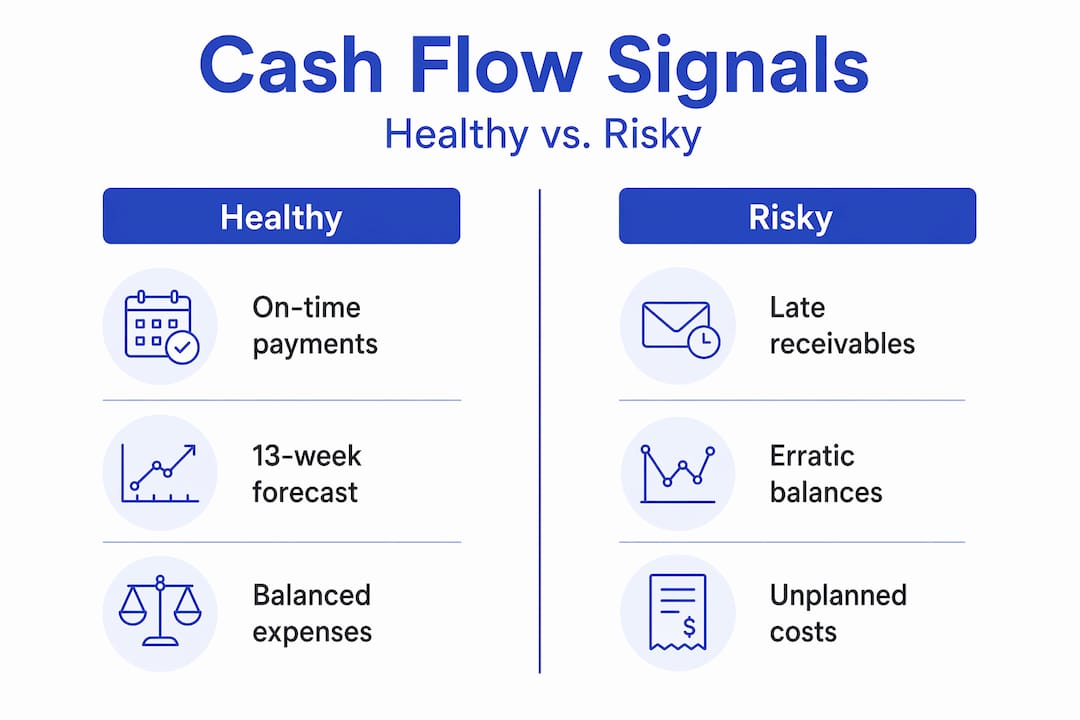
Healthy vs. risky cash flow signals
The table below outlines the key signals that distinguish a startup with healthy cash flow from one that is heading toward a liquidity crisis.
| Indicator | Healthy cash flow | Risky cash flow |
|---|---|---|
| Accounts receivable | Collected within 30 days | Outstanding beyond 60 days |
| Monthly burn rate | Tracked and forecasted | Unknown or estimated loosely |
| Cash runway | 6 to 12 months visible | Less than 3 months with no plan |
| Payables management | Scheduled and on time | Delayed or missed payments |
| Revenue recognition | Recorded accurately by period | Recorded when cash arrives |
| Bank reconciliation | Completed monthly | Rarely or never performed |
The distinction between these two states is almost entirely a function of accounting discipline. Startups that track these indicators consistently are in a position to act before a problem becomes a crisis.
Common pitfalls to avoid:
- Missed receivables: Failing to follow up on outstanding invoices creates an artificial gap between earned revenue and available cash.
- Hidden burn rate: Without categorized expense tracking, founders often underestimate how much the business is spending each month.
- Unrecorded liabilities: Deferred payments, vendor credit terms, and subscription renewals can create sudden cash demands that catch unprepared founders off guard.
- Confusing profit with cash: A business can be profitable on paper while simultaneously running out of cash if payment cycles are misaligned.
Pro Tip: Set up a rolling 13-week cash flow forecast updated every Monday. This gives your founding team a short-term view of liquidity that monthly reports alone cannot provide, and it forces the discipline of reconciling actuals against projections on a regular cadence.
Accounting as your startup’s decision-making engine
Sound accounting does more than prevent financial disasters. It actively enables better decisions at every stage of a startup’s growth. Hiring a new engineer, adjusting pricing, entering a new market, or deciding whether to extend a product line are all choices that carry financial consequences. Without reliable numbers, those decisions are based on intuition rather than evidence.

Consider the difference between a founder who reviews a monthly profit and loss statement alongside a cash flow report and one who makes decisions based on a general sense of how the business is performing. The first founder can identify which product lines are most profitable, which customer segments are generating the highest margins, and which cost centers are growing faster than revenue. The second founder is essentially guessing.
Accounting systems help founders manage cash runway and make informed decisions, and the absence of these systems creates a compounding disadvantage over time. Early-stage decisions made without accurate financial data tend to create structural inefficiencies that become increasingly costly to unwind as the business scales.
Decision-making with and without real-time accounting
| Decision area | With real-time accounting | Without real-time accounting |
|---|---|---|
| Hiring | Based on margin data and runway projections | Based on gut feel or revenue optimism |
| Pricing | Informed by actual cost of goods and margins | Set by market comparison without cost awareness |
| Investment timing | Triggered by clear financial milestones | Reactive and often too late |
| Expense approvals | Benchmarked against budget and actuals | Approved without context or category limits |
| Pivot decisions | Supported by product-level P&L data | Driven by anecdotal feedback |
| Vendor negotiations | Backed by spend analysis and payment history | Conducted without leverage or data |
The contrast is stark. Real-time accounting transforms financial data from a historical record into a live decision-support tool.
How founders use monthly reports to guide strategy
- Review the profit and loss statement to identify revenue trends, gross margin changes, and expense categories that are growing disproportionately.
- Analyze the cash flow statement to confirm that operating activities are generating or consuming cash as expected, and to validate the accuracy of the runway forecast.
- Examine the balance sheet to assess the health of assets, liabilities, and equity, particularly as the startup approaches a fundraising round.
- Compare actuals against budget to understand where the business is over or under performing relative to its plan, and to adjust forecasts accordingly.
- Flag key variances for discussion with the leadership team, ensuring that financial insights are translated into operational decisions within the same reporting cycle.
Establishing this monthly rhythm is one of the most valuable habits a founding team can build. Bookkeeping for startups is not simply about record-keeping; it is about creating the informational foundation from which strategic decisions are made with confidence. Founders who invest in this process early find that it pays dividends not just in operational clarity but also in financial stability for startups over the medium and long term.
Building investor and lender trust: The fundraising advantage
Every founder who has gone through a fundraising process knows that investors do not simply evaluate a product or a team. They evaluate the quality of the information they receive. A compelling pitch deck supported by clean, accurate financial statements carries significantly more weight than an identical pitch backed by disorganized or inconsistent numbers.
Investors and lenders expect organized, accurate financial statements and credible metrics such as burn rate and runway. When a startup cannot provide these clearly and promptly, it signals to potential backers that the founding team lacks the operational discipline required to steward their capital responsibly. This perception, once formed, is difficult to reverse within a single due diligence process.
“Organized financials are not just a compliance requirement. They are a statement of intent. When a startup presents clean books, it communicates that the founders understand their business at a level of detail that justifies trust and investment.”
The fundraising advantage of strong accounting extends beyond angel and venture capital rounds. Banks and government-linked financing schemes in Singapore, such as those administered through Enterprise Singapore, also require detailed financial documentation before extending credit or grants. Startups that maintain accurate records from the outset are better positioned to access these resources quickly when opportunities arise.
Must-have financial statements for fundraising
Every startup preparing for a funding conversation should have the following documents ready, current, and reconciled:
- Balance sheet: A snapshot of the company’s assets, liabilities, and shareholders’ equity at a specific point in time. Investors use this to assess the financial health and net worth of the business.
- Profit and loss statement (P&L): A summary of revenues, costs, and expenses over a defined period. This document reveals whether the business is generating or consuming value through its operations.
- Cash flow statement: A record of all cash inflows and outflows categorized by operating, investing, and financing activities. This is often the most scrutinized document during early-stage due diligence.
- Accounts receivable aging report: A breakdown of outstanding invoices by age, which helps investors assess the quality and collectability of revenue.
- Burn rate and runway summary: A clear calculation of monthly cash consumption and the number of months of runway remaining at the current burn rate.
Founders who are weighing the question of DIY vs professional bookkeeping should consider the fundraising context carefully. Investor-grade financials require a level of accuracy and consistency that is difficult to maintain without professional support, particularly as transaction volumes increase and the complexity of the business grows.
Surviving compliance and taxes in Singapore
Singapore is widely recognized as one of the most business-friendly jurisdictions in the world, and its regulatory framework reflects that reputation. However, compliance obligations are real, specific, and time-sensitive. Startups that neglect their accounting responsibilities do not simply face administrative inconvenience; they risk financial penalties, reputational damage, and complications that can affect future fundraising or licensing applications.
Accurate financial records are the foundation of every compliance obligation a Singapore startup will encounter. Without them, meeting deadlines becomes a reactive scramble rather than a planned process.
Key compliance tasks for Singapore startups
The following sequence outlines the core compliance responsibilities that every Singapore-registered company must address:
- Maintain proper accounting records from the date of incorporation. The Companies Act requires Singapore companies to keep books of accounts that accurately reflect the financial position of the business, and these records must be retained for a minimum of five years.
- Prepare annual financial statements in accordance with the Singapore Financial Reporting Standards (SFRS). For most startups, this means producing a balance sheet, profit and loss statement, and notes to the accounts on an annual basis.
- File annual returns with ACRA (the Accounting and Corporate Regulatory Authority). This must be completed within the prescribed deadlines following the company’s financial year end, and failure to comply attracts penalties.
- Register for GST (Goods and Services Tax) if annual taxable turnover exceeds SGD 1 million. Once registered, the company must file GST returns on a quarterly basis and maintain supporting documentation for all transactions.
- File corporate income tax returns with IRAS (the Inland Revenue Authority of Singapore). This includes the Estimated Chargeable Income (ECI) filing, which must be submitted within three months of the financial year end, and the Form C-S or Form C filing by the statutory deadline.
- Claim applicable tax exemptions and incentives such as the Start-Up Tax Exemption scheme, which allows qualifying new companies to exempt a portion of their chargeable income from tax in the first three years of assessment.
- Conduct an annual audit if the company does not qualify for the audit exemption. Startups with annual revenue below SGD 10 million and fewer than 20 shareholders may qualify for exemption, but this must be assessed carefully.
Pro Tip: Use your accounting software to set automated reminders for each filing deadline at least 30 days in advance. Cross-reference your accounts monthly so that when a deadline arrives, the underlying data is already reconciled and ready. Founders who treat compliance as an ongoing process rather than an annual event avoid the costly errors that come from rushed last-minute filings. Reviewing common bookkeeping mistakes that Singapore businesses make is a practical way to identify and close gaps in your current process before they become compliance issues.
Why “just focusing on growth” is risky: What experience shows
There is a widely held belief among early-stage founders that accounting is something to be addressed once the business reaches a certain scale. The logic goes: if revenue is growing, the financial details will sort themselves out later. This belief is not just incorrect. It is one of the most consistently damaging misconceptions in the startup ecosystem.
The pattern is well-documented. A startup gains traction, revenue climbs, and the team focuses entirely on product development and customer acquisition. Meanwhile, the accounting function is handled informally, often by a founder with no financial background using a basic spreadsheet. Expenses are not categorized properly. Receivables are not tracked systematically. Tax obligations accumulate without a clear picture of the liability. Then, at the moment when the business needs to raise its next round or respond to a regulatory inquiry, the financial records are in a state that cannot support either.
Weak bookkeeping increases the risk of cash visibility problems that contribute to startup failure, and this risk does not diminish as revenue grows. In fact, it intensifies. A larger business has more transactions, more complexity, and more stakeholders who depend on accurate financial information. The cost of reconstructing historical records at scale is vastly higher than the cost of maintaining them correctly from the outset.
Several high-profile startup collapses in recent years have been traced not to a failure of the product or the market but to a failure of financial governance. Leadership teams that could not answer basic questions about their burn rate, their unit economics, or their true cash position made expansion and hiring decisions that the business could not sustain. By the time the financial reality became clear, the runway was gone.
The uncomfortable truth is that growth without financial clarity is not growth at all. It is expansion of risk. A startup that understands why bookkeeping matters and invests in it early is not diverting resources from growth. It is building the infrastructure that makes sustainable growth possible.
True financial discipline means knowing, at any given moment, where the cash is, what the profitability looks like at the product or customer level, and what risks are building on the balance sheet. Founders who cultivate this discipline early find that it sharpens every other aspect of their decision-making and makes their businesses significantly more resilient to the unexpected.
Professional help for startup accounting in Singapore
Managing accounting well from the earliest stages of a startup is one of the highest-leverage investments a founder can make. The challenge is that most founders are not accountants, and the time required to maintain accurate books while simultaneously building a product and acquiring customers is simply not available.

Bizsquare Accounting provides specialized startup bookkeeping services designed specifically for Singapore founders who need accurate, compliant, and investor-ready financial records without the overhead of a full-time finance team. From monthly bookkeeping and GST filing to corporate tax advisory and outsourced CFO support, the firm’s consultants bring the expertise and systems that early-stage companies need to operate with financial confidence. Explore the full range of accounting services for startups available to Singapore companies and take the first step toward building a financial foundation that supports every stage of your growth.
Frequently asked questions
What is the most common accounting mistake startups make?
Startups most often fail to track their cash flow rigorously, which leads to unexpected shortfalls and funding gaps; weak bookkeeping is a direct contributor to the cash visibility problems that cause startup failure.
How does accounting help with fundraising?
Accurate and organized financial statements increase credibility with investors and lenders, as organized financials and credible metrics such as burn rate and runway are standard expectations during due diligence.
What reports should my startup prepare regularly?
Startups should consistently prepare balance sheets, profit and loss statements, and cash flow reports each month, since investors and lenders expect these documents to be current and accurately reconciled.
Does accounting help avoid legal trouble in Singapore?
Yes, maintaining accurate books ensures that startups meet Singapore’s filing deadlines with ACRA and IRAS, satisfy GST reporting requirements, and avoid the financial penalties that accompany non-compliance.
Can I handle accounting myself as a founder?
Many founders manage basic bookkeeping in the earliest stages, but most benefit significantly from professional accounting services as transaction volumes grow, compliance obligations multiply, and investor-grade reporting becomes necessary.