

InvoiceNow is Singapore’s Peppol-based e-invoicing network, managed by IMDA, and GST-registered businesses must submit invoice data to IRAS through InvoiceNow-Ready Solutions under a phased rollout running from 2028 to 2031. The practical next step is simple: check your IRAS notification for your mandatory date, then choose an IMDA-accredited provider before that deadline arrives.
TL;DR:
- Businesses with annual taxable supplies under $200,000 must comply with InvoiceNow from April 2028, with deadlines extending up to 2031 for larger firms.
- Validating specific GST field mappings, including invoice type codes and payment identifiers, is crucial to prevent submission rejections under Singapore’s Peppol BIS Billing 3.0 standard.
- Connecting involves selecting an IMDA-accredited provider, registering your UEN in the Peppol Directory, and running test invoices for smooth activation before your mandatory deadline.
- Using the overseas Peppol template instead of Singapore-specific profiles can lead to submission failures, making local template compliance essential.
- Early planning helps avoid last-minute technical issues, and professional support from providers or advisors can streamline the transition and ensure compliance.
Table of Contents
- 1. What InvoiceNow and Peppol mean for your business
- 2. The GST InvoiceNow requirement and phased rollout timeline
- 3. How to get connected: registering, choosing a provider and obtaining a Peppol ID
- 4. Singapore-specific Peppol billing notes and technical highlights to watch
- 5. Grants, free-of-charge packages and where to get help
- 6. Practical checklist: pre-activation checks and your first 30 days
- 7. Why early planning matters for InvoiceNow readiness
- 8. How Bizsquare supports your InvoiceNow and GST readiness
- FAQ
- Sources
1. What InvoiceNow and Peppol mean for your business
InvoiceNow is Singapore’s nationwide e-invoicing network, built on the global Peppol standard and overseen by IMDA. Peppol allows invoice data to move directly between finance systems, rather than as a PDF attached to an email. This system-to-system exchange means your accounting software talks to your buyer’s accounting software, without manual re-entry.
For Singapore businesses, this shift carries three practical benefits. We see these play out across companies at different stages of growth.
- Automation: invoices post directly into accounting systems, cutting manual data entry.
- Faster processing: buyers can approve and pay invoices sooner, improving cash flow.
- Better data quality: structured fields reduce errors compared with scanned or typed invoices.
This matters because InvoiceNow is not an optional convenience anymore. It is becoming the backbone of GST reporting in Singapore, and understanding it now saves confusion later.
2. The GST InvoiceNow requirement and phased rollout timeline
IRAS has set a phased timeline requiring GST-registered businesses to transmit invoice data via InvoiceNow-Ready Solutions. The GST InvoiceNow requirement/gst-invoicenow-requirement) sets mandatory dates tied to annual taxable supplies.
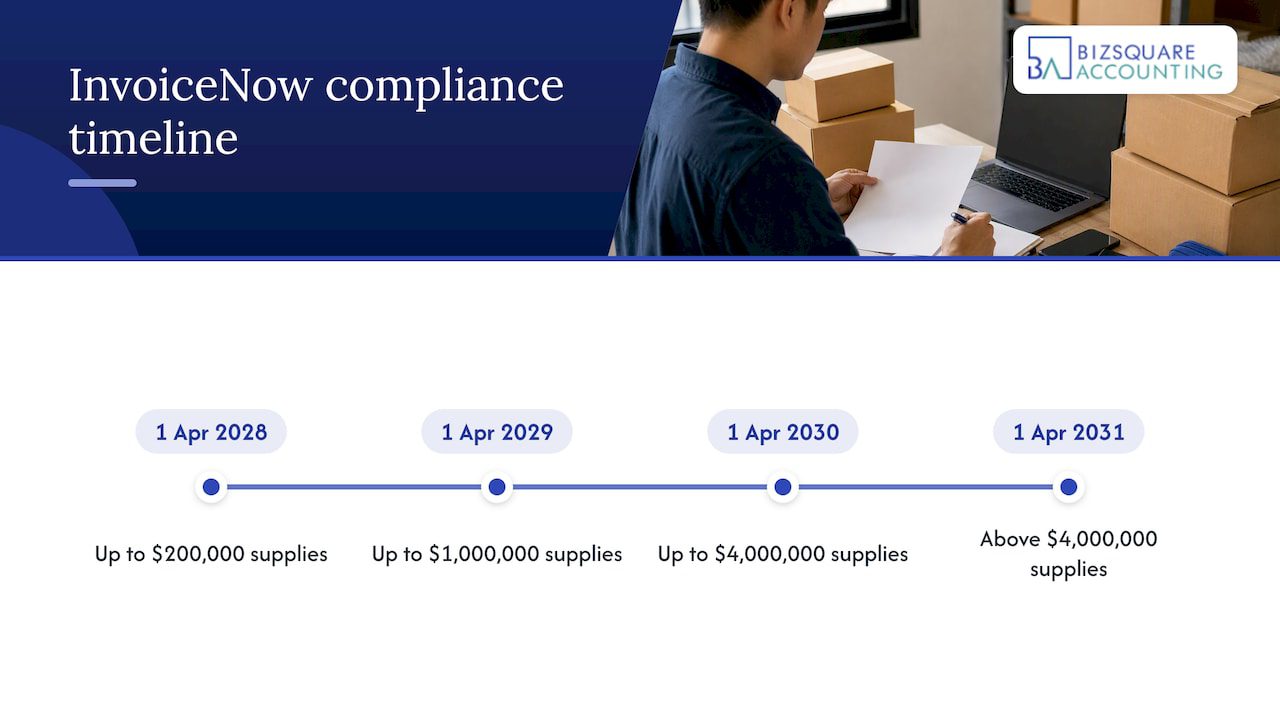
The phased dates and thresholds are: businesses with annual taxable supplies up to $200,000 must comply from 1 April 2028, those up to $1,000,000 from 1 April 2029, those up to $4,000,000 from 1 April 2030, and businesses above $4,000,000 from 1 April 2031, according to IRAS.
Some groups may be notified earlier depending on their GST registration profile, while certain exempt or non-GST transactions fall outside scope. Because IRAS assigns dates based on your Unique Entity Number and accounting period rather than a single fixed date for everyone, you should confirm your specific deadline directly through your IRAS notification. Relying only on your revenue bracket can lead to planning the wrong timeline, so cross-check both figures before committing resources.
3. How to get connected: registering, choosing a provider and obtaining a Peppol ID
Getting InvoiceNow-ready involves a sequence of practical steps, and following them in order avoids rework later. We recommend starting this process well before your mandatory date.
- Check the IMDA list of Access Point Providers and InvoiceNow-Ready Solution Providers to find an accredited option.
- If you choose a provider, ask them to register your UEN in the SG Peppol Directory on your behalf.
- If you run an in-house accounting system, contact an accredited Access Point for technical integration support.
- Once connected, activate the GST InvoiceNow submission feature within your chosen solution.
- Run test invoices through the system and confirm that responses and acknowledgements are received correctly.
Each provider handles onboarding slightly differently, so ask for a written setup timeline before signing anything.
Pro Tip: Test with a small batch of real invoices first, rather than switching your entire invoicing process over in one go.
4. Singapore-specific Peppol billing notes and technical highlights to watch
The Singapore version of Peppol billing, called SG Peppol BIS Billing 3.0, carries specific fields that overseas templates often miss. Getting these details wrong is the most common reason businesses face rejected submissions.
- InvoiceTypeCode 380 must appear on standard invoices, as set out in IMDA’s technical notes on SG Peppol BIS Billing 3.0.
- PaymentMeans codes Z01 and Z02 identify GIRO and PayNow Corporate payments respectively, alongside correct UEN usage.
- GST registration numbers must be included on taxable invoices, and GST category codes must map correctly to your accounting system.
An invoice that uses a generic international Peppol template, rather than the Singapore-specific profile, can fail submission entirely, as documented by the Singapore Peppol Guide. This happens because overseas templates often handle rounding, GST categorisation and payment identifiers differently from local requirements. Checking your provider’s field mapping against the Singapore profile before going live prevents this problem.
5. Grants, free-of-charge packages and where to get help
IMDA offers financial support to ease adoption costs, and checking eligibility before budgeting can save unnecessary spending. Several resources exist beyond the grant itself.
- IMDA’s grant and free-of-charge solution notices list eligibility criteria for funded InvoiceNow packages, detailed on the InvoiceNow grants page.
- Provider user guides and technical playbooks walk through setup steps in plain language for non-technical staff.
- Banks and accounting platforms increasingly offer onboarding support alongside their standard business accounts.
Combining a grant-funded solution with proper bookkeeping support often gives SMEs the smoothest transition path.
6. Practical checklist: pre-activation checks and your first 30 days
A short checklist before and after activation reduces errors significantly. We suggest working through these steps methodically rather than rushing the switch.
- Confirm your IRAS notification and note your exact mandatory activation date.
- Verify GST field mappings, customer and supplier master data, and payment identifiers.
- Run test invoices, log every response received, and reconcile results against your accounting records.
- Train relevant staff on the new workflow and document the process for future reference.
- Preserve all supporting records needed for GST input-tax claims, since these remain your responsibility.
Pro Tip: Keep a simple log of every test invoice and its response, since this becomes useful evidence if IRAS ever queries your submission history.
Many businesses find the invoice checklist for Singapore requirements a helpful reference during this period.
7. Why early planning matters for InvoiceNow readiness
We often see businesses treat InvoiceNow as a technical task for their software provider alone. In practice, GST field mapping and master-data accuracy need accounting judgement too. Early planning reduces audit risk, avoids last-minute integration rushes, and gives your finance team time to test properly before deadlines bite.
— Vandro
8. How Bizsquare supports your InvoiceNow and GST readiness
We help businesses prepare for InvoiceNow without treating it as a standalone IT project. Because GST compliance, bookkeeping accuracy and tax filing sit together, we look at the whole picture rather than just the technical connection.

Our relevant services include GST filing and advisory, cloud accounting setup compatible with InvoiceNow, bookkeeping support to maintain data accuracy, outsourced CFO services for ongoing financial oversight, and IRAS audit support if needed.
| Service | What it covers |
|---|---|
| GST Filing & Advisory | Confirming mandatory dates, reporting obligations and GST codes |
| Accounting and Bookkeeping Services | Master-data accuracy, reconciliation and ongoing records |
| Corporate Advisory & Outsourced CFO Services | Financial oversight during the transition period |
If your business is approaching its InvoiceNow deadline, our corporate tax filing and advisory team can map out your readiness plan, and our accounting and bookkeeping services can handle the ongoing reconciliation once you are live.
FAQ
Is InvoiceNow mandatory in Singapore?
Yes, for GST-registered businesses, under a phased timeline set by IRAS running from 2028 to 2031 depending on annual taxable supplies. Businesses below the GST registration threshold are not currently covered by this mandate.
Which countries use Peppol for e-invoicing?
Peppol operates across multiple countries in Europe, Asia-Pacific and beyond, each with its own local billing profile. Singapore’s version, maintained through the Singapore Peppol Guide, is called SG Peppol BIS Billing 3.0.
How do I get a Peppol ID in Singapore?
You obtain a Peppol ID by registering your UEN through an IMDA-accredited Access Point Provider or InvoiceNow-Ready Solution Provider. Check the IMDA InvoiceNow page for the current list of accredited providers.
What is a Peppol e-invoice and how is it used?
A Peppol e-invoice is structured invoice data transmitted directly between accounting systems, not a PDF or scanned document. Once routed through InvoiceNow, a copy of this data is automatically shared with IRAS for GST reporting purposes.
Do I need new accounting software to use InvoiceNow?
Not necessarily, many existing platforms like Xero, QuickBooks and MYOB support InvoiceNow connectivity through accredited providers. Our cloud accounting setup service can confirm whether your current system qualifies.
What happens if I miss my mandatory InvoiceNow date?
Missing your assigned date under the IRAS GST InvoiceNow requirement may affect your GST reporting compliance. Confirming your exact date early, then testing ahead of time, helps avoid this situation.
Can I still send PDF invoices after InvoiceNow applies to me?
A PDF attachment is not recognised as an InvoiceNow e-invoice, since the system requires structured data sent directly between systems. You may still send PDFs to customers for reference, but your GST submission to IRAS must go through InvoiceNow.
Does InvoiceNow apply to businesses selling through online stores?
Yes, GST-registered online sellers fall under the same phased requirement based on their annual taxable supplies. Businesses setting up e-commerce payment flows may also find it useful to review Shopify setup guidance for Singapore when integrating payment and invoicing systems together.
Are there grants available to help with InvoiceNow setup costs?
IMDA publishes grant details and free-of-charge solution packages for eligible businesses on its InvoiceNow grants page. Eligibility criteria vary, so checking the current notice before budgeting is worthwhile.
What GST codes do I need to map for InvoiceNow?
Your accounting system needs GST category codes that align with SG Peppol BIS Billing 3.0 requirements, detailed in the Singapore Peppol Guide. Incorrect mapping is one of the most common causes of rejected submissions.
Sources
For readers who want to check details directly, these official sources cover the full picture.