

In Singapore, the standard GST filing cycle is quarterly, and returns and payment are due one month after the accounting period ends, as set out by IRAS/filing-gst/due-dates-and-requests-for-extension). The immediate action for most finance teams is to confirm the filing frequency assigned on myTax Portal, verify Corppass authorisations, and keep the acknowledgement page after each submission.
TL;DR:
- Most businesses must file GST returns quarterly, with deadlines one month after each quarter ends, regardless of their financial year-end unless IRAS approves a special period.
- Businesses enrolled in GIRO should file on time and verify enrollment since GIRO deductions occur on the 15th of the month following the due date, not as an extension.
- Changing GST periods requires a formal request at least 30 days before the new cycle begins and approval from IRAS, with the same one-month filing rule applying afterward.
- All GST return figures must be reported in Singapore dollars, with records of exchange rates kept in case of IRAS inquiries, and nil returns are mandatory for periods with no taxable activity.
- Late filings trigger penalties starting at $200 plus $200 per month of delay, and defaulting can lead to estimated assessments and higher penalties unless an extension is properly requested in advance.
Table of Contents
- Standard GST filing periods and calendar quarter deadlines
- Filing deadlines, GIRO timing and how to stay ahead of both
- Monthly filing: when it applies and how to check your frequency
- Filing a GST return through myTax Portal step by step
- Changing GST accounting periods and special arrangements
- Preparing the GST F5: boxes, currency and nil returns
- Penalties, estimated assessments and extension rules
- Practical checklist and best practices for every filing period
- Why calendar discipline matters more than most businesses realise
- How Bizsquare supports your GST filing cycle
- Sources
- FAQ
Standard GST filing periods and calendar quarter deadlines
Most GST-registered businesses in Singapore file on a quarterly cycle, and the accounting periods generally follow the calendar quarter unless a different frequency has been approved. This means finance teams can map their obligations directly against a familiar calendar, provided their financial year aligns with the standard quarters.
The due dates for quarterly filing fall exactly one month after each period ends:
- January to March: filing and payment due by 30 April.
- April to June: filing and payment due by 31 July.
- July to September: filing and payment due by 31 October.
- October to December: filing and payment due by 31 January.
Businesses with a non-standard financial year-end should not assume their GST periods automatically shift to match. Unless a special accounting period has been approved, the default quarterly cycle applies regardless of when the company’s financial year closes, so it is worth checking this early rather than assuming alignment.
Filing deadlines, GIRO timing and how to stay ahead of both
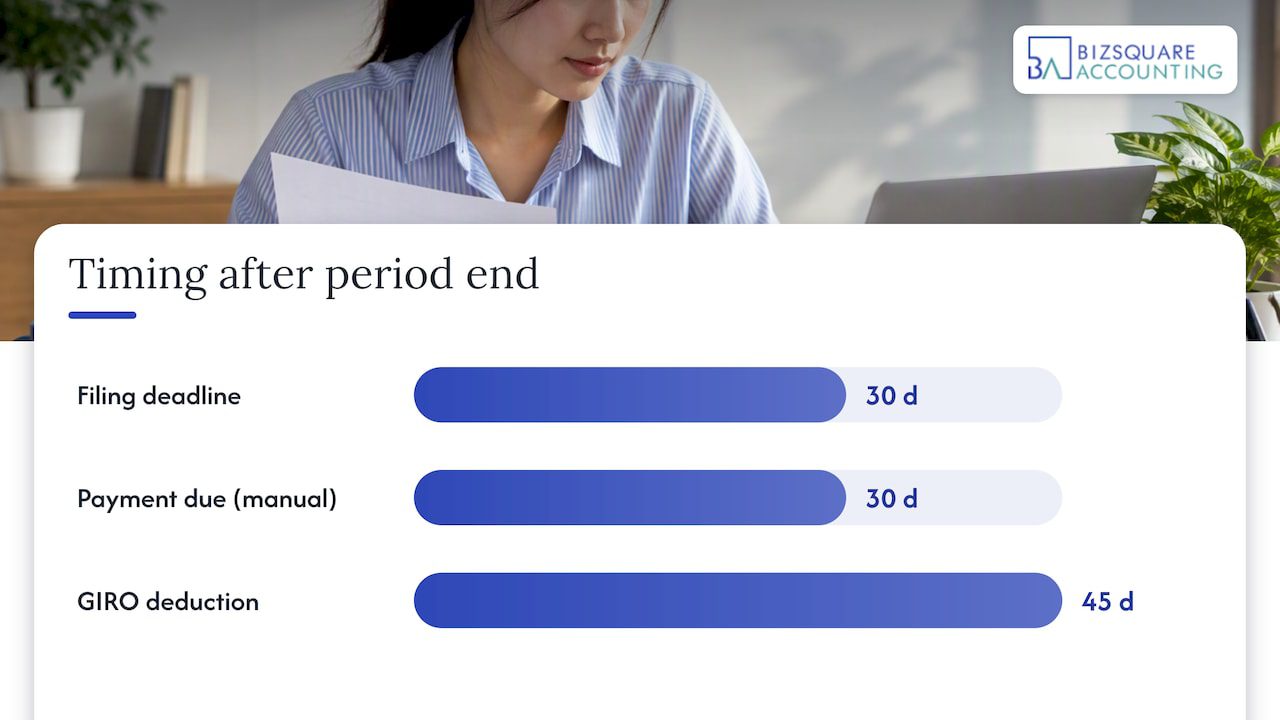
Filing and payment share the same one-month deadline after the accounting period ends, but businesses enrolled in GIRO experience a slightly different payment mechanic. According to IRAS, GIRO deductions are taken on the 15th day of the month following the payment due date, giving a short buffer before funds actually leave the company’s account.
This buffer is useful, but it should never be mistaken for an extension to the filing deadline itself. To stay ahead of both obligations:
- File the return by the standard due date, regardless of when GIRO will deduct payment.
- Confirm GIRO enrolment status well before the deduction date to avoid a failed transaction.
- Save the acknowledgement page immediately after submission, since it serves as the primary proof of filing.
Businesses without GIRO should arrange payment manually before the due date, as late payment penalties apply from that date, not from any later deduction cycle.
Monthly filing: when it applies and how to check your frequency
Quarterly filing is the default, but some businesses are approved for monthly filing instead. This typically applies to businesses that expect regular GST refunds, since a monthly cycle allows those refunds to be processed more frequently, improving cash flow for exporters or businesses with substantial zero-rated supplies.
Monthly filing is not something a business can simply choose. It requires approval from IRAS, and the request should reflect a genuine business reason rather than a preference for administrative convenience.
To confirm your assigned frequency:
- Log in to myTax Portal using Corppass credentials and check the GST account details.
- Review the accounting period start and end dates shown against your GST registration.
- Contact IRAS through myTax Mail if the frequency shown does not match your business’s actual filing pattern.
Filing a GST return through myTax Portal step by step
Filing is done entirely through myTax Portal, and access depends on Corppass roles being set up correctly beforehand. Businesses that skip this setup often lose time scrambling for authorisation near the deadline, so it pays to organise roles well in advance.
- Assign Corppass roles so that at least one staff member has the ‘GST (Filing and Applications)’ e-service, split between ‘Preparer’ and ‘Approver’ where possible.
- Reconcile sales, purchases and import records against your accounting system before the filing window opens.
- Log in to myTax Portal with Singpass under the authorised Corppass account.
- Select the correct GST F5 return and enter all figures in Singapore dollars.
- Have the Approver review the completed return before submission.
- Submit the return and download or print the acknowledgement page for your records.
Pro Tip: Store the acknowledgement page in the same folder as your reconciliation working papers, so both pieces of evidence sit together if IRAS ever asks for supporting documents.
Changing GST accounting periods and special arrangements
Some businesses request a change to their GST accounting periods so that filing aligns with their financial year-end rather than the calendar quarter. This is known as a special accounting period, and it can simplify internal reporting for companies whose financial year does not follow January to December.
According to IRAS’ guidance on changing GST accounting periods, the process has firm timing requirements:
- Submit the request through myTax Mail at least 30 days before the start of the first affected accounting period.
- IRAS approval is required before the new period takes effect, so the change is never automatic.
- If the 30 day window is missed, the business must continue filing under its existing accounting periods until the next opportunity to request a change.
Special accounting periods still follow the same one-month filing rule after each period ends, only the calendar dates shift to match the approved schedule.
Preparing the GST F5: boxes, currency and nil returns
The GST F5 return contains fifteen boxes covering total supplies, taxable purchases, output tax, input tax, and the resulting net GST payable or claimable. Getting these figures right depends on consistent bookkeeping throughout the period, not just a rushed reconciliation at filing time.
A few rules apply consistently across every filing:
- All amounts must be reported in Singapore dollars, even where transactions originated in foreign currency.
- Businesses should keep records of the exchange rates used for conversion, in case IRAS requests supporting evidence.
- A nil return is still required for any period where the business had no taxable supplies or purchases, since silence is not treated as compliance.
Skipping a nil return is a common oversight, particularly for dormant companies or those between projects, and it carries the same penalties as missing an active return.
Penalties, estimated assessments and extension rules
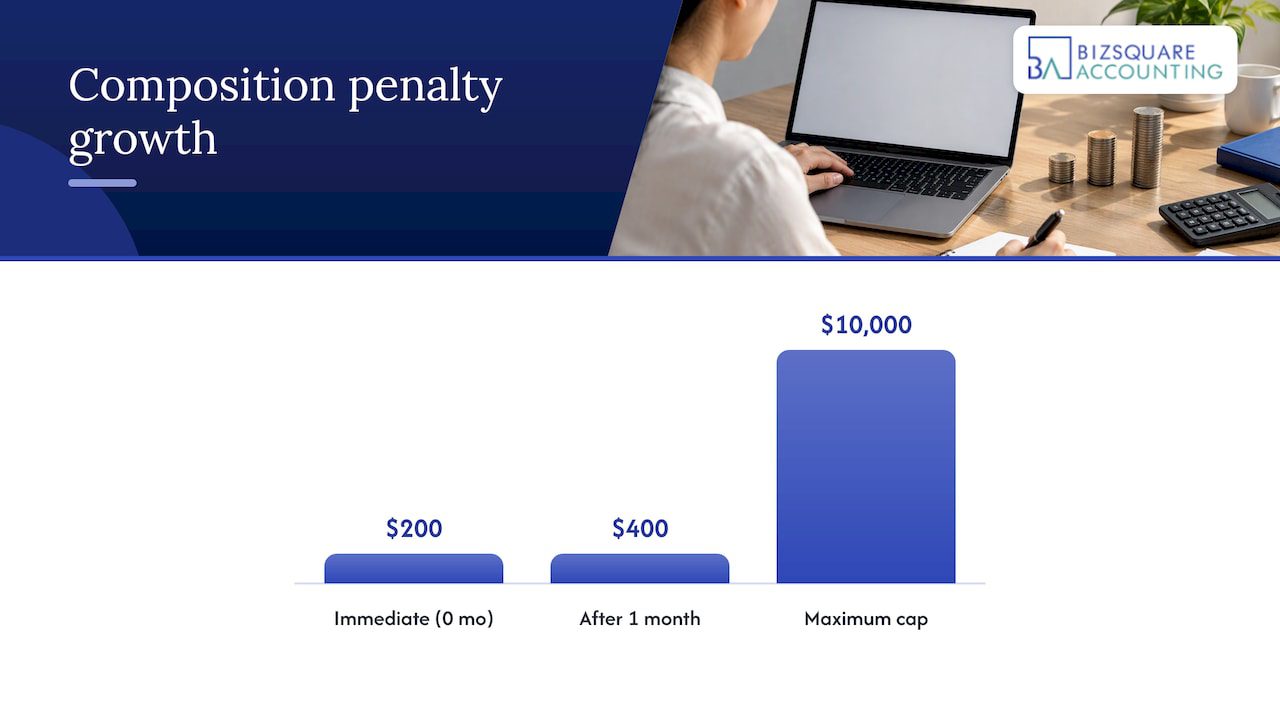
Missing the filing deadline triggers consequences quickly. Under IRAS’ rules for GST-registered businesses, a $200 composition penalty applies immediately, with a further $200 added for every completed month the return remains outstanding, up to a maximum of $10,000.
Late payment carries its own separate penalty structure:
- A 5% penalty applies immediately on the outstanding tax once the due date passes.
- An additional 2% penalty per month applies after 60 days, capped at 50% of the tax owed.
- IRAS may also issue an estimated assessment if the return remains unfiled, and the business must still pay based on that estimate until the actual return is submitted.
Extensions are rarely granted, since IRAS generally treats one month as a reasonable period to prepare a return. Where a genuine extension is needed, a request with supporting documents should reach IRAS at least five working days before the due date. For a fuller breakdown of these penalties and how Corppass access ties into avoiding them, see this guide to GST filing deadlines.
Practical checklist and best practices for every filing period
A disciplined monthly routine, even under a quarterly filing cycle, catches errors long before they become deadline emergencies. Businesses that treat GST as a once-a-quarter task tend to discover cut-off errors and import tax mismatches too late to fix them cleanly.
- Reconcile sales, purchases and import GST every month, regardless of your filing frequency.
- Maintain a two-person control: one preparer, one approver, with both reviewing figures before submission.
- Schedule GIRO or manual payment arrangements as soon as the period closes, not the week of the deadline.
- Keep exchange rate records and supporting invoices filed alongside each period’s working papers.
- Archive every acknowledgement page in a dedicated compliance folder.
Pro Tip: Set a recurring calendar reminder ten days before each filing deadline, giving the approver enough time to review without rushing the submission.
Why calendar discipline matters more than most businesses realise
Missing a filing deadline rarely stays a simple fine. It often triggers an estimated assessment, which then requires correction, and that correction takes longer than the original filing ever would have. A clear split between preparer and approver, paired with a simple monthly reconciliation habit, protects both the finance team and the directors who sign off on compliance. Keeping an audit trail, including every archived acknowledgement page, turns a stressful IRAS query into a five minute lookup.
— Vandro
How Bizsquare supports your GST filing cycle
Staying on top of quarterly deadlines, Corppass roles and monthly reconciliations takes consistent attention, and many finance teams would rather redirect that time towards running the business. Bizsquare Accounting offers a more hands-off route to the same outcome, built around fixed engagements rather than ad hoc fire drills near each deadline.

- Ongoing bookkeeping and reconciliation support that keeps your accounts ready before each filing window opens, through our accounting and bookkeeping services.
- GST filing and advisory support, including Corppass setup and correspondence with IRAS, through our corporate tax filing and advisory service.
- Outsourced CFO support for businesses that want ongoing visibility over cash flow tied to their GST obligations, without hiring an in-house finance team.
If managing your GST filing cycle has become harder internally, consider discussing a tailored quote for GST filing and advisory support.
FAQ
What is the GST filing cycle?
The GST filing cycle is the recurring accounting period, usually quarterly in Singapore, for which a business must submit a GST return. Filing and payment are due one month after each accounting period ends.
What is the due date for filing the GST return in Singapore?
The due date falls one month after the end of the accounting period. For calendar quarters, this means 30 April, 31 July, 31 October and 31 January depending on the quarter.
Is GST filing every month?
Not by default. Most businesses file quarterly, and monthly filing only applies where IRAS has specifically approved it, usually for businesses expecting regular GST refunds.
How to check GST filing frequency?
Log in to myTax Portal using Corppass credentials and review the accounting period details shown under your GST registration. Contact IRAS through myTax Mail if the frequency does not match your expectations.
What happens if I file my GST return late?
A $200 composition penalty applies immediately, with a further $200 for each completed month of delay, up to $10,000. Late payment carries a separate penalty on top of this.
Do I still need to file a nil GST return?
Yes, a nil return is required for any period with no taxable supplies or purchases. Skipping it carries the same penalties as missing an active return.
Can I request an extension to file my GST return?
Extensions are rarely granted, since one month is generally considered a reasonable preparation period. A request with supporting reasons should be sent at least five working days before the due date.
How do I change my GST accounting periods?
Submit a request through myTax Mail at least 30 days before the first affected period, and wait for IRAS approval before treating the new schedule as active.
What currency should I use on the GST F5 return?
All figures must be reported in Singapore dollars, even where the underlying transactions were in a foreign currency. Keep your exchange rate records in case IRAS asks for them.
Does GIRO change my GST filing deadline?
No, GIRO only affects when payment is deducted, typically on the 15th of the month after the due date. The filing deadline itself stays one month after the accounting period ends.