

Under the Companies Act, a Singapore company may only pay dividends out of distributable profits. The board may authorise interim dividends when it reasonably believes profits and solvency support the payment, while shareholders approve final dividends at the AGM. Dividends paid by a Singapore resident company are generally exempt from income tax under the one-tier system.
TL;DR:
- Directors must ensure dividends are paid only out of actual, correctly recognized profits, excluding unrealized gains or non-distributable reserves.
- Proper documentation, including board minutes, dividend vouchers, and approval resolutions, is essential to defend the dividend decision later.
- Companies need to verify retained profits and cash support with recent accounts and check the constitution for any restrictions before declaring dividends.
- Singapore’s one-tier system generally exempts dividends paid by resident companies from further taxation, but accurate record-keeping remains crucial.
- Foreign dividends may be exempt under FSIE conditions if they’ve been taxed abroad at at least 15%, and non-resident payments typically face no Singapore withholding tax.
Table of Contents
- The legal test: section 403 and what counts as distributable profits
- Interim versus final dividends: approvals, timing and documentation
- Director duties, solvency checks and personal liability
- Tax treatment in Singapore: one-tier system and reporting obligations
- Foreign-sourced dividends and withholding tax: FSIE conditions and non-resident payments
- Practical compliance checklist: steps, documents and sample wording for resolutions and vouchers
- Bizsquare’s perspective: where directors commonly need help and how advisers add value
- How Bizsquare can help with dividend compliance and next steps to get support
- Sources
- FAQ
The legal test: section 403 and what counts as distributable profits
Section 403 of the Companies Act sets the baseline rule for every company registered in Singapore. No dividend may be paid to shareholders except out of profits. Section 403(2) goes further, and makes any director who wilfully pays or permits an unlawful dividend liable to a fine, imprisonment, or both, along with civil recovery claims from creditors or a liquidator.
The word “profits” carries real technical weight. It generally includes accumulated realised revenue profits, retained earnings from prior years, and realised capital gains, but excludes unrealised revaluation surpluses and other reserves the accounts specifically mark as non-distributable. Directors cannot treat a paper gain on an unsold property, for instance, as cash available for shareholders.
The company’s own constitution can narrow these powers further. Some constitutions require higher approval thresholds or restrict when interim dividends may be declared, so checking the constitution alongside the statute matters. This is why accountants or auditors typically sign off on the profit figures before any board resolution goes ahead.
Interim versus final dividends: approvals, timing and documentation
Interim dividends are a board matter. Directors rely on recent interim management accounts and form a genuine, documented opinion that profits and cash support the payment, as SingaporeLegalAdvice explains. Final dividends work differently. They need shareholder approval at the AGM, and once declared, the final dividend becomes a binding debt owed to shareholders, unlike an interim dividend, which the board can revise before payment.
A workable sequence for either type looks like this.
- Prepare interim accounts or rely on the latest audited financial statements.
- Confirm retained profits and cash position support the proposed payout.
- Hold a board meeting and record the resolution with reasons in the minutes.
- For final dividends, table the resolution at the AGM for shareholder approval.
- Issue dividend vouchers and process payment through the company’s bank account.
Keeping this paperwork organised protects directors later, particularly when questions arise about solvency at the time of declaration.
Director duties, solvency checks and personal liability
Directors must form a genuine opinion, not a hopeful assumption, that the company has sufficient profits and will remain solvent after payment. That opinion needs a paper trail: board minutes, supporting accounts, and where the numbers sit close to the line, an accountant’s confirmation.
Section 403(2) exposes directors who wilfully permit unlawful dividends to fines, imprisonment, or both. Creditors or a liquidator can also seek repayment directly from the directors involved, and one director can later claim contribution from co-directors who shared responsibility. Contemporaneous minutes, auditor input, and documented reliance on professional advice remain the strongest practical defences.
Tax treatment in Singapore: one-tier system and reporting obligations
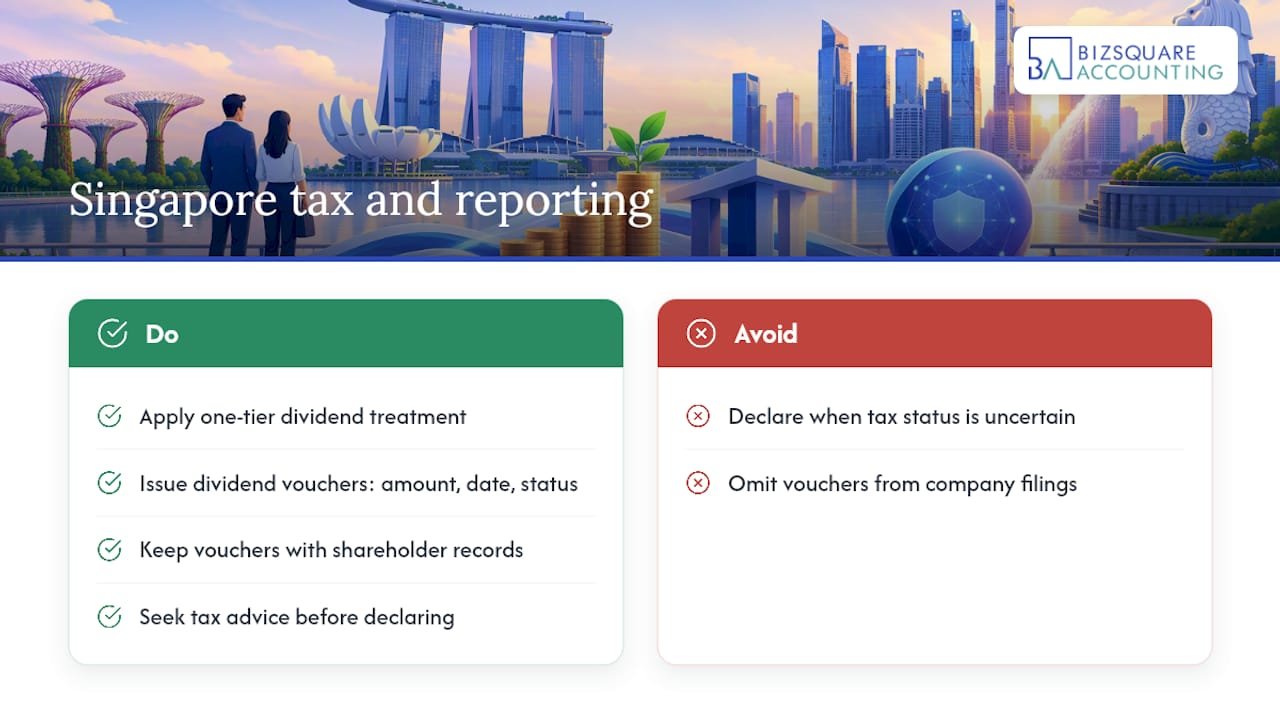
Singapore runs a one-tier corporate tax system, meaning tax is paid once, at the company level. Dividends paid by a Singapore resident company are generally not taxable again in the hands of the recipient, according to IRAS guidance updated on 27 February 2026. This exemption applies whether the shareholder is an individual or another company.
Even though the dividend itself is not separately taxed, companies still need to issue dividend vouchers showing the amount paid, the date, and the tax status of the dividend. These vouchers form part of the shareholder’s records and support the company’s own corporate tax filing. Directors who are uncertain whether a distribution qualifies for one-tier treatment, particularly where profits come from unusual sources, should seek tax advice before the dividend is declared rather than after.
Foreign-sourced dividends and withholding tax: FSIE conditions and non-resident payments
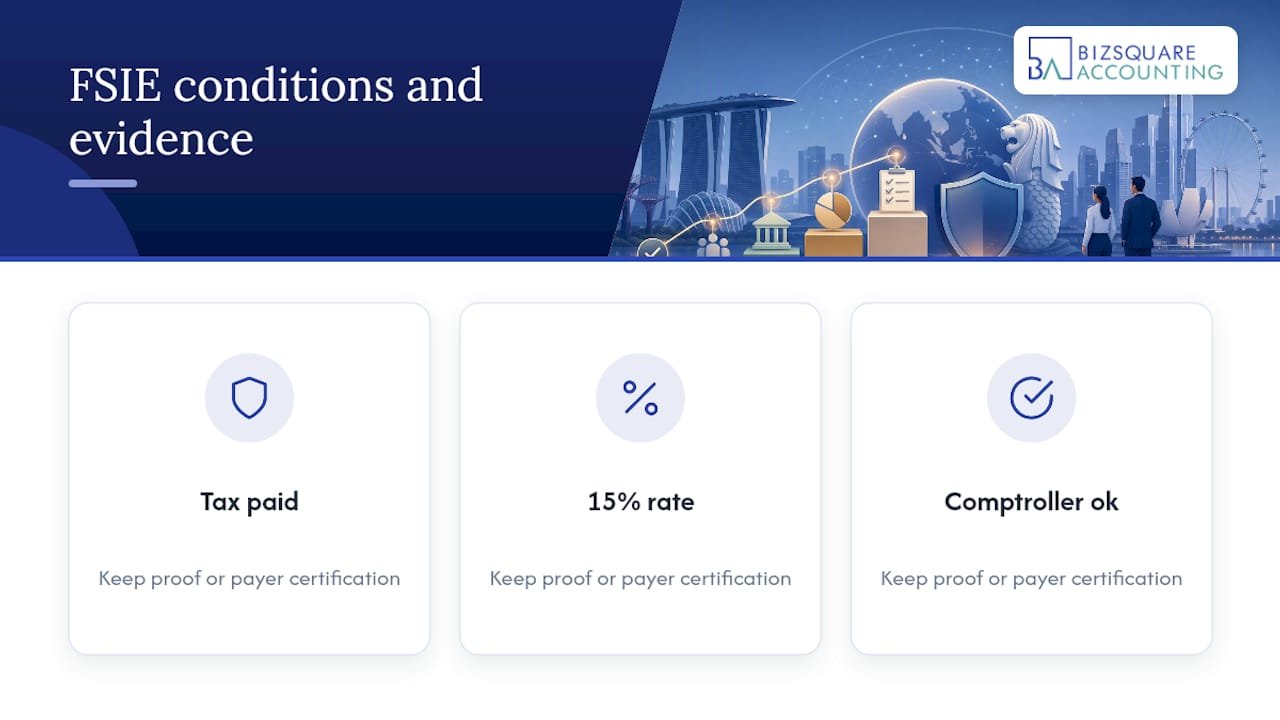
Dividends received from overseas subsidiaries follow separate rules. Under the Foreign-Sourced Income Exemption regime, foreign dividends may be exempt when the income was subject to tax overseas, the foreign headline tax rate was at least 15%, and the Comptroller is satisfied the exemption benefits the company. Companies relying on foreign dividends to fund a Singapore dividend should keep proof of tax paid abroad, or certification from the foreign payer, ready for IRAS review.
On the outbound side, IRAS confirms that dividend payments to non-resident shareholders are generally not subject to Singapore withholding tax, a point worth understanding alongside broader withholding tax obligations that can apply to other cross-border payments.
Practical compliance checklist: steps, documents and sample wording for resolutions and vouchers
Before any dividend is declared, gather the essentials. This keeps the process defensible if questioned later.
- Interim management accounts or the latest audited financial statements.
- Board minutes recording the directors’ opinion on profits and solvency.
- A signed dividend voucher stating amount, date, and tax treatment.
- The shareholder resolution, where a final dividend requires AGM approval.
- Bank payment instructions matching the approved amount and shareholders.
Run three checks against these documents before signing off: confirm the retained profits ledger actually supports the payout, confirm cash on hand covers the payment without straining operations, and confirm the constitution places no additional restriction on the distribution.
Pro Tip: Ask your adviser to prepare a full board pack, including interim accounts, a solvency memo and draft resolution wording, so directors can form a documented opinion at the same meeting.
Bizsquare’s perspective: where directors commonly need help and how advisers add value
Advisers typically start by verifying the distributable profits figure against the ledger before any resolution is drafted. This single step catches most problems early.
The most frequent gaps we see are missing interim accounts, dividends declared without checking the company’s own constitution, and vouchers issued without matching board minutes. A short compliance review, bringing recent management accounts and the constitution, usually resolves these within a single meeting and gives directors a clear, documented basis for the decision.
— Vandro
How Bizsquare can help with dividend compliance and next steps to get support
Getting dividend approvals right takes more than a template resolution. It takes accurate books, a properly minuted board decision, and a tax position that holds up under review.

Professional accounting and corporate secretarial services support directors through each stage of this process:
- Corporate Secretarial Services for board minutes, resolutions and AGM support.
- Accounting and Bookkeeping Services to keep retained profits and cash positions accurate.
- Corporate Tax Filing & Advisory for dividend tax treatment and FSIE claims.
Bring your latest management accounts and company constitution, and our team can turn around a compliance review quickly. Request a quote from Bizsquare to get your next dividend declaration on solid ground.
Sources
For the exact statutory wording, consult section 403 of the Companies Act directly. IRAS publishes detailed guidance on dividend taxation and the FSIE regime, and ACRA’s model constitution shows how dividend powers are typically drafted. For close or unusual cases, always check with your company’s auditor or corporate secretary before declaring a dividend.
This article is general information, not a substitute for advice from a qualified financial advisor. Consult a qualified financial professional about your own circumstances before acting on anything here.
- Companies Act 1967 – Singapore Statutes Online
- Dividends – Inland Revenue Authority of Singapore
- Corporate income tax, Ministry of Finance
- Dividend payments guide for Singapore business owners, SingaporeLegalAdvice
FAQ
What are the rules for dividend payments in Singapore?
Dividends can only be paid out of a company’s profits, never out of capital, under section 403 of the Companies Act. The board approves interim dividends based on interim accounts, while shareholders approve final dividends at the AGM.
Do I have to pay tax on dividends in Singapore?
Dividends paid by a Singapore resident company are generally exempt from further tax in the recipient’s hands under the one-tier system. Foreign-sourced dividends may also qualify for exemption if they meet the FSIE conditions.
What are the three conditions for a company to pay a dividend?
A company generally needs sufficient distributable profits, a board or shareholder resolution depending on dividend type, and a reasonable director opinion that the company remains solvent after payment. These conditions flow from section 403 and standard director duties, and each should be documented at the board meeting.
What is the difference between interim and final dividends?
Interim dividends are declared by the board using interim accounts and can be adjusted before payment. Final dividends require shareholder approval at the AGM and become a binding debt once declared.
Are dividends paid to non-resident shareholders taxed in Singapore?
Dividend payments to non-resident shareholders are generally not subject to Singapore withholding tax. Directors should still confirm the tax position of the recipient’s own jurisdiction, since Singapore rules do not determine tax treatment overseas.