
TL;DR:
- Most small service businesses and sole proprietors benefit from cash-basis accounting because it keeps records simple and reflects actual cash flow.
- However, it does not show receivables or payables, which can misrepresent true profitability and limit growth analysis.
Cash-basis accounting is the right choice for most sole proprietors, freelancers, and small service businesses. It records income when payment arrives and expenses when bills are paid, keeping bookkeeping simple and your cash position visible at all times.
Here is what you need to know before deciding:
- Best fit: Sole proprietors, freelancers, consultants, and small service firms with limited inventory.
- Main benefit: You see exactly how much cash you have, and you pay tax only on money you have actually received.
- Key limit: It does not show what customers owe you or what you owe suppliers, so it can misrepresent true profitability.
- Next step: Confirm IRS eligibility for your business size, then choose bookkeeping software that supports cash-basis reporting.
Table of Contents
- What is cash-basis accounting, and how does it differ from accrual?
- How does cash accounting record transactions in practice?
- Which businesses typically use cash accounting?
- What are the main advantages of cash-basis accounting?
- What are the disadvantages and risks of cash-basis accounting?
- Cash vs accrual: a side-by-side comparison
- How does cash accounting affect your business as it grows?
- When and how do you change your accounting method?
- Practical recordkeeping tips for cash-basis businesses
- Key Takeaways
- The case for starting simple and knowing when to stop
- Bizsquare helps you get your books right from the start
- Authoritative sources and next reading
- FAQ
What is cash-basis accounting, and how does it differ from accrual?
Cash-basis accounting records revenue only when cash enters your bank account and records expenses only when cash leaves it. There are no accounts receivable (AR) or accounts payable (AP) ledgers. The method maps directly to your bank statement, which makes it easy to verify.
A quick timing example: Suppose you complete a project on December 20 and send an invoice the same day. Your client pays on January 10. Under cash basis, you record that income in January, not December. Under accrual, you record it in December, when the work was earned.
Key characteristics of cash-basis accounting:
- Income recognized when payment is received, not when invoiced.
- Expenses recognized when paid, not when the bill arrives.
- No AR or AP accounts required.
- Bank statement serves as the primary record.
- Generally simpler to maintain than accrual books.
How does cash accounting record transactions in practice?
Recording transactions under cash basis follows a straightforward sequence. Each entry ties directly to a bank deposit or a payment cleared from your account.
Step-by-step for three common scenarios:
- Immediate sale (cash or card): A customer pays $500 at the point of service on March 3. Record $500 income on March 3. Done.
- Invoice paid later: You send a $2,000 invoice on April 1. The client pays on April 28. Record $2,000 income on April 28, not April 1.
- Supplier bill paid: You receive a $300 supply bill on May 5 and pay it on May 15. Record the $300 expense on May 15.
Daily and month-end bookkeeping checklist:
- Log every bank deposit as income on the date it clears.
- Log every payment as an expense on the date it leaves your account.
- Reconcile your books to your bank statement at month-end.
- Review any outstanding invoices and note that they are not yet income.
- Confirm no prepaid expenses were recorded before the payment date.
Pro Tip: Run your bank reconciliation before closing each month. If a deposit or payment appears in your bank statement but not in your books, that is a cash-basis entry you missed. Catching it monthly prevents a year-end scramble.
QuickBooks and similar tools tie cash-basis entries directly to bank feeds, which reduces manual entry errors and speeds up reconciliation.


Which businesses typically use cash accounting?
Cash basis suits sole proprietors, freelancers, and small service businesses with limited inventory and straightforward transactions. Common examples include:
- Independent consultants and coaches.
- Freelance writers, designers, and developers.
- Small retail shops with mostly cash or card sales.
- Tradespeople such as plumbers, electricians, and landscapers.
- Sole-proprietor medical or dental practices.
IRS eligibility and Schedule C: Most sole proprietors file Schedule C with their Form 1040 and may use cash basis by default. The IRS sets a gross receipts threshold for method eligibility. Businesses exceeding the IRS gross receipts threshold over the prior three tax years are generally required to use accrual accounting, per IRS Publication 538 and the rules under 26 U.S.C. § 448. Always verify the current threshold with IRS guidance, as the figure can be adjusted.
Inventory restriction: Businesses that maintain inventory as a material income-producing factor may be required to use accrual for inventory-related items, even if they use cash basis for other transactions. If inventory is a significant part of your revenue, consult a tax professional before choosing your method.
What are the main advantages of cash-basis accounting?
The benefits of cash accounting are most tangible for small businesses that operate without complex credit arrangements. Here are the four core advantages:
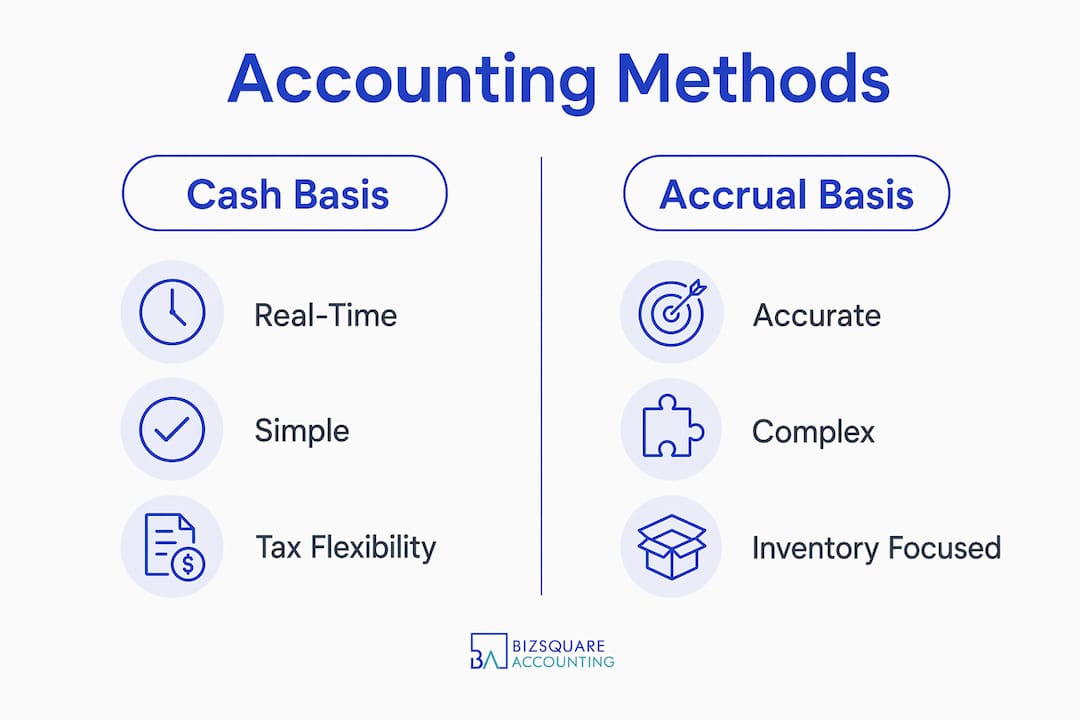
- Simplicity: There are no AR or AP accounts to maintain. Your books mirror your bank statement, so reconciliation takes minutes rather than hours.
- Real-time cash visibility: You always know exactly how much money is in your account. This clarity supports day-to-day cash flow management decisions without needing a separate cash-flow report.
- Tax-timing flexibility: You pay tax only on income you have actually received. If you invoice a client in late December and they pay in January, that income falls into the next tax year, potentially lowering your current-year tax bill. This flexibility is not available under accrual accounting.
- Lower bookkeeping cost: Fewer accounts and simpler entries mean less time spent on bookkeeping, and lower fees if you hire a bookkeeper.
A practical tax-timing example: A freelance designer invoices $8,000 on December 26. The client pays on January 4. Under cash basis, the $8,000 is January income. Under accrual, it is December income. That single timing difference can shift the designer into a lower tax bracket for the current year, depending on total annual income.
What are the disadvantages and risks of cash-basis accounting?
Cash basis has real limitations that can mislead owners about the health of their business. Understanding these risks helps you decide when the method stops serving you.
Core limitations:
- No visibility into outstanding receivables or unpaid bills.
- Does not reflect true profitability when large invoices are pending.
- Not GAAP-compliant, which can complicate bank loan applications and investor due diligence.
- Subscription or staged-contract businesses will find that cash basis distorts monthly recurring revenue and unit economics.
- Large year-end payments can create artificial income spikes that inflate tax liability.
Performance distortion example: A consulting firm completes $40,000 of work in Q4 but collects only $10,000 before December 31. The cash-basis books show a quiet quarter. The accrual books show $40,000 earned. An owner relying solely on cash-basis records might cut staff or delay investment based on a misleading picture.
Cash-basis accounting can make a business appear cash-rich when significant unpaid obligations exist. Relying solely on cash inflows and outflows may mask future payments due and unrecorded customer debts, creating a false sense of financial security.
Red-flag checklist, consider switching methods when:
- Receivables regularly exceed one month of revenue.
- You carry significant inventory.
- A lender or investor requests GAAP-compliant financial statements.
- Subscription or retainer revenue makes up a large share of income.
- Your business approaches the IRS gross receipts threshold.
Cash vs accrual: a side-by-side comparison
The table below compares both methods across the decision factors that matter most to small business owners.
| Decision Factor | Cash Basis | Accrual Basis |
|---|---|---|
| Income/expense timing | Recorded when cash changes hands | Recorded when earned or incurred |
| Bookkeeping complexity | Low, maps to bank statement | Higher, requires AR, AP, and adjusting entries |
| Cash-position visibility | Immediate and accurate | Requires separate cash-flow statement |
| Performance accuracy | Can lag or distort true profitability | Reflects economic reality more accurately |
| Suitability by business type | Sole proprietors, freelancers, low-inventory service firms | Credit-heavy, inventory-heavy, or investor-backed businesses |
| Tax-timing flexibility | High, income deferred until received | Low, income recognized when earned |
| Lender/investor acceptance | Limited, not GAAP-compliant | Preferred, meets GAAP and audit requirements |
Verdict: Cash basis is the practical default for small, low-inventory service businesses that prioritize simplicity and cash visibility. Accrual is the better fit for businesses that extend credit, carry inventory, or need to present audited financials to lenders or investors. For a deeper look at when accrual becomes the stronger choice, see why accrual accounting may suit growing businesses.
How does cash accounting affect your business as it grows?
Cash basis gives immediate clarity on cash position, but specialists note it lacks the forward-looking detail necessary for growth planning. As your business scales, certain tradeoffs become harder to ignore.
Key tradeoffs to watch:
- Cash visibility is strong, but you cannot see committed future revenue or upcoming obligations.
- Delayed receivables visibility can hide declining margins until cash actually stops arriving.
- Businesses with subscriptions or staged contracts will find cash basis distorts monthly recurring revenue.
- Rapid growth often means larger AR balances, which cash basis simply does not capture.
Trigger points to re-evaluate your method:
- Inventory becomes a material part of operations.
- You begin extending credit terms to customers regularly.
- A bank requests audited or GAAP-compliant statements for a loan.
- Investors ask for accrual-based financials.
- AR balances remain consistently high at month-end.
Timing a method change carefully minimizes tax disruption. Switching at the start of a new fiscal year is generally cleaner than mid-year. Before making any change, consult current IRS guidance on accounting methods and speak with a tax professional. The adjustment can affect taxable income in the transition year, and professional advice helps you plan for that impact.
When and how do you change your accounting method?
Switching from cash to accrual, or the reverse, requires a deliberate process. The IRS has specific rules, and skipping steps can create compliance problems.
- Evaluate the need: Confirm that your current method no longer fits your business size, structure, or reporting requirements.
- Choose the switch date: The start of a new tax year is the cleanest transition point.
- Restate or adjust prior periods: Work with a bookkeeper or accountant to identify items that need reclassification under the new method.
- File IRS Form 3115 if required: Most voluntary method changes require filing Form 3115, Application for Change in Accounting Method, with your tax return. This form also handles the one-time adjustment to taxable income that often results from the transition.
- Update your bookkeeping software: Reconfigure your chart of accounts to include AR, AP, and accrual-based entries if switching to accrual.
- Consult a tax professional: Switching methods can create a one-time accounting adjustment that affects your tax liability. A qualified CPA or tax advisor helps you plan for this and file correctly.
Schedule C filers: Sole proprietors filing Schedule C typically select their accounting method on the first return they file. Changing it later requires the Form 3115 process described above.
Practical recordkeeping tips for cash-basis businesses
Clean books under cash basis depend on discipline at the transaction level. These habits prevent year-end surprises and keep your records audit-ready.
Monthly bank reconciliation steps:
- Match every deposit in your books to a cleared bank deposit.
- Match every expense entry to a cleared bank payment.
- Flag any item in the bank statement not yet in your books and record it immediately.
- Confirm the closing balance in your books equals the bank statement balance.
Handling special items:
- Refundable deposits received: Do not record as income until the deposit is either applied to a sale or confirmed non-refundable.
- Prepaid expenses paid: Record the full amount as an expense on the date paid, unless the prepayment covers a future period that materially affects your tax position. In that case, consult a tax professional.
- End-of-year cutoffs: Confirm that December payments cleared before December 31 are recorded in the current year, and January clearances are recorded in the new year.
For a practical month-end checklist tailored to small businesses, the bookkeeping accuracy guide from Bizsquare covers the core steps in plain language.
Software features to look for: Choose accounting software that supports cash-basis reporting, connects directly to your bank feed, and can generate a cash-basis profit and loss statement. Tools like QuickBooks, Wave, and FreshBooks all offer cash-basis reporting modes. For additional practical guidance, the cash basis guide for sole traders from CWA Business Consulting provides a useful external perspective.
Key Takeaways
Cash-basis accounting is the right starting point for most small service businesses and sole proprietors, provided gross receipts stay below the IRS threshold and inventory is not a material factor.
| Point | Details |
|---|---|
| Best-fit business type | Sole proprietors, freelancers, and low-inventory service firms benefit most from cash basis. |
| Tax-timing advantage | Income deferred until received can lower current-year tax liability, a flexibility accrual does not offer. |
| Main limitation | No visibility into receivables or payables means cash basis can misrepresent true profitability. |
| IRS eligibility | Businesses exceeding the IRS gross receipts threshold are generally required to use accrual. |
| Bizsquare support | Bizsquare provides accounting and bookkeeping services to help small businesses set up and maintain cash-basis records correctly. |
The case for starting simple and knowing when to stop
The conventional wisdom in small-business accounting circles is that cash basis is a beginner’s method, something to outgrow as quickly as possible. That framing is misleading. For a freelance consultant billing $200,000 a year with no inventory and no credit sales, cash basis is not a compromise. It is the correct tool for the job.
The real risk is not using cash basis too long. The real risk is not recognizing the specific signals that tell you the method has stopped serving your business. Large, persistent AR balances, a bank asking for audited statements, or a subscription model with deferred revenue, these are the moments that call for a change, not an arbitrary revenue milestone.
Small business owners who stay on cash basis past those trigger points often do so because switching feels complicated. The process is manageable with the right guidance, and the cost of staying on the wrong method compounds quietly over time.
Bizsquare helps you get your books right from the start
Setting up your accounting method correctly from day one saves significant time and tax exposure later. Bizsquare provides professional accounting and bookkeeping services for small businesses and entrepreneurs who want clean, compliant records without managing the complexity themselves.
For businesses considering a method change, or those setting up books for the first time, Bizsquare’s team handles the technical steps, including chart-of-accounts setup, month-end reconciliation, and coordination with your tax advisor on IRS filing requirements. Bizsquare also offers corporate tax filing and advisory services for owners who need help navigating the tax consequences of switching methods.
Contact Bizsquare to discuss your bookkeeping setup and get your accounting method working for your business, not against it.
Authoritative sources and next reading
- IRS Publication 538: The primary IRS reference for accounting periods and methods, including cash and accrual rules for small businesses.
- IRS Form 3115 guidance: Official instructions for filing an application to change your accounting method, required for most voluntary switches.
- 26 U.S.C. § 448 via Cornell Law: The statutory basis for IRS restrictions on cash-method use, including the gross receipts threshold.
- AccountingTools, cash-basis accounting overview: Concise practitioner-level explanations of cash-basis rules, tax-timing strategies, and eligibility notes.
- Bizsquare bookkeeping services: Professional bookkeeping support for small businesses managing cash-basis records or planning a method change.
This article provides general information about accounting methods and is not a substitute for professional tax or legal advice. Consult a qualified CPA or tax advisor to confirm the rules that apply to your specific business situation.
FAQ
Why would a small business choose cash accounting?
Cash-basis accounting is simpler to maintain, provides a real-time view of cash on hand, and allows tax-timing flexibility because income is taxed only when received. It suits sole proprietors and small service firms with limited inventory and straightforward transactions.
When is cash accounting not the right choice?
Cash basis becomes problematic when a business carries significant inventory, extends credit regularly, or needs GAAP-compliant financials for a bank loan or investor. At those points, accrual accounting gives a more accurate picture of financial performance.
Should an LLC use cash or accrual accounting?
A single-member LLC taxed as a sole proprietor can generally use cash basis, provided it meets IRS gross receipts eligibility requirements. Multi-member LLCs and those taxed as corporations may face additional restrictions, so confirming eligibility with a tax professional is advisable.
Does switching accounting methods require IRS approval?
Most voluntary changes require filing IRS Form 3115, Application for Change in Accounting Method. The form also handles the one-time taxable income adjustment that often results from the transition.
Can cash-basis businesses use accounting software?
Yes. Tools such as QuickBooks, Wave, and FreshBooks all support cash-basis reporting modes. The key is to configure the software to record income and expenses on the date cash clears, not the invoice or bill date.