

Why Use Professional Accounting for Your Singapore Business
Overview
– Many Singapore business owners view accounting as a costly compliance task, neglecting its strategic value.
– Professional accounting provides crucial financial insights, regulatory compliance, and cash flow management, facilitating growth.
Most Singapore business owners treat accounting as a necessary cost, something to deal with during tax season and forget about the rest of the year. That mindset is expensive. The question of why use professional accounting goes well beyond basic compliance. Professional accounting, formally known as managed financial reporting and advisory services, delivers measurable benefits across compliance accuracy, cash flow visibility, strategic planning, and regulatory readiness. This article breaks down exactly what skilled accountants do for Singapore businesses, how local regulations like ACRA filings and GST InvoiceNow factor in, and what to look for when choosing a provider.
Table of Contents
- Key Takeaways
- Why use professional accounting: the core roles that matter
- Benefits of professional accounting beyond just compliance
- Singapore-specific regulations that require specialist expertise
- Outsourcing vs. in-house: what makes financial sense for Singapore SMEs
- How to select and work effectively with an accounting provider
- My perspective: accounting is an investment, not an overhead line
- How Bizsquare Accounting supports your financial health
- FAQ
Key Takeaways
| Point | Details |
|---|---|
| Beyond compliance value | Professional accountants deliver financial insight, cash flow management, and strategic planning support. |
| Singapore regulatory complexity | ACRA BizFinx v4.0 and GST InvoiceNow require specialist knowledge to avoid filing rejections and penalties. |
| Outsourcing beats in-house for SMEs | Outsourced accounting offers deeper expertise, flexible pricing, and multi-layer review without fixed overheads. |
| Clean bookkeeping is foundational | Accurate, timely bookkeeping speeds up year-end processes and improves the quality of financial reporting. |
| Choosing the right provider matters | Assess Singapore-specific compliance expertise, service scalability, and communication protocols before committing. |
Why use professional accounting: the core roles that matter
Many entrepreneurs picture an accountant as someone who records income and expenses, then files taxes once a year. That picture is incomplete. Professional accounting services cover a much wider operational scope, and the foundation starts with bookkeeping. Clean bookkeeping speeds up year-end account preparation and improves the accuracy of every report and advisory service that follows.
Here is what professional accountants actually handle for Singapore businesses on a regular basis:
- Transaction recording and reconciliation. Every financial transaction gets recorded accurately and matched against bank statements, so discrepancies surface early rather than at year-end.
- Organized, regulatory-compliant records. Records are structured to meet ACRA requirements, making statutory submission straightforward rather than a scramble.
- Financial statement preparation. Accountants prepare profit and loss statements, balance sheets, and cash flow statements that reflect the true financial position of the business.
- Statutory filing assistance. This includes ACRA annual return submissions, XBRL tagging, and BizFinx filing, which have specific format requirements that non-specialists frequently get wrong.
- Tax documentation and filing support. Corporate Income Tax returns, GST reporting, and reconciliation between invoicing systems and IRAS submissions all require careful document control.
- Payroll processing and invoice management. Accurate payroll calculations, CPF contributions, and supplier or customer invoice management reduce administrative errors and keep operations running without disruption.
You can also review concrete examples of accounting services specific to Singapore businesses to understand what each service entails in practice.
Pro Tip: Set a fixed monthly meeting with your accountant to review a brief financial summary. Consistent communication prevents minor discrepancies from compounding into serious problems.
Benefits of professional accounting beyond just compliance
Compliance keeps you legal. Good accounting helps you grow. The distinction matters. Timely, accurate financial insights reduce the risk of cash shortages and support better budgeting and forecasting decisions. These are not abstract benefits. They show up in day-to-day decisions about hiring, inventory, pricing, and capital allocation.
Consider a Singapore SME with monthly revenue of SGD 200,000. Without professional accounting, the owner may see cash in the bank and assume profitability. A professional accountant, however, tracks accounts receivable aging, upcoming supplier obligations, and deferred tax liabilities. That picture is entirely different from the bank balance alone. The accountant surfaces the real cash position, not just the apparent one.
The professional accounting advantages in this area include:
- Transparent profitability reporting. Monthly profit and loss statements reveal which products, services, or business units are generating margin and which are not.
- Cash flow forecasting. Accountants project cash needs weeks or months ahead, helping businesses plan for payroll, loan repayments, or new investments without surprises.
- Budgeting and growth planning. Accurate historical data makes forward projections credible and usable, rather than speculative.
- Financing readiness. Banks and investors require clean, well-structured financial statements. Professional accounting ensures the numbers are audit-ready and convincing.
- Stress reduction. Knowing your financial position accurately and consistently removes the anxiety of uncertainty that many business owners carry unnecessarily.
Pro Tip: Ask your accountant for a monthly one-page cash flow summary alongside the standard reports. A single clear snapshot makes financial decision-making significantly faster for busy founders.
The importance of professional bookkeeping becomes most visible when businesses seek funding. Lenders do not approve loans based on informal spreadsheets. They assess organized, credible financial records, and professional accountants produce exactly that.
Singapore-specific regulations that require specialist expertise
Singapore has some of the most specific and technically demanding financial reporting requirements in Southeast Asia. The value of certified accountants becomes most apparent when businesses face these local regulatory complexities.
ACRA BizFinx v4.0 and XBRL filing requirements
ACRA BizFinx v4.0 became mandatory from mid-April 2026. It aligns with updated Singapore Financial Reporting Standards (SFRS) and requires full re-validation of financial statements using the new taxonomy. This is not a minor administrative update. Incorrect XBRL tagging using outdated taxonomy structures results in server rejection or regulatory penalties.
Filing rejections due to taxonomy errors are common among companies that manage XBRL filings without specialist support. The re-validation process requires someone who understands both the accounting standards and the technical mapping rules within BizFinx. Most business owners do not have that combination of skills in-house.
The table below compares the risk exposure between companies using professional accounting and those managing filings internally:
| Area | Professional accounting support | DIY or ad hoc approach |
|---|---|---|
| XBRL taxonomy accuracy | Re-validated using current BizFinx v4.0 standards | High risk of outdated mapping errors |
| Filing rejection risk | Low, with pre-submission checks | High, especially after taxonomy updates |
| GST InvoiceNow integration | Managed by specialist with system connectivity | Requires in-house IT coordination |
| Penalty exposure | Minimized through early preparation | Elevated due to late detection of errors |
| Year-end turnaround speed | Fast, due to organized records throughout the year | Slow, due to reactive document gathering |
GST InvoiceNow and its compliance demands
GST InvoiceNow is Singapore’s phased rollout requiring GST-registered businesses to transmit invoice data directly to IRAS through the InvoiceNow network. The rollout runs from 2025 to 2031, with early adopters receiving government grants as an incentive.
Over 63,000 businesses are already onboard. The benefits include lower error rates, faster GST refunds, and reduced manual processing. However, getting there requires connecting invoicing systems to the InvoiceNow network, validating invoice mappings between ERP data and GST returns, and maintaining data quality for tax filings. Professional accounting services manage these technical requirements without placing the IT burden on the business owner.
Staying current with ACRA taxonomy updates is not optional for Singapore companies that want to avoid regulatory action. The combination of XBRL filing precision and InvoiceNow integration represents a significant compliance burden that benefits from dedicated specialist management. You can also review new ACRA rules in 2026 for additional context on how these changes affect company directors and secretaries.
Outsourcing vs. in-house: what makes financial sense for Singapore SMEs
The professional accounting services benefits become especially clear when comparing outsourcing against hiring a full-time accountant. For most Singapore SMEs and startups, outsourcing wins on every practical dimension.
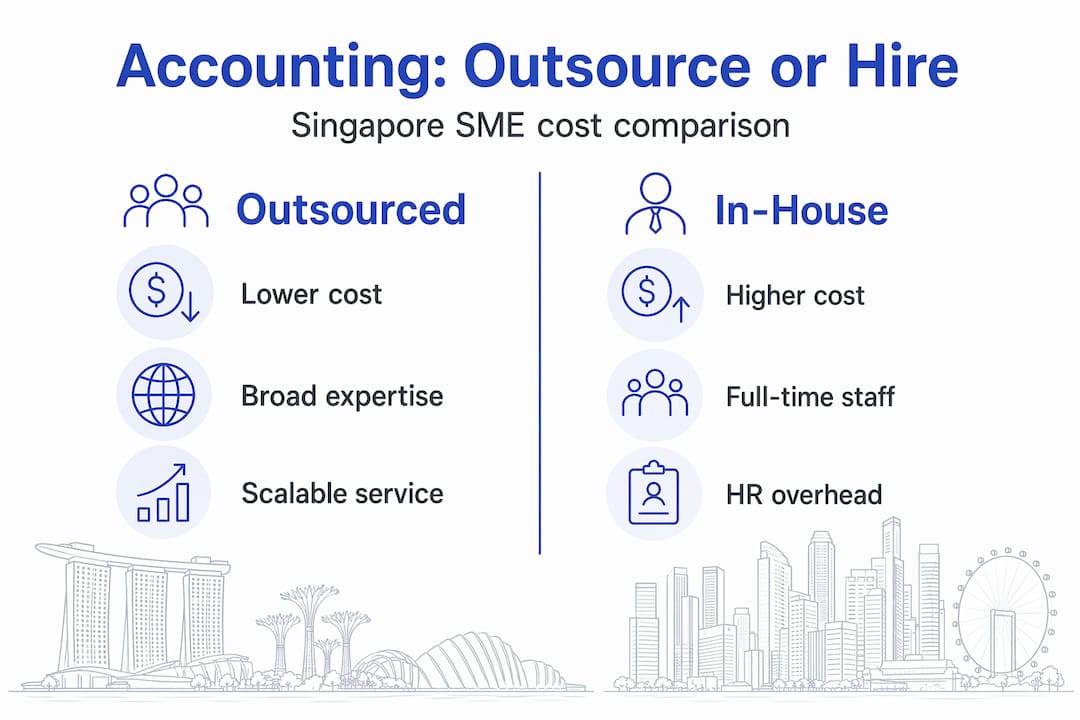
Hiring a full-time accountant carries hidden costs beyond salary. Employer CPF contributions, medical benefits, recruitment fees, and training costs typically add 30 to 40 percent on top of base salary in the first year alone. For a mid-level accountant earning SGD 4,500 per month, the real annual cost often exceeds SGD 75,000 before accounting for turnover risk or performance gaps.

Outsourced accounting firms provide access to a team with deeper and broader expertise than any single hire. They bring established processes, cloud accounting tools, and structured multi-layer review practices that reduce both errors and fraud risk. A sole in-house accountant has no second set of eyes on the work. An outsourced firm operates with built-in review structures.
Here is what outsourcing specifically offers Singapore business owners:
- No recruitment delays. Service begins quickly, without a hiring cycle that can take two to three months.
- Flexible, scalable pricing. Service plans adjust as the business grows, adds entities, or changes reporting frequency without renegotiating a salary.
- Access to cloud accounting platforms. Many outsourced firms provide access to tools like Xero or QuickBooks as part of the service, reducing software costs.
- Stronger internal controls. Multi-level review processes reduce the risk of undetected errors or financial irregularities.
- Executive time freed for operations. Removing day-to-day finance burdens allows founders and directors to focus on sales, product development, and customer relationships instead.
Pro Tip: Request a service scope document from any outsourced provider before signing. It should specify deliverables, turnaround times, and escalation procedures clearly. Vague agreements lead to service gaps when you need support most.
For businesses exploring this comparison further, the DIY vs. professional bookkeeping guide provides a detailed breakdown of where the cost and quality differences show up in practice.
How to select and work effectively with an accounting provider
Choosing the right provider is not just about price. The benefits of hiring accountants only materialize when the provider has the specific expertise your Singapore business needs. Here are practical steps to guide that decision.
- Verify Singapore-specific compliance knowledge. Confirm that the provider is familiar with ACRA filing requirements, XBRL and BizFinx v4.0 rules, IRAS corporate tax obligations, and GST InvoiceNow compliance. Ask direct questions about their experience with these requirements.
- Assess the full service scope. Some firms offer compliance-only services. Others add advisory services such as cash flow modeling, budgeting support, or outsourced CFO functions. Know what your business needs now and what it will need in 12 months.
- Understand the pricing model. Fixed monthly retainers are generally more predictable than hourly billing. Ask what triggers additional charges, such as year-end filings, audit support, or XBRL preparation.
- Set communication protocols upfront. Agree on reporting frequency, response times for queries, and who your primary contact is. Delayed responses to compliance questions cost businesses real money in missed deadlines.
- Use financial reports proactively. The reasons for using tax professionals and accounting specialists do not end at filing. Request that reports include commentary, not just numbers. A one-paragraph explanation of what changed in the month’s figures is worth more than a spreadsheet without context.
- Review the provider’s technology stack. Accounting providers using cloud platforms give you real-time access to your own financial data. That transparency matters when you need to make quick decisions.
You can also use this guide to choosing accounting services to evaluate providers against specific criteria relevant to Singapore businesses.
How Bizsquare Supports Your Financial Health
Bizsquare works with Singapore entrepreneurs, SMEs, and growing companies to deliver the full spectrum of professional accounting services benefits. From the moment of company formation through to ongoing compliance and strategic growth, the team brings specialist expertise in ACRA filings, XBRL and BizFinx v4.0 preparation, GST InvoiceNow readiness, and IRAS corporate tax advisory.
For business owners who want structured, scalable support, Bizsquare offers tailored accounting and bookkeeping services designed for Singapore’s regulatory environment. The firm’s outsourced CFO and corporate advisory services provide a higher level of financial strategy for companies planning to raise funds, expand, or restructure. For those starting out, Bizsquare also assists with company incorporation in Singapore, making compliance straightforward from day one. Speak with us today to find a service plan that matches your business stage and growth goals.
FAQ
1.) What does professional accounting actually cover?
Professional accounting covers transaction recording, financial statement preparation, tax filing, payroll, XBRL statutory submissions, and financial advisory. It goes well beyond basic bookkeeping to include compliance management and strategic financial reporting.
2.) Why hire an accountant instead of doing it yourself?
DIY accounting increases the risk of filing errors, missed deadlines, and non-compliance with Singapore regulations like ACRA BizFinx v4.0 and GST InvoiceNow. A professional accountant brings specialist knowledge that reduces penalties and improves financial accuracy.
3.) What is BizFinx v4.0 and why does it matter?
BizFinx v4.0 is ACRA’s updated financial statement filing tool, mandatory from mid-April 2026. It requires XBRL-tagged financial statements that match the latest SFRS taxonomy, and incorrect submissions result in rejection or regulatory penalties.
4.) How does GST InvoiceNow affect Singapore businesses?
GST InvoiceNow requires GST-registered businesses to transmit invoice data directly to IRAS through a connected network. Professional accountants manage the system integration and data validation needed to comply with this phased requirement, which runs through 2031.
5.) Is outsourced accounting more cost-effective than hiring in-house?
Yes, for most Singapore SMEs. Hiring a full-time accountant typically costs 30 to 40 percent more than the base salary when you include CPF, benefits, and recruitment fees. Outsourced accounting provides broader expertise at a predictable, scalable cost without fixed employment obligations.
6.) When should a business start using professional accounting services?
The right time is from company formation. Early engagement establishes clean financial records, proper compliance processes, and clear reporting structures that make growth significantly easier to manage. You can review signs your business needs professional accounting to assess your current situation.
7.) How do professional accountants help with cash flow management?
Professional accountants track accounts receivable aging, upcoming liabilities, and project future cash needs. They produce forward-looking cash flow forecasts that allow business owners to plan payroll, investments, and operational costs without relying on bank balance alone.
8.) Can professional accounting services help with bank loan applications?
Yes. Lenders require organized, credible financial statements before approving business loans. Professional accountants produce audit-ready reports that present the business’s financial position accurately and convincingly to financial institutions.
9.) What should I look for in a Singapore accounting provider?
Look for proven experience with ACRA and IRAS requirements, clear service scope documentation, transparent pricing, and familiarity with tools like BizFinx and GST InvoiceNow. Communication responsiveness and the ability to scale services as the business grows are equally important criteria.
10.) Does professional accounting help with IRAS tax compliance?
Yes. Professional accountants manage corporate tax filing, GST returns, and reconciliation between accounting records and tax submissions. Proper IRAS tax compliance reduces audit risk and keeps the business in good standing with Singapore’s tax authority.
11.) What is the difference between bookkeeping and professional accounting?
Bookkeeping covers the recording of daily financial transactions. Professional accounting builds on that foundation to include financial statement preparation, statutory filings, tax advisory, and business planning support. Clean bookkeeping is the starting point; professional accounting is the full structure built on top of it.