



The Role of Tax Advisory for Singapore Businesses
Overview
Most Singapore business owners view tax advisory as only seasonal compliance, missing its strategic year-round value. Properly structured advisory influences business decisions, mitigates risks, and delivers measurable financial benefits; technology now enables scalable, proactive guidance accessible to SMEs. Selecting the right advisor involves assessing expertise, communication, integration, and technology to foster a continuous, strategic partnership.
Most business owners in Singapore think of tax advisory as something that happens once a year, around filing season. That framing severely limits the value they extract from what is actually one of the most consequential financial relationships a company can have. The role of tax advisory extends well beyond submitting accurate returns to the Inland Revenue Authority of Singapore. When structured correctly, it functions as an ongoing strategic partnership that shapes business decisions, protects against regulatory risk, and creates measurable financial outcomes throughout the year. This article examines what that broader role looks like in practice, and why it matters now more than ever.
Table of Contents
- Key Takeaways
- The full scope of the role of tax advisory
- Why companies need tax advisory: benefits and business impact
- How tax advisory transforms financial planning and operations
- Engaging and maximizing tax advisory services
- Common pitfalls and misconceptions about tax advisory
- My perspective on tax advisory for Singapore businesses
- How Bizsquareaccounting can support your tax advisory needs
- FAQ
Key Takeaways
| Point | Details |
|---|---|
| Tax advisory is not just compliance | The role spans financial planning, risk management, cash flow optimization, and long-term business strategy. |
| Year-round engagement matters | 75% of firms report growing client demand for continuous advisory, not just seasonal filing support. |
| Advisory delivers measurable ROI | Firms transitioning to advisory services see up to a 50% revenue increase per client, reflecting the depth of value delivered. |
| Technology is reshaping delivery | AI tools now enable scalable, consistent tax advisory that was previously accessible only to large corporations. |
| Choosing the right advisor is strategic | Evaluating an advisor on expertise, communication cadence, and service scope will determine long-term business impact. |
The full scope of the role of tax advisory
Many business owners still confuse tax advisory with tax preparation. Tax preparation is transactional: a professional collects your financial records, applies the relevant rules, and files a return. Tax advisory is fundamentally different. It is the proactive, year-round practice of analyzing a company’s financial position and structuring decisions to minimize tax exposure, capture available incentives, and reduce regulatory risk before problems arise. Modern tax advisors move beyond historic reporting to actively shaping future financial outcomes.
The core functions of a qualified tax advisor include:
- Tax planning and structuring: Analyzing corporate structures, transactions, and operational decisions through the lens of tax efficiency before those decisions are finalized.
- Regulatory compliance oversight: Monitoring changes to Singapore’s tax laws and IRAS regulations to keep the company consistently compliant without last-minute scrambling.
- Risk identification and mitigation: Spotting exposures in areas like transfer pricing, withholding tax, and GST classification before they become audit triggers.
- Incentive and grant identification: Identifying eligibility for schemes such as the Start-Up Tax Exemption, Enterprise Development Grant, and other IRAS-sanctioned reliefs.
- Financial forecasting support: Incorporating tax outcomes into cash flow projections and capital planning so that the company’s financial model reflects real after-tax numbers.
The gap between traditional tax preparation and genuine advisory services is also a technology story. Digital disruption automates routine compliance tasks, which frees qualified advisors to focus on higher-value strategic work. This is not a distant future state. As of 2026, 93% of accounting and tax firms now offer advisory services, reflecting an industry-wide shift from compliance-first to consultative partnerships.
Pro Tip: When evaluating a tax advisory firm, ask specifically what percentage of their client engagement time is devoted to proactive planning versus reactive compliance. That ratio tells you more about their advisory model than any service brochure.
Why companies need tax advisory: benefits and business impact
The importance of tax advisory becomes clearest when examined through specific, concrete business outcomes rather than abstract principles. Consider a Singapore-incorporated manufacturing company preparing to restructure its operations by adding a regional holding entity. Without advisory input, the directors might structure that holding entity in a way that inadvertently creates a permanent establishment risk or triggers withholding tax obligations on intercompany payments. A qualified tax advisor identifies and resolves those issues before the structure is executed, not after the IRAS inquiry arrives.
The measurable benefits of tax consultancy for companies in Singapore include the following:
- Tax risk minimization. Proactive IRAS tax compliance management reduces the likelihood of penalties, interest charges, and reputational damage associated with non-compliance. Advisors track regulatory updates so clients do not face surprises when legislation changes.
- Identification of tax-saving opportunities. Singapore’s tax framework includes numerous incentives that many SMEs fail to claim because they are unaware of eligibility criteria. Advisors who know the business model can match the company to applicable schemes and document claims correctly.
- Cash flow optimization. Tax obligations that are poorly planned can create cash flow disruptions, particularly for businesses with seasonal revenue cycles. Advisors model estimated tax payments and timing strategies to keep cash available when operations need it.
- Informed capital allocation decisions. Whether a company is considering a new equipment purchase, a market expansion, or an acquisition, the after-tax cost and benefit of that decision differs significantly from the pre-tax view. Advisors quantify that difference and provide numbers that actually guide decision-making.
- Long-term relationship depth and strategic alignment. Transitioning to advisory services enhances client relationship depth, retention, and stable revenue. That dynamic works in both directions: businesses that maintain long-term advisory relationships receive guidance that is increasingly calibrated to their specific circumstances over time.
“Clients who engage in advisory services receive clearer insights to navigate risks and improve decisions,” reflecting findings from a 2026 industry analysis on advisory client outcomes. This is not incidental. It reflects the compounding effect of having a professional who understands your business embedded in your financial decision process.
For Singapore’s SME segment specifically, advisory services have been linked to significant revenue growth outcomes, underscoring that the return on investment for quality tax advisory extends well beyond the tax line itself.
How tax advisory transforms financial planning and operations
The distinction between reactive compliance and proactive advisory is not merely philosophical. It has direct operational consequences for how a business manages its finances across the full calendar year.
The reactive vs. proactive divide
In a reactive model, the tax professional enters the picture after the financial year ends, reviews what happened, and files accordingly. The company has no real-time visibility into its tax position, and any opportunities to structure transactions more efficiently have already passed. In a proactive model, the advisor is engaged when major decisions are being made, when contracts are being negotiated, and when the financial year is still open. That timing creates optionality that simply does not exist after the fact.
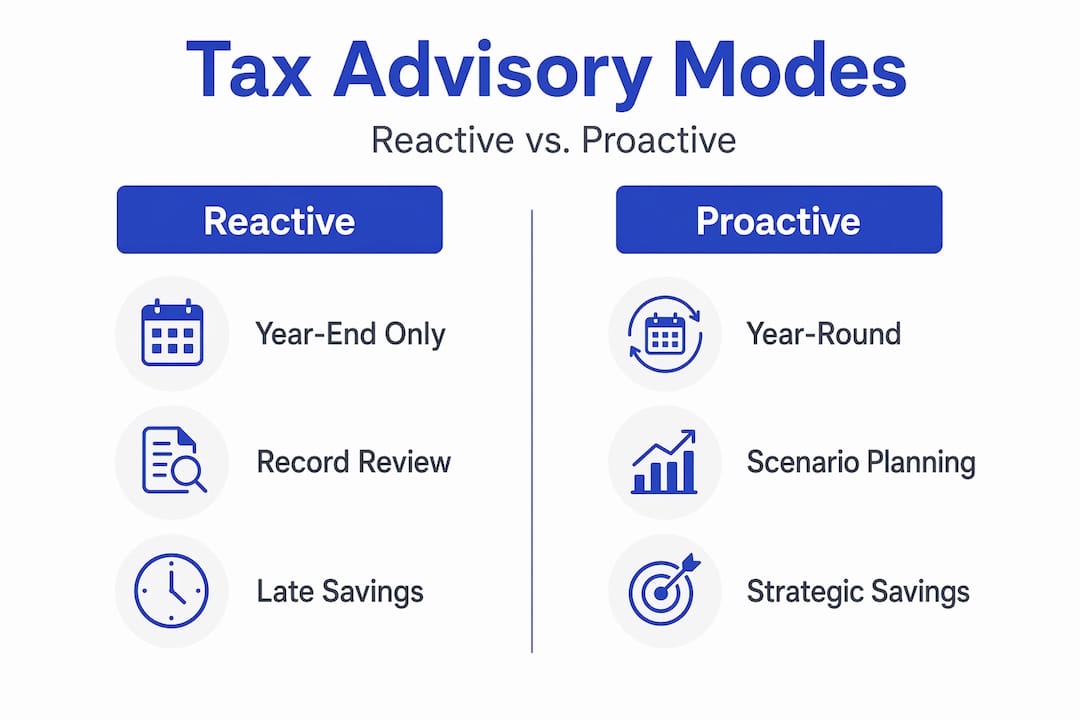
The table below illustrates the key operational differences between the two approaches:
| Dimension | Reactive compliance | Proactive tax advisory |
|---|---|---|
| Engagement timing | Post year-end | Year-round |
| Primary output | Completed tax return | Strategic guidance and planning |
| Risk management | Identified after exposure | Prevented before exposure |
| Incentive capture | Opportunistic | Systematic and documented |
| Cash flow planning | Not addressed | Integrated into forecasts |
| Business decision support | Minimal | Embedded in key decisions |
Technology and scalability in modern advisory
AI tools now democratize expert tax knowledge and automate advisory workflows, which means that the quality of advisory available to mid-sized Singapore companies has increased substantially. Advisors using AI-assisted platforms can model multiple tax scenarios quickly, flag regulatory changes in real time, and deliver consistent advice across a larger client base without sacrificing depth. For business owners, this translates to faster turnaround on planning questions and more data-backed recommendations.

Tax advisory also touches broader financial strategy in areas like business valuation and cash flow management that go well beyond the tax return. A company preparing for fundraising, for example, needs a clean financial picture that includes normalized tax positions and documented compliance history. An advisor who has been embedded in the business can produce that picture accurately and quickly.
Pro Tip: Ask your tax advisor to run a scenario analysis at the start of each financial year. Even a basic model comparing two or three structural or timing alternatives can reveal tax savings that significantly outweigh the advisory fee itself.
Engaging and maximizing tax advisory services
Understanding why companies need tax advisory is one part of the equation. Knowing how to select and engage those services effectively is equally important, and it is where many businesses leave substantial value on the table.
When evaluating tax advisory service offerings, business owners should assess the following:
- Breadth of expertise. Tax advisory for a Singapore company involves corporate income tax, GST, transfer pricing if the business has related-party transactions, and potentially withholding tax on cross-border payments. Confirm that the advisor has documented experience across all relevant areas, not just corporate income tax filing.
- Proactive communication cadence. A genuine advisor initiates contact when regulatory changes occur or when financial data suggests a planning opportunity. If the relationship is entirely reactive, it is effectively still a compliance arrangement.
- Integration with bookkeeping and accounting. Bookkeeping in Singapore provides the foundational financial data that tax planning depends on. Advisors who work closely with the company’s accounting function, or who provide both services, have significantly better visibility into the business and can act on information faster.
- Pricing model transparency. Advisory services can be priced on a retainer, by project, or on a value basis. Each model has implications for how freely the company can call on the advisor without worrying about escalating hourly charges. Understand the structure before engaging.
- Technology infrastructure. Firms using modern cloud-based accounting and tax platforms provide real-time collaboration, which accelerates the advisory process and reduces the back-and-forth of document collection.
Transitioning from a traditional tax preparer relationship to a trusted advisor relationship requires an adjustment on both sides. Business owners need to share financial and strategic information more openly and earlier. Advisors need to demonstrate that their input influences outcomes, not just documents. When both conditions are met, the relationship becomes one of the most durable professional engagements a company maintains.
Common pitfalls and misconceptions about tax advisory
The most pervasive misconception is that tax advisory is synonymous with filing the corporate income tax return. That misconception leads companies to engage advisors only when a deadline is approaching, which eliminates most of the strategic value the relationship could deliver. By the time a professional reviews a completed financial year, the tax position is largely fixed.
A closely related mistake is underestimating the cost of not having advisory. Companies that view advisory as an unnecessary expense rarely quantify what they are forgoing: unclaimed incentives, suboptimal transaction structures, missed planning windows, and the compounding effect of decisions made without tax visibility. Year-round engagement reduces financial volatility and enables timely strategy implementation, which has a direct dollar value.
Another common issue is ignoring the need for continuous engagement during periods of business change. Company restructures, new revenue streams, significant capital expenditure, and cross-border expansion all carry tax implications that need to be addressed contemporaneously, not retrospectively. Businesses that check in with their advisor only at year-end are consistently behind on these decisions.
Finally, many business owners underestimate the skills and technology mindset shift that effective advisory demands from both the firm and the client. Advisory services require a transformation in how both parties operate. Firms must move from data processors to strategic counselors, and business owners must be willing to invest in that relationship with time, information, and an appropriate budget. When that alignment is absent, the advisory relationship defaults to compliance, regardless of what the engagement letter says.
How Bizsquare can support your tax advisory needs

Bizsquare works with SMEs and growing companies across Singapore to deliver corporate tax filing and advisory services that go well beyond year-end compliance. The advisory approach at Bizsquare is built around year-round engagement, meaning clients receive guidance on structural decisions, incentive eligibility, and financial planning throughout the financial year, not only when a filing deadline approaches.
Beyond tax advisory, the firm offers a fully integrated suite of corporate services, including corporate secretary services, accounting and bookkeeping, company incorporation, and outsourced CFO support. This integration matters because tax planning depends on accurate, current financial data. When advisory and accounting functions operate within the same firm, the quality and speed of advisory input improves considerably.
Business owners seeking a thorough grounding in Singapore’s tax filing requirements can start with the corporate tax filing guide, which provides a structured walkthrough of the compliance process. For those ready to explore what a genuine advisory partnership looks like, Bizsquare offers consultations tailored to the company’s specific structure, growth stage, and financial priorities.
FAQ
What is the role of tax advisory for businesses?
The role of tax advisory encompasses proactive tax planning, regulatory compliance oversight, risk identification, incentive capture, and integration of tax considerations into broader financial decisions. It extends well beyond annual tax return preparation to serve as a year-round strategic function.
Why do companies need tax advisory services?
Companies need tax advisory to minimize tax risk, identify applicable incentives, optimize cash flow, and make capital allocation decisions based on accurate after-tax projections. Without advisory input, significant financial decisions are made without full visibility into their tax consequences.
How do tax advisors help with tax planning strategies?
Tax advisors help by analyzing the company’s structure and transactions before they are finalized, modeling alternative scenarios to identify the most tax-efficient outcomes, and ensuring that applicable exemptions and reliefs are documented and claimed correctly within IRAS guidelines.
What is the difference between tax advisory and tax filing?
Tax filing is the transactional process of preparing and submitting a tax return based on completed financial records. Tax advisory is the ongoing, strategic engagement that shapes decisions before and during the financial year to optimize the tax position that the filing ultimately reflects.
How should a business owner choose a tax advisor in Singapore?
When choosing a tax advisor, business owners should evaluate the advisor’s expertise across all relevant tax areas, their communication approach, their integration with accounting functions, their technology infrastructure, and their pricing transparency. A genuine advisory relationship involves regular, proactive contact rather than year-end-only engagement.


3 Comments
MES scheme Singapore: what finance teams need to know
August 27, 2026, at 6:16 pm[…] finance team is already stretched thin managing permits, GST returns and audit preparation, our tax advisory service can take that project off your plate entirely. We also handle the accounting and bookkeeping work […]
Directors' 14 Day Checklist for Striking Off a Company in Singapore
September 06, 2026, at 9:30 am[…] the same unresolved issue simply repeats the delay. Many directors find it worthwhile to consult a tax adviser or work through corporate tax filing requirements properly before submitting, rather than risk a […]
What Is Tax Planning for Singapore Business Owners
September 25, 2026, at 11:06 am[…] only at filing time, consistently identify more savings and face fewer surprises. Bizsquare’s tax advisory services are structured around this year-round […]