

Bookkeeping vs Accounting: A Guide for Singapore Businesses
Overview
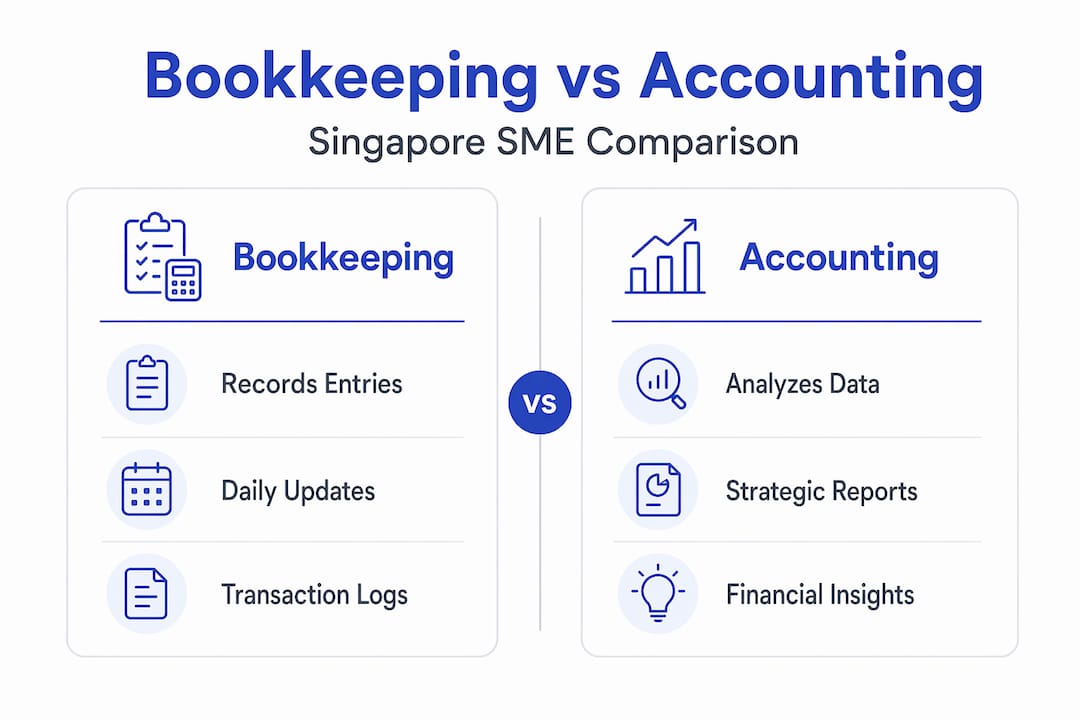
Bookkeeping involves daily transaction recording, forming the foundation for accurate financial data management. Accounting interprets this data, producing reports, tax filings, and strategic insights to support business growth. Understanding their distinct roles ensures regulatory compliance and informed decision-making for Singapore businesses.
Many Singapore business owners treat bookkeeping and accounting as interchangeable terms for the same back-office function. They are not. Understanding the difference between bookkeeping and accounting is one of the most practical steps a business owner can take toward stronger financial management, cleaner compliance, and smarter decision-making. One function captures the facts; the other interprets them. Conflating the two leads to missed tax filings, inaccurate financial statements, and costly reconstructions when IRAS or ACRA comes calling. This guide explains what each role involves, where they diverge, and how to apply both effectively in your Singapore business.
Table of Contents
- What is bookkeeping? The foundation of your financial records
- What is accounting? Turning data into strategic business insights
- Key differences between bookkeeping and accounting in Singapore
- How bookkeeping and accounting support regulatory compliance and business decisions
- Practical tips for Singapore business owners: choosing bookkeeping and accounting services
- Why understanding bookkeeping and accounting as distinct yet complementary roles transforms your business
- How Bizsquare can simplify bookkeeping and accounting for your Singapore business
- Frequently asked questions
Key Takeaways
| Point | Details |
|---|---|
| Bookkeeping records transactions | Bookkeeping is the foundational process of accurately recording all financial transactions as they happen. |
| Accounting analyzes data | Accounting involves interpreting bookkeeping data to prepare reports, ensure compliance, and support decisions. |
| Both roles complement each other | Bookkeeping provides the data accuracy accounting needs; both are essential for business success and compliance. |
| Compliance requires both | Singapore regulations like IRAS and ACRA require proper bookkeeping and accounting for financial reporting and tax filings. |
| Professional services enhance outcomes | Engaging experts in both bookkeeping and accounting helps avoid errors, save costs, and enable strategic growth. |
What is bookkeeping? The foundation of your financial records
Bookkeeping is where financial management begins. Before any analysis, forecasting, or tax filing can happen, every transaction your business makes must be captured accurately and on time. That is the work of bookkeeping.
Bookkeeping is the ongoing process of recording every financial transaction a company makes, including sales, expenses, payroll, and reconciliations, following Singapore Financial Reporting Standards (SFRS). In practice, this means a bookkeeper records every invoice issued, every supplier payment made, every payroll run processed, and every bank transaction matched to internal records.
The core bookkeeping tasks most Singapore businesses rely on include:
- Recording daily transactions: Sales receipts, purchase invoices, and expense claims are entered into the accounting system promptly.
- Categorizing transactions: Each entry is assigned to the correct account, whether revenue, cost of goods sold, or operating expenses, to keep the chart of accounts clean.
- Bank reconciliation: The bookkeeper matches the company’s internal records against bank statements, identifying discrepancies before they compound.
- Payroll recording: Salaries, CPF contributions, and statutory deductions are logged accurately each pay cycle.
- Accounts receivable and payable management: Outstanding invoices and bills are tracked so nothing slips through.
- Maintaining the general ledger: All entries feed into this master record, which becomes the source document for accounting work.
The importance of bookkeeping services is often underestimated until something goes wrong. A single month of unreconciled transactions can cascade into hours of correction work and, in the worst cases, incorrect tax submissions. Bookkeeping’s value lies in its consistency and discipline. Done well, it makes every downstream function faster, more accurate, and far less stressful.
Pro Tip: Set a fixed weekly schedule for bookkeeping updates rather than catching up monthly. Businesses that reconcile weekly spot errors when they are small and correctable, not when they have already distorted quarterly reports.
What is accounting? Turning data into strategic business insights
With bookkeeping producing a clean, accurate record of every transaction, accounting takes that data and puts it to work. The two functions are sequential: accounting cannot be done well without reliable bookkeeping underneath it.
Accounting builds on bookkeeping records to produce financial statements, manage tax filings, analyze performance, and advise on decision-making for Singapore companies. Where a bookkeeper asks “what happened?”, an accountant asks “what does it mean, and what should we do about it?”
The primary responsibilities within accounting practice include:
- Preparing financial statements: The profit and loss statement, balance sheet, and cash flow statement are compiled from bookkeeping records and presented in compliance with SFRS.
- Tax filing and advisory: Corporate income tax returns, GST returns, and estimated chargeable income submissions to IRAS are prepared and filed by the accountant.
- ACRA compliance: Annual return filings and financial statements submitted to the Accounting and Corporate Regulatory Authority rely on finalized accounts.
- Budgeting and forecasting: Accountants analyze historical financial data to project future revenues, costs, and cash flow, informing growth decisions.
- Audit preparation: For companies that do not qualify for audit exemption, accountants coordinate the documentation and process.
- Financial analysis and advisory: Ratio analysis, profitability reviews, and cost assessments give business owners a clear picture of performance.
Understanding the basics of accounting reveals why the discipline requires formal training and professional judgment. Decisions such as revenue recognition timing, depreciation methods, and tax deduction eligibility are not mechanical tasks. They require knowledge of applicable standards and regulatory requirements specific to Singapore.
The role of accounting services extends well beyond compliance. A qualified accountant advising a growing Singapore SME might identify that the business is eligible for a corporate tax rebate it has not claimed, or that its current cost structure is eroding margins in ways the profit and loss statement makes visible. That is the kind of insight bookkeeping alone cannot provide.
Pro Tip: Do not wait until year-end to engage your accountant. Quarterly accounting reviews allow for mid-year tax planning, which is far more effective than reviewing your position when the financial year has already closed.
Key differences between bookkeeping and accounting in Singapore
The bookkeeping vs. accounting distinction becomes clearest when you examine the two roles side by side. Here is a structured comparison relevant to Singapore business owners.
| Attribute | Bookkeeping | Accounting |
|---|---|---|
| Primary function | Recording and organizing transactions | Analyzing, interpreting, and reporting financial data |
| Frequency | Daily, weekly, monthly | Monthly, quarterly, annually |
| Output | General ledger, bank reconciliations, payroll records | Financial statements, tax returns, forecasts, management reports |
| Skills required | Attention to detail, familiarity with accounting software | Professional qualifications (e.g., ACCA, CPA), regulatory knowledge |
| Singapore compliance context | Follows SFRS for transaction categorization | Prepares filings for IRAS and ACRA, advises on regulatory obligations |
| Decision-making role | Provides raw data | Interprets data for strategic and tax decisions |
| Who typically does it | Bookkeeper, accounts executive, or outsourced provider | Chartered accountant or certified professional |
Bookkeeping is transactional and occurs daily or weekly, while accounting is analytical and happens quarterly or annually, with most businesses over S$250,000 in revenue needing both for IRAS and ACRA compliance.
Several additional distinctions are worth noting for Singapore businesses specifically:
- Regulatory responsibility: Bookkeepers ensure records comply with SFRS categorization. Accountants take responsibility for the final financial position submitted to regulatory authorities.
- Professional liability: Accountants bear professional and legal accountability for the financial statements they produce. Bookkeepers do not carry this obligation.
- Scope of advice: Bookkeeping is descriptive. Accounting is prescriptive. An accountant can advise on restructuring a salary-dividend mix to reduce personal and corporate tax exposure. A bookkeeper records what was paid.
- Cost profile: Bookkeeping is a recurring operational cost. Accounting fees are often tied to specific deliverables such as year-end accounts, tax filings, or advisory engagements.
Understanding whether your business needs one or both functions is addressed in detail in our guide on DIY vs. professional bookkeeping, as well as in this comparison of in-house and outsourced bookkeeping in Singapore.
How bookkeeping and accounting support regulatory compliance and business decisions
Regulatory compliance in Singapore is non-negotiable. The Companies Act, IRAS requirements, and ACRA filing obligations all demand accurate, timely financial records. Both bookkeeping and accounting play defined roles in meeting these requirements.
Here is how the two functions work together to keep your business compliant and well-positioned:
- SFRS-compliant transaction recording: Accurate bookkeeping ensures every transaction is categorized correctly under Singapore Financial Reporting Standards, forming the foundation for any external filing or audit.
- GST return preparation: For GST-registered businesses, quarterly GST returns depend entirely on the accuracy of bookkeeping records. Errors at the recording stage flow directly into incorrect returns filed with IRAS.
- ACRA annual filings: The financial statements submitted as part of the annual return to ACRA are prepared by accountants. Their accuracy depends on the quality of the underlying bookkeeping records.
- Audit exemption qualification: Most small companies in Singapore qualify for audit exemption if they meet size criteria, simplifying compliance based on solid bookkeeping under ACRA rules. Meeting those criteria consistently requires clean, current records maintained throughout the year.
- Corporate tax filing: IRAS requires all companies to file their estimated chargeable income within three months of the financial year-end and the full corporate tax return by November 30 each year. Both depend on finalized accounts produced from bookkeeping records.
- Budgeting and financial decisions: Management accounts produced by accountants from bookkeeping data enable business owners to assess whether expansion is viable, whether a product line is profitable, and whether cash flow supports planned expenditure.
Maintaining IRAS tax compliance is substantially easier when bookkeeping is current and organized. Businesses that fall behind often face emergency reconstruction exercises before filing deadlines, which increase the risk of error and the cost of professional fees.
Pro Tip: If your business qualifies for the simplified SFRS for Small Entities framework, ensure your bookkeeper is familiar with its reduced disclosure requirements. Using the full SFRS unnecessarily adds complexity without adding regulatory value for eligible small companies.
Practical tips for Singapore business owners: choosing bookkeeping and accounting services
Knowing the differences between bookkeeping and accounting in theory is useful. Applying that knowledge to how you structure your financial management is where it becomes valuable.
Consider the following when deciding how to approach bookkeeping and accounting for your Singapore business:
- Assess your transaction volume first. A business processing a handful of invoices per week has different needs from one managing hundreds of transactions across multiple revenue streams. Transaction volume is the most reliable indicator of how much bookkeeping resource you require.
- Match service level to regulatory obligations. GST-registered businesses, companies with employees, and those holding assets or operating across multiple entities face more complex compliance demands. These businesses benefit from professional bookkeeping rather than owner-managed spreadsheets.
- Do not separate bookkeeping and accounting artificially. Most businesses with revenue above S$250,000 benefit from having both bookkeeping and accounting to avoid duplicate work and maximize tax planning. Engaging both from the same provider or coordinating closely between providers reduces errors and removes the friction of data handover.
- Engage professional services before compliance deadlines, not after. Many Singapore SMEs bring in an accountant only when a filing is overdue. This reactive approach is more expensive and more stressful than maintaining an ongoing engagement that keeps records current.
- Consider outsourcing as a scalable solution. Professional bookkeeping services give growing businesses access to experienced practitioners without the fixed cost of a full-time hire. This model works well for businesses that need reliable compliance support but do not yet justify an in-house finance team.
- Start early for new businesses. Startup bookkeeping services establish the right chart of accounts, expense categories, and reporting practices from day one, avoiding the costly exercise of restructuring records once the business has grown.
Pro Tip: When evaluating service providers, ask specifically whether they handle both the bookkeeping and the accounting, or just one. Providers who manage both functions have a natural incentive to keep records clean throughout the year because their accounting team works directly from those same records.
Why understanding bookkeeping and accounting as distinct yet complementary roles transforms your business
There is a persistent tendency among business owners to treat financial management as a single task, one that either gets done or does not. This framing is the root of most financial compliance problems seen in Singapore SMEs. The confusion is understandable: both bookkeeping and accounting involve numbers, both require software, and both are often performed by people with similar job titles. But treating them as one function creates dangerous blind spots.
Bookkeeping forms the foundation ensuring accurate data, while accounting provides strategic insights like budgeting and compliance advising, helping business owners make informed growth decisions. The critical word here is “foundation.” A building does not become structurally sound because it has excellent architectural drawings. It becomes sound because those drawings rest on a properly built base. Bookkeeping is that base.
What experience across Singapore businesses reveals is that the companies with the cleanest financial management are not necessarily the largest or most sophisticated. They are the ones where the business owner genuinely understands what their bookkeeper does, what their accountant does, and why the two must communicate regularly. When these two functions operate in silos, you get reconciliation gaps, tax positions that do not reflect reality, and management accounts that tell a different story from the general ledger.
The payoff for getting this right is not just compliance. Banks and institutional lenders reviewing a Singapore company for financing will scrutinize financial statements, and the quality of underlying bookkeeping is visible in those statements. Clean, consistent records signal operational discipline. Reconstructed or inconsistent records signal risk. For businesses pursuing growth capital, trade credit, or government grants, the quality of your financial records is a direct input to whether you qualify.
Recognizing the essence of accounting as a distinct discipline, rather than a more expensive version of bookkeeping, is the shift that allows business owners to use their financial data proactively rather than reactively. Bookkeeping tells you what happened. Accounting tells you what to do next. Both are necessary. Neither is optional.
How Bizsquare can simplify bookkeeping and accounting for your Singapore business
Running a business in Singapore demands financial records that are accurate, compliant, and ready to support decisions at any point in the year. Getting there requires both functions working together under a clear and consistent process.
Bizsquare provides comprehensive bookkeeping services in Singapore and accounting under a single engagement, covering transaction recording, SFRS compliance, financial statement preparation, and full IRAS tax compliance services including GST returns and corporate tax filings. Our team works with startups, SMEs, and established companies to maintain clean records throughout the year, not just at filing time. For a deeper understanding of what corporate tax filing involves, our corporate tax filing guide walks through the full process step by step. Speak with our consultants to build a financial management structure that fits your business and keeps you ahead of every compliance obligation.
Frequently asked questions
What is the main difference between bookkeeping and accounting?
Bookkeeping involves recording every financial transaction daily, while accounting analyzes and interprets this data to prepare reports and advise on business decisions. As defined in accounting services guidance, bookkeeping captures the records and accounting builds on them to produce financial statements and strategic insights.
Do all businesses in Singapore need both bookkeeping and accounting?
Most businesses with annual revenue above S$250,000 benefit from both to meet IRAS and ACRA requirements and manage financial performance effectively. Revenue above S$250,000 is the general threshold at which having both functions in place delivers the greatest compliance and tax planning benefit.
Can I do bookkeeping myself and just hire an accountant?
While possible for very simple business structures, professional bookkeeping improves accuracy, reduces the risk of errors flowing into tax filings, and makes the accountant’s work faster and less expensive. Early-stage businesses may manage internally, but professional bookkeeping consistently delivers better compliance outcomes when paired with accounting.
How does good bookkeeping affect my tax filings in Singapore?
Accurate bookkeeping underpins all tax submissions, including GST, CPF, and corporate income tax, ensuring correct figures are filed with IRAS without emergency reconstructions. Without current bookkeeping, tax filing and GST returns become guesswork or costly last-minute exercises for Singapore businesses.
What bookkeeping standards do Singapore small businesses usually follow?
Eligible SMEs typically use the simplified Singapore Financial Reporting Standard for Small Entities (SFRS for SE) to reduce disclosure complexity while maintaining compliance. Most firms choose either full SFRS or the simplified SFRS for Small Entities, which reduces disclosure requirements for eligible small companies.