


Why Choose Singapore for Business: Strategic Benefits Explained
Overview
Singapore’s stable legal system, transparent regulations, and strategic regional location make it an attractive hub for internationally oriented businesses seeking credibility and access to ASEAN markets. Its high global competitiveness ranking reflects strong institutions, efficient governance, and favorable tax incentives, though operational costs and compliance demands can be significant. Businesses that leverage Singapore’s institutional strengths for long-term regional growth and investor confidence will derive the most sustained competitive advantage.
Singapore’s business reputation extends well beyond a single headline ranking or a government slogan. For entrepreneurs weighing their next strategic move, the city-state consistently surfaces as a premier destination, and for reasons that are both well-documented and frequently misunderstood. The business-friendly environment that Singapore has built over decades is grounded in deliberate policy, transparent governance, and a legal infrastructure that rewards compliance-minded operators. This article breaks down what Singapore genuinely offers, where the trade-offs lie, and how founders can apply these insights to make a decision that serves their actual growth strategy.
Table of Contents
- What sets Singapore apart: A business-ready environment
- How Singapore ranks globally and what it means for you
- Advantages and trade-offs: Costs, compliance, and credibility
- Making your choice: When Singapore is the right strategic fit
- Building lasting advantage: What most guides miss about choosing Singapore
- Accelerate your business setup in Singapore
- Frequently asked questions
Key Takeaways
| Point | Details |
|---|---|
| Singapore’s global edge | Singapore combines transparent governance with pro-business policies for a reliable launchpad. |
| Rankings are signals, not destiny | International rankings highlight Singapore, but strategic fit depends on your business model and region. |
| Consider costs and compliance | High credibility is matched by higher operating costs and stricter rules—plan accordingly before entering. |
| Use strengths for lasting advantage | Success comes from leveraging Singapore’s ongoing reputation and legal infrastructure—not just from company setup simplicity. |
What sets Singapore apart: A business-ready environment
With this context in mind, let’s pinpoint the pillars of Singapore’s attractiveness for new and growing businesses.
Singapore does not earn its reputation by accident. The government has spent decades building institutional structures that make it straightforward for businesses to set up, operate, and scale. The result is an operating environment where rules are clear, enforcement is consistent, and the relationship between business and government is largely cooperative rather than adversarial.
Several foundational pillars support this profile:
- Pro-business governance: Singapore’s legislative framework is designed to reduce friction for entrepreneurs. Laws covering corporate formation, employment, intellectual property, and commercial contracts are well-codified and regularly updated to remain internationally relevant.
- Transparent legal infrastructure: Courts are independent, contract enforcement is reliable, and dispute resolution mechanisms are accessible. This predictability is particularly valuable for foreign investors who need assurance that their interests are protected under a credible legal system.
- Streamlined regulatory compliance: Incorporation can be completed within one to two business days in most cases. Regulatory requirements are published clearly by agencies such as the Accounting and Corporate Regulatory Authority (ACRA) and the Inland Revenue Authority of Singapore (IRAS), which means businesses are rarely caught off guard by shifting rules.
- Government incentives and grants: Enterprise Singapore and the EDB administer a range of grants, tax incentives, and capability development programs specifically designed for startups and growing SMEs. These include schemes such as the Startup SG Equity initiative and various research and development tax deductions.
- Low corporate tax rates: Singapore’s headline corporate tax rate is capped at 17%, and qualifying new companies can benefit from significant tax exemptions in their first three years of operation. This makes the effective tax rate substantially lower for early-stage businesses.
The World Bank Business Ready economy profiling further substantiates this picture, placing Singapore among the top-tier jurisdictions globally on metrics such as regulatory quality, market openness, and financial services access.
For foreign entrepreneurs seeking business accounting benefits for foreign entrepreneurs, Singapore’s standardized accounting frameworks and ACRA reporting requirements also provide a clear operational structure. And for those evaluating the company incorporation advantages that Singapore offers specifically for foreign-owned entities, the private limited company structure remains the most commonly used vehicle, offering limited liability, credibility, and flexibility in ownership.
What sets Singapore apart from other so-called business-friendly environments is not simply the presence of favorable policies in isolation, but the consistency and institutional depth with which those policies are maintained. Many lower-cost jurisdictions offer competitive tax rates or simplified incorporation, but few pair these features with Singapore’s level of institutional trust, professional services ecosystem, and access to regional capital markets.
How Singapore ranks globally and what it means for you
Having defined Singapore’s foundational environment, it is important to look at how it stacks up internationally, and what leaders like IMD actually measure.
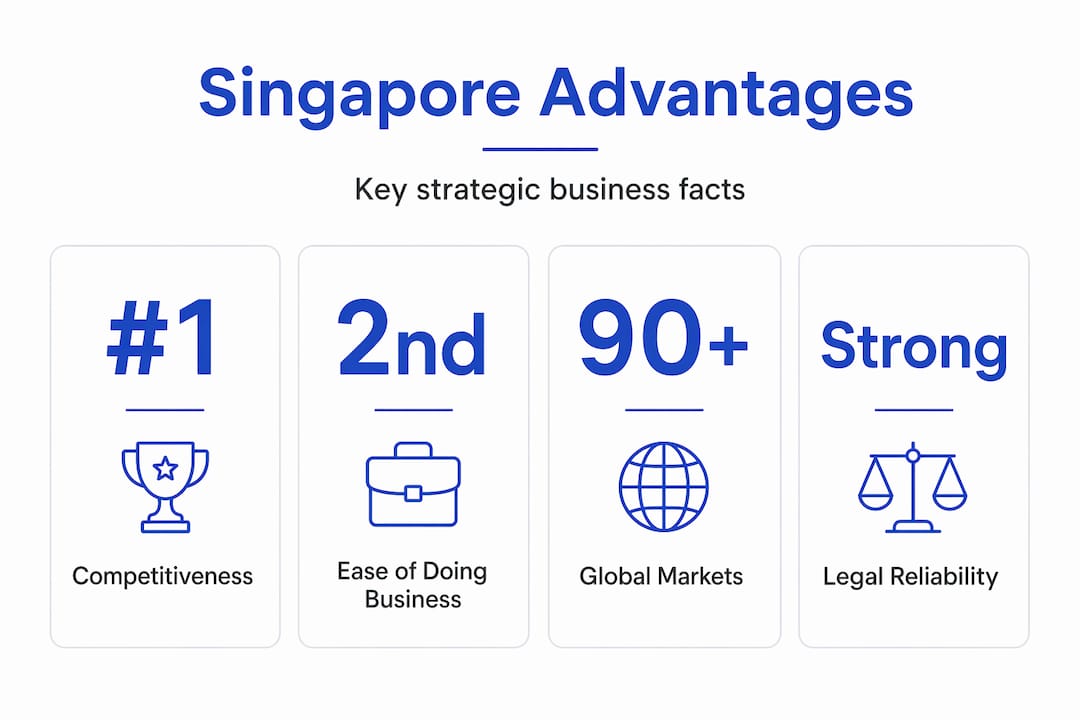
Singapore is widely assessed as highly competitive by the IMD World Competitiveness Ranking, consistently placing in the top three economies globally. This ranking evaluates over 300 criteria across economic performance, government efficiency, business efficiency, and infrastructure, which makes it one of the most credible and holistic assessments available to founders doing cross-country comparisons.
However, rankings require interpretation. A high competitiveness ranking signals that a jurisdiction excels across a broad basket of indicators, but it does not guarantee that every business model will thrive there equally. What a strong IMD or World Bank ranking does signal to founders is this: the rules of engagement are clear, institutions function as expected, and the system is set up to support legitimate commercial activity.
A comparison of key business hubs:
| Dimension | Singapore | Hong Kong | Dubai (UAE) | Ireland |
|---|---|---|---|---|
| Corporate tax rate | 17% (with startup exemptions) | 16.5% | 9% (federal) | 12.5% |
| Regional HQ appeal | Very high (ASEAN gateway) | High (China access) | High (MENA/Africa) | High (EU access) |
| Legal system reliability | Very high | High | Moderate to high | Very high |
| Ease of incorporation | Very fast (1 to 2 days) | Fast | Fast | Moderate |
| Operating cost | High | Very high | Moderate to high | High |
| Talent pool | Strong, multilingual | Strong | Growing | Strong |
| IP protection framework | Robust | Robust | Developing | Robust |
This table illustrates a nuanced reality. Singapore does not win on every single metric. Dubai offers a lower corporate tax rate at the federal level, and Ireland’s 12.5% rate attracts significant European holding company activity. However, Singapore’s combination of factors including legal predictability, talent access, ASEAN market positioning, and robust intellectual property protection creates a holistic advantage that is difficult to replicate with one or two low-cost metrics alone.
Statistic to note: Singapore ranked first in the IMD World Competitiveness Ranking in recent years, edging out longtime competitors across both government efficiency and business efficiency sub-indices.
Pro Tip: When using global rankings as part of your location decision, do not compare headline scores alone. Drill into the sub-indices most relevant to your sector. A logistics company will weight infrastructure differently than a fintech startup weighing financial regulation and data governance frameworks.
Understanding filing corporate tax obligations in Singapore is also part of interpreting what the rankings really mean in practice. A jurisdiction’s tax ranking only translates into real savings if your business structure is correctly set up to take advantage of applicable exemptions and incentive schemes.
Advantages and trade-offs: Costs, compliance, and credibility
Those high international rankings do not mean Singapore is perfect for every business. Here is what you need to weigh for your situation.
The advantages Singapore delivers are substantial and well-documented. But responsible strategic planning requires an honest assessment of both sides. Understanding the full picture helps founders avoid the mistake of choosing a jurisdiction based on prestige rather than operational fit.
Core advantages:
Reputation and credibility are among Singapore’s most tangible business assets. Incorporating in Singapore sends a clear signal to investors, clients, and partners about your governance standards. For businesses seeking Series A funding or targeting institutional clients in Asia, a Singapore-registered company often commands greater trust than counterparts in less regulated jurisdictions. This is not simply perception; it reflects the quality of the legal and regulatory infrastructure that backs up every registered entity.
Operational stability is another defining feature. Power infrastructure, telecommunications, logistics, and banking services in Singapore are consistently rated among the best in the world. Downtime, disruptions, and service failures are genuinely rare. For businesses that depend on reliable operations, this reliability translates directly into cost savings and client confidence.

Intellectual property protection is a critical consideration for technology, creative, and innovation-driven firms. Singapore’s IP framework is robust, and the government has made significant investments in making the city-state an IP hub for Southeast Asia, including establishing frameworks for IP valuation, licensing, and commercialization.
Access to capital and banking services is meaningful for growth-stage businesses. Singapore hosts a dense ecosystem of private equity firms, venture capital funds, family offices, and international banks, making it considerably easier to raise institutional capital than from a lower-cost but less financially developed hub.
Common compliance and administrative requirements include:
- Appointment of at least one resident director who is ordinarily resident in Singapore, a requirement that applies regardless of the nationality of the company’s ultimate owners.
- Annual filing of financial statements with ACRA, unless the company qualifies as a small company and is exempt from audit.
- Annual general meetings (or resolutions in lieu) as required under the Companies Act.
- Corporate tax returns filed with IRAS, along with estimated chargeable income (ECI) submissions within three months of the financial year end.
- Goods and Services Tax (GST) registration once the company’s taxable turnover exceeds SGD 1 million per annum.
- Maintenance of statutory registers, including registers of directors, shareholders, and charges.
- Adherence to transfer pricing documentation requirements for companies with related-party transactions.
“There are trade-offs: Singapore’s advantages can be accompanied by higher operating costs and compliance and administrative demands compared with some lower-cost jurisdictions.”
The table below summarizes key cost and compliance considerations:
| Factor | What to expect in Singapore |
|---|---|
| Office rental | Among the highest in Asia-Pacific |
| Professional services fees | Competitive but not inexpensive |
| Employment costs | Higher base salaries relative to regional peers |
| Compliance administration | Moderate volume; manageable with professional support |
| Banking setup | Generally accessible for compliant, well-structured entities |
| Tax administration | Clear framework; multiple filing deadlines to manage |
Good bookkeeping benefits in Singapore become evident quickly once you appreciate how compliance obligations stack up across the financial year. Maintaining clean, accurate records from day one is not just good practice; it is the foundation that makes every subsequent filing faster, more accurate, and less costly.
Similarly, corporate secretary compliance support is not optional for most companies. A qualified corporate secretary ensures that statutory deadlines are met, registers are properly maintained, and the company remains in good standing with ACRA at all times.
Pro Tip: Before finalizing Singapore as your base, model your total annual compliance cost, including corporate secretary fees, accounting, tax filing, and any audit requirements, against the revenue and credibility gains you realistically expect to achieve within the first 24 months. This exercise often reveals whether Singapore’s cost structure is justified at your current stage of growth.
For companies navigating IRAS tax compliance requirements, early engagement with a qualified tax advisor can identify applicable exemptions and incentives that materially reduce the effective tax burden, particularly for newly incorporated entities eligible for startup tax exemption schemes.
Making your choice: When Singapore is the right strategic fit
Now let’s synthesize these lessons into a practical decision toolkit for your business expansion or relocation.
Not every business is equally suited to Singapore’s operating environment. The city-state rewards companies that can leverage its institutional strengths, its credibility, its talent pool, its regional connectivity, and its legal stability. But for businesses that are primarily cost-driven, operationally simple, or geographically tethered to markets where Singapore’s brand carries less premium, the calculus may look different.
Key questions to ask when considering Singapore:
- Does your business model benefit from regional HQ positioning in Southeast Asia?
- Will your target clients, investors, or partners place meaningful weight on a Singapore incorporation?
- Can your revenue projections sustain Singapore’s operating cost base, including office space, professional services, and employment costs?
- Do you have access to, or can you appoint, a qualified resident director?
- Are you eligible for startup tax exemptions or specific sector-based incentive schemes?
- Does your business involve intellectual property, data, or technology where Singapore’s legal protections add tangible value?
- Is access to Singapore’s banking ecosystem and capital markets a material factor in your growth plan?
When Singapore is the clear strategic fit:
Singapore makes compelling sense for internationally oriented firms that need ASEAN market access, companies that will be raising institutional capital from Asia-based investors, professional services firms where reputation and governance standards directly influence client acquisition, and technology or IP-intensive businesses that benefit from Singapore’s robust protection frameworks.
When a lower-cost hub may be worth considering:
If the primary goal is to minimize operating costs and the business is not oriented toward institutional clients or regional expansion, a lower-cost Southeast Asian jurisdiction may offer a more practical entry point. Similarly, if the business’s geographic revenue is predominantly outside ASEAN, the Singapore premium may not generate a sufficient return.
However, an important nuance for founders is this: if your plan is to use Singapore mainly for credibility, governance, and regional HQ positioning, you should model the total compliance and operating cost load against alternative hubs and assess whether you can monetize the added credibility quickly enough to justify the investment.
Practical checklist for making the call:
- Run a 24-month financial model that includes all incorporation, compliance, operational, and staffing costs
- Map your top five target clients or investors and assess how much weight they place on Singapore’s jurisdiction
- Review sector-specific incentives available through the EDB or Enterprise Singapore
- Consult with a qualified incorporation advisor to understand your eligibility for tax exemptions
- Identify whether your business model requires physical presence in Singapore or whether a regional office structure would suffice
Pro Tip: Red flags that suggest reconsidering include: your primary revenue market has no meaningful connection to Singapore or ASEAN, your business model generates margins too thin to absorb Singapore’s compliance cost base, and you cannot commit to the ongoing governance requirements without professional support. These are not reasons to avoid Singapore permanently, but they are signals to time your entry strategically rather than prematurely.
Understanding accounting service roles in this decision-making process is also important. A qualified accounting partner does more than file numbers; they help you model the financial reality of your Singapore strategy before you commit resources.
Building lasting advantage: What most guides miss about choosing Singapore
Most standard guides to doing business in Singapore focus heavily on setup mechanics: how to incorporate, what the tax rate is, and how quickly you can get started. These are useful details, but they address the beginning of the journey, not the substance of it.
The harder and more consequential question is not whether you can set up in Singapore efficiently. Most founders can. The real question is whether your business is structured to actually leverage what Singapore offers after the incorporation documents are signed.
Many entrepreneurs choose Singapore primarily because of how it looks to external stakeholders, which is a legitimate consideration, but it is an incomplete strategy. The city-state’s most durable advantages are not cosmetic. They are institutional. Singapore’s legal predictability, its role as a regional arbitration center, its depth of professional services talent, its banking infrastructure, and its network of double taxation agreements with over 90 countries represent structural advantages that compound over time when actively leveraged.
The businesses that genuinely extract long-term value from a Singapore base are those that embed Singapore’s institutional credibility into their client relationships, use it to access financing on better terms, and deploy it as a platform for systematic regional expansion. A Singapore-incorporated entity is a statement about governance standards, and the businesses that understand this use it accordingly.
At the same time, the IMD World Competitiveness Ranking reinforces an important contrarian point: ranking and competitiveness signals are meaningful, but the optimal choice still depends on your market geography, cost structure, and eligibility for tax incentives rather than on rankings alone. Choosing Singapore because it scores well in global indices, without mapping those strengths to your specific business model, is a strategic shortcut that often leads to cost overruns and under-realized returns.
The founders who benefit most from Singapore are not those who chose it for bragging rights. They chose it because they could draw a direct line from Singapore’s institutional strengths to a specific competitive advantage in their target market. That is the discipline most guides fail to address. For companies ready to think at that level, the company incorporation for growth pathway in Singapore is genuinely worth pursuing with full conviction and proper planning.
Accelerate your business setup in Singapore
For founders and decision-makers primed to move ahead, streamlined setup and tailored advisory can make a meaningful difference in how quickly you achieve operational momentum and compliance confidence.
Bizsquare provides end-to-end support across the full lifecycle of your Singapore business journey. From navigating the company incorporation guide to managing your annual compliance calendar, our consultants bring both technical expertise and practical business judgment to every engagement. We help you structure your entity correctly from day one, manage your corporate secretary services obligations with precision, and ensure your corporate tax guide obligations are met on time and optimized for applicable incentives. Whether you are incorporating for the first time or expanding an existing group structure into Singapore, Bizsquare offers the expert partnership you need to turn Singapore’s advantages into tangible business outcomes.
Frequently asked questions
What are the main reasons to choose Singapore for business?
Singapore offers a pro-business government, globally recognized legal reliability, and a transparent tax system, making it attractive for startups, regional holding companies, and established firms seeking ASEAN market access. Its combination of institutional stability and efficient regulatory frameworks is rare among competing jurisdictions.
Does Singapore have any disadvantages for businesses?
Key drawbacks include higher operating costs and strict compliance requirements compared to some lower-cost jurisdictions, which can challenge early-stage businesses with limited operating budgets. Founders should model these costs carefully against projected revenue before committing to a Singapore incorporation.
Are business rankings enough to decide if Singapore is right for me?
Global rankings are a useful signal, but the optimal choice depends on your specific market geography, cost structure, and eligibility for tax incentives rather than on headline index positions alone. A thorough analysis of your business model against Singapore’s operating environment will always yield better decisions than rankings comparisons in isolation.
What types of businesses benefit most from Singapore’s environment?
Internationally focused firms, professional services providers, and companies prioritizing credibility and regional HQ positioning benefit most from Singapore’s institutional strengths, capital market access, and legal frameworks. Technology and IP-intensive businesses also derive significant value from Singapore’s robust intellectual property protection regime.