


TL;DR:
Many small Singaporean businesses worry about whether their records can pass IRAS audits due to strict GST compliance requirements. Building a reliable bookkeeping system with essential tools and consistent practices helps ensure accurate records and smoother audits. Regular reconciliation, clear documentation, and choosing between cash and accrual methods improve financial clarity and support ongoing compliance and growth.
Step-by-Step Bookkeeping for Singapore SMEs: A Practical Guide
Many small business owners in Singapore lose sleep over one question: are my records good enough to survive an IRAS audit? With GST compliance requirements tightening and penalties for poor documentation very real, the stakes are high. Yet bookkeeping does not have to be a source of anxiety. When you build the right system from the start, accurate records become a natural byproduct of running your business well. This guide walks through every essential step, from choosing your method to organizing GST documents, so you can stay compliant and make smarter financial decisions year-round.
Table of Contents
- What you need before you start bookkeeping
- Breakdown: Step-by-step bookkeeping workflow
- Choosing your bookkeeping method: Cash vs. accrual
- GST compliance: Essential documents and record-keeping tips
- Common mistakes and how to avoid them
- What most guides miss about bookkeeping in Singapore
- Get support for reliable bookkeeping and compliance
- Frequently asked questions
Key Takeaways
| Point | Details |
|---|---|
| Start with a strong setup | Having the right documents and tools is essential before you begin bookkeeping. |
| Follow routine workflows | Use a consistent, step-by-step process to capture, record, and reconcile transactions every month. |
| Choose the right method | Decide on cash or accrual bookkeeping early and stick with it for accuracy and compliance. |
| Prioritize GST compliance | Keep all required documents organized and up to date to avoid penalties and missed GST claims. |
| Avoid common errors | Schedule reconciliations and automate your records to prevent costly mistakes. |
What you need before you start bookkeeping
Before recording a single transaction, it pays to confirm you have the right foundation in place. Skipping this stage is one of the most common reasons Singapore SMEs find themselves scrambling at tax time, missing documents, or using inconsistent methods that complicate their filings.
Essential tools and documents
A reliable bookkeeping setup requires three core elements: accounting software (cloud-based options work well for most SMEs), a dedicated business bank account kept strictly separate from personal finances, and a consistent system for issuing and storing invoices and receipts. Without these three pillars, even the most disciplined record-keeping effort will develop gaps.
The documents you must maintain include:
- Tax invoices and receipts for all sales and purchases
- Credit notes issued or received for adjustments
- Contracts and rental or lease agreements relevant to business operations
- Payment evidence such as bank transfer confirmations, checks, or payment slips
- Import and export permits if your business deals in goods
- Bank statements for every business account
GST-registered businesses/basics-of-gst/invoicing-price-display-and-record-keeping/keeping-records) in Singapore must keep proper business and accounting records for at least 5 years to support GST declarations. This applies to both physical and digital records, so a hybrid storage approach, keeping scanned digital copies alongside organized physical files, is a practical safeguard.
Choosing your bookkeeping method
Two primary methods exist: cash-based and accrual-based bookkeeping. Cash-based bookkeeping records income when cash is received and expenses when cash is paid. Accrual-based bookkeeping records income when it is earned and expenses when they are incurred, regardless of when cash actually moves. The choice affects your financial statements, your GST reporting timing, and how clearly you can see your true financial position at any given moment.
| Feature | Cash-based | Accrual-based |
|---|---|---|
| When income is recorded | When cash is received | When invoice is issued |
| When expenses are recorded | When cash is paid | When expense is incurred |
| GST timing impact | Based on payment date | Based on invoice date |
| Best for | Micro-businesses, sole traders | Growing SMEs, companies with credit terms |
| Financial visibility | Simpler, less forward-looking | More accurate picture of obligations |
Use the accounting checklist to confirm you have every document category covered before you begin entering data.
Pro Tip: Start with simple digital tools and upgrade as your business grows. A basic cloud accounting platform with automatic bank feeds and receipt scanning eliminates the most common source of bookkeeping errors, manual data entry, without requiring a large upfront investment. Explore business automation steps to identify which repetitive tasks you can systematize early.
Breakdown: Step-by-step bookkeeping workflow
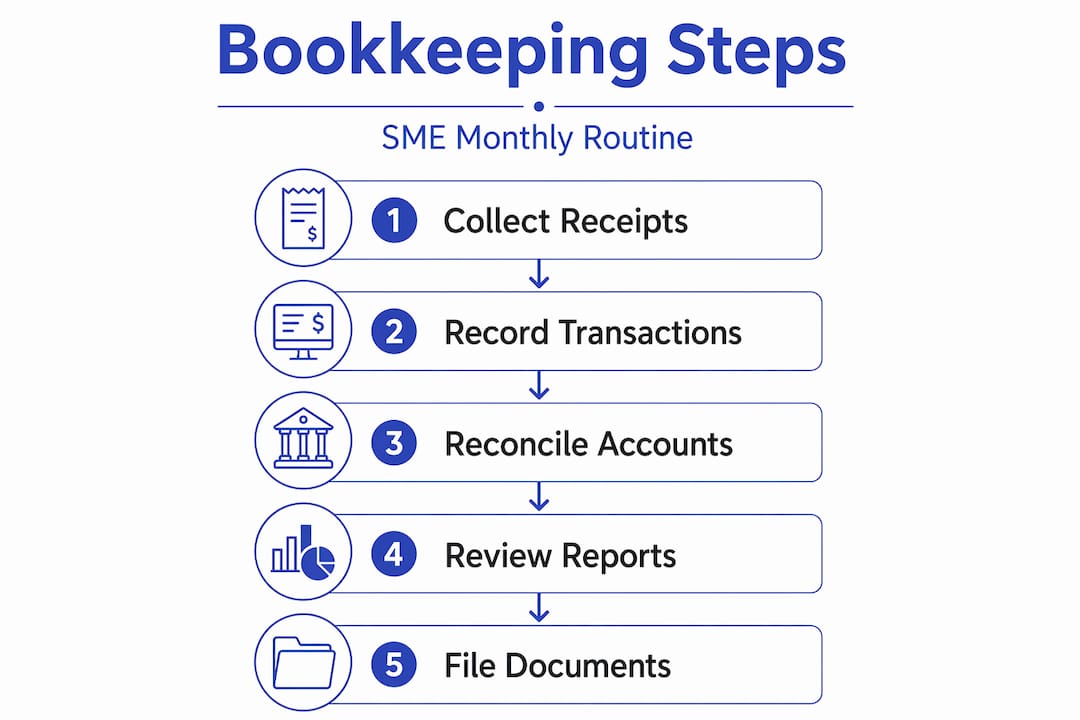
With your prerequisites checked off, here is the core bookkeeping routine you will repeat month after month. Consistency is what separates businesses that breeze through audits from those that scramble to reconstruct records under pressure.

The core workflow
A practical bookkeeping workflow follows three repeating stages: set up a chart of accounts, record transactions consistently using double-entry methods, and reconcile accounts monthly against bank statements. Here is how each step works in practice.
- Set up a chart of accounts. A chart of accounts is a structured list of every financial category your business uses, revenue streams, expense types, assets, liabilities, and equity. Tailor it to your specific business structure. A retail business needs inventory and cost-of-goods-sold accounts. A service business needs categories for professional fees and project-related expenses. A well-designed chart of accounts makes every subsequent step faster and cleaner.
- Record all transactions consistently. Every sale, purchase, expense, and payment must be entered promptly. The gold standard is double-entry bookkeeping, where every transaction affects at least two accounts, one debit and one credit, keeping your books balanced. For example, when a client pays an invoice, you debit your cash account and credit your accounts receivable account. This method catches errors naturally because your books will not balance if a transaction is entered incorrectly.
- Reconcile accounts monthly. Reconciliation means comparing your accounting records against your actual bank statements to confirm they match. Any discrepancy, whether a missing transaction, a duplicate entry, or a bank fee not yet recorded, gets identified and corrected. Monthly reconciliation prevents small errors from compounding into major discrepancies that are painful to untangle later.
- Generate and review financial reports. At the end of each month, produce a profit and loss statement and a balance sheet. These two reports tell you whether your business is profitable, how much cash you hold, and what you owe. They also form the basis for your GST returns and annual tax filings.
- Prepare for GST filing. If your business is GST-registered, extract your output tax (GST collected on sales) and input tax (GST paid on purchases) figures from your records each quarter. Ensure every figure is supported by a valid tax invoice or receipt before submitting.
Manual vs. software-driven bookkeeping
| Factor | Manual bookkeeping | Software-driven bookkeeping |
|---|---|---|
| Setup cost | Low | Low to moderate |
| Time per month | High | Low to moderate |
| Error risk | Higher | Lower (automation reduces data entry) |
| Audit readiness | Depends on discipline | Consistently structured |
| GST report generation | Manual calculation | Automated |
| Scalability | Limited | High |
The decision between DIY vs. professional bookkeeping often comes down to transaction volume and the owner’s available time. For early-stage businesses, software-driven DIY bookkeeping is a reasonable starting point. As transaction volume grows, the case for startup bookkeeping benefits from a professional service becomes compelling.
Pro Tip: Schedule a fixed bookkeeping day each week or fortnight. Treating it like a non-negotiable appointment, rather than a task you fit in when convenient, prevents the backlog that causes most compliance problems. Pair this habit with invoicing strategies that keep your receivables current and your records clean.
Choosing your bookkeeping method: Cash vs. accrual
Having mapped the standard workflow, the next essential decision is which bookkeeping method matches your business needs. This choice is not merely administrative. It shapes how you report GST, how clearly you understand your financial obligations, and how useful your records are for decision-making.
Cash-based bookkeeping
Cash-based bookkeeping is straightforward. Income appears in your books when a customer pays you. Expenses appear when you pay a supplier. This method suits micro-businesses and sole traders with simple transaction patterns, low credit exposure, and minimal outstanding invoices. The main limitation is visibility. Your books may show a healthy cash balance while significant unpaid invoices and upcoming obligations remain invisible.
Key features of cash-based bookkeeping:
- Simple to maintain with minimal accounting knowledge
- GST is reported based on when payment is received or made
- Less useful for businesses with long payment cycles or significant credit terms
- Can create misleading snapshots of financial health during growth phases
Accrual-based bookkeeping
Accrual-based bookkeeping records income when it is earned, even if payment has not yet arrived, and records expenses when they are incurred, even if the bill has not yet been paid. This method gives a far more accurate picture of your business’s true financial position and is generally required as businesses grow and take on more complex financial structures.
Key features of accrual-based bookkeeping:
- Better reflects actual profitability and financial obligations
- GST is typically reported based on invoice date rather than payment date
- Required for companies that need audited financial statements
- More complex to maintain but more informative for strategic decisions
Cash-based vs. accrual-based bookkeeping affects when you record transactions, and you should understand the implication on the timing of invoices and bills before committing to either method. Switching methods mid-year creates complications because your comparative figures will not align, making trend analysis unreliable and potentially triggering questions from IRAS.
The bookkeeping service benefits of engaging a professional become especially clear at this decision point. An experienced advisor can assess your business structure, transaction volume, and GST registration status to recommend the method that best serves your compliance and financial reporting needs.
Pro Tip: Consistency in method is the most important factor. Whichever approach you choose, apply it uniformly across every reporting period. If your business circumstances change significantly, consult a professional before switching methods to understand the accounting and tax implications.
GST compliance: Essential documents and record-keeping tips
The bookkeeping method you choose drives not just what you track but also what you must keep on file for GST compliance. Singapore’s IRAS has specific, non-negotiable requirements for GST-registered businesses, and meeting them requires a deliberate document management system.
Required GST records
GST record-keeping/basics-of-gst/invoicing-price-display-and-record-keeping/keeping-records) depends on what invoices and receipts you issue and how you document each sales and purchase transaction, including serially numbered tax invoices and receipts, credit notes, rental agreements, and evidence of payment. The complete list of records to maintain includes:
- Tax invoices issued for all taxable supplies above SGD 1,000 (simplified tax invoices for amounts below this threshold)
- Receipts for all business purchases
- Credit notes and debit notes for any adjustments to previously issued invoices
- Import and export documentation for goods-based businesses
- Rental and lease agreements for premises or equipment
- Bank statements and payment confirmations as evidence that transactions occurred
- Contracts for services rendered or received
Warning: Incomplete or missing GST documentation puts your input tax claims at serious risk. IRAS can disallow claims where supporting documents are absent, and repeated documentation failures can trigger penalties and formal audits. Do not treat record-keeping as optional.
Best practices for organizing records
Organize your records by tax period, separating sales records from purchase records within each period. Number every document serially and maintain a log that cross-references document numbers with transaction entries in your accounting software. For digital records, use a cloud storage system with automatic backups and access controls. For physical records, use clearly labeled folders stored in a secure, accessible location.
Review your records monthly to catch missing documents before they become a compliance issue. Conduct a more thorough annual review before your GST return deadline to confirm that every claim is fully supported. Engage your outsourcing bookkeeping guide to understand how a professional service can manage this documentation burden on your behalf.
Common mistakes and how to avoid them
As you fine-tune your bookkeeping process, here are the most frequent missteps and how Singapore SMEs can sidestep them.
- Missed account reconciliations. Skipping monthly reconciliation allows errors to accumulate. Set a recurring calendar reminder for the same date each month and treat it as a firm deadline, not a suggestion.
- Lost invoices and receipts. Physical receipts fade, get misplaced, or are never filed. Automate digital backups by photographing receipts immediately using your accounting software’s mobile app. Many platforms allow you to attach receipt images directly to transaction entries.
- Inconsistent transaction recording. Entering transactions in batches weeks after they occur increases the risk of errors and omissions. Record transactions as they happen, or at minimum, on a fixed daily or weekly schedule.
- Inadequate GST documentation. Maintaining consistent, auditable documentation, including serial numbering, invoices and receipts, credit notes, and payment evidence, is crucial because insufficient documentation can lead to input tax claim disallowance and penalties.
- Mixing personal and business finances. Using a personal bank account for business transactions creates reconciliation nightmares and raises questions during audits. Maintain a dedicated business account from day one.
- Failing to track GST on imports. Businesses importing goods into Singapore may be subject to import GST. Failing to account for this correctly leads to both compliance gaps and missed input tax recovery opportunities.
The decision between in-house vs. outsourced bookkeeping often hinges on how many of these mistakes a business has already experienced. Outsourcing to a specialist removes the human error risk and ensures that compliance standards are met consistently.
Pro Tip: Cross-check all records against IRAS requirements on a quarterly basis, not just at year-end. A quarterly review catches documentation gaps while they are still easy to remedy, rather than discovering them under deadline pressure.
What most guides miss about bookkeeping in Singapore
Most bookkeeping guides stop at compliance. Follow these steps, keep these records, file on time. That framing is accurate but incomplete, and it leads many business owners to treat bookkeeping as a regulatory burden rather than a strategic asset.
Here is the harder truth: the businesses that thrive in Singapore’s competitive SME environment are almost always the ones with clean, current financial records. Not because IRAS demands it, but because those records give owners the visibility to make faster, better decisions. When your books are current, you can see a cash flow problem forming weeks before it becomes a crisis. You can identify which products or services are actually profitable. You can negotiate with confidence because you know your numbers.
Singapore’s GST framework, with its quarterly filing cycle and strict documentation requirements, actually creates a structural advantage for disciplined businesses. Every quarter, a GST-registered business that maintains proper records has a complete, reviewed snapshot of its financial activity. That is four built-in financial checkpoints per year that most businesses in other jurisdictions do not have.
The owners who recognize signs your business needs professional accounting early, before problems compound, consistently report less tax-season stress, cleaner audits, and better access to financing. Lenders and investors look at financial records before making decisions. Clean books are not just a compliance requirement. They are a credibility signal.
Automation and periodic professional review are not luxuries reserved for large companies. Even the smallest SME benefits from a cloud accounting platform that reconciles automatically and flags anomalies. The cost of these tools is almost always less than the cost of reconstructing records manually or managing an IRAS inquiry.
Get support for reliable bookkeeping and compliance
Managing bookkeeping yourself is achievable with the right tools and discipline, but there comes a point where expert support pays for itself many times over, especially when GST compliance, financial reporting, and tax filing are all in play.
Bizsquare Accounting provides end-to-end outsourced bookkeeping services for Singapore SMEs, covering transaction recording, GST reporting, account reconciliation, and financial statement preparation. Whether you are still weighing the DIY or hire a bookkeeper decision or already know you need professional support, our consultants can assess your current setup and recommend the most efficient path forward. Reach out to Bizsquare Accounting to learn how we can simplify your compliance obligations and strengthen your financial foundation.
Frequently asked questions
How long do I need to keep my business and accounting records in Singapore?
GST-registered businesses/basics-of-gst/invoicing-price-display-and-record-keeping/keeping-records) in Singapore must keep proper business and accounting records for at least 5 years to support GST declarations. This applies to both digital and physical records.
What is the simplest way to start bookkeeping for my small business?
A practical starting workflow is to set up a chart of accounts, record transactions consistently using double-entry methods, and reconcile your accounts monthly against bank statements. Cloud accounting software makes all three steps significantly faster.
Which bookkeeping method should I use: cash or accrual?
Cash-based vs. accrual-based bookkeeping affects when you record transactions, so choose based on your business complexity and GST reporting preferences, but apply your chosen method consistently across all periods.
What happens if my GST records are incomplete or missing?
Insufficient GST documentation can result in input tax claim disallowance and IRAS penalties, making thorough record-keeping essential for every GST-registered business in Singapore.
How can I automate or simplify bookkeeping in Singapore?
Use cloud accounting software that integrates with Singapore’s GST framework, supports automatic bank feeds, and provides automated receipt capture to reduce manual data entry and minimize compliance errors.