


A flawlessly registered business is the only foundation strong enough to support a multi-million dollar expansion into the Asian markets. If you’re feeling overwhelmed by the intricacies of singapore company incorporation, specifically the ACRA BizFile+ system or the strict nominee director requirements for foreign owners, your concerns are completely valid. Many founders worry about missing a single compliance deadline and facing penalties that could stall their momentum. At Bizsquare Accounting, we don’t just crunch numbers; we act as the guardian of your business health while you focus on your vision.
This guide empowers you to master every legal requirement and registration step for 2026. You’ll gain a clear understanding of your annual filing obligations and the strategic compliance needed to launch and scale your business successfully. We’ll walk you through the transition from a newly formed entity to a legally compliant operation ready for regional growth, ensuring you have the structural integrity to thrive in Singapore’s competitive ecosystem.
The Comprehensive Guide to Singapore Company Incorporation in 2026
Key Takeaways
- Navigate the 2026 regulatory landscape with a clear understanding of why the Private Limited structure remains the premium choice for SMEs under the latest Singapore Companies Act.
- Simplify your singapore company incorporation by following a precise roadmap for ACRA registration, including strategic SSIC code selection and name reservation via BizFile+.
- Secure your business health as a foreign founder by mastering the essential requirements for resident Nominee Directors and the 2026 criteria for Employment Pass success.
- Strengthen your corporate foundation by adopting a proactive compliance mindset, ensuring timely Annual General Meetings (AGMs) serve as a springboard for future scaling.
- Discover how to leverage your Singapore entity as a strategic gateway to confidently expand your regional footprint into Malaysia, Indonesia, and Vietnam.
Understanding the 2026 Singapore Company Incorporation Landscape
Establishing a business in Singapore requires more than just administrative filing; it’s about building a robust foundation for future scaling. In 2026, the Private Limited (Pte Ltd) company remains the gold standard for SMEs and startups. This structure treats the business as a separate legal entity, distinct from its shareholders. Whether you’re a local entrepreneur launching a boutique agency or an international investor entering the Asian market, singapore company incorporation provides the structural integrity needed to protect your personal assets while pursuing aggressive growth.
The regulatory environment is governed by the Singapore Companies Act, which saw significant digital-first updates in early 2026 to enhance corporate transparency. This regulatory oversight is managed by the Accounting and Corporate Regulatory Authority (ACRA), the national regulator that ensures every one of the city-state’s 500,000+ business entities operates within a framework of high-standard compliance. At Bizsquare Accounting, we don’t just crunch numbers; we act as a strategic partner to ensure your entry into this hub is seamless and secure.
Key Benefits of Incorporating in Singapore
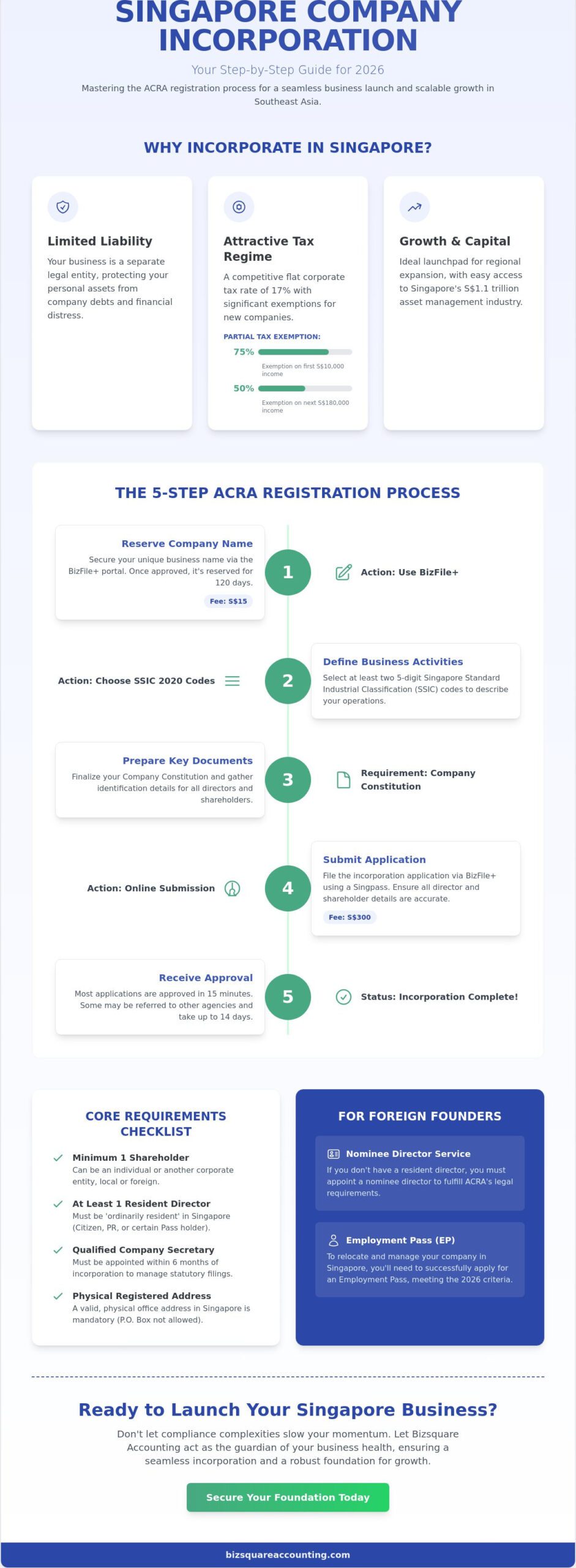
Singapore’s reputation as a premium business destination isn’t accidental. Shareholders enjoy limited liability, meaning their personal wealth is protected if the company faces financial distress. From a fiscal perspective, the tax environment is highly attractive. The headline corporate tax rate is a flat 17%, but the Partial Tax Exemption (PTE) scheme provides significant relief, offering a 75% exemption on the first S$10,000 of normal chargeable income and a 50% exemption on the next S$180,000. This efficiency, combined with the ease of raising capital through Singapore’s S$1.1 trillion asset management industry, makes it an ideal launchpad for regional expansion.
Eligibility and Basic Requirements for 2026
To maintain its status as a trusted global hub, ACRA enforces specific entry requirements for singapore company incorporation. Every company must have at least one shareholder, which can be an individual or another corporate entity. Crucially, you must appoint at least one director who is “ordinarily resident” in Singapore, meaning they hold a Singapore Citizen, Permanent Resident, or specific EntrePass/Employment Pass status. Within six months of your successful incorporation, you’re also mandated to appoint a qualified Company Secretary to manage statutory filings. This ensures your business health is monitored by professionals who understand the nuances of local law, allowing you to focus on scaling your operations confidently.
Step-by-Step Guide to the ACRA Registration Process
Building a resilient business starts with a robust legal foundation. The process of singapore company incorporation is governed by the Accounting and Corporate Regulatory Authority (ACRA). While the system is highly efficient, it demands precision to avoid administrative delays. Whether you’re launching a disruptive fintech startup or an established SME expanding into Southeast Asia, following the correct sequence ensures your venture stands on solid ground from day one. We don’t just crunch numbers; we help you architect a compliant structure that’s ready to scale.
The journey begins with selecting a unique company name. You must reserve this via the BizFile+ portal for a fee of S$15. Once approved, the name is held for 120 days. During this window, you’ll need to identify at least two Singapore Standard Industrial Classification (SSIC) codes. These five-digit codes, based on the SSIC 2020 version, define your primary business activities and dictate your future regulatory obligations. You’ll also finalize your Company Constitution, which functions as the internal rulebook for governance and shareholder rights.
Navigating the BizFile+ Portal
The actual submission happens through BizFile+, ACRA’s electronic filing system. You’ll need a Singpass to log in and verify the identities of all proposed directors and shareholders. Every director must be at least 18 years old and shouldn’t have a history of disqualification. During the application, you’ll input your registered office address, which must be a physical location in Singapore rather than a P.O. Box. After you pay the S$300 registration fee, most applications are approved within 15 minutes, though some may take up to 14 days if they require manual review by specific government agencies.
Documentation and Post-Registration Essentials
Once ACRA approves the filing, you’ll receive a Unique Entity Number (UEN) and a digital Business Profile. This profile is your company’s official birth certificate. Your next priority is to issue share certificates to all founders and investors to formalize ownership. You’re also legally required to set up Statutory Registers for members, directors, and secretaries within the first 30 days. To ensure these legal milestones are handled with professional care, many founders choose to engage expert company secretarial services to manage ongoing compliance while they focus on revenue.
The final step in establishing your operational health is opening a corporate bank account. Local institutions like DBS, OCBC, and UOB offer specialized packages for new entities, while international banks cater to those with global footprints. With your UEN and Business Profile in hand, you can confidently sign contracts, hire your first employees, and begin your growth journey in the region’s most stable business ecosystem. We believe that compliance isn’t a hurdle, it’s a springboard for your future success.
Special Considerations for Foreign Entrepreneurs and Investors
Establishing a presence in Asia often starts with a singapore company incorporation. While the process is streamlined, non-resident founders must navigate specific regulatory layers that don’t apply to local citizens. Whether you’re launching a fintech startup or scaling an established consultancy, understanding these requirements ensures your business starts on a secure foundation. Singapore’s regulatory environment is designed to be welcoming, yet it demands a high level of transparency and structural integrity.
Foreigners cannot self-register a company through the Accounting and Corporate Regulatory Authority (ACRA). You must engage a registered filing agent to act on your behalf. This agent performs essential Anti-Money Laundering (AML) and Know Your Customer (KYC) checks. These are mandatory under Singapore law to maintain the integrity of the financial system. We don’t just crunch numbers; we ensure your entry into the market meets every legal benchmark from day one, protecting your business health and reputation.
The Role of the Nominee Director
The Companies Act requires every private limited company to have at least one director who is ordinarily resident in Singapore. For founders living abroad, a Nominee Director fills this gap. This role isn’t merely a formality. The nominee bears the same legal responsibilities and risks as any other director, including potential personal liability for statutory breaches or tax obligations.
- Professional Security: Using a professional corporate service provider for this role is significantly safer than asking an acquaintance. It ensures the individual is well-versed in compliance and acts as a trusted guardian of your corporate standing.
- Transitioning: Once your work pass is approved and you relocate, you can confidently replace the nominee with yourself as the resident director.
- Risk Mitigation: Professional firms use clear indemnity agreements to protect both the founder and the nominee, ensuring a transparent relationship.
Work Pass Requirements for Founders
By 2026, securing your stay in Singapore involves navigating the COMPASS (Complementarity Assessment Framework). This points-based system for Employment Pass (EP) applications evaluates your fixed monthly salary, qualifications, and how your firm contributes to local diversity. High-earning founders may also qualify for the Overseas Networks & Expertise (ONE) Pass, which requires a fixed monthly salary of at least S$30,000 or demonstrated high-level achievements in specific sectors.
The EntrePass remains a viable route for entrepreneurs with venture-backed startups or proprietary technology. Successfully managing your singapore company incorporation and maintaining a healthy compliance record are critical factors if you eventually apply for Singapore Permanent Resident (PR) status. A clean track record shows the government that your business is a stable, long-term contributor to the national economy. Speak with us today to align your incorporation strategy with your long-term residency goals.
Post-Incorporation: Building a Robust Compliance Foundation
Completing your singapore company incorporation is a significant milestone, but the real work of protecting your investment begins immediately after. We view compliance as the “health” of your organization. It’s a springboard for scaling, not a weight holding you back. A clean regulatory record signals to banks and investors that your business is a stable, premium entity worthy of partnership. Whether you’re a lean startup or a scaling SME, maintaining this structural integrity is what allows you to move fast without the fear of legal friction.
Singapore law requires every company to hold an Annual General Meeting (AGM) to ensure transparency among stakeholders. For private companies, you must hold this meeting within six months of your financial year-end. Within 30 days of the AGM, you’re required to file Annual Returns with ACRA. Missing these windows leads to immediate consequences; ACRA imposes composition fines that typically start at S$300 per late filing and can escalate quickly for multiple defaults.
Tax obligations with the Inland Revenue Authority of Singapore (IRAS) follow a strict calendar. You must file your Estimated Chargeable Income (ECI) within three months of your financial year-end. This is followed by the filing of Form C or C-S by 30 November each year. Additionally, you must monitor your revenue for GST registration. If your taxable turnover exceeds S$1 million at the end of any calendar year, registration is mandatory. Once registered, you’ll manage quarterly GST filings to stay in good standing with the authorities.
Essential Corporate Secretarial Services
A corporate secretary acts as the guardian of your statutory records. They maintain the Register of Registrable Controllers and the Register of Nominee Directors to ensure you stay ahead of anti-money laundering regulations. When your business undergoes significant changes, such as a change in share capital or director appointments, they manage the necessary board resolutions. Their expertise is also vital in proving your “Singapore Tax Resident” status, which requires demonstrating that the control and management of the business actually happen within Singapore’s borders.
Accounting and Tax Compliance
We don’t just crunch numbers; we build financial frameworks. Adopting Singapore Financial Reporting Standards (SFRS) from day one ensures your bookkeeping is ready for any audit or investment due diligence. Accurate records simplify the preparation of your ECI and the eventual filing of financial statements in XBRL format. ACRA uses this digital format to enhance transparency across the business ecosystem. Proper accounting ensures you never overpay on taxes while maximizing the various tax exemptions available to new Singapore companies.
Don’t let administrative hurdles slow your momentum. Speak with our expert team today to secure your company’s compliance foundation.
Strategic Growth: Moving from Registration to Regional Scaling
Successful singapore company incorporation is the first major milestone. It isn’t the finish line. For approximately 70% of multinational entities operating in Southeast Asia, Singapore serves as the centralized hub for expanding into Indonesia, Malaysia, and Vietnam. This strategic positioning allows businesses to manage regional operations from a stable, transparent base. Whether you’re a lean startup or a growing SME, your financial foundations must remain rock-solid to support this level of ambition.
Scaling requires more than basic bookkeeping. An outsourced CFO provides the structural integrity needed to manage regional cash flow across different currencies and jurisdictions. They ensure your business health remains robust as you move from seed funding toward Series A or B rounds. This level of strategic financial advisory helps SMEs prepare for rigorous investor due diligence. Investors want to see a clear path to profitability. We help you present that story through precise data and professional reporting.
Expanding Across Southeast Asia
Launching an Indonesia company incorporation from a Singapore HQ requires meticulous planning. You’ll need to manage cross-border payroll while utilizing Singapore’s extensive network of over 90 Double Taxation Agreements (DTAs). These treaties prevent the same income from being taxed twice. This protects your profit margins significantly. Managing these tax treaty benefits requires a deep understanding of both local and international regulations. We simplify this complexity so you can focus on market entry and customer acquisition.
- Cross-Border Payroll: Ensuring employees in Vietnam or Malaysia are paid accurately in accordance with local labor laws.
- Tax Optimization: Leveraging DTAs to reduce withholding taxes on dividends and interest.
- Regulatory Alignment: Maintaining compliance in multiple countries while reporting back to the Singapore parent company.
The Bizsquare Advantage: Beyond Number Crunching
At Bizsquare Accounting, we don’t just crunch numbers. We act as your strategic partner and wise mentor. Our premium advisory identifies growth opportunities and potential compliance hurdles long before they impact your bottom line. We provide customized compliance packages that evolve as your company scales. This ensures you remain agile in a competitive market. Our team balances the seriousness of regulatory security with the aspirational energy of regional growth. We project an image of reliability that makes your firm feel indispensable to investors and partners alike.
Your business deserves a partner that understands the regional ecosystem. We provide the calm expertise needed to strengthen your financial position and scale with confidence.
Speak with our expert consultants to start your Singapore journey today
Secure Your Business Future in Singapore’s 2026 Market
Navigating the evolving regulatory landscape requires more than just submitting paperwork; it demands a strategic vision. Successful singapore company incorporation hinges on a precise ACRA registration process and a rock-solid compliance foundation. Whether you’re a local founder or a foreign investor, the transition from initial registration to regional scaling is where your long-term business health is truly defined.
At Bizsquare, we don’t just crunch numbers. Since 2013, we’ve served as a dedicated strategic partner for SMEs across Singapore, Indonesia, and Malaysia. With over a decade of regional expertise, our premium service model provides the secretarial, tax, and CFO advisory you need to strengthen your corporate foundations. We simplify complex regulatory requirements to turn compliance into a springboard for your growth.
Don’t leave your corporate structure to chance. Start your Singapore company incorporation with Bizsquare today and build your business on a decade of trusted expertise. Your journey toward regional leadership begins with a partner who values your ambition as much as your security.
Frequently Asked Questions
Can a foreigner 100% own a company in Singapore?
Yes, you can maintain 100% foreign ownership of your business under the Singapore Companies Act. The regulatory framework allows international entrepreneurs to hold all shares without the need for local partners or nominees. To ensure your singapore company incorporation remains compliant, you must appoint at least one ordinary resident director who lives in Singapore. This structure provides a secure foundation for global investors to scale their operations within a stable legal environment.
How long does the Singapore company incorporation process take in 2026?
The incorporation process typically concludes within 1 to 3 business days once the Accounting and Corporate Regulatory Authority (ACRA) receives your completed application. Whether you’re a local founder or an overseas investor, the digital BizFile+ system facilitates a rapid and efficient setup. If your application requires a secondary review by other government agencies, such as for regulated industries, the timeline can extend from 14 days to 2 months. We manage these timelines meticulously to ensure your business starts on the right foot.
What is the minimum paid-up capital required to start a business?
You can establish your company with a minimum paid-up capital of just S$1. This low entry requirement allows you to simplify your initial setup while focusing your resources on growth and scaling. While S$1 is the legal minimum, certain business activities or work pass applications may require a higher capital amount to demonstrate financial health to stakeholders. We help you determine the ideal capital structure to strengthen your corporate profile from the very beginning.
Do I need a physical office address for my Singapore company?
Yes, every company must register a physical office address in Singapore that’s accessible to the public during ordinary office hours. This address serves as the official location for all legal communications and government correspondence; you can’t use a P.O. Box for this purpose. Many startups utilize premium virtual office services to fulfill this mandate while maintaining a professional corporate image. It’s a strategic way to meet compliance requirements without the high overhead of a traditional lease.
What are the ongoing annual costs of maintaining a Singapore company?
Maintaining your company involves recurring costs for corporate secretarial services, annual tax filings, and ACRA annual return fees. For instance, the ACRA annual return filing fee is currently S$60 for most private companies. You’ll also need to budget for professional accounting services to ensure your business remains in good health and follows IRAS regulations. We don’t just crunch numbers; we provide a clear roadmap of these costs to help you manage your cash flow confidently.
Can I incorporate a company myself, or must I hire a professional firm?
Singapore citizens and permanent residents can incorporate a company themselves via the ACRA portal, but foreign entrepreneurs are legally required to engage a professional filing agent. Even for locals, partnering with an expert firm ensures your singapore company incorporation is handled with professional precision. Whether you’re a first-time founder or an established SME, our premium advisory services help you navigate complex regulations. We act as your strategic partner to ensure every detail aligns with your long-term business goals.
What happens if I miss the ACRA or IRAS filing deadlines?
Missing filing deadlines results in automatic late lodgment penalties that start at S$300 per breach and can reach S$600 for ACRA filings. Continued non-compliance may lead to court summons, heavy fines from IRAS, or even the disqualification of directors. We prioritize your regulatory health by proactively managing these timelines so you don’t face unnecessary legal hurdles. By pairing compliance with growth, we help you focus on your business while we safeguard your reputation with the authorities.